Collection agencies face increasing pressure to maintain accurate records of account activity, consumer communications, payments, disputes, and compliance-related actions. Without a reliable audit trail, responding to client requests, regulatory reviews, consumer disputes, or internal audits can become time-consuming and risky.
As agencies place greater emphasis on compliance and operational visibility, technology investments continue to grow. In fact, the global collection management software market is projected to reach $5.06 billion by 2033. This reflects the industry's increasing reliance on modern collection platforms.
In this article, we compare the best collection audit trail software solutions for third-party agencies and evaluate the features that support documentation, accountability, and audit readiness.
Brief look:
Collection audit trail software helps agencies create and maintain a verifiable record of collection activity throughout the account lifecycle. These records may include account updates, communication history, payment activity, dispute documentation, workflow actions, user activity, and compliance-related events.
For third-party debt collectors, audit trails provide the documentation needed to support operational oversight, client reporting, regulatory reviews, and consumer dispute resolution.
McKinsey notes that many collections organizations continue to rely on fragmented processes and limited account visibility. This is why leading operations increasingly use detailed data, reporting, and activity tracking to improve oversight and decision-making.
Collection agencies invest in audit trail capabilities to:
Audit trails create value only when they capture meaningful information throughout the recovery lifecycle. In the next section, we will examine how audit trails work in debt collection operations and the types of records agencies should expect modern collection platforms to maintain.
Suggested Read: How To Choose an Audit-Ready Debt Collection System

Audit trails function as a chronological record of activity across the collections lifecycle. Every significant action performed on an account is documented, creating a history that agencies can review, report on, and reference when questions arise.
A collection audit trail typically captures:
The quality of an audit trail depends heavily on the collection platform maintaining it. In the next section, we compare eight collection audit trail software platforms used by U.S. collection agencies and evaluate the features that support documentation, accountability, and compliance oversight.
Suggested Read: 5 Best SOC 2 Compliant Debt Collection APIs Agencies Trust (2026 Picks)
Collectors need software that can maintain a reliable record of account activity throughout the recovery lifecycle. The platforms below offer different approaches to auditability.

Tratta is a collections and recovery platform designed to help agencies manage consumer interactions, payments, compliance requirements, and recovery workflows within a connected environment. Its strength as an audit trail solution comes from the visibility it provides into consumer activity, payment events, campaign performance, and operational outcomes.
Why We Chose It
Features
Best For:
Tratta is best suited for agencies that want audit visibility across consumer engagement, payment activity, and recovery performance. It is particularly attractive for organizations seeking an alternative to disconnected reporting and documentation systems.

Latitude is one of the most established debt collection and recovery platforms used by third-party agencies, debt buyers, and creditors. The platform provides extensive account history tracking, workflow visibility, and documented audit records across the collections lifecycle.
Why We Chose It
Features
Best For:
Latitude is best for larger agencies that require deep account-level documentation and enterprise-grade recovery management. Its audit trail capabilities are particularly valuable for organizations operating complex recovery processes.
Quantrax RMEx is a collections management platform built specifically for debt recovery organizations. Its focus on compliance controls, operational visibility, and workflow management makes it a strong candidate for agencies prioritizing accountability and audit readiness.
Why We Chose It
Features
Best For:
Quantrax RMEx is best for agencies that want a collections-focused platform with strong operational controls and compliance visibility. It is particularly suited to organizations that prioritize process accountability and workflow management.
CollectOne is a long-established debt collection platform used by collection agencies, debt buyers, legal collections teams, and government recovery organizations. Its audit trail strength comes from its action-code-driven architecture, which creates a structured record of account activity and collection events throughout the recovery lifecycle.
Why We Chose It
Features
Best For:
CollectOne is best for agencies seeking a proven collections platform with extensive account history tracking. It is particularly suitable for organizations that depend on detailed activity records and long-term account documentation.
Collect! is one of the strongest audit trail-focused platforms on this list because it explicitly records user activities, data modifications, workflow actions, and compliance-related events. The platform is widely used by collection agencies and debt buyers that require detailed operational documentation.
Why We Chose It
Features
Best For:
Collect! is best for agencies that prioritize detailed documentation and operational accountability. It is particularly attractive for organizations seeking explicit audit logging functionality.
Cogent Collect focuses on helping agencies centralize account information, collection activities, and operational workflows. Its audit trail value comes from maintaining organized documentation of account events, collector actions, and recovery processes.
Why We Chose It
Features
Best For:
Cogent Collect is best for agencies looking for centralized visibility into collection operations. It is a strong option for teams that value historical account documentation and process transparency.

Debtmaster 360 positions itself as a centralized system of record for debt collection agencies. Its audit trail capabilities stem from its ability to consolidate account data, communication records, payment information, and collection activity into a single platform.
Why We Chose It
Features
Best For:
Debtmaster 360 is best for agencies seeking a centralized documentation and activity management platform. It is particularly useful for organizations managing multiple communication channels and large volumes of account data.

C&R Software Debt Manager is an enterprise collections platform that emphasizes workflow control, process management, and operational visibility. Its audit trail strengths come from documenting account progression, workflow execution, and collection activities across the recovery lifecycle.
Why We Chose It
Features
Best For:
Debt Manager is best for larger collection organizations that require visibility into complex recovery workflows. It is particularly well suited for agencies focused on process governance and operational consistency.
The platforms above approach audit trails differently. In the next section, we will examine how to choose collection audit trail software based on your agency's compliance requirements, documentation needs, and operational goals.
Suggested Read: Debt Recovery Legal Tracking Automation for High-Volume Collection Agencies
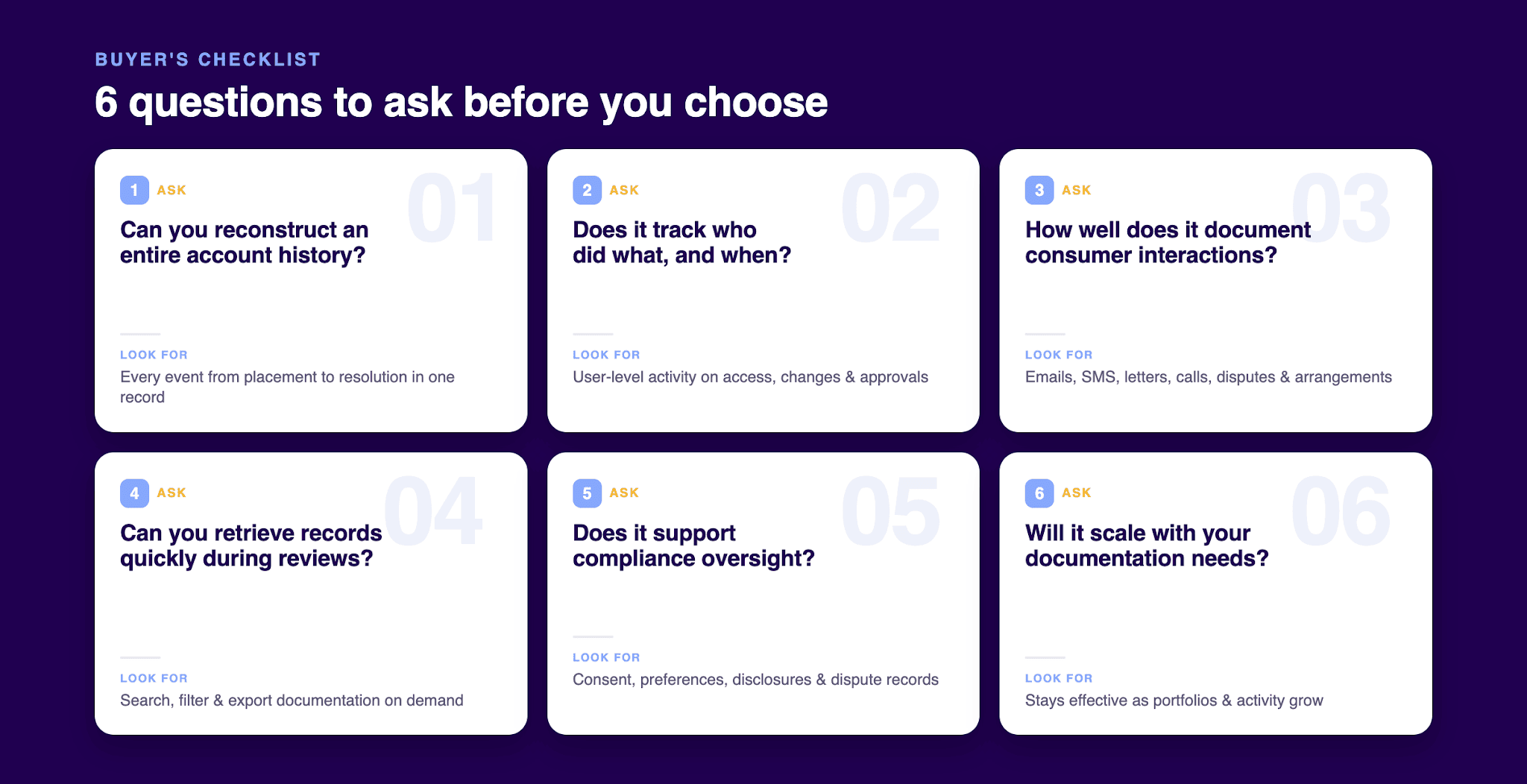
The right solution should help your agency maintain accurate records, improve accountability, and simplify audits without creating additional administrative work.
You need to ask the following questions:
Some platforms simply record basic account activity, while others provide detailed documentation of communications, payments, workflow actions, user activity, and compliance-related events. The collection audit trail software you choose should create a reliable system of accountability, documentation, and operational visibility.
Without reliable audit trail software, collection agencies can struggle to reconstruct account histories, respond to disputes, verify collection activity, and demonstrate compliance during audits or client reviews. Documentation gaps can increase operational risk and create accountability challenges. It can also make it more difficult to prove that accounts were handled according to agency policies and regulatory requirements.
Tratta stands out by connecting consumer interactions, payment activity, communication records, operational reporting, and recovery workflows within a single platform. Rather than forcing teams to piece together information from multiple systems, it helps agencies maintain a more complete and accessible record of account activity.
Strong audit trails support more than compliance. They help agencies operate with greater confidence, consistency, and accountability. Schedule a free demo to see how Tratta can help your team strengthen documentation and improve operational visibility.
Collection audit trail software helps debt collection agencies maintain a documented record of account activity, communications, payments, disputes, workflow actions, and user activity. These records support compliance, accountability, and operational oversight throughout the recovery lifecycle.
Collection agencies use collection audit trail software to document collection efforts, respond to client requests, investigate disputes, support audits, and maintain visibility into account handling. It helps create a verifiable history of actions taken on each account.
A strong audit trail should capture account updates, communication history, payment activity, user actions, workflow changes, dispute records, and compliance-related events. The goal is to create a complete timeline of account activity that can be reviewed when needed.
Legal collections audit trail software places greater emphasis on documentation, historical account records, litigation-related activity, and evidentiary support. These capabilities help legal collection teams maintain detailed records that may be needed during disputes, reviews, or legal proceedings.
Agencies should look for account history tracking, user activity monitoring, communication documentation, payment records, compliance reporting, search capabilities, and workflow visibility. These features help ensure collection activities can be reviewed, verified, and reported efficiently.