2026 Guide to TCPA and SMS Compliance Automation in Debt Collections
Strategies for Debt Collection
2026 Guide to TCPA and SMS Compliance Automation in Debt Collections
Published on:
August 3, 2026
A single missed opt-out request or improperly timed text can expose collection agencies to complaints, litigation, and regulatory scrutiny. At the same time, consumers increasingly expect digital communication, making SMS a critical recovery channel.
The global SMS Compliance Platform market is projected to reach USD 4.13 billion by 2033 as organizations invest in safer, more scalable messaging programs. For debt collectors, the challenge is balancing outreach efficiency with regulatory obligations.
This guide explores how SMS compliance automation helps agencies manage consent, enforce communication rules, reduce risk, and scale text messaging programs without relying on manual compliance processes.
Quick look:
SMS compliance automation uses software-driven controls to manage consent, opt-outs, disclosures, communication timing, and audit documentation across collection messaging programs.
Manual compliance processes increase the risk of TCPA violations, FDCPA issues, consumer complaints, regulatory scrutiny, and inconsistent communication practices.
Essential compliance controls include consent management, opt-out enforcement, communication timing restrictions, disclosure management, state-specific rule application, and centralized recordkeeping.
Scaling outreach safely requires automated workflows, standardized messaging, centralized communication records, preference management, and ongoing compliance monitoring.
2026 best practices focus on embedded compliance controls, omnichannel engagement, self-service consumer experiences, dynamic rule enforcement, analytics-driven oversight, and unified communication platforms.
What Is SMS Compliance Automation in Third-Party Collection Operations?
SMS compliance automation refers to the use of software-driven controls to manage regulatory requirements for collection text messaging. It removes reliance on agents or administrators to manually track consent records, monitor communication timing, apply disclosures, process opt-outs, and maintain audit logs.
SMS messages consistently achieve open rates around 90%–98%. They are one of the most visible consumer communication channels available to agencies. While this creates opportunities to improve engagement and recovery rates, it also increases the importance of maintaining compliance across every message sent.
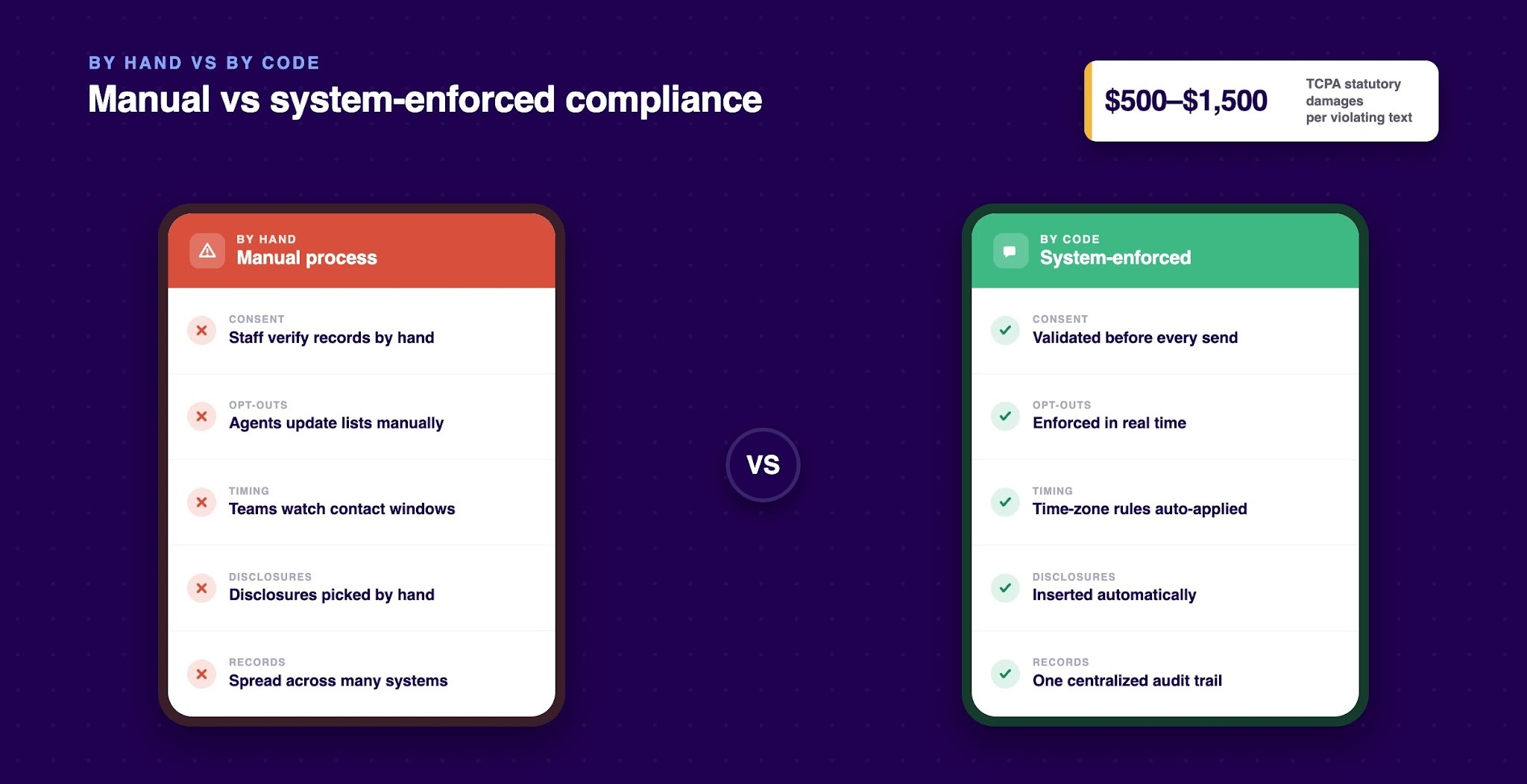
Table showing the differences between manual compliance processes and system-enforced compliance
Compliance Area
Manual Compliance Processes
System-Enforced Compliance
Consent Management
Staff verify consent records manually
Consent status is validated automatically before messages are sent
Opt-Out Requests
Agents update suppression lists manually
Opt-outs are processed and enforced in real time
Communication Timing
Teams monitor permissible contact windows
Messages are automatically restricted by time-zone rules
Required Disclosures
Users select disclosures manually
Appropriate disclosures are inserted automatically
Documentation
Records stored across multiple systems
All activity is logged in a centralized audit trail
Automated controls reduce dependence on human intervention, helping agencies create more consistent and defensible communication practices across high-volume portfolios.
In the next section, we will examine the hidden risks these processes can introduce and why they become increasingly difficult to manage as SMS volumes grow.
Hidden Risks of Manual Text Management in Debt Collections
Text messaging helps agencies reach consumers quickly. However, manual compliance processes create legal exposure at scale. A missed opt-out, missing disclosure, or improper contact can trigger violations under theTCPA,FDCPA, andRegulation F.
The most common risk areas include:
Consent Verification Under the TCPA (47 U.S.C. § 227) The Telephone Consumer Protection Act governs many automated text communications. Agencies must maintain records supporting their right to send messages. Missing documentation can make it difficult to defend outreach practices. TCPA violations may result in statutory damages of $500 per text and up to $1,500 per text for willful violations.
Opt-Out Enforcement and Revocation of Consent Consumers can revoke consent to receive text messages. Agencies must process and honor those requests promptly. Manual suppression processes increase the risk of continued outreach after revocation. Each post-opt-out text can increase regulatory and litigation exposure.
Communication Timing Requirements Under FDCPA § 805 (15 U.S.C. § 1692c) Debt collectors generally cannot communicate at unusual or inconvenient times. The statute establishes a presumption that communications before 8 a.m. and after 9 p.m. are inconvenient. Manual scheduling becomes risky when agencies operate across multiple time zones.
Electronic Communication Rules Under Regulation F (12 CFR § 1006.6) Regulation F expanded guidance around electronic communications, including text messaging. Agencies must consider consumer preferences, disclosure requirements, and procedures that reduce third-party disclosure risks. Manual workflows often struggle to apply these requirements consistently across campaigns.
Harassment Risks Under FDCPA § 806 (15 U.S.C. § 1692d) The FDCPA prohibits conduct intended to harass, oppress, or abuse consumers. While Regulation F's 7-in-7 rule applies to telephone calls, excessive electronic communications may still create compliance concerns. Poor campaign governance can increase complaint volume and legal scrutiny.
False, Misleading, or Incomplete Communications Under FDCPA § 807 (15 U.S.C. § 1692e) Debt collectors cannot use deceptive, misleading, or inaccurate representations. Missing disclosures, outdated templates, and inconsistent messaging can create compliance issues. These risks often increase when multiple teams manage campaigns manually.
These challenges explain why agencies are moving toward automated compliance controls.
Tratta embeds consent validation, opt-out enforcement, disclosure management, communication controls, and audit documentation directly into operational workflows. Backed by independently validated security infrastructure (PCI DSS Level 1 Service Provider, SOC 2 Type 2), the platform helps agencies maintain more consistent compliance practices without relying on manual processes.Schedule a free demo.
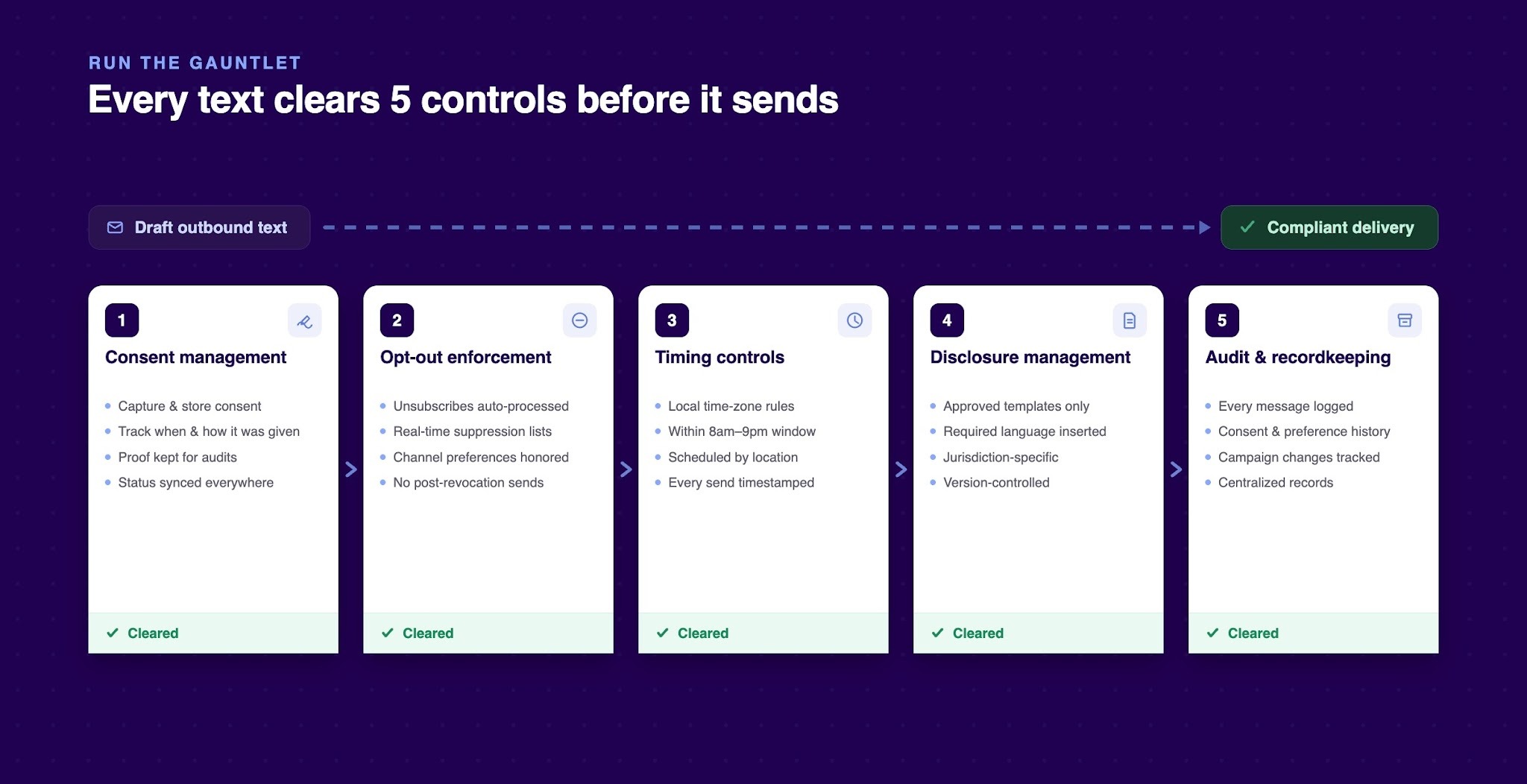
5 Essential Controls for Compliant Collection Texting
Agencies need operational controls that consistently apply regulatory requirements across every message, campaign, and consumer interaction.
The following controls help reduce risk while supporting scalable SMS outreach:
1. Consent Management
Every compliant texting program starts with documented consumer authorization:
Capture and store consent records.
Track when and how consent was obtained.
Maintain proof of authorization for audits.
Update consent status across systems.
2. Opt-Out and Preference Enforcement
Consumers must be able to control how they are contacted:
Process unsubscribe requests automatically.
Maintain real-time suppression lists.
Honor channel-specific preferences.
Prevent messaging after consent revocation.
3. Communication Timing Controls
Outreach should align with applicable contact restrictions:
Apply local time-zone rules automatically.
Restrict messaging outside permitted hours.
Schedule campaigns based on consumer location.
Document communication timestamps.
4. Disclosure Management
Required disclosures should be applied consistently:
Use approved message templates.
Insert required language automatically.
Support jurisdiction-specific disclosures.
Maintain version control for templates.
5. Audit Trails and Recordkeeping
Every communication should be documented and accessible:
Log message activity automatically.
Retain consent and preference history.
Track campaign-level changes.
Centralize compliance documentation.
These controls provide the foundation for compliant text messaging programs. However, implementing controls is only the first step. In the next section, we will explore strategies that help agencies scale SMS outreach while maintaining compliance across growing portfolios and communication volumes.
6 Strategies for Scaling SMS Outreach Without Increasing Compliance Risk
As SMS volumes grow, compliance becomes harder to manage through policies and manual reviews alone. Agencies need processes that enable them to expand consumer outreach while maintaining consistent compliance with the TCPA, FDCPA, Regulation F, and state-specific requirements.
Top strategies include:
1. Automate Consent and Preference Management
Consent records become difficult to manage as account volumes increase. Automating consent tracking helps ensure outreach decisions are based on current consumer permissions rather than manual verification.
The benefits include:
Reduced risk of contacting consumers without valid authorization
Faster suppression of revoked consent
Stronger documentation during audits
More consistent communication practices
2. Standardize Messaging Templates
Inconsistent messaging often creates unnecessary compliance risk. Approved templates help agencies maintain required disclosures and reduce variation across campaigns.
This approach can help:
Improve message consistency
Reduce disclosure-related errors
Simplify campaign approvals
Support regulatory reviews
3. Centralize Communication Records
Compliance becomes harder when records are spread across multiple systems. Centralized communication histories create a single source of truth for consumer interactions.
Federal compliance is only part of the challenge. State-level requirements often require different disclosures, workflows, or communication rules.
Automated controls can help:
Reduce manual reviews
Improve rule consistency
Support multi-state portfolios
Minimize regulatory gaps
5. Monitor Consumer Preferences Across Channels
Consumers increasingly engage across multiple communication channels. Preference management should extend beyond individual SMS campaigns.
This helps agencies:
Honor communication preferences consistently
Reduce complaints
Improve consumer experience
Strengthen compliance controls
6. Use Reporting to Identify Compliance Trends
Compliance monitoring should be continuous rather than reactive. Regular reporting can reveal issues before they develop into larger operational or legal problems.
Key advantages include:
Earlier identification of risk areas
Improved campaign governance
Better decision-making
Stronger compliance oversight
These strategies help agencies scale messaging programs more safely, but execution depends heavily on the technology supporting those efforts. In the next section, we will examine the capabilities agencies should prioritize when evaluating compliance-focused messaging software for stronger recovery performance.
What to Look for in Compliance-Focused Messaging Software for Better Recovery
The right solution should help agencies improve consumer engagement while reducing compliance risk, administrative effort, and operational complexity.
When evaluating software, prioritize the following capabilities:
Automated Consent and Preference Management The platform should track consumer consent, manage communication preferences, and automatically enforce opt-in and opt-out requests across messaging workflows.
Embedded Compliance Control Compliance controls should be embedded directly into operational workflows. This helps reduce reliance on manual reviews and supports more consistent adherence to regulatory requirements.
State-Specific Disclosure Management The software should dynamically apply disclosures and communication rules based on consumer location, client requirements, and applicable regulations.
Centralized Audit Documentation Every communication, consent record, preference update, and campaign activity should be documented automatically to support audits, disputes, and compliance reviews.
Omnichannel Campaign and Consumer Engagement Tools Messaging should connect consumers to self-service account access, payment options, and resolution workflows while providing visibility into engagement and campaign performance.
Tratta was built around these requirements. It helps agencies turn compliant outreach into completed resolutions through integrated campaigns, consumer self-service tools, and real-time performance tracking. This creates a more connected experience for both consumers and collection teams.Talk to us to learn more.
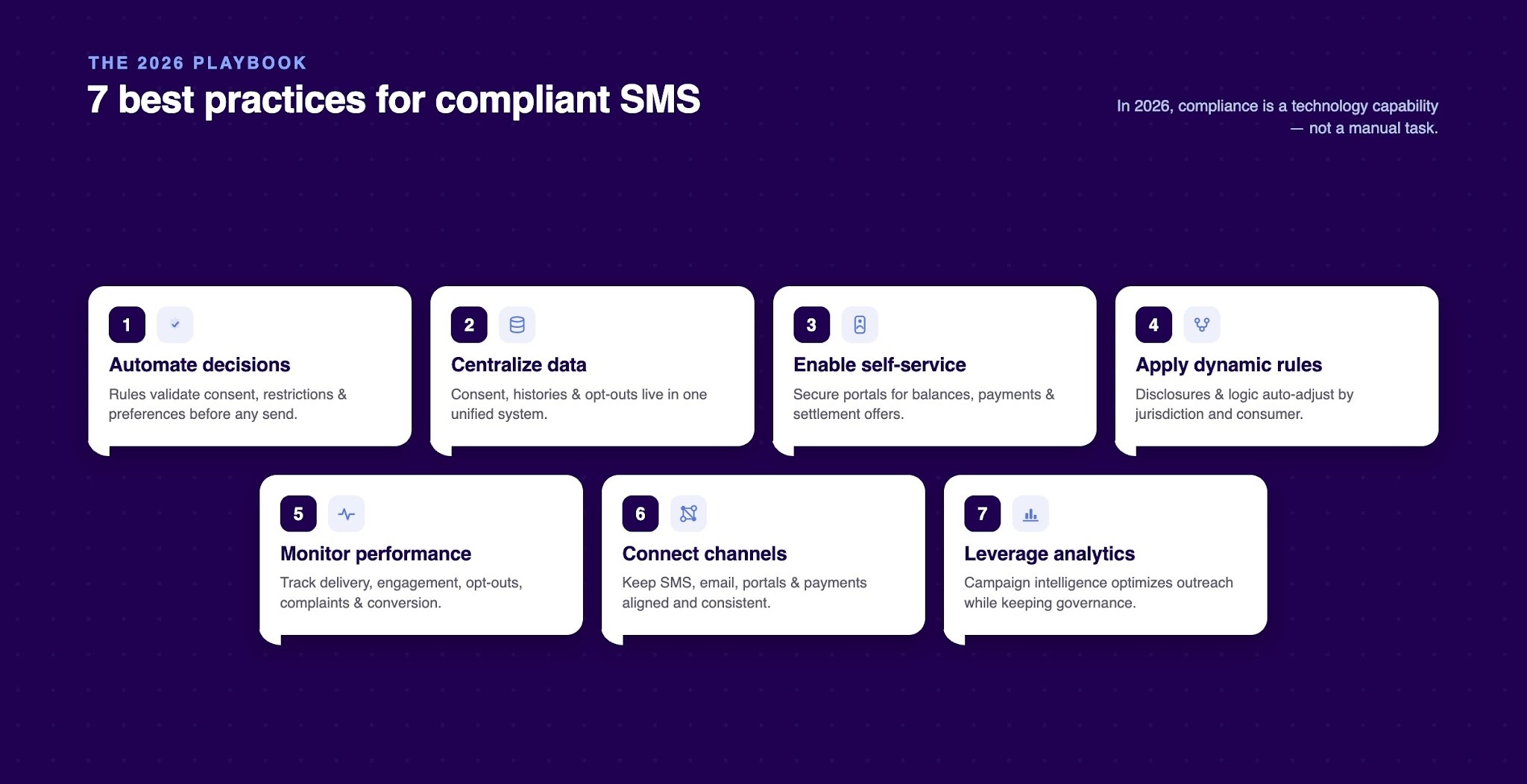
7 Best Practices for Compliant SMS Outreach in Debt Collection in 2026
SMS programs are becoming more sophisticated as agencies adopt automation, consumer self-service tools, and omnichannel engagement strategies. In 2026, compliance is less about manual oversight and more about using technology to apply rules consistently across every consumer interaction.
Tips to make the most of SMS compliance automation:
Automate Decisions: Use rules-based workflows to validate consent, apply communication restrictions, and enforce consumer preferences before messages are sent.
Centralize Data: Maintain consent records, communication histories, opt-outs, and account activity within a unified system to improve visibility and audit readiness.
Enable Self-Service: Direct consumers to secure portals where they can review balances, payment options, and settlement opportunities without agent intervention.
Apply Dynamic Rules: Use technology that automatically adjusts disclosures, communication logic, and outreach workflows based on jurisdiction and consumer attributes.
Monitor Performance: Track delivery rates, engagement metrics, opt-out activity, complaints, and conversion trends to identify potential compliance risks early.
Connect Collection Channels: Align SMS, email, portals, and payment experiences so consumer preferences and communication controls remain consistent across channels.
Leverage Analytics: Use reporting and campaign intelligence to optimize outreach strategies while maintaining governance over messaging practices.
Agencies that embed compliance controls directly into their messaging infrastructure will be better positioned to scale outreach, reduce risk, and maintain consistent consumer experiences. In 2026, the competitive advantage will belong to organizations that treat compliance as a technology-driven capability rather than a manual responsibility.
Conclusion
Text messaging can improve engagement and accelerate recoveries, but it also creates significant exposure when compliance processes fail to keep pace with outreach volume. As collection operations become increasingly digital, agencies need a more scalable approach to managing compliance across every consumer interaction.
Tratta helps agencies bring compliance, consumer engagement, and recovery workflows together within a single platform. Its embedded compliance controls, omnichannel campaign tools, consumer preference management, self-service payment experiences, and centralized reporting capabilities help teams operate more efficiently while maintaining stronger oversight.
See how Tratta can help your organization improve collection communications without adding operational complexity.Schedule a free demo to explore the platform in action.
Frequently Asked Questions
1. Is SMS debt collection legal in the United States?
Yes. Debt collectors can contact consumers through text messages, provided they comply with applicable laws such as the TCPA, FDCPA, Regulation F, and state-specific consumer protection requirements.
2. What is SMS compliance automation?
SMS compliance automation uses software-driven controls to manage consent tracking, opt-out enforcement, communication timing, disclosures, and audit documentation. It helps reduce manual compliance tasks and lowers regulatory risk.
3. What are the penalties for TCPA text message violations?
TCPA violations can result in statutory damages of $500 per violating text message and up to $1,500 per message for willful or knowing violations. Large-scale campaigns can create significant financial exposure when compliance controls fail.
4. How can collection agencies manage SMS opt-outs more effectively?
Agencies can improve opt-out management by using automated suppression workflows, centralized preference management, and real-time updates across communication channels. This helps prevent messages from being sent after a consumer revokes consent.
5. What features should agencies look for in SMS compliance software?
Note: This information is not legal advice. Tratta recommends that you consult with your legal counsel to make sure that you comply with applicable laws in connection with your collection and outreach activities.
Sign up for our monthly newsletter
Debt collection insights that keep you compliant and competitive.
Thank you! Your submission has been received!
Oops! Something went wrong while submitting the form.