Maintaining Compliance with FDCPA and Regulation F: 2026 Guide for Agencies
Compliance
Maintaining Compliance with FDCPA and Regulation F: 2026 Guide for Agencies
Published on:
August 3, 2026
Collection agencies face growing compliance pressure from regulators, consumers, and clients. A single communication error, missed disclosure, or documentation gap can lead to complaints, disputes, and regulatory scrutiny.
According to the CFPB's 2025 annual complaint report, consumers submitted approximately 207,800 debt collection complaints during the reporting period, underscoring continued scrutiny of collection practices. Agencies understand the importance of compliance, but keeping pace with evolving requirements is not always easy.
Maintaining compliance with FDCPA and Regulation F requires consistent processes, strong controls, and ongoing oversight. This guide explains the key requirements, common compliance risks, and best practices agencies should follow in 2026.
Brief look:
FDCPA establishes the law, while Regulation F provides detailed operational rules for communications, disclosures, disputes, and consumer rights.
Compliance challenges continue growing due to increased communication channels, stricter documentation expectations, evolving state requirements, and heightened regulatory scrutiny.
Key compliance requirements include communication restrictions, validation notices, dispute handling procedures, consumer preference management, time-barred debt rules, and record retention obligations.
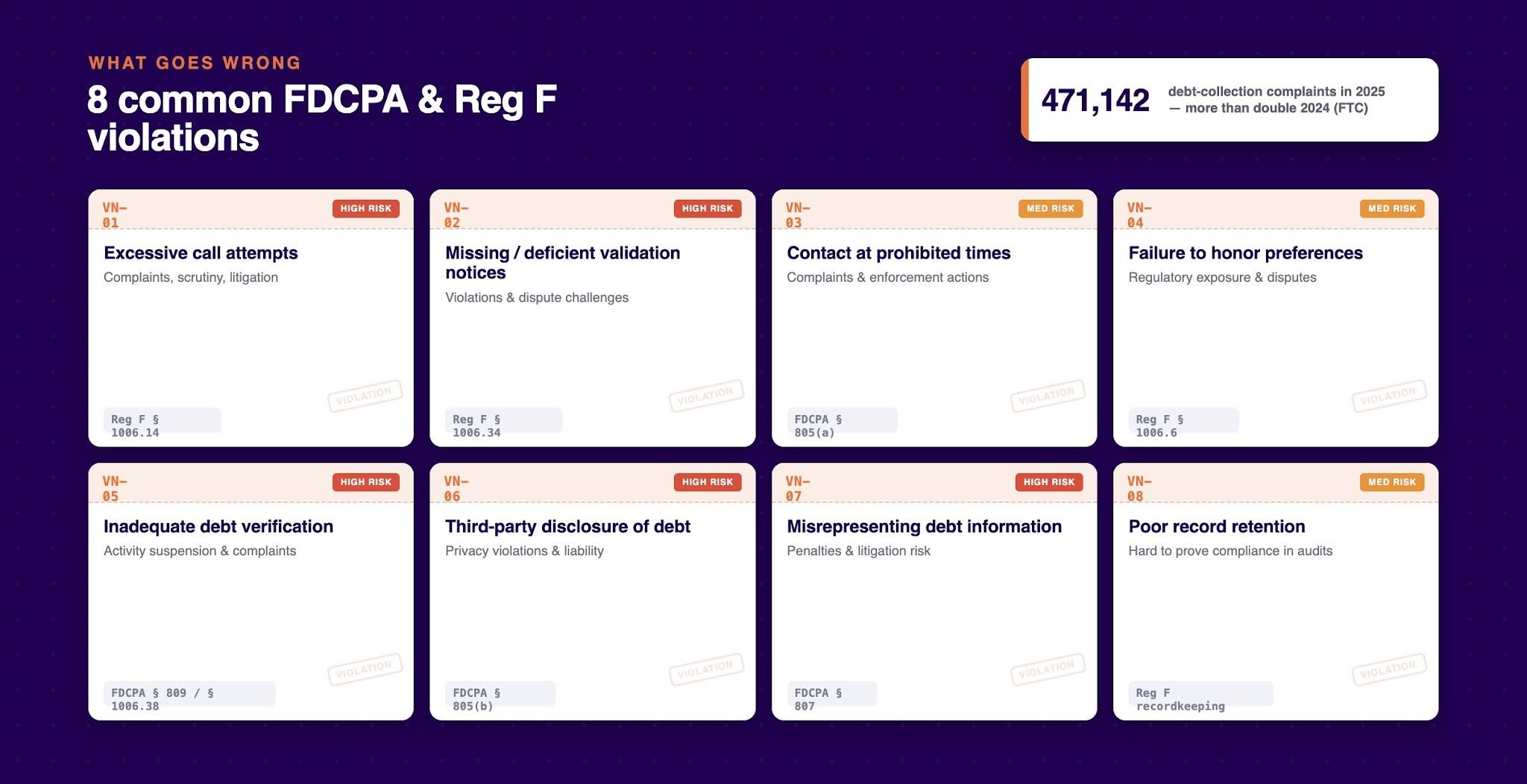
Common violations involve excessive call attempts, deficient disclosures, improper consumer communications, poor dispute management, and inadequate documentation practices.
Strong compliance programs require documented policies, ongoing training, communication controls, audit trails, regular monitoring, and technology-supported oversight.
Why Maintaining Compliance with FDCPA and Regulation F Is More Challenging in 2026?
The Fair Debt Collection Practices Act (FDCPA) establishes the federal rules governing how third-party debt collectors interact with consumers. Regulation F, which implements and clarifies the FDCPA, introduced more detailed requirements covering communications, validation notices, dispute handling, call frequency, electronic communications, and recordkeeping.
While the core requirements remain familiar, maintaining compliance has become increasingly complex in today's collections environment.
Several factors contribute to this challenge:
More Communication Channels: Agencies now engage consumers through calls, SMS, email, portals, and other digital channels. Each channel introduces additional compliance considerations.
Stricter Communication Controls: Regulation F established detailed requirements around call frequency, consumer preferences, disclosures, and electronic communications. Agencies must consistently apply these controls across all accounts.
Higher Consumer Awareness: Consumers are increasingly familiar with their rights and more likely to file complaints when they believe a violation has occurred.
Greater Documentation Expectations: Agencies must maintain clear records of communications, disputes, consents, and collection activities to demonstrate compliance.
Complex Technology Environments: Data often flows across multiple systems, vendors, and communication platforms. Maintaining consistent compliance controls across these environments can be difficult.
Agencies must also understand the specific requirements that govern their collection activities. In the next section, we will examine the FDCPA and Regulation F rules that third-party debt collectors must follow to maintain compliance.
What Are the FDCPA and Regulation F Rules for Third-Party Debt Collection?
Compliance begins with understanding the rules themselves. While the FDCPA establishes the legal framework governing debt collection activities, Regulation F provides detailed guidance on how many of those requirements must be implemented in practice.
The rules are:
1. FDCPA Requirements
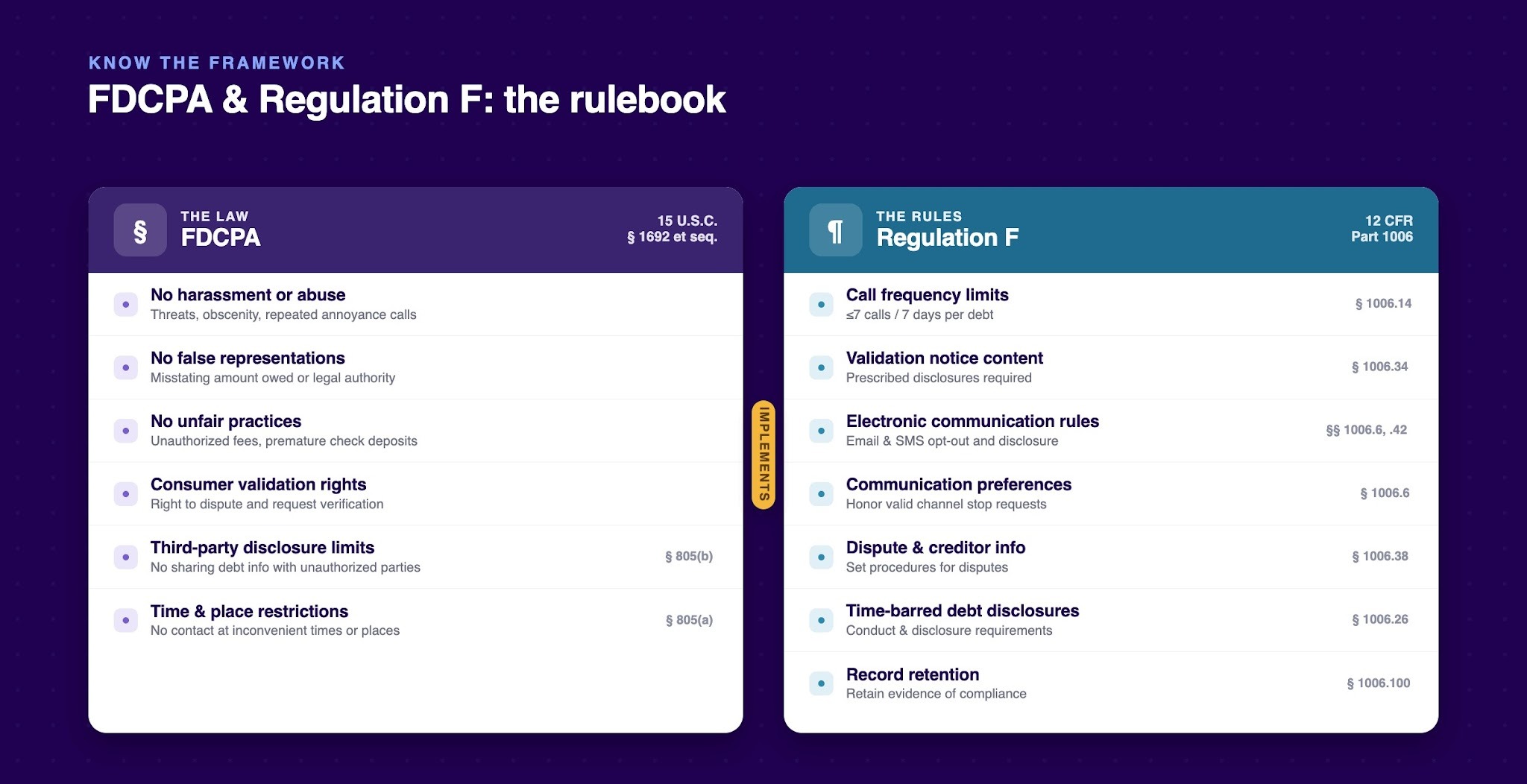
The Fair Debt Collection Practices Act (15 U.S.C. § 1692 et seq.) was enacted to eliminate abusive, deceptive, and unfair debt collection practices. The law applies primarily to third-party debt collectors and establishes clear limits on how consumers may be contacted and treated during the collection process.
Key FDCPA requirements include:
Prohibition on Harassment and Abuse: Collectors may not use threats, obscene language, repeated calls intended to annoy, or other harassing conduct.
Restrictions on False or Misleading Representations: Collectors may not misrepresent the amount owed, falsely claim legal authority, or use deceptive collection tactics.
Prohibition on Unfair Collection Practices: Agencies may not collect unauthorized fees, deposit post-dated checks prematurely, or engage in unconscionable collection conduct.
Consumer Validation Rights: Consumers have the right to dispute a debt and request verification within the statutory dispute period.
Third-Party Disclosure Restrictions: Collectors generally may not disclose debt information to unauthorized third parties.
Restrictions on Time and Place of Communications: Communications cannot occur at inconvenient times or locations known to be unacceptable to the consumer.
2. Regulation F Requirements
Regulation F (12 CFR Part 1006) implements and clarifies the FDCPA through more detailed operational requirements. The rule addresses several areas that previously lacked clear guidance, particularly regarding modern communication channels and consumer disclosures.
Key Regulation F requirements include:
Call Frequency Limits (§ 1006.14): Collectors are generally presumed compliant when they do not place more than seven calls within seven consecutive days regarding a particular debt.
Validation Notice Requirements (§ 1006.34): Agencies must provide detailed validation information containing specific disclosures prescribed by the regulation.
Electronic Communication Rules (§§ 1006.6 and 1006.42): Email, text messages, and other electronic communications must comply with disclosure and opt-out requirements.
Consumer Communication Preferences (§ 1006.6): Collectors must honor valid requests to stop using specific communication channels.
Dispute and Original Creditor Information Requirements (§ 1006.38): Agencies must follow specific procedures when consumers dispute debts or request original creditor information.
Time-Barred Debt Disclosures (§ 1006.26): Collection activities involving time-barred debts must comply with applicable disclosure and conduct requirements.
Record Retention Requirements (§ 1006.100): Agencies must retain evidence demonstrating compliance with Regulation F requirements.
Tratta supports FDCPA and Regulation F compliance through embedded workflow controls and independently validated security infrastructure (PCI DSS Level 1 Service Provider, SOC 2 Type 2). The platform helps agencies manage communication preferences, validation requirements, audit trails, and consumer interactions using configurable rules and automated controls. Request a demo today.
Common FDCPA and Regulation F Violations Made by Agencies
Most compliance violations do not result from intentional misconduct. They often occur when policies are outdated, processes are inconsistent, or compliance controls fail to keep pace with operational demands. Understanding these violations can help agencies strengthen controls and reduce regulatory risk.
While these violations may appear straightforward, many occur because agencies lack sufficient visibility into daily collection activities. Strong compliance programs focus on prevention rather than correction after a violation has already occurred.
Agencies should pay particular attention to:
Communication Monitoring: Review call activity, SMS campaigns, emails, and other outreach channels for compliance risks.
Disclosure Accuracy: Ensure validation notices, consumer disclosures, and required communications contain all required information.
Consumer Preference Management: Maintain processes for honoring opt-out requests and channel-specific communication restrictions.
Dispute Handling Procedures: Verify that disputes, verification requests, and original creditor requests follow documented workflows.
Documentation Controls: Retain records that demonstrate compliance with communication, disclosure, and dispute requirements.
Agencies must also develop processes that actively prevent them. In the next section, we will examine the potential penalties associated with FDCPA and Regulation F violations.
According to FTC data, consumers submitted 471,142 debt collection complaints in 2025, more than double the number reported in 2024. Violations can expose collection agencies to consumer lawsuits, regulatory enforcement actions, client concerns, and reputational harm.
Potential penalties include:
Individual Civil Liability: Under 15 U.S.C. § 1692k(a), consumers may recover actual damages resulting from FDCPA violations, along with additional statutory damages in eligible cases.
Class Action Exposure: FDCPA violations may lead to class action litigation. Under 15 U.S.C. § 1692k(a)(2)(B), agencies can face statutory damages in addition to litigation and defense costs.
Attorney's Fees and Costs: Section 1692k(a)(3) allows prevailing consumers to recover reasonable attorney's fees and court costs, increasing the financial impact of violations.
CFPB Enforcement Actions: The CFPB has the authority to investigate potential violations of Regulation F and the FDCPA. Enforcement actions may result in consent orders, corrective actions, and monetary penalties.
FTC Enforcement Activity: The FTC may pursue enforcement actions against collectors engaging in unfair, deceptive, or abusive practices prohibited by the FDCPA.
Many FDCPA and Regulation F penalties stem from preventable issues such as communication errors, missing disclosures, inadequate documentation, and inconsistent processes.
Tratta helps agencies reduce these risks through automated communication controls, centralized recordkeeping, audit trails, and configurable compliance workflows. Agencies can proactively address compliance gaps before they result in complaints, investigations, or enforcement actions. Contact us to learn more.
Building a Defensible FDCPA and Regulation F Compliance Program
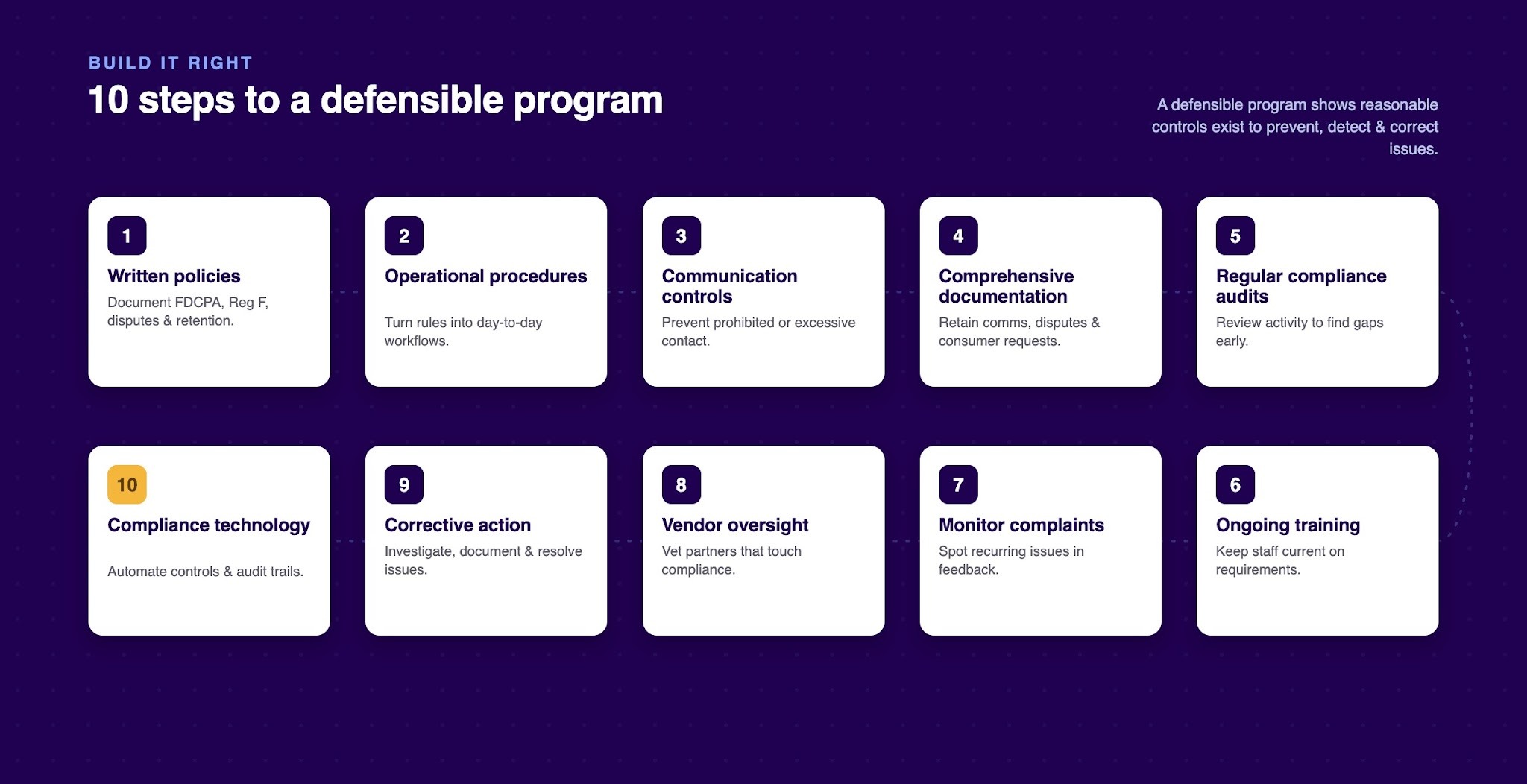
Compliance programs should help agencies demonstrate that reasonable controls, policies, and oversight mechanisms exist to prevent, detect, and correct compliance issues. A defensible compliance program can strengthen regulatory readiness while reducing operational risk.
Key steps include:
Establish Written Compliance Policies: Create documented policies that address FDCPA requirements, Regulation F obligations, consumer communications, dispute handling, disclosures, and record retention.
Define Clear Operational Procedures: Translate regulatory requirements into day-to-day workflows that employees can consistently follow across departments.
Implement Communication Controls: Develop safeguards that help prevent prohibited communications, excessive call activity, and violations of consumer preferences.
Maintain Comprehensive Documentation: Retain records of communications, disputes, validation notices, consumer requests, and compliance-related activities.
Conduct Regular Compliance Audits: Review collection activities, communication records, and operational processes to identify potential compliance gaps.
Provide Ongoing Employee Training: Ensure collectors, supervisors, and compliance personnel understand current regulatory requirements and internal procedures.
Monitor Consumer Complaints: Analyze complaints for recurring issues that may indicate weaknesses in policies, training, or controls.
Strengthen Vendor Oversight: Evaluate technology providers, communication vendors, and service partners to ensure they support compliance objectives.
Establish Corrective Action Processes: Create formal procedures for investigating, documenting, and resolving identified compliance issues.
Use Compliance Technology: Use systems that automate controls, maintain audit trails, and support consistent policy enforcement across collection operations.
Maintaining compliance requires continuous attention and operational discipline. In the next section, we will examine best practices agencies can use to strengthen FDCPA and Regulation F compliance on an ongoing basis.
Best Practices for Maintaining FDCPA and Regulation F Compliance
Regulatory requirements, consumer expectations, communication channels, and operational processes continue to change. Agencies that maintain strong compliance records typically rely on consistent controls, ongoing oversight, and a culture of accountability.
Consider the following best practices:
Maintain Complete Audit Trails: Agencies should be able to demonstrate when communications occurred, what disclosures were provided, and how consumer requests were handled.
Review Policies Regularly: Compliance policies should be reviewed and updated to reflect regulatory developments, operational changes, and emerging risks.
Prioritize Complaint Analysis: Consumer complaints often provide early warning signs of compliance weaknesses. Tracking trends can help agencies address issues proactively.
Strengthen Cross-Department Collaboration: Compliance, operations, management, and technology teams should work together to ensure controls remain effective.
Test Compliance Controls Periodically: Regular testing helps verify that communication restrictions, disclosure requirements, and workflow safeguards are functioning as intended.
Following best practices can significantly reduce compliance risk, but manual oversight alone may not be sufficient in a complex regulatory environment.
Agencies increasingly rely on technology to strengthen controls, improve documentation, and support regulatory readiness. In the next section, we will examine how collection technology can help support FDCPA and Regulation F compliance.
Use Tratta for FDCPA and Regulation F Compliance Management
Tratta is a cloud-based collections platform designed for third-party collection agencies, debt buyers, collection law firms, and creditors. It helps teams manage payments, communications, compliance, reporting, and consumer engagement from a single environment.
The following Tratta features support FDCPA and Regulation F compliance:
Security and Compliance: Tratta's compliance framework helps agencies apply regulatory controls directly within operational workflows. This can help reduce the risk of inconsistent collection practices and manual compliance errors.
Omnichannel Communications: Centralized communication management helps agencies monitor consumer interactions across SMS, email, voice, and digital channels. This supports compliance with communication restrictions and consumer preferences.
Tratta Campaigns: Automated campaign workflows help agencies apply communication rules consistently across large account volumes. Standardized outreach reduces the likelihood of non-compliant messaging practices.
Contact Center: A centralized communication environment creates a documented record of consumer interactions. This helps agencies demonstrate compliance during audits, disputes, and investigations.
Consumer Self-Service Payment Portal: Consumers can manage accounts, submit disputes, review settlement offers, and make payments through a secure digital experience. Self-service capabilities help support consumer rights while reducing manual processing.
Reporting and Analytics: Real-time dashboards and reporting tools provide visibility into communication activity, consumer engagement, and operational performance. Compliance teams can identify potential issues more quickly.
Multilingual Payment IVR: Automated payment experiences help maintain consistent consumer interactions while supporting documented account activity and communication workflows.
Integrations: Integration capabilities help maintain data consistency across collection systems, communication platforms, and operational tools. Accurate data supports more reliable compliance management.
Customization and Flexibility: Agencies can configure permissions, workflows, business rules, and communication processes to align with internal compliance requirements.
Payments and Merchant Services: Integrated payment workflows help create accurate records of payment activity, authorizations, and transaction histories that may be needed for compliance reviews.
Effective compliance management depends on consistency, visibility, and documentation. By bringing communications, payments, reporting, and compliance controls together in a single platform, Tratta helps agencies build stronger operational processes that support ongoing FDCPA and Regulation F compliance.
Conclusion
Maintaining compliance with FDCPA and Regulation F requires constant attention to communications, disclosures, disputes, documentation, and consumer rights. When compliance controls break down, agencies may face consumer complaints, lawsuits, regulatory investigations, financial penalties, and damage to client relationships.
Tratta helps agencies strengthen compliance management by centralizing communications, consumer interactions, payments, reporting, and documentation within a single platform. With configurable workflows, audit trails, communication controls, and real-time visibility, Tratta helps collection teams operate more consistently.
Schedule a demo to see how technology can help your agency strengthen controls, improve documentation, and support regulatory readiness.
Frequently Asked Questions
1. What is the difference between the FDCPA and Regulation F?
The FDCPA is the federal law that governs how third-party debt collectors may collect consumer debts. Regulation F implements and clarifies the FDCPA by providing detailed rules for communications, validation notices, dispute handling, disclosures, and other collection activities.
2. Who must comply with FDCPA and Regulation F?
FDCPA and Regulation F primarily apply to third-party debt collectors and collection agencies collecting consumer debts on behalf of others. Certain debt buyers may also be subject to these requirements depending on their activities.
3. What are the most common FDCPA and Regulation F violations?
Common violations include excessive call attempts, failure to provide required validation notices, contacting consumers at prohibited times, improper third-party disclosures, failure to honor communication preferences, and inadequate dispute handling procedures.
4. What penalties can result from FDCPA and Regulation F violations?
Agencies may face consumer lawsuits, statutory damages, attorneys' fees, regulatory enforcement actions, and reputational harm. In some cases, violations may also lead to class action litigation and increased regulatory scrutiny.
5. How can collection agencies improve FDCPA and Regulation F compliance?
Agencies can strengthen compliance by implementing documented policies, training employees regularly, monitoring communications, maintaining audit trails, conducting compliance reviews, and using technology to automate compliance controls and recordkeeping.
Note: This information is not legal advice. Tratta recommends that you consult with your legal counsel to make sure that you comply with applicable laws in connection with your collection and outreach activities.
Sign up for our monthly newsletter
Debt collection insights that keep you compliant and competitive.
Thank you! Your submission has been received!
Oops! Something went wrong while submitting the form.