Collection agencies today operate in an environment where consumer communication, payment handling, and documentation are under far greater scrutiny than they were a few years ago. A simple misunderstanding of the Fair Debt Collection Practices Act (FDCPA) can create operational friction across recovery teams, especially when communication records, payment conversations, and account activity are spread across disconnected systems.
That pressure is increasing alongside broader shifts in customer service and workflow management. In fact, 73% of customer service organizations are expected to implement agent-assist solutions to improve operational consistency and manage increasingly complex interactions. For third-party collection agencies, operational consistency matters even more when consumer communication and account documentation are tied to FDCPA-sensitive workflows.
This blog explains the FDCPA definition, who the law primarily applies to, and common operational areas affected by FDCPA-sensitive workflows handling consumer debt at scale.
The FDCPA definition refers to the Fair Debt Collection Practices Act, a federal law that regulates how third-party debt collectors communicate with consumers while collecting personal, family, or household debt. Introduced in 1977, the law establishes rules around consumer communication, disclosures, dispute handling, and collection conduct during debt recovery activities.
The FDCPA primarily applies to third-party collection agencies, debt buyers, and certain collection law firms collecting consumer debt on behalf of another party. Its purpose is to reduce abusive, deceptive, or unfair debt collection practices while creating clearer standards for consumer interactions.
Before the FDCPA was enacted, consumers often faced repeated calls, misleading statements, public embarrassment, and aggressive collection tactics with limited oversight. The law was introduced to create clearer boundaries around how debt collectors contact and communicate with consumers.
Not every internal collections activity falls under the FDCPA in the same way. Some original creditors handling their own consumer accounts may operate under different regulatory expectations depending on how collection activity is structured.
For third-party collection agencies, though, FDCPA-sensitive workflows are far more central to day-to-day operations because consumer communication standards directly affect outreach, documentation, and account handling practices.
Suggested Read: Fair Debt Collection Practices Act (FDCPA)
The FDCPA does not regulate only whether a collector can ask for payment. It sets boundaries around how third-party debt collectors communicate with consumers, what they must disclose, when they must stop or limit contact, and how they should handle disputed debts. For collection agencies, these rules affect daily workflows across calls, letters, emails, payment discussions, account notes, and consumer response handling.

Several FDCPA sections directly regulate consumer communication practices. Under 15 U.S.C. § 1692c, debt collectors cannot contact consumers at unusual or inconvenient times, including before 8 a.m. or after 9 p.m., unless permission is given. The law also limits communication at a consumer’s workplace if the employer does not allow personal collection-related calls.
The FDCPA further restricts third-party disclosures. Collectors generally cannot discuss a consumer’s debt with friends, family members, employers, or unrelated third parties.
Communication conduct is regulated under multiple sections:
Debt validation requirements under 15 U.S.C. § 1692g create another major operational responsibility for collection agencies. Collectors must provide consumers with validation information that includes:
If a consumer disputes the debt within the required period, collection activity generally pauses until verification is provided.
For agencies managing high account volumes, this creates significant documentation and tracking requirements. Teams need visibility into:
Without centralized documentation workflows, dispute handling can become difficult across multiple agents, communication channels, or account systems.
The FDCPA also affects how payment-related discussions are handled during consumer interactions. Collectors cannot misrepresent the amount owed, make misleading claims about legal consequences, or pressure consumers using deceptive collection tactics during payment conversations.
That is why FDCPA-sensitive operations extend beyond legal review alone.
Suggested Read: Text of Fair Debt Collection Practices Act in Federal Code
Many FDCPA-related challenges do not begin with a single consumer interaction. For collection agencies, operational issues often develop gradually when communication records, payment activity, dispute handling, and account documentation are spread across disconnected systems and workflows.
As consumer accounts move through different stages of recovery, maintaining consistent communication and complete account visibility becomes harder across teams.
Collection agencies often manage calls, emails, SMS conversations, payment discussions, and account notes across multiple platforms. When systems do not communicate clearly with one another, agents may lack visibility into previous outreach attempts or consumer responses.
This can create communication gaps, duplicate outreach, or incomplete account records during consumer interactions. In high-volume recovery operations, inconsistent communication handling can make account tracking more difficult across teams and channels.
Fragmented records can create operational challenges when agencies need to review communication history, dispute activity, or prior payment arrangements. Teams may spend additional time searching through spreadsheets, call logs, emails, or manually updated notes to understand account status.
Limited reporting visibility can also make it harder for operations leaders to monitor workflow consistency across recovery teams.
Manual notes, scattered payment records, and inconsistent follow-up handling often reduce operational clarity. As account volumes grow, these workflows may slow internal coordination and create gaps in consumer interaction tracking across the recovery process.
As collection operations scale, fragmented systems and manual processes often undermine FDCPA compliance. When agents lack a unified view of prior communications, disputes, payment arrangements, or account updates, even routine outreach becomes risky and inconsistent. The result: Greater exposure to compliance gaps, harder follow-up coordination, and limited visibility across growing recovery teams.
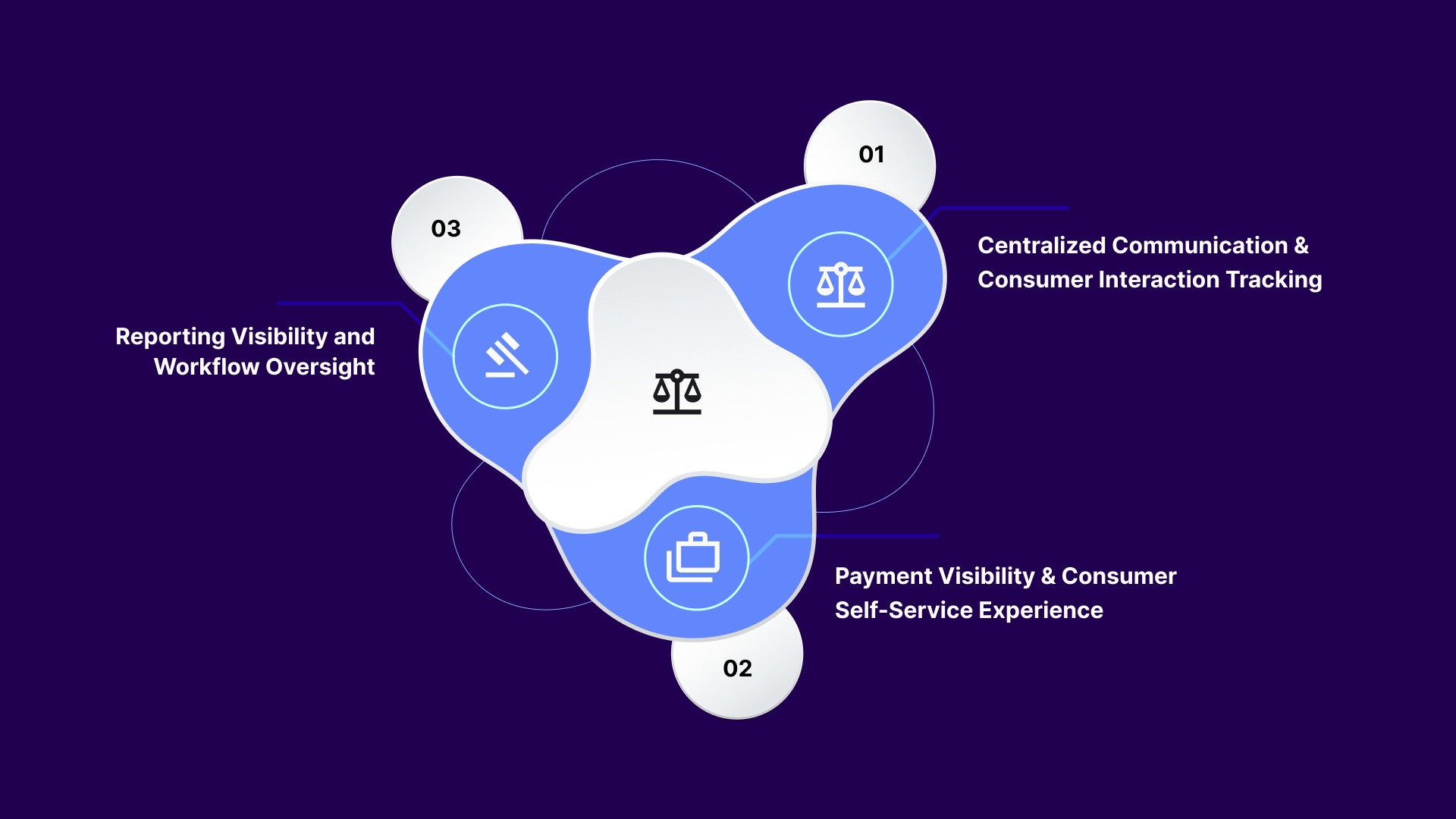
Instead of storing records across separate systems or spreadsheets, agencies can maintain more consistent account-level documentation in one operational environment.
Platforms like Tratta support centralized digital communication workflows designed for consumer debt recovery operations. This can help teams review communication history, monitor account activity, and reduce operational gaps caused by disconnected outreach channels.
Payment accessibility is another major operational area for collection agencies managing consumer debt. Consumers increasingly expect flexible and convenient ways to review balances, make payments, and manage account activity without depending entirely on agent-assisted interactions.
Tratta’s Consumer Self-Service Platform and Embedded Payments capabilities are designed to support consumer payment access within a centralized recovery workflow. Its inbound Multilingual Payment IVR can also support consumers who prefer self-service payment options through phone-based interaction rather than agent-led conversations.
Recovery operations leaders often need clearer visibility into communication handling, payment workflows, dispute activity, and operational challenges across teams. Fragmented systems can make reporting slower and reduce visibility into workflow consistency.
Tratta’s Reporting and Analytics capabilities help agencies monitor operational activity, review workflow trends, and maintain clearer oversight across consumer recovery processes without positioning the platform as a legal compliance solution or guarantee of outcomes.
Understanding the FDCPA definition is only one part of managing consumer debt recovery operations effectively. The larger challenge for many collection agencies is maintaining consistent consumer interactions across growing account volumes and multiple operational systems.
If your recovery teams are still managing consumer communication, payment activity, reporting, and account tracking across disconnected tools, it may be time to evaluate whether your workflows provide enough operational visibility for FDCPA-sensitive environments.
Can your teams track consumer interactions, payment conversations, disputes, and account-level activity from one place? Book a Free Demo with Tratta to perform multiple operations that increase visibility within a single recovery platform designed for consumer debt operations.
As recovery operations scale, agencies often reassess whether their existing systems can support higher communication volumes, larger account inventories, and more complex consumer interaction tracking without slowing internal coordination.
Delays in updating account activity, payment status, or dispute information can create operational inefficiencies across recovery teams. When agents do not have timely account visibility, follow-up coordination and consumer interactions may become harder to manage consistently.
Consumer accounts often move through multiple communication stages over time. Timeline visibility helps teams understand prior outreach activity, payment discussions, and account progression before additional action is taken on the account.
Operational bottlenecks can slow communication handling, payment processing visibility, dispute review coordination, and internal reporting workflows. Over time, these inefficiencies may affect how quickly teams respond to account activity across recovery operations.
Centralized reporting helps operations leaders review workflow activity across agents, communication channels, payment updates, and account movement from a broader operational perspective. This visibility can help teams identify gaps, delays, or inconsistent workflow patterns more efficiently.