A consumer is ready to make a payment, but your office is closed. Another consumer wants to pay by phone without waiting for an agent. A third would rather complete the process online after starting the call. An inbound payment IVR gives each of them a clear self-service path.
Inbound payment IVR is a consumer-initiated phone system that verifies the caller, presents menu-driven payment options, and lets the consumer check a balance or make a payment without first speaking to an agent. Unlike outbound IVR, it does not place automated calls or run system-initiated voice campaigns.
For collection agencies, law firms, debt buyers, and credit issuers, the value is straightforward: inbound payment IVR expands payment access while reducing the number of routine transactions that agents must handle manually.
This guide explains how inbound payment IVR works, where it fits within a modern collection workflow, which features matter most, and how companies connects phone payments with online self-service, reporting, and account data.
Inbound payment IVR is an automated, phone-based payment channel that begins when a consumer calls an organization. The system uses prerecorded prompts and Dual-Tone Multi-Frequency (DTMF) keypad input to guide the caller through a defined workflow.
In debt collection, that workflow may allow an authenticated consumer to:
The interaction is initiated by the consumer. That distinction matters because inbound payment IVR solves a different problem from automated outbound calling.
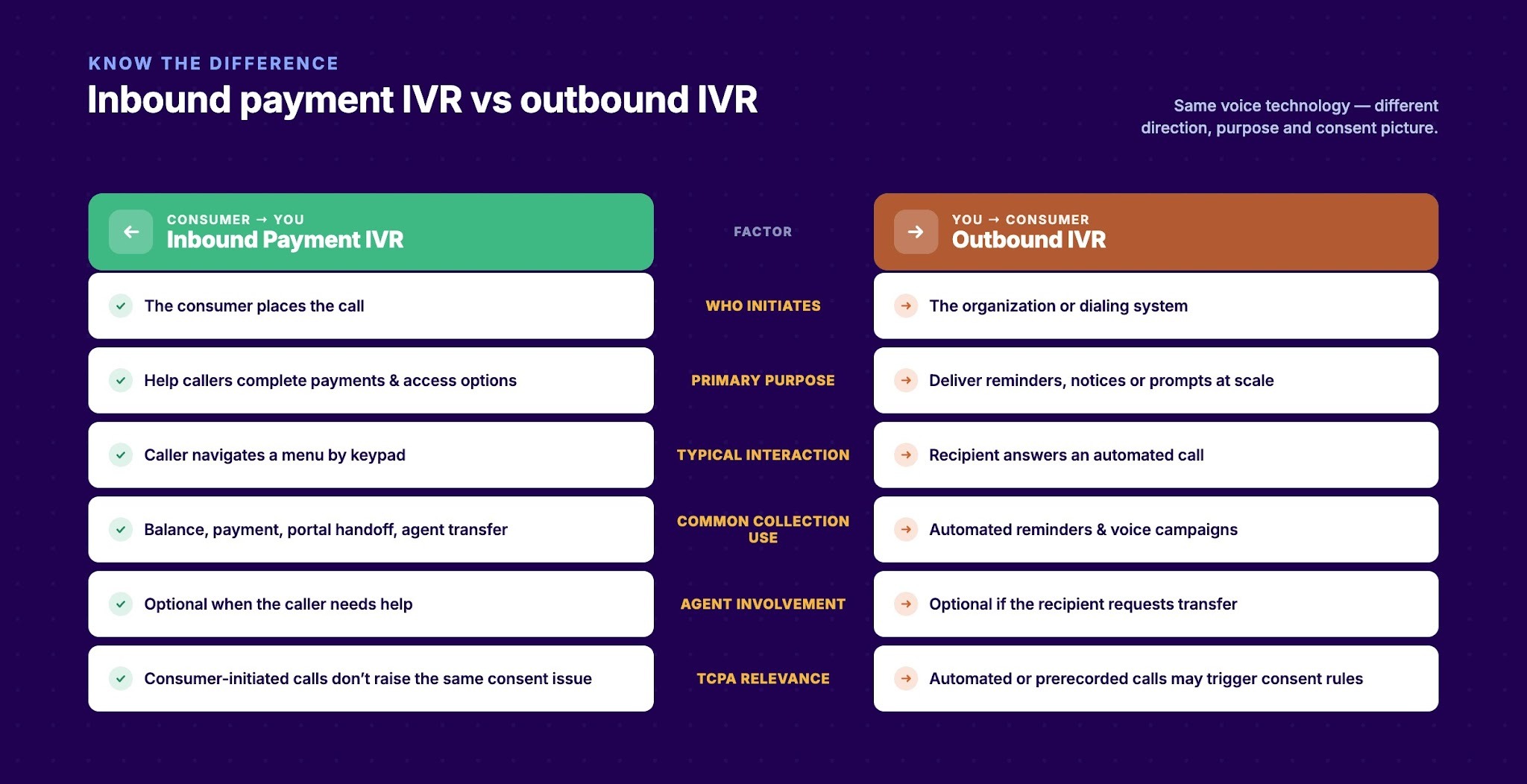
Inbound and outbound IVR both use automated voice technology, but their direction, purpose, and compliance considerations are different.
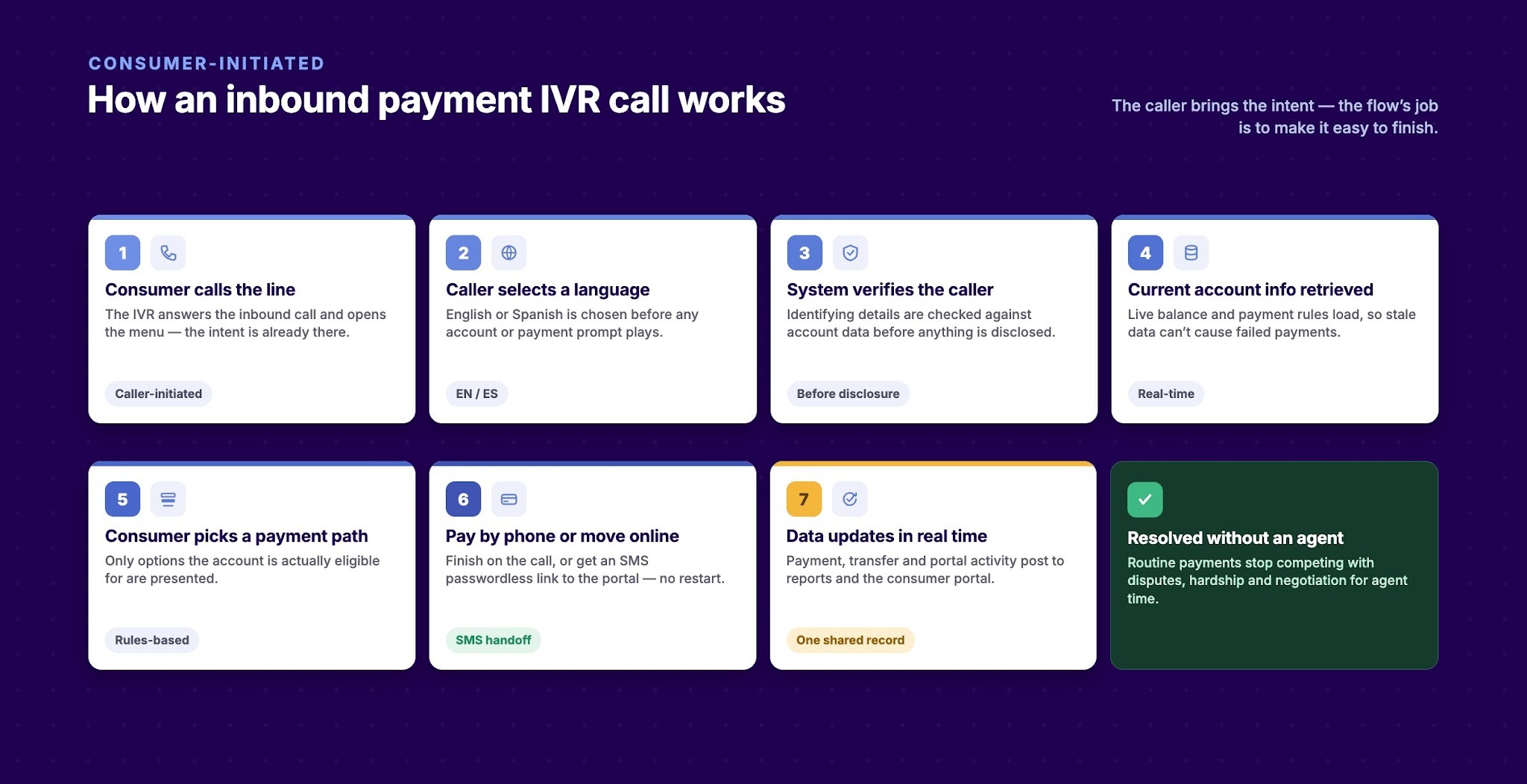
An effective inbound IVR payment journey should move the caller from intent to resolution with as little friction as possible. A typical interaction follows these steps.
The workflow begins when a consumer calls the agency’s published phone number or dedicated payment line. The IVR answers the incoming call and presents the opening menu.
Because the consumer initiates the interaction, the call represents existing payment intent. The system’s job is to make that intent easy to complete.
The IVR asks the caller to select a language before presenting account or payment prompts. Tratta currently supports English and Spanish within its inbound payment flow.
Language access is not a minor usability feature. In 2025, the U.S. Census Bureau reported that more than one in five people age five and older spoke a language other than English at home during the 2017–2021 period.
Before revealing account information, the IVR asks the caller for identifying details. The system then checks those details against the connected account data.
This step helps prevent unauthorized disclosure. Under Regulation F, debt collectors generally may not communicate information about a debt to third parties, subject to limited exceptions. The CFPB’s Debt Collection Rule guidance reinforces why identity verification must happen before sensitive account details are presented.
Once the caller is verified, the IVR can retrieve the current balance and available payment rules. Real-time access matters because stale data can create failed payments, overpayments, incorrect balances, or unnecessary agent escalations.
The caller follows keypad prompts to select an available action. Depending on the agency’s configuration and the account, that may include making a payment, reviewing a balance, or transferring to an agent.
The IVR should present only relevant choices. A consumer should not hear a settlement, plan, or payment option that the account is not eligible to use.
Some consumers will finish the transaction by phone. Others will prefer a visual, mobile-friendly experience.
After verification, the caller can choose to receive a text message containing a passwordless session link to the Consumer Self-Service Payment Portal. This is a channel handoff, not an outbound IVR campaign and not simply an SMS verification code.
The consumer can then continue the payment journey online without starting over or creating unnecessary login friction.
When a payment is completed through IVR, the result generally appears in reports and in the consumer’s online portal in real time. The Admin Console also records whether the consumer called the IVR, paid, transferred to an agent, or moved into the portal.
That shared record makes it easier for agents and operations teams to understand what happened without reconciling separate phone, payment, and portal logs.
Also Read: IVR Best Practices for Collection Agencies in the US: 5 Core Design Principles
Inbound payment IVR is most valuable when it removes friction from high-intent consumer interactions.
Consumers do not always call during an agency’s staffed hours. A self-service phone channel allows eligible callers to complete payment-related actions when agents are unavailable.
This turns the phone line into an always-available payment path instead of a voicemail endpoint after closing time.
Many inbound calls involve predictable actions: checking a balance, making a payment, or asking for access to an online payment option. When the IVR handles those tasks, agents can focus on interactions that require judgment or empathy, including disputes, hardship discussions, negotiations, and complex account questions.
Inbound IVR does not replace agents. It prevents straightforward payments from competing with complex cases for the same agent capacity.
Not every consumer wants to use the same channel. Some prefer a web portal, while others are more comfortable calling a phone number and following familiar keypad prompts.
Connecting IVR with embedded debt collection payments and online self-service allows consumers to choose a workable path without fragmenting the underlying payment operation.
Language barriers can cause callers to repeat steps, abandon the interaction, or request an agent for a task they could otherwise complete independently. A bilingual menu lets English- and Spanish-speaking consumers understand the available options and move through the payment flow more confidently.
An isolated IVR tells you that a call happened. A connected IVR can show whether verification succeeded, which path the caller selected, whether the consumer moved online, whether a payment completed, and whether an agent transfer occurred.
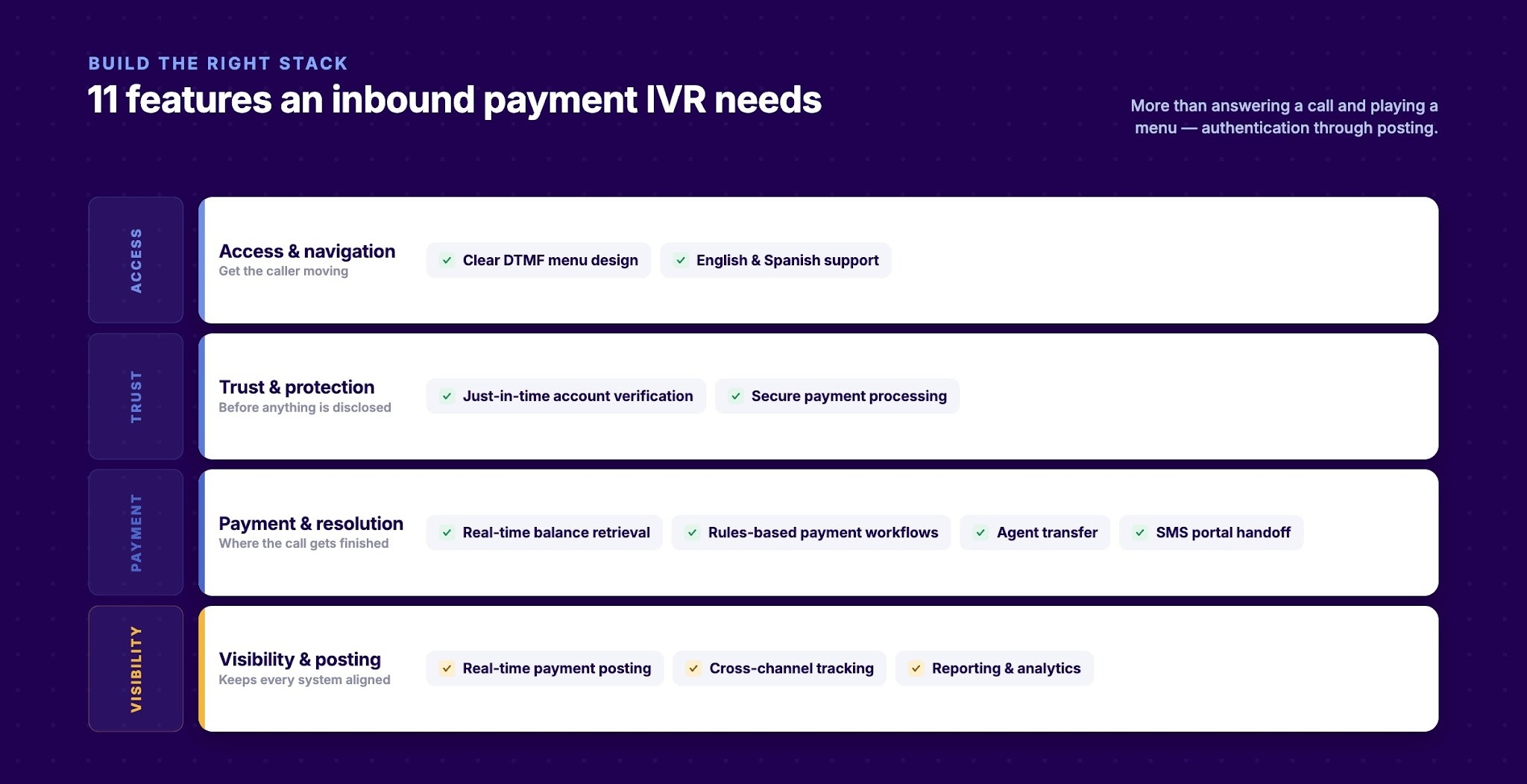
The right IVR should do more than answer a call and play a menu. Collection agencies should evaluate how well the system handles the complete path from authentication to payment posting.
For a deeper measurement framework, see these 13 IVR analytics metrics for debt collection workflows.
Tratta’s Multilingual Payment IVR is designed specifically for inbound, high-volume payment workflows. It is not a conversational AI phone agent or an outbound dialing product. Consumers call in and navigate structured English or Spanish menus using their phone keypad.
The product connects several parts of the payment journey that are often split across separate tools.
To explore the wider payment workflow, read The IVR Payment Gap: What Most Debt Collectors Are Missing.
Inbound calls avoid the central product and consent mismatch created by outbound automated dialing, but they still involve sensitive consumer and payment information. Agencies should evaluate several controls.
For a deeper operational checklist, read 8 Ways to Build an FDCPA-Compliant Debt Collection IVR Setup.
Technology alone does not create a successful payment channel. The implementation must connect the IVR with the agency’s existing account, payment, and reporting workflows.
Start with a narrow list of high-volume, low-complexity actions. These may include identity verification, balance access, one-time payment, portal handoff, and agent transfer.
Do not place disputes, hardship decisions, or complex negotiations inside a rigid menu when they require human review.
Document which payment options are available by client, portfolio, account status, jurisdiction, and consumer. Decide when the IVR should stop self-service and transfer the caller to an operator.
Choose an integration method that keeps balances and payment outcomes up to date. Tratta supports REST APIs for real-time, bidirectional updates, SFTP for flat-file exchange, and webhooks for payment-related events.
Put the most common actions first. Avoid long introductions, repeated disclosures, unclear labels, and unnecessary layers. Each menu should answer one question and move the caller closer to resolution.
Review English and Spanish prompts for accuracy, tone, timing, and equivalent meaning. Test the complete journey rather than checking individual recordings in isolation.
Confirm what happens after failed verification, a payment decline, an agent-transfer request, an abandoned call, and an SMS portal handoff. A workflow is only as reliable as its exception paths.
Monitor call volume, verification success, menu abandonment, payment completion, portal handoff, agent transfers, repeat calls, and processing failures. Use those signals to reduce friction rather than adding more prompts.
Even well-designed inbound payment IVR systems can create friction when product capabilities, payment workflows, or channel handoffs are misunderstood.
Avoiding the following mistakes helps agencies maintain accurate positioning, simplify the consumer experience, and turn more inbound calls into completed payments.
Inbound payment IVR gives consumers a structured way to make payments by phone without waiting for an agent. Its value comes from consumer-initiated access, clear menu design, reliable identity verification, secure payment handling, and accurate data across every connected system.
For collection agencies, the strongest implementation is not a standalone phone tree. It is an integrated payment channel that connects the IVR with the consumer portal, current account data, payment processing, agent workflows, and reporting.
Tratta’s Multilingual Payment IVR brings those pieces together through English and Spanish DTMF flows, just-in-time verification, rules-based payment options, real-time updates, agent transfers, SMS portal handoff, and cross-channel tracking.
Request a demo to see how Tratta can connect inbound phone payments with consumer self-service and your existing collection workflows.
Inbound payment IVR is a consumer-initiated phone system that uses automated prompts and keypad inputs to verify callers, provide relevant account options, and accept payments without requiring every caller to speak with an agent.
Yes. Because the inbound payment IVR is self-service, consumers can complete supported payment-related actions without waiting for a live agent to become available.
Yes. During the inbound call, Tratta can send the consumer an SMS containing a passwordless session link to the online portal. The consumer can then continue the payment journey on their phone.
No. It handles routine payment actions and transfers callers when human assistance is needed. Agents remain essential for disputes, negotiations, hardship conversations, and complex account questions.
The IVR connects through APIs, webhooks, or file-based integrations to retrieve account information and return payment outcomes. Tratta operates as a connected payment and operations layer while the agency’s existing system of record remains the source of truth.
Yes, Tratta's IVR is PCI compliant. Payment information entered by phone is encrypted and is not stored in call logs. Agencies should still review their complete payment environment and responsibilities with their security and compliance teams.
Track call volume, verification success, abandonment by menu step, payment completion, failed payments, SMS portal handoffs, agent transfers, repeat calls, and the time callers need to complete each action.