8 Legal Tech Stack Components Every Collection Law Firm Needs in 2026
Industry & Trends
8 Legal Tech Stack Components Every Collection Law Firm Needs in 2026
Published on:
September 6, 2026
Managing a collection law firm requires more than tracking cases and filing documents. Attorneys, collectors, payment teams, compliance leaders, and client-service teams all need reliable access to the same account history as a matter moves from placement and pre-litigation activity through filing, judgment, payment, and closure.
When those workflows sit across disconnected systems, routine work becomes harder. Staff re-enter data, payment updates arrive late, communication records become difficult to reconstruct, and client reports require manual reconciliation.
The wider legal industry is investing heavily in technology to solve similar operational problems. Grand View Research projects that the global legal technology market will reach approximately $69.7 billion by 2033, driven in part by increasing legal information complexity, regulatory demands, and pressure for more efficient services.
For collection law firms, however, buying more software is not the goal. The goal is to create a connected legal tech stack that supports litigation, consumer resolution, compliance, payments, and client reporting without producing another layer of operational complexity.
This guide explains the eight components that collection law firms should evaluate in 2026, how those components work together, and how to choose between specialized and consolidated technology strategies.
Quick look:
The audience is collection law firms: Litigation management, court workflows, judgment tracking, and legal-document automation make this stack different from the technology used by a standard collection agency.
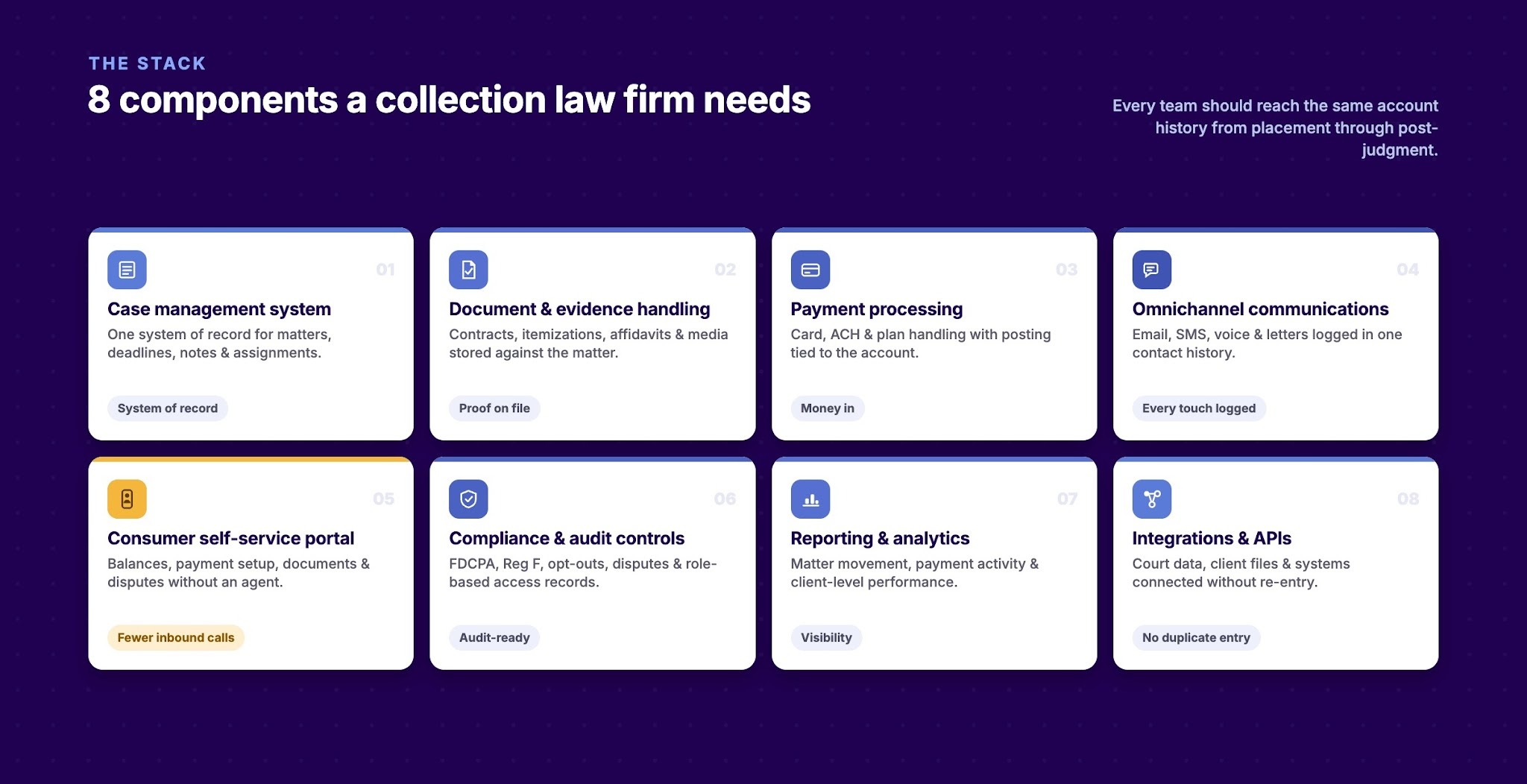
Eight components form the core stack: These include case management, collection account management, court workflow technology, document automation, consumer communications, payments, compliance, and integration and analytics infrastructure.
Connectivity matters as much as functionality: A specialized tool can still weaken operations if it cannot exchange reliable data with the rest of the stack.
One system should remain the source of truth: Each platform needs a defined role so account, case, payment, and communication data do not conflict.
The right sourcing model depends on the firm: Best-of-breed and consolidated strategies can both work when the firm deliberately manages integrations, ownership, security, and vendor risk.
What Is a Legal Tech Stack for Collection Law Firms?
A legal tech stack for collection law firms is the connected set of software used to manage account placements, legal matters, court activity, consumer communications, payments, compliance records, documents, integrations, and performance reporting.
A strong stack connects both workflows without confusing their responsibilities. The case-management platform may control legal tasks and deadlines, while a separate recovery or payment platform manages consumer self-service. The systems should exchange the right information without competing to become the authoritative record for the same data.
What Makes a Strong Legal Tech Stack for Collection Law Firms?
The quality of a legal tech stack depends less on the number of products and more on whether the environment supports accurate, repeatable work. Collection law firms should look for the following characteristics:
A clearly defined source of truth: The firm should know which system owns account balances, legal status, consumer details, documents, payment outcomes, and communication preferences. Other tools should read from or write back to those authoritative records through controlled integrations.
Connected legal and recovery workflows: A payment, dispute, settlement, returned transaction, or consumer update may affect legal activity. Information should move between teams without relying on spreadsheets, inboxes, or repeated manual entry.
Compliance built into routine actions: Disclosures, permissions, communication preferences, access controls, and audit records should be part of the workflow rather than a separate review performed after activity occurs.
Configurable processes: Collection law firms work across different clients, debt types, jurisdictions, legal stages, and court requirements. Technology should support controlled variation without forcing the firm to create a separate process for every portfolio.
Defensible records: The firm should be able to reconstruct what happened, who took an action, which version of a document was used, when a consumer interacted, and how a payment or case status changed.
Secure consumer experiences: Digital payment and communication tools should be simple for consumers while protecting account and payment data.
Scalable administration: New users, clients, portfolios, workflows, and integrations should not require the firm to rebuild its entire environment.
Useful operational visibility: Dashboards and reports should help teams act—not merely show activity. Leaders need insight into recovery, litigation status, exceptions, payment performance, workloads, and client outcomes.
8 Legal Tech Stack Components Collection Law Firms Need
No single product performs every legal, operational, and consumer-facing function equally well. The strongest stack assigns a clear role to each component and defines how information moves between them.
Component
Primary Role in the Stack
Case and matter management
Organize legal work, ownership, tasks, and deadlines
Collection account management
Manage placements, balances, recovery status, and account activity
Litigation and court workflow technology
Support filing, service, docket, hearing, and judgment workflows
Document automation and eSignature
Generate, control, execute, and retain legal and consumer documents
Consumer communication technology
Manage compliant email, SMS, phone, and preference workflows
Payment and self-service technology
Enable secure payments, plans, settlements, and online resolution
Compliance, security, and audit technology
Apply controls and preserve evidence of compliant operations
Integration, reporting, and analytics infrastructure
Connect systems and turn operational data into usable insight
1. Case and Matter Management Software
Case and matter management software is the operational center for legal work. It should give attorneys and support staff a structured view of every matter, including ownership, deadlines, notes, documents, tasks, and procedural status.
Core capabilities typically include:
Matter intake and assignment
Attorney and staff task management
Deadline and calendar controls
Notes and activity histories
Document organization
Conflict and permission controls
Client and matter-level views
For collection law firms, generic matter management may not be enough. The software should accommodate high-volume, repeatable legal workflows while still allowing exceptions for contested matters, unique client requirements, and jurisdiction-specific procedures.
2. Collection Account Management and System-of-Record Software
Collection account management software organizes the financial and recovery side of the matter. It may hold placement data, balances, creditor information, consumer details, account status, payment history, and recovery activity.
The firm should explicitly decide whether this platform or the legal case-management system is authoritative for each data category. Without that decision, staff may see one balance in the legal file and another in the payment system.
Important capabilities include:
Placement and portfolio management
Current balance and transaction history
Client-specific account rules
Consumer and responsible-party records
Recovery status and account segmentation
Payment and settlement status
Import, export, API, or file-based data exchange
The best system of record is not necessarily the product with the most features. It is the system the firm can govern consistently and connect reliably to the rest of the stack.
3. Litigation and Court Workflow Technology
Collection law firms need technology that supports the procedural work ordinary collection agencies do not perform. This may include filing, service, court deadlines, docket updates, hearing schedules, judgment entry, garnishment or execution workflows where permitted, and post-judgment monitoring.
At the federal level, attorneys and other authorized filers use the judiciary’s Case Management/Electronic Case Files system to submit pleadings, motions, and other documents electronically. State and local court processes vary, so firms must evaluate jurisdiction coverage rather than assume one connector works everywhere.
Useful capabilities include:
Court and jurisdiction mapping
Filing and service tracking
Docket and deadline updates
Hearing and appearance scheduling
Judgment and post-judgment status
Exception queues for rejected or incomplete filings
Connections to approved filing providers where available
Automation should support legal operations, not make legal judgments. Attorneys and qualified staff remain responsible for legal review, procedural decisions, and jurisdiction-specific requirements.
4. Document Automation and eSignature Tools
High-volume collection litigation generates repeated documents with matter-specific data. Document automation can reduce manual preparation while improving consistency across notices, pleadings, affidavits, settlement documents, stipulations, and client correspondence.
The technology should merge approved data into controlled templates, track versions, restrict unauthorized edits, and preserve the executed record.
Key capabilities include:
Template and clause management
Matter-data merge fields
Conditional content and jurisdiction-specific language
Approval and version controls
Batch document generation
Electronic signature workflows
Certificates, timestamps, and document histories
Secure retention and retrieval
The firm should test every automated template against its legal and client-review processes. Faster document generation only helps when the underlying data and approved language are correct.
5. Consumer Communication Technology
Collection law firms communicate with consumers across email, SMS, phone, letters, portal messages, and attorney or agent conversations. Communication technology should coordinate those channels while preserving consent, preferences, disclosures, delivery outcomes, and account history.
Core functions may include:
Email and SMS templates
Communication preferences and opt-outs
State- or client-specific disclosures
Delivery and failure tracking
Secure messaging
Contact-hour and suppression rules
Account-level interaction history
Escalation to an attorney, collector, or support team
Communication controls should reflect the firm’s policies and applicable law. Technology can enforce configured rules, but it does not replace legal review or compliance governance.
6. Payment and Consumer Self-Service Technology
Consumers may be ready to resolve an account without speaking to an attorney or collector. A secure self-service layer can allow eligible consumers to view balances, make payments, accept approved settlement offers, establish permitted payment plans, upload documents, or submit a dispute.
Collection law firms need controls that apply policies consistently and retain evidence of what occurred. Regulation F requires covered debt collectors to retain records that evidence compliance or noncompliance with the FDCPA and the rule for specified periods.
The CFPB’s record-retention provision specifically identifies records such as communication logs and documents provided to consumers as potential evidence.
A compliance and audit layer should support:
Role-based permissions
Multi-factor authentication
Communication preferences and suppression rules
Disclosure and policy-version control
Timestamped activity histories
Document and communication retention
Consent and authorization records
Exception alerts and review queues
Exportable audit evidence
Compliance technology should make controlled behavior easier and exceptions visible. It should not be marketed as a substitute for counsel, documented policies, training, monitoring, or human review.
8. Integration, Reporting, and Analytics Infrastructure
The stack becomes operationally useful only when its components exchange accurate information. Integration tools move data between the system of record, case-management software, court workflow tools, payment systems, client environments, and reporting layers.
Integration options may include:
REST APIs
Webhooks
Secure SFTP or flat-file exchange
Prebuilt system connectors
Event-driven updates
Data warehouses and scheduled exports
Reporting then turns that connected data into information for attorneys, operations leaders, compliance teams, and clients.
Collection law firms should be able to monitor:
Matters by legal stage and jurisdiction
Filing, service, hearing, and judgment status
Recovery and liquidation performance
Payments, plans, settlements, returns, and chargebacks
Staff workloads and exception queues
Consumer communication and engagement
Client- and portfolio-level outcomes
Data-sync failures and unresolved discrepancies
Avoid building dashboards on top of inconsistent data. Reporting should follow clear ownership, reconciliation, and data-quality rules.
How to Build a Legal Tech Stack Without Creating Data Silos
Adding a new platform is easy. Making it work reliably with the firm’s people, data, and procedures requires deliberate planning. Use the following steps to reduce fragmentation:
Map the end-to-end workflow first: Follow a matter from placement through demand, litigation, payment, judgment, closure, and client reporting. Document every system, handoff, approval, and manual workaround.
Assign ownership to each data category: Decide which system owns balances, legal status, payment history, consumer preferences, documents, court events, and client instructions.
Define integration requirements before vendor selection: Identify which events require real-time updates, which can use scheduled files, and what should happen when a transfer fails.
Design exception handling: Every integration eventually encounters missing fields, rejected records, duplicates, stale balances, or unavailable systems. Create queues, owners, and resolution targets for those exceptions.
Standardize permissions and offboarding: User roles should reflect job responsibilities across every platform. Access should be reviewed and removed consistently when responsibilities change.
Test with real workflows: A feature demonstration is not an implementation test. Validate common cases, exceptions, high-volume batches, payment reversals, filing failures, and client-specific rules.
Measure adoption and outcomes: Track whether staff use the intended workflow, whether manual reconciliation declines, whether data becomes more accurate, and whether cycle times improve.
Common Legal Tech Stack Mistakes Collection Law Firms Make
Technology problems often begin with selection and governance decisions rather than software defects. Watch for these recurring mistakes:
Buying before mapping workflows: A firm may purchase a strong product that solves the wrong bottleneck or duplicates capabilities it already owns.
Assuming more tools create a stronger stack: Each additional platform introduces another vendor, user-access model, integration, data source, and failure point.
Failing to define the source of truth: Conflicting balances, case stages, consumer details, or payment histories are inevitable when multiple systems can overwrite the same information without clear ownership.
Ignoring court and jurisdiction coverage: A litigation tool that works well in one court system may not support the filing provider, document rules, or procedural workflow required elsewhere.
Separating payments from legal status: A completed, failed, reversed, or disputed payment may affect case activity. Delayed updates can create unnecessary filings, consumer confusion, or inaccurate reporting.
Treating compliance as a final review: Controls are more reliable when they shape routine work through permissions, rules, templates, and exception handling.
Underestimating change management: Even capable software fails when users do not understand the new process, keep using spreadsheets, or recreate the old workflow inside the new system.
Measuring implementation instead of outcomes: Going live is not the goal. Firms should measure accuracy, adoption, cycle time, exception volume, consumer completion, and client visibility.
Best-of-Breed vs. Consolidated: How Should Collection Law Firms Approach Their Tech Stack?
Collection law firms generally choose between specialized tools connected through integrations and a smaller number of broader platforms. This is a best-of-breed versus consolidated-platform decision, not a traditional build-versus-buy question.
Approach
Potential Advantages
Potential Tradeoffs
Best-of-breed stack
Deeper specialized functionality, wider vendor choice, and the ability to select a strong product for each workflow
More integrations, vendors, permissions, contracts, data mappings, and failure points to manage
Consolidated platform strategy
Fewer handoffs, more centralized administration, shared data, and simpler reporting
Greater dependence on fewer vendors and potentially less depth in specialized legal or jurisdictional workflows
Hybrid strategy
Keeps specialized litigation or court tools while consolidating consumer-facing recovery, payments, and reporting
Requires clear boundaries and disciplined integration governance to prevent overlap
Neither model is automatically better. The right decision depends on the firm’s legal footprint, caseload, client mix, internal IT capacity, compliance requirements, and tolerance for vendor concentration.
Before selecting an approach, ask:
Which capabilities are truly differentiating for our firm?
Which workflows require specialized legal or jurisdictional functionality?
How many integrations can our team realistically govern?
Can we locate a complete account, legal, communication, and payment history without manual reconciliation?
What happens operationally if one vendor or integration becomes unavailable?
How difficult is it to add a client, portfolio, jurisdiction, or user role?
Are we paying for overlapping products that teams do not fully use?
Can our reporting layer reconcile data across the full matter lifecycle?
Many firms will find that a hybrid model is the most practical: retain specialized case and court technology where legal depth matters, while consolidating selected consumer-facing, payment, communication, and reporting workflows.
Where Tratta Fits in a Collection Law Firm’s Legal Tech Stack
Tratta serves as the digital collections, consumer self-service, and payment layer within a collection law firm’s broader technology environment.
It connects consumer-facing recovery workflows with the firm’s existing system of record without replacing legal case-management software, court filing systems, docket management, or attorney judgment.
Consumer Self-Service Payment Portal: Tratta’s consumer self-service portal gives eligible consumers a branded, mobile-responsive way to view balances, make payments, access approved payment plans or settlements, upload documents, and manage account actions.
Embedded Payments and Merchant Services: Its payment and merchant-services layer supports configurable payment types, real-time balance validation, payment-plan management, settlement workflows, reconciliation, and portfolio-based routing, including law-firm trust-account use cases.
Multilingual Inbound Payment IVR: Tratta’s Multilingual Payment IVR provides English and Spanish, menu-driven inbound payment workflows. It is an inbound-only payment channel, not an outbound dialer or predictive-calling product.
Omnichannel Consumer Communications:Omnichannel Communications supports configurable email and SMS workflows, communication preferences, disclosures, templates, delivery tracking, and consumer-response data.
Reporting and Analytics: Tratta’s reporting tools provide dashboards, payment and plan reporting, reconciliation visibility, consumer-journey analytics, scheduled reports, and exportable records.
Integration With Existing Legal Systems:REST APIs, webhooks, and secure file exchange allow Tratta to work as an operations layer connected to the firm’s existing case-management or collection system rather than competing with it as the legal system of record.
Security and Compliance Controls: Tratta’s security and compliance infrastructure includes PCI DSS Level 1 and SOC 2 Type II controls, tokenized payment data, role-based access, configurable disclosures, and audit-ready workflow records.
Conclusion
A legal tech stack for collection law firms must support more than general account recovery. It needs to connect legal case management, court activity, documents, consumer communications, payments, compliance, integrations, and client reporting across the full matter lifecycle.
The strongest stack is not necessarily the one with the fewest tools or the most features. It is the one with clear system boundaries, reliable data movement, usable controls, defined ownership, and enough flexibility to handle different clients, jurisdictions, and legal stages.
Start by mapping the firm’s real workflows and failure points. Then decide which capabilities require specialized legal technology, which functions can be consolidated, and how every component will contribute to one accurate operational record.
Tratta strengthens this ecosystem by connecting consumer self-service, payments, communications, reporting, and compliance-focused recovery workflows with a firm’s existing legal systems. Schedule a free demo to see how Tratta can fit into your collection law firm’s legal tech stack.
Frequently Asked Questions
1. What is a legal tech stack for collection law firms?
A legal tech stack for collection law firms is the connected group of systems used to manage account placements, legal matters, court workflows, documents, communications, payments, compliance records, integrations, and reporting.
2. How is a collection law firm tech stack different from a collection agency tech stack?
Collection law firms need legal-specific capabilities such as matter management, filing and service workflows, court deadlines, hearing schedules, judgment tracking, and legal-document controls. A standard collection agency may not need those litigation functions.
3. What software should serve as the system of record?
The answer depends on the firm’s architecture. Some firms use a collection platform as the account and balance system of record while a case-management platform controls legal status and documents. The important requirement is to define ownership for each data category and prevent conflicting updates.
4. Should collection law firms use one platform or several specialized tools?
Both approaches can work. Specialized tools may provide deeper legal functionality, while consolidated platforms can reduce vendors and data silos. Many firms use a hybrid model that preserves specialized court and case tools while consolidating consumer-facing recovery and payment functions.
5. Which integrations matter most for a collection law firm?
Common priorities include connections between the system of record, case-management software, filing or court workflow providers, payment systems, consumer communication tools, document platforms, client data feeds, and reporting environments.
6. How often should a collection law firm review its legal tech stack?
Review the stack at least annually and whenever the firm adds a major client, jurisdiction, workflow, acquisition, or regulatory requirement. Integration failures, repeated manual work, rising exception volume, and conflicting reports are also signs that a review is overdue.
7. What is the biggest legal tech stack risk for collection law firms?
Data fragmentation is one of the largest operational risks. When systems disagree about balances, legal status, consumer preferences, or payments, the firm may create inaccurate workflows, reporting problems, and avoidable compliance exposure.
8. How should a firm measure whether its technology stack is working?
Measure data accuracy, user adoption, manual touches, processing time, integration failures, exception volume, payment completion, filing outcomes, audit readiness, and client-reporting effort. A successful stack should improve operational outcomes, not simply add features.
Note: This article is educational and does not constitute legal advice. Collection law firms should work with qualified counsel and compliance professionals when configuring legal, communication, payment, and record-retention workflows.
Note: This information is not legal advice. Tratta recommends that you consult with your legal counsel to make sure that you comply with applicable laws in connection with your collection and outreach activities.
Sign up for our monthly newsletter
Debt collection insights that keep you compliant and competitive.
Thank you! Your submission has been received!
Oops! Something went wrong while submitting the form.