Missed payments and broken arrangements remain a persistent operational drain, extending recovery timelines, increasing collector workload, and weakening liquidation rates. This challenge is amplified by shifting communication behaviors.
According to a recent report, the global automated SMS-based payment reminder market reached $7.71 billion in 2025 and is projected to grow at a 14.90% CAGR.
As consumers increasingly expect real-time reminders and self-service payment access, manual call-centric follow-up models struggle to maintain consistent repayment discipline.
Automated payment follow-up services address this gap by combining structured reminders, multichannel delivery, and intelligent escalation workflows. In this article, we examine five practical ways automated payment follow-up services improve debt recovery.
In brief:
Automated payment follow-up services are software-driven systems that manage, schedule, and execute payment reminders without manual collector intervention. They replace ad-hoc calls, spreadsheets, and fragmented messaging tools with structured, rule-based workflows. This ensures consistency, accuracy, and scale.
These systems centralize follow-up execution across every stage of the repayment lifecycle. You gain predictable engagement without increasing collector workload or compliance risk.
In effective collections software, automated follow-up typically includes:
In the next section, we examine how these features turn payment follow-up into a scalable recovery engine that improves engagement, repayment discipline, and debt recovery performance.
Suggested Read: Automated Payment Reminders
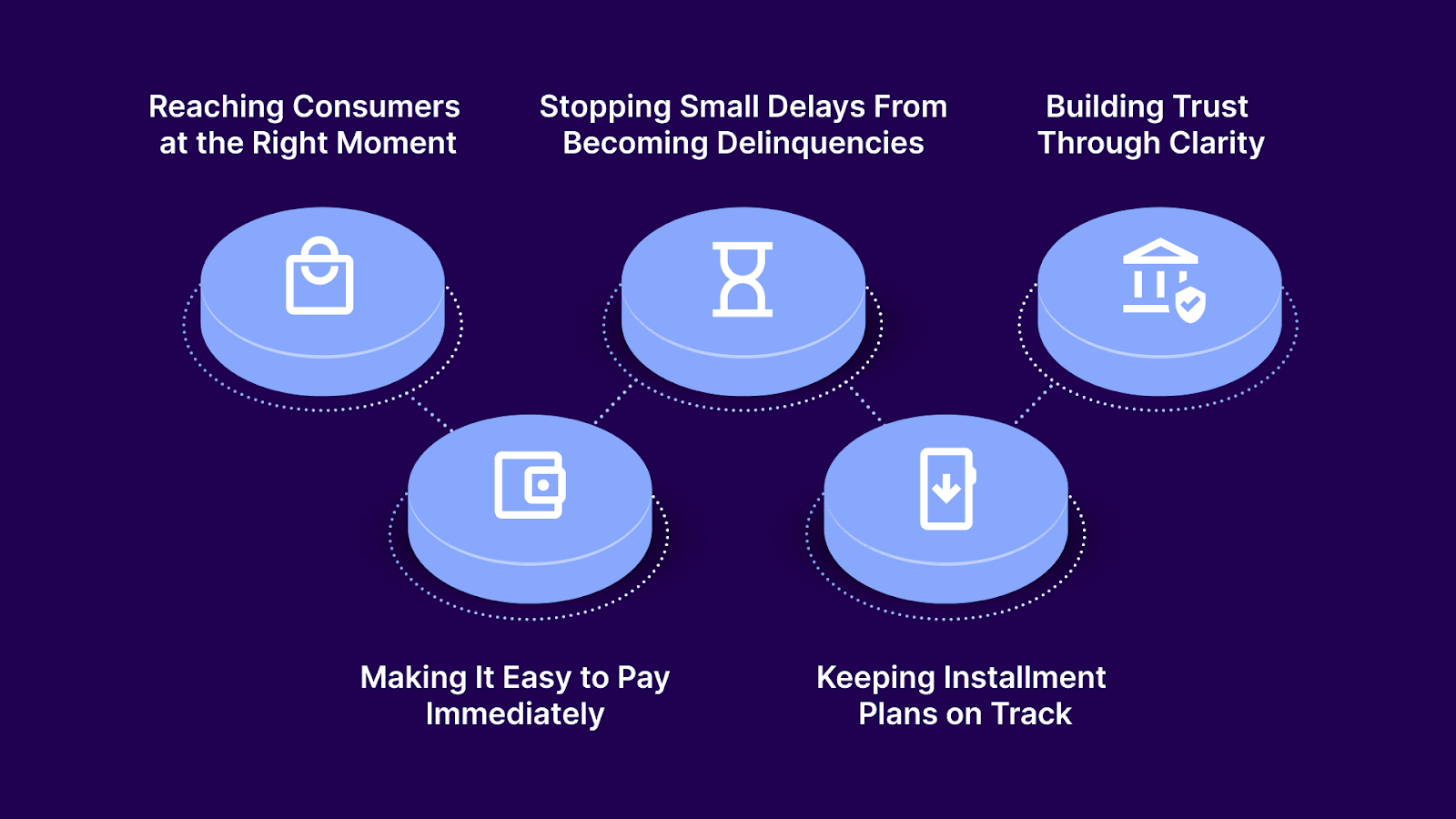
Automated payment reminders change how repayment behavior is shaped. Instead of reacting to missed payments, you move to proactive, structured engagement that guides consumers toward consistent action.
This improves cash flow, reduces broken arrangements, and strengthens recovery performance across portfolios.
Most payments happen when timing, clarity, and convenience align. Automated reminders reach consumers at precisely those moments. This increases the likelihood of follow-through before distractions take over.
These reminders focus on timing, context, and relevance.
Best channel: SMS
Why: High open rates, immediate visibility, fast action.
Example SMS Template:
Hello {First Name}, this is {Agency Name}, a debt collector. Your scheduled payment of {Amount} is due on {Date}. View your balance or pay securely: {Secure Link}. Reply STOP to opt out, HELP for help.
Every extra step increases the risk of nonpayment. Automated reminders remove friction by giving consumers direct access to secure payment options. This shortens the path from reminder to completed transaction.
These features eliminate common payment delays.
Best channel: Email
Why: Allows full disclosures, secure links, payment context, and proper identity verification.
Compliant Email Template:
Subject: Secure Payment Link – {Agency Name} – {Account Reference}
Hello {First Name},
This message is from {Agency Name}, a debt collector, regarding your account. A payment of {Amount} is currently due.
To review your balance or make a secure payment, please visit the link below:
{Secure Payment Link}
If you have already submitted payment, please disregard this message. If you have questions or need assistance, you may contact us using the details below.
{Agency Name}
{Business Address}
{Phone Number}
{Email Address}
This communication is from a debt collector. This is an attempt to collect a debt, and any information obtained will be used for that purpose.
Further Read: Effective Payment Reminder Email Templates
Payment breakdown usually begins with small slips. Automated reminders step in early, before those slips become serious problems. This helps you protect accounts that are still recoverable.
These workflows intervene before risk escalates.
Best Channel: SMS
Why: Allows fast, low-friction intervention before a minor delay becomes a serious delinquency.
Example:
Hello {First Name}, this is {Agency Name}, a debt collector. We noticed your recent payment was delayed. If you need more time or want to review your options, please visit: {Secure Payment Link}. Reply STOP to opt out, HELP for help.
Installment plans succeed when consistency holds. Automated reminders help consumers stay focused across long repayment timelines. This protects plan performance and reduces drop-offs.
These systems maintain momentum across months of payments.
Best Channel: IVR with SMS follow-up
Why: Reinforces commitment, improves plan adherence, and provides immediate payment access without increasing pressure.
IVR Script Template:
Hello, this is an automated call from {Agency Name}, a debt collector, regarding your account. Your scheduled installment payment of {Amount} is due on {Date}. To make a payment now or hear your balance, please press 1 or visit {Secure Payment Link}.
SMS Follow-Up Template:
Hello {First Name}, this is {Agency Name}, a debt collector. Your installment payment of {Amount} is due on {Date}. Pay securely here: {Secure Payment Link}. Reply STOP to opt out, HELP for help.
Consumers pay more reliably when they understand what they owe and what comes next. Automated reminders create predictable, transparent communication. This builds trust and encourages voluntary repayment.
These controls improve clarity across the payment journey.
Best Channel: Email
Why: Provides transparency, documentation, and reassurance, which encourages voluntary repayment and reduces disputes.
Email Template:
Subject: Payment Confirmation – {Agency Name} – {Account Reference}
Hello {First Name},
This message is from {Agency Name}, a debt collector, confirming your recent payment of {Amount} received on {Date}. Your remaining balance is {Remaining Balance}.
You may review your payment history and account details here:
{Secure Payment Link}
If you have questions or need assistance, you may contact us using the details below.
{Agency Name}
{Business Address}
{Phone Number}
{Email Address}
This communication is from a debt collector. This is an attempt to collect a debt, and any information obtained will be used for that purpose.
Tratta brings these functionalities together through omnichannel payment reminders, combining SMS, email, IVR, and secure portal engagement. This allows you to deliver consistent, compliant follow-up at scale. Schedule a free demo today.
Regulatory exposure is one of the highest operational risks in debt collection. A single misstep can trigger consumer complaints, litigation, regulatory scrutiny, and costly settlements.
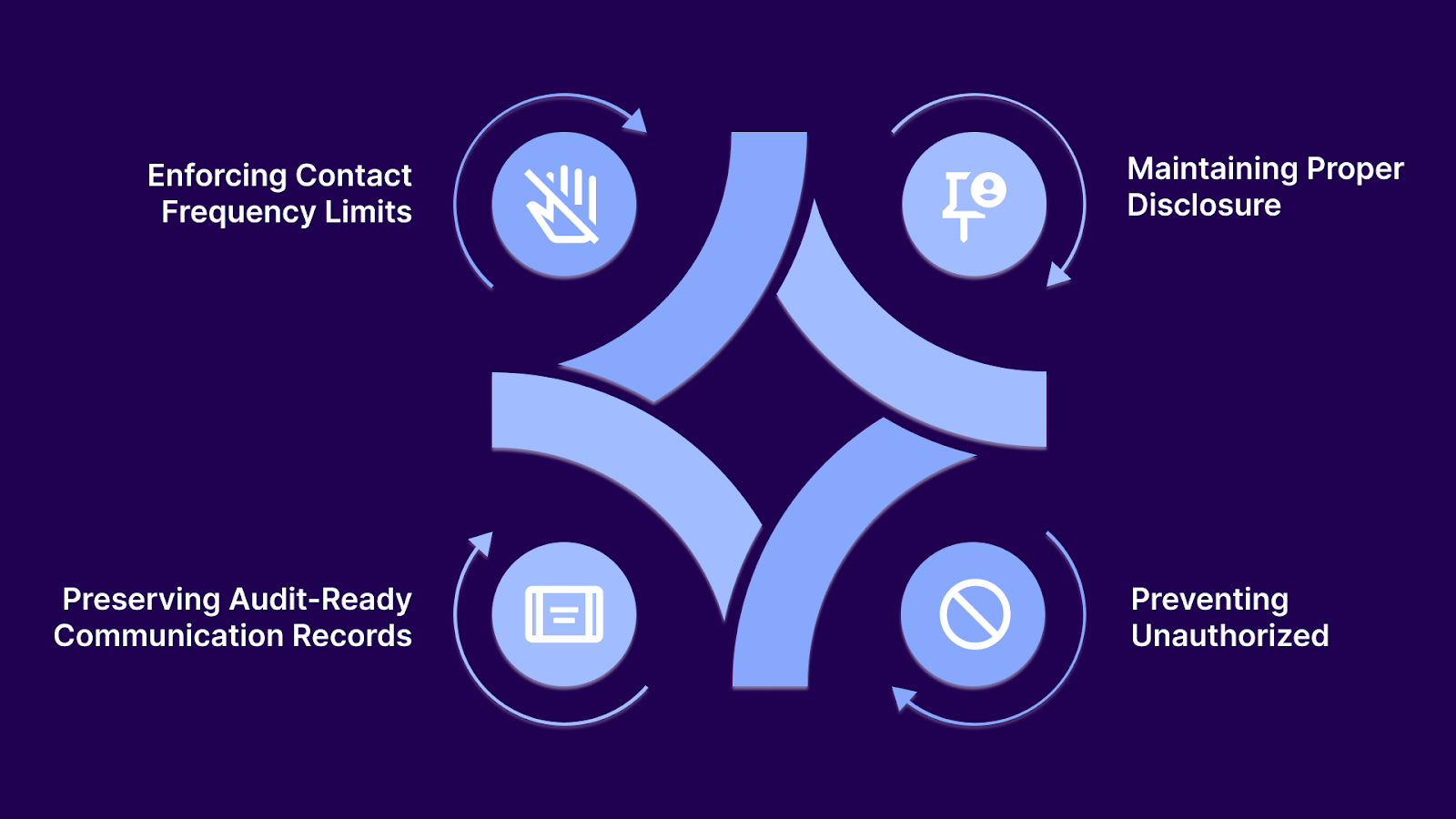
Automated payment systems reduce this risk by embedding compliance logic directly into outreach workflows, preventing violations before they occur.
The next section examines how automation also delivers direct financial returns that materially improve agency performance.
Suggested Read: Guide to Smart Payment Follow-Ups That Drive Faster Collections
According to a McKinsey global operations study, automated customer engagement and payment follow-up systems can reduce operational costs by up to 40% while improving recovery rates by approximately 10%.
Automated follow-up delivers the strongest ROI in the following areas:
Tratta enables agencies to capture these ROI gains by automating payment follow-up campaigns across SMS, email, IVR, and secure portals. You can build structured, rules-based engagement flows that adapt to payment behavior in real time, ensuring timely reminders, intelligent escalation, and consistent consumer touchpoints. Learn more.
Automated follow-up directly reshapes the performance metrics that determine recovery speed, portfolio value, and agency profitability.
Table showing core collection metrics that get improved by automating reminders:
When reminders become consistent, timely, and easy to act upon, repayment behavior stabilizes, recovery timelines shorten, and operational strain declines.
To maximize improvement across these metrics, agencies should focus on:
Real gains across these metrics depend on more than automation alone. They require the right software infrastructure to execute follow-up reliably, compliantly, and at scale.
Suggested Read: Text Messaging Strategies and Templates for Debt Collection
Tratta is a compliance-first, payment-centric collections platform built specifically for U.S. collection agencies, collection law firms, original creditors, and debt buyers. It is designed to execute high-volume payment follow-up workflows reliably and at scale.
Rather than layering automation on top of legacy systems, Tratta embeds compliance and payment logic directly into everyday collection operations.
Core features that power Tratta’s automated follow-up workflows include:
What sets Tratta apart is how flawlessly these features work together. Campaign logic, payment execution, and compliance enforcement operate as one continuous workflow. You can automate follow-up with confidence, accuracy, and full regulatory alignment.
Without automated payment reminders, even well-run collection operations face predictable breakdowns. Missed follow-ups lead to broken payment plans, delayed engagement increases delinquency risk, and manual workflows introduce compliance exposure that can quickly escalate into regulatory and financial consequences.
Tratta eliminates these failure points by embedding automated, omnichannel payment follow-up, compliance-by-code controls, and real-time payment execution into a single platform. Its campaign-driven architecture ensures consistent engagement, regulatory alignment, and frictionless payment access.
If you are evaluating how to modernize your payment follow-up workflows, Tratta offers a proven, compliance-first approach. Speak with our team to see how Tratta can fit into your existing collections infrastructure.
Payment follow-up is the structured process of reminding consumers about upcoming, overdue, or missed payments. In collections, this includes scheduled reminders, settlement nudges, and installment plan engagement to improve repayment consistency. Automated follow-up ensures timely, compliant, and scalable execution.
Polite payment follow-up uses neutral, respectful language that focuses on clarity and convenience rather than pressure. Messages should provide payment options, support flexibility, and avoid threatening or coercive wording. Automation helps standardize tone while maintaining compliance.
A polite reminder clearly states the amount due, the due date, and how to pay, using simple, supportive language. It avoids pressure driven by urgency and provides easy access to payment channels. Consistent, well-timed reminders improve response without harming consumer trust.
Payment follow-up services include automated SMS reminders, email campaigns, IVR payment systems, self-service portals, and installment plan automation. Advanced platforms combine these into omnichannel workflows to improve recovery and compliance simultaneously.
Automated follow-up ensures consistent timing, regulatory compliance, and scalable execution. It reduces collector workload, minimizes human error, and improves repayment discipline. This leads to faster recovery, lower costs, and reduced regulatory risk.