6 Best SOC 2 and PCI Compliant Debt Collection Software Platforms in 2026
Compliance
Debt Collection & Recovery Software
6 Best SOC 2 and PCI Compliant Debt Collection Software Platforms in 2026
Published on:
August 3, 2026
A security incident can do more than expose sensitive data. It can disrupt operations, damage client trust, and create costly compliance challenges for collection agencies. As agencies handle increasing volumes of consumer and payment information, choosing secure technology partners has become a business necessity.
The growing demand for secure collections technology is reflected in the global debt collection software market, which is projected to reachUSD 13.77 billion by 2034.
In this article, we review SOC 2 and PCI-compliant debt collection software platforms and examine the security, compliance, and operational capabilities agencies should consider when evaluating solutions in 2026.
Quick look:
SOC 2 and PCI compliance help collection agencies evaluate whether a software provider follows recognized security, data protection, and payment security standards.
The platforms reviewed include Tratta, C&R Software (Debt Manager), InterProse ACE, CollectOne, Collect! by Comtech Systems, and Latitude by Genesys, each with different strengths for third-party collection operations.
Security alone is not enough because agencies should also assess workflow compatibility, scalability, integration capabilities, and operational flexibility before selecting a platform.
The strongest solutions combine compliance, consumer engagement, payment capabilities, automation, reporting, and configurable workflows within a single environment.
Choosing the right platform can help reduce operational risk, strengthen client confidence, protect sensitive information, and support long-term agency growth.
What is a SOC 2 and PCI Compliant Debt Collection Software?
SOC 2 andPCI compliance help collection agencies assess whether a software provider adheres to established security and data protection practices. SOC 2 focuses on controls related to security, availability, processing integrity, confidentiality, and privacy, while PCI DSS focuses on protecting payment card data.
These certifications have become increasingly important as agencies manage larger volumes of consumer and payment information. According to IBM's 2024 Cost of a Data Breach Report, the average cost of a data breach in the financial sector reached$6.08 million, highlighting the financial impact of security failures.
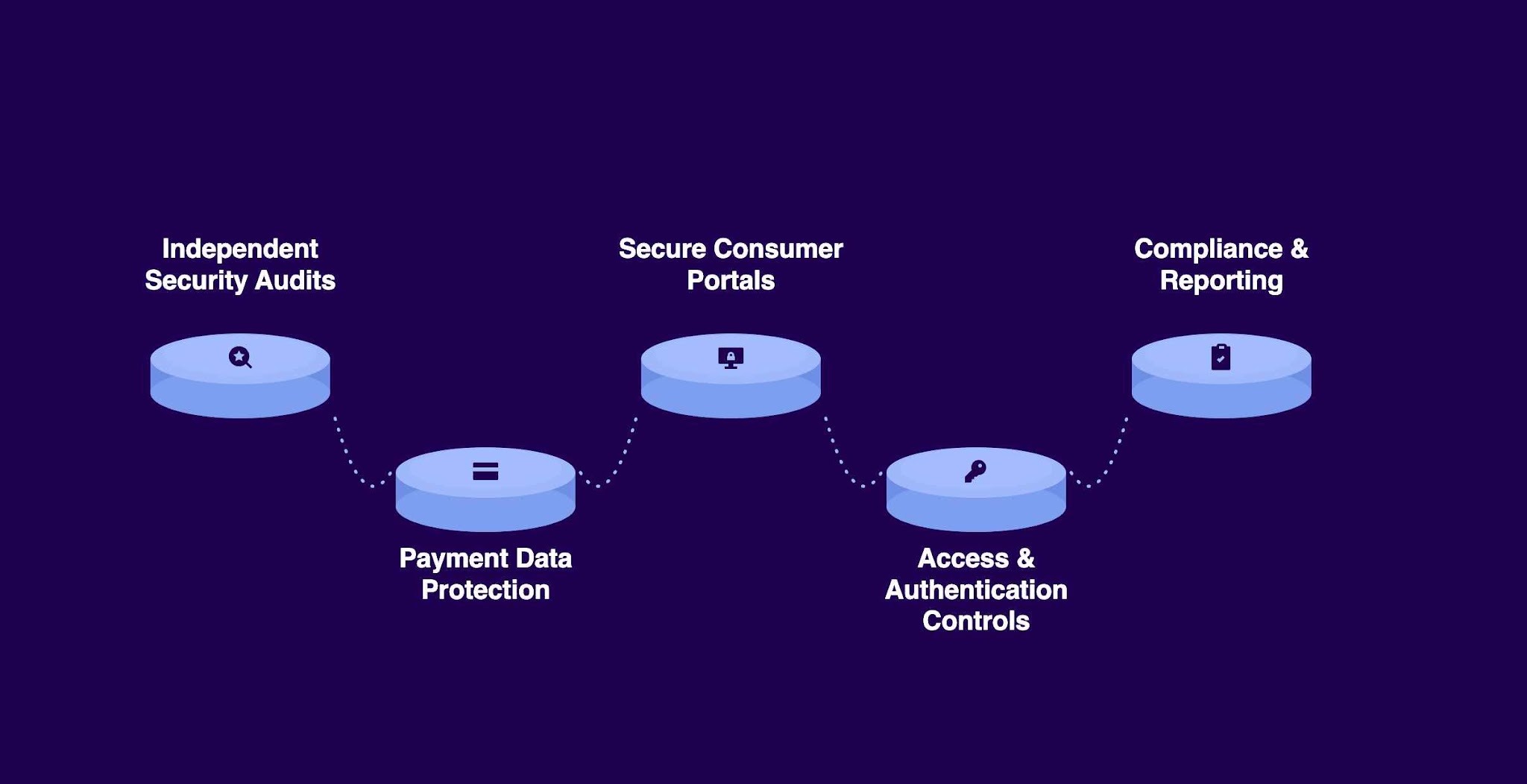
When evaluating SOC 2 and PCI-compliant debt collection software, look for:
Independent Security Audits: Third-party assessments help validate security controls and operational practices.
Payment Data Protection: PCI-focused controls help safeguard cardholder information and payment workflows.
Secure Consumer Portals: Consumer-facing experiences should protect sensitive account and payment data.
Access and Authentication Controls: Strong permission management helps limit unauthorized access to information.
Compliance and Reporting Capabilities: Documentation, audit trails, and compliance controls support regulatory oversight.
To help agencies compare available options, we evaluated the most popular solutions. In the next section, you can understand our ranking procedure.
Selecting collection software involves more than reviewing feature lists. We evaluated each platform based on the factors most likely to influence compliance, data protection, operational efficiency, and long-term scalability.
Our assessment considered:
Publicly available SOC 2 and PCI compliance information.
Security controls and data protection practices.
Consumer payment and self-service capabilities.
Collection-specific functionality and automation tools.
Integration and interoperability options.
Reporting, audit, and compliance support features.
No single platform is the right fit for every agency. The comparison table below provides a high-level view of how these solutions align across key evaluation criteria before we examine each platform in greater detail.
Centralized collection management and productivity tools
Agencies focused on operational efficiency
Collect! by Comtech Systems
SOC 2 Type II, PCI-compliant payment ecosystem
Regulation F and compliance-focused workflows
Compliance-driven collection agencies
Latitude by Genesys
Enterprise security and compliance controls
Business process automation and account treatment strategies
Large agencies and debt buyers
A high-level comparison can help narrow the field, but software selection ultimately depends on your agency's operational requirements, compliance priorities, and growth plans. In the following sections, we take a closer look at each platform's strengths, ideal use cases, and key differentiators.
6 Top SOC 2 and PCI Compliant Debt Collection Software for Third-Party Agencies
Security and compliance have become important evaluation criteria forcollection agencies selecting new technology platforms. However, agencies also need solutions that support consumer engagement, payment processing, operational efficiency, and regulatory requirements.
The following platforms combine security-focused infrastructure with collection-specific functionality designed for third-party recovery operations.
1. Tratta
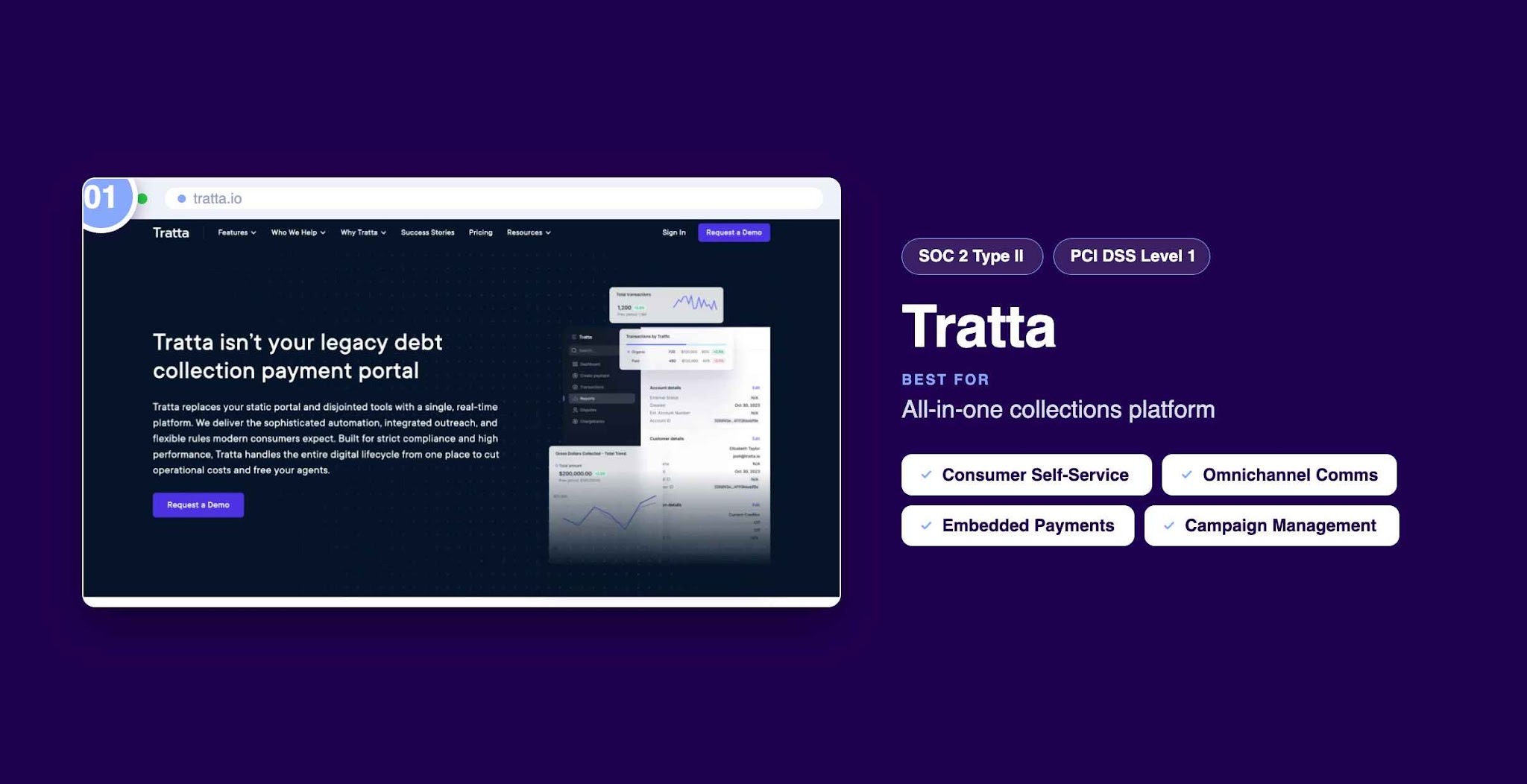
Tratta is a cloud-based debt collection platform designed for third-party collection agencies, legal firms, and debt buyers. The platform combines compliance-focused workflows, consumer engagement tools, omnichannel communications, and payment capabilities within a single environment.
Its SOC 2 Type II and PCI DSS Level 1 certifications make it a strong option for agencies that prioritize security alongside operational scalability.
SOC 2 and PCI Compliant Features
SOC 2 Type II certified infrastructure
PCI DSS Level 1 compliant payment environment
Secure payment processing workflows
Role-based access controls
Comprehensive audit documentation
Additional Features
Consumer Self-Service Portals Consumers can access account information and resolve balances through secure digital experiences. This helps reduce agent workload while improving convenience.
Omnichannel Communications Agencies can manage SMS, email, voice, and digital engagement strategies from a centralized platform. Consumer interactions remain connected throughout the recovery process.
Embedded Payment Workflows Tratta connects engagement and payment experiences within a single ecosystem. This can help reduce friction between consumer contact and account resolution.
Customization and Flexibility Agencies can configure workflows, user experiences, and operational processes to align with their business requirements. This provides greater flexibility than rigid, one-size-fits-all collection systems.
Campaign Management Teams can create, manage, and monitor outreach campaigns across multiple communication channels from a centralized environment. This helps agencies coordinate consumer engagement efforts while maintaining operational visibility.
Best For: Third-party collectors seeking an advanced platform that combines compliance, consumer engagement, payments, and security within a single solution.
2. C&R Software (Debt Manager)
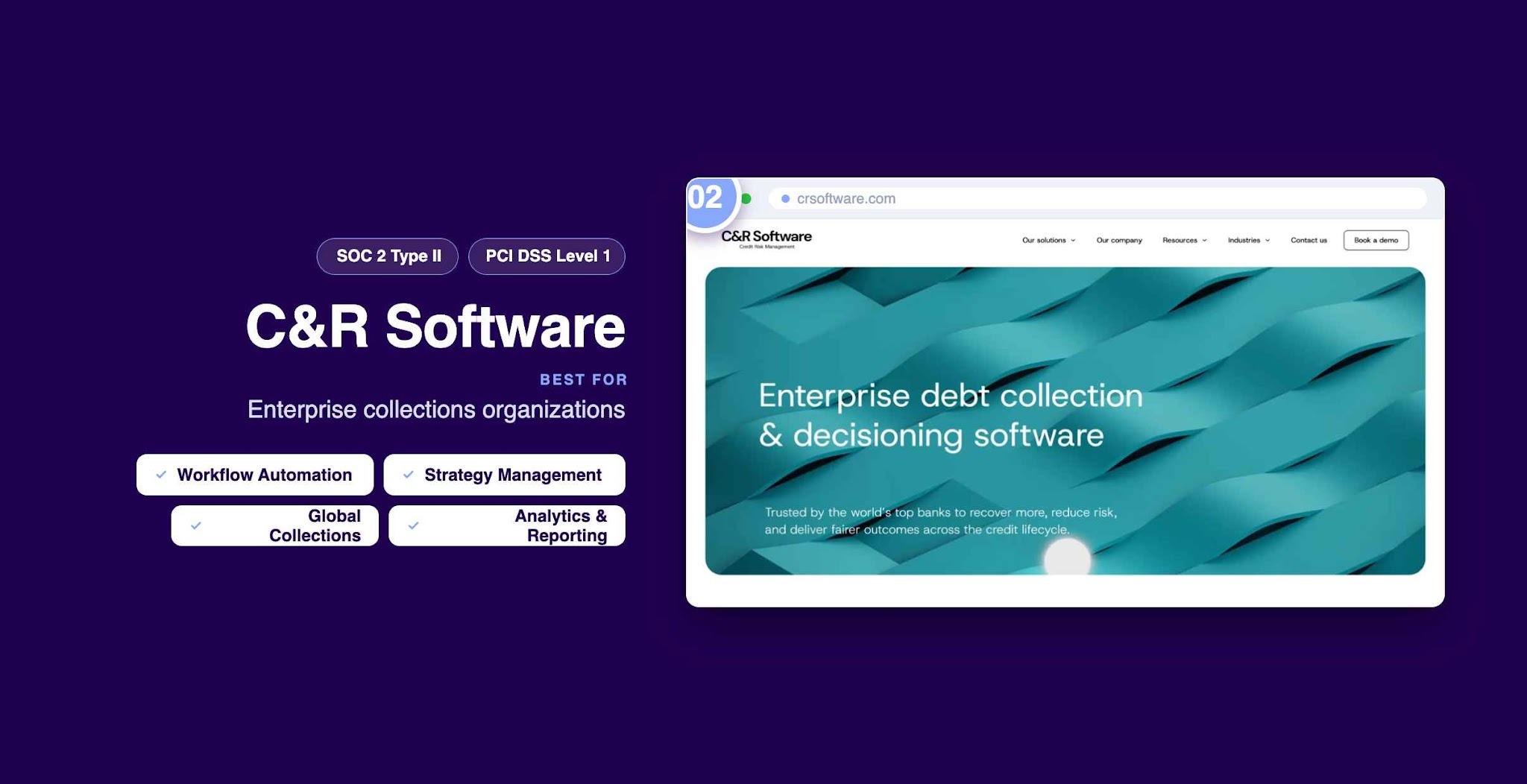
C&R Software's Debt Manager platform is known for its enterprise-grade collections and recovery capabilities. The platform serves organizations managing complex collections operations across multiple regions and business lines. Its key differentiator is the breadth of workflow orchestration and decisioning capabilities available throughout the collections lifecycle.
SOC 2 and PCI Compliant Features
SOC 2 Type II attestation
PCI DSS Level 1 compliance
Security and availability controls
Protected payment data handling
Formal compliance governance processes
Additional Features
Workflow Automation Agencies can automate account treatment strategies and operational processes. This helps reduce manual effort across large account inventories.
Strategy Management Users can build and adjust collection strategies through configurable business rules. This provides greater control over account workflows.
Global Collections Support The platform supports multi-region and multi-language operations. This makes it suitable for organizations operating across different markets.
Analytics and Reporting Performance metrics can be tracked across portfolios and workflows. Teams gain visibility into operational and recovery trends.
Scalable Architecture The platform is designed to support large-scale collection environments. Agencies can manage growing account volumes without changing systems.
Best For: Enterprise collection organizations requiring advanced workflow automation and strategy management capabilities.
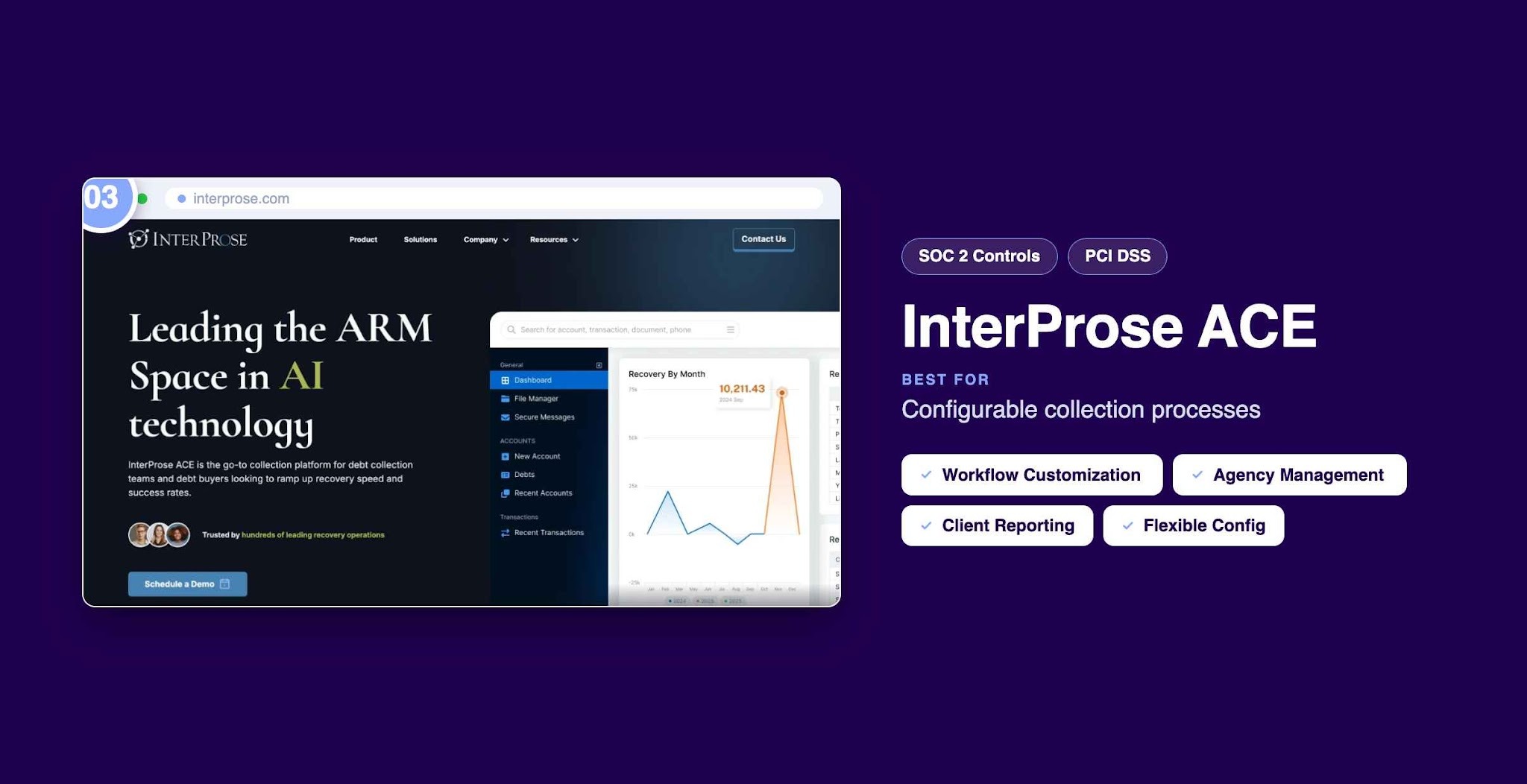
3. InterProse ACE
InterProse ACE is a long-established collection software platform built specifically for third-party agencies. The platform's primary strength is its configurability, allowing agencies to tailor workflows, account management processes, and operational rules to their business requirements. It is particularly attractive to organizations seeking extensive operational flexibility.
SOC 2 and PCI Compliant Features
SOC 2 security controls
PCI DSS compliance resources
Secure data management practices
Controlled user permissions
Audit support capabilities
Additional Features
Workflow Customization Agencies can configure workflows around their preferred collection processes. This helps align the platform with existing operations.
Agency Management Tools The platform includes functionality for account management, collector workflows, and operational oversight. Teams can manage activities from a centralized environment.
Client Reporting Agencies can provide detailed reporting to creditors and portfolio owners. This helps support transparency and accountability.
Flexible Configuration Business rules and operational settings can be adjusted without major development work. Organizations gain greater control over platform behavior.
Account Management Controls Users can manage placements, inventory movement, and account activity through structured workflows. This helps maintain consistency across operations.
Best For: Agencies that require extensive workflow customization and operational flexibility.
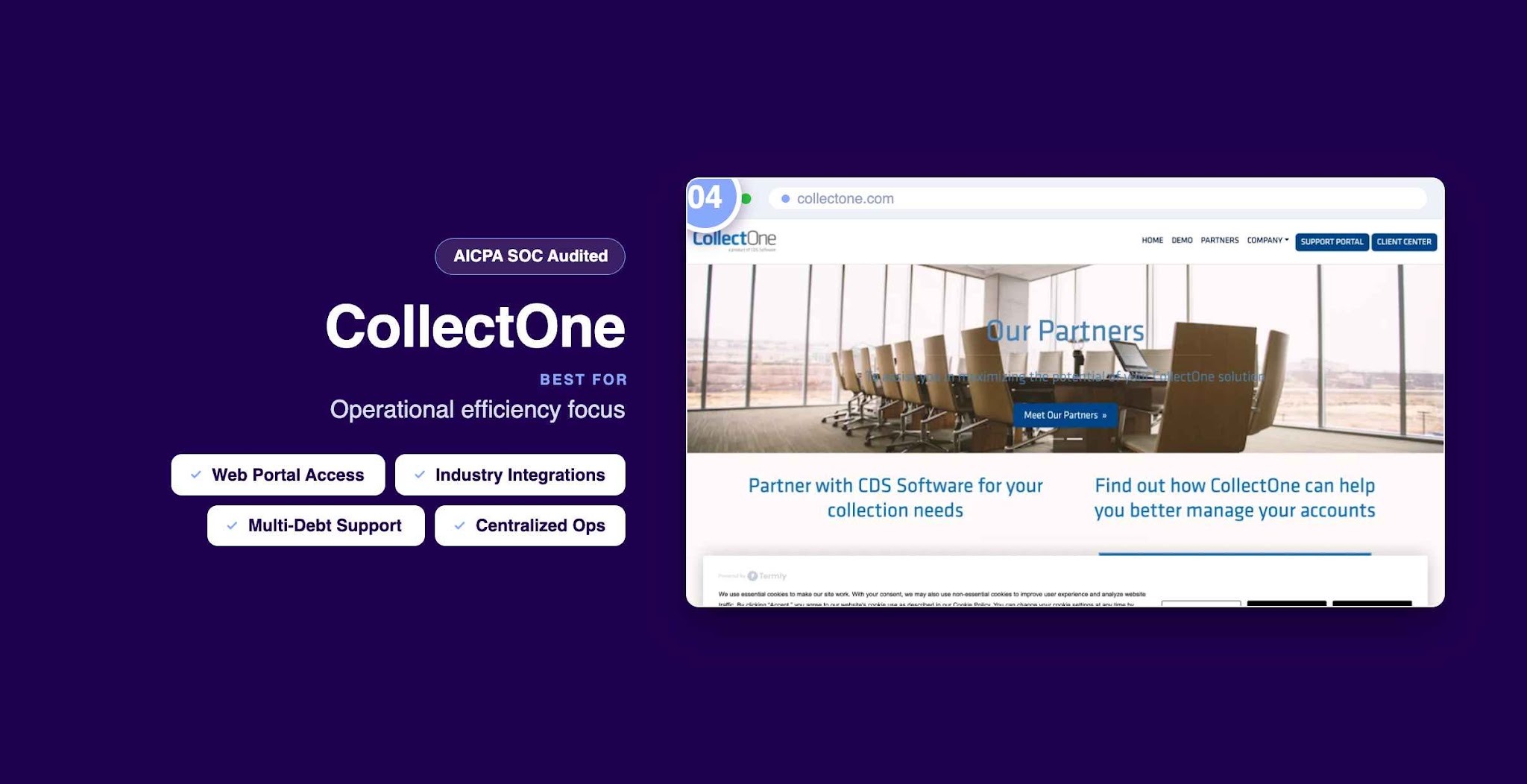
4. CollectOne
CollectOne is a collection management platform focused on productivity, automation, and operational efficiency. The platform supports multiple debt categories while providing a broad range of integrations and account management capabilities. Its key differentiator is its emphasis on centralized collection operations within a single environment.
SOC 2 and PCI Compliant Features
AICPA SOC-audited environment
Secure account management controls
Protected consumer information workflows
Controlled user access
Security-focused operational processes
Additional Features
Web Portal Access Consumers can access account information through online self-service tools. This supports digital engagement and account resolution.
Industry Integrations The platform offers connections with industry systems and service providers. Agencies can streamline operational workflows across partners.
Multi-Debt Support Organizations can manage different debt categories within a single platform. This helps reduce system fragmentation.
Collector Productivity Tools Workflow tools are designed to help staff manage accounts more efficiently. Teams can handle higher volumes with greater consistency.
Centralized Operations Collection activities can be managed from a unified platform. This helps simplify oversight and administration.
Best For: Agencies seeking an all-in-one collection management environment with strong operational efficiency tools.
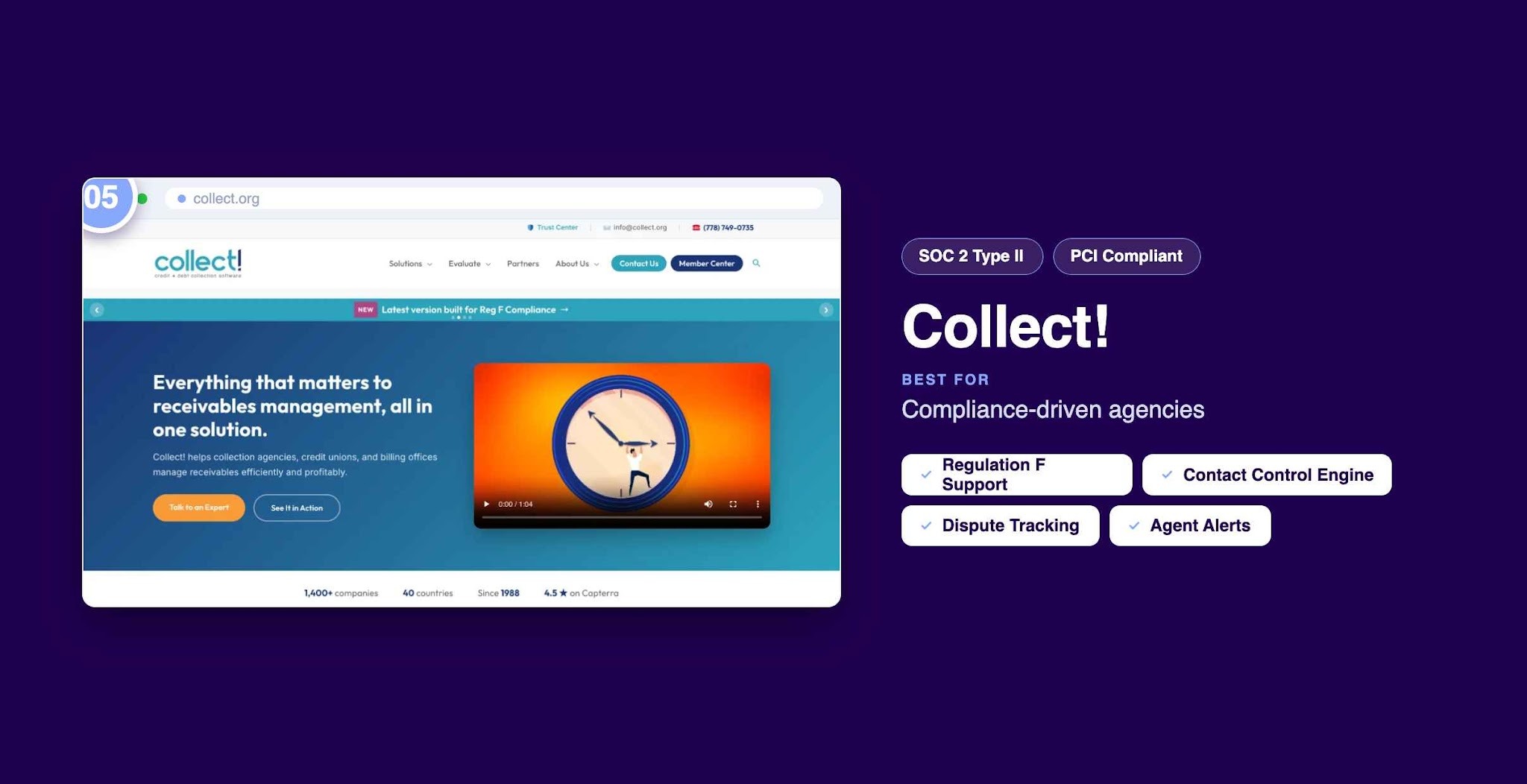
5. Collect! by Comtech Systems
Collect! is a collection software platform with a strong focus on operational control and regulatory support. The platform offers extensive functionality for agencies that need detailed account management and compliance-related workflows. Its standout differentiator is its emphasis on configurable controls and regulatory management capabilities.
SOC 2 and PCI Compliant Features
SOC 2 Type II audited environment
PCI-compliant payment ecosystem
Tokenization support
Security-focused access controls
Compliance-oriented audit capabilities
Additional Features
Regulation F Support The platform includes functionality designed to support Regulation F requirements. Agencies can manage consumer communication workflows more effectively.
Contact Control Engine Communication controls help govern outreach activity. This supports more structured engagement practices.
Dispute Tracking Teams can document and monitor dispute-related activity. This helps maintain organized account records.
Workflow Analysis Reporting tools provide visibility into operational activity. Managers can identify process improvement opportunities.
Agent Alerts Notifications help staff manage account actions and deadlines. This supports better workflow execution.
Best For: Agencies prioritizing compliance-focused workflows and communication management controls.
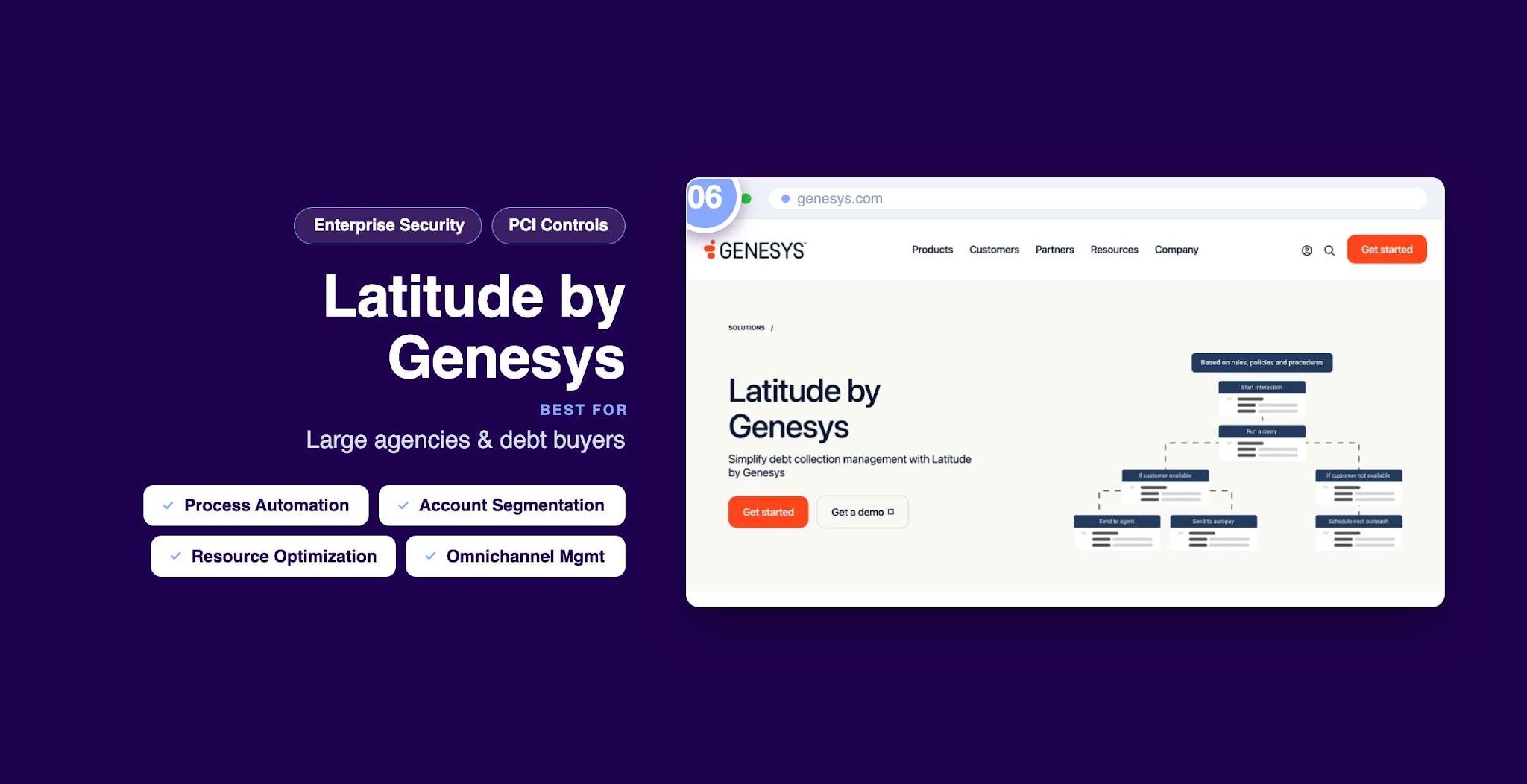
6. Latitude by Genesys
Latitude is an enterprise collections and recovery platform designed for creditors, debt buyers, and third-party collection agencies. The platform is known for its sophisticated business process automation and account treatment capabilities. Its primary differentiator is its ability to support highly structured collection strategies across complex recovery operations.
SOC 2 and PCI Compliant Features
Enterprise security controls
Secure data management practices
Protected payment workflows
User access management
Compliance-focused operational controls
Additional Features
Business Process Automation Agencies can automate account workflows and treatment strategies. This helps improve consistency across operations.
Account Segmentation Users can organize accounts based on business rules and recovery objectives. This supports more targeted collection efforts.
Resource Optimization The platform helps agencies allocate collector resources more efficiently. Teams can focus efforts on higher-priority activities.
Omnichannel Management Agencies can manage outreach across multiple communication channels. This supports coordinated consumer engagement strategies.
Operational Analytics Reporting capabilities provide insight into performance and recovery outcomes. Managers can make more informed decisions using operational data.
Best For: Larger agencies and debt buyers that require sophisticated workflow automation and account strategy management.
While each platform approaches security, compliance, and collection operations differently, the right choice ultimately depends on your agency's specific requirements.
In the next section, we will examine the key factors to consider when selecting SOC 2 and PCI-compliant debt collection software.
How to Choose SOC 2 and PCI Compliant Debt Collection Software
Compliance certifications are important, but they should not be the only factor driving a software decision. The right platform should align with your agency's operational requirements, growth plans, security expectations, and client obligations.
Ask the following questions:
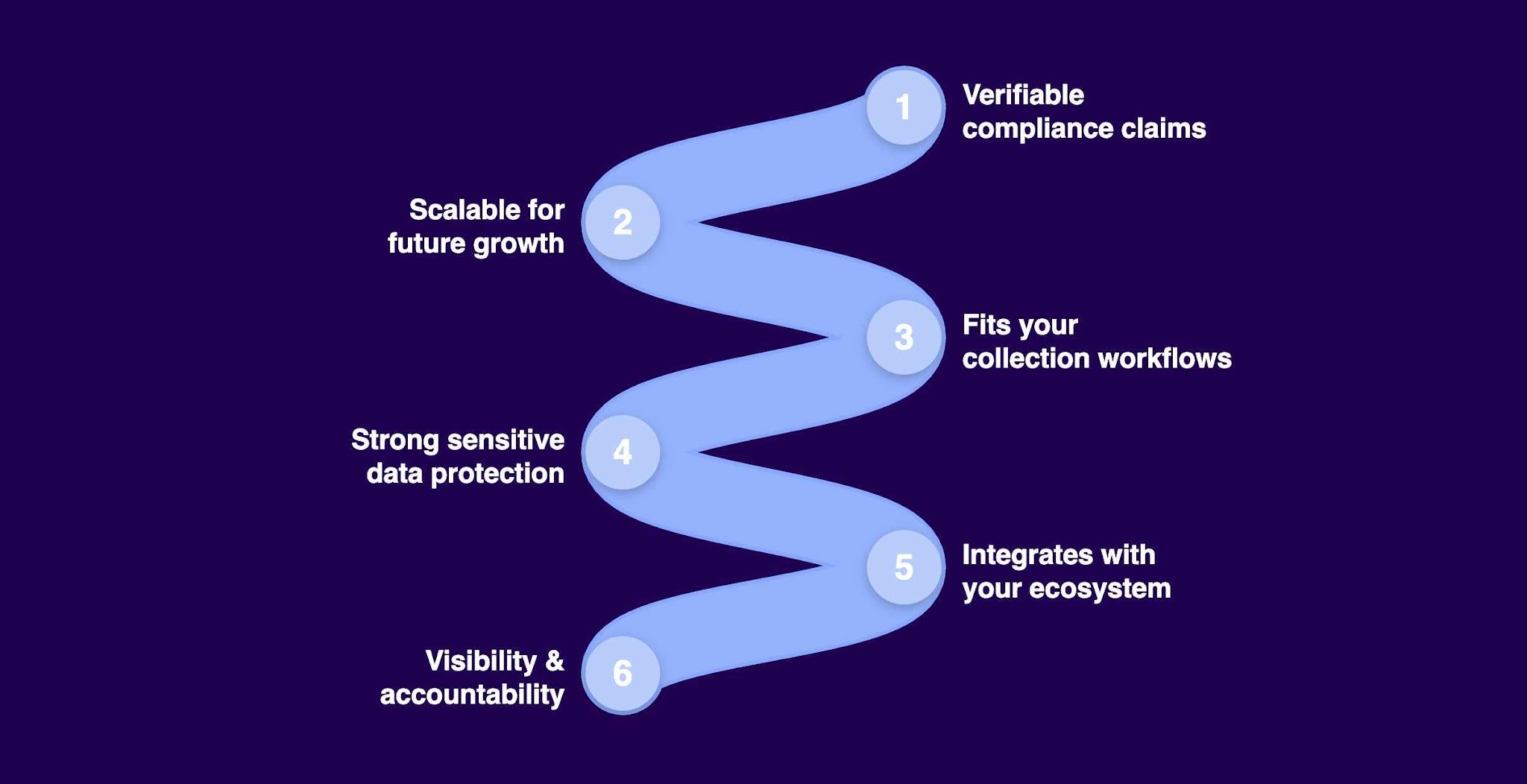
Can the provider verify its compliance claims? Security certifications should be current, documented, and available for review. Agencies should understand exactly what has been audited and how compliance is maintained over time.
Will the platform support your agency's growth? Collection software should be able to handle increasing account volumes, additional clients, and evolving operational requirements. Replacing systems because of growth limitations can be expensive and disruptive.
How well does it fit your collection workflows? Every agency operates differently. The platform should support your business processes rather than forcing your teams to adapt to rigid workflows.
How does the provider protect sensitive data? Consumer and payment information require strong security controls. Understanding how a provider approaches access management, monitoring, and data protection can help reduce risk.
Can it integrate with your existing ecosystem? Collection operations often depend on multiple systems and partners. Strong integration capabilities help reduce manual work and improve information flow across the organization.
What level of visibility and accountability does it provide? Agencies need clear insight into operational activity, user actions, and system events. Transparency becomes increasingly important during audits, client reviews, and compliance assessments.
Selecting collection software is ultimately about balancing security, compliance, and operational effectiveness. The best platform should not only protect sensitive information but also help your agency operate more efficiently as collection requirements change.
Conclusion
Choosing the wrong collection platform can create risks that extend far beyond technology. Weak security controls, limited compliance visibility, poor payment data protection, and inflexible workflows can expose agencies to operational disruptions, client concerns, and costly remediation efforts.
Tratta combines SOC 2 Type II and PCI DSS Level 1 compliance with tools designed specifically for debt collection operations. Its independently validated SOC 2 Type II and PCI DSS Level 1 controls, omnichannel engagement capabilities, consumer self-service experiences, integrated payments, and flexible workflows help agencies balance security, efficiency, and growth within a single platform.
See how Tratta can help your agency strengthen security while improving collection operations.Schedule a free demo to explore the platform and its capabilities firsthand.
Frequently Asked Questions
1. What is SOC 2 debt collection software?
SOC 2 debt collection software refers to collection platforms that have undergone an independent audit of their controls related to security, availability, processing integrity, confidentiality, and privacy. These assessments help agencies evaluate how providers protect sensitive consumer and operational data.
2. Why should agencies consider debt collection software PCI and SOC 2 compliant?
Debt collection software, PCI and SOC 2 compliant solutions, help agencies address both payment security and broader data protection requirements. Together, these frameworks provide greater assurance around payment processing, system controls, and information security practices.
3. What should I look for in SOC 2 Type 2 debt collection software?
When evaluating SOC 2 Type 2 debt collection software, look beyond the certification itself and review how the platform supports security, compliance, integrations, scalability, and collection workflows. Type II reports assess how controls operate over time rather than at a single point.
4. How does SOC 2 audit-ready debt collection software help agencies?
SOC 2 audit-ready debt collection software typically includes controls, documentation, monitoring practices, and operational processes designed to support ongoing security governance. This can make it easier to respond to client reviews, compliance assessments, and security questionnaires.
5. What are the benefits of a SOC 2-compliant debt collection cloud platform?
A SOC 2 compliant debt collection cloud platform can help agencies strengthen data protection while supporting remote access, scalability, system availability, and operational flexibility. Many agencies also view SOC 2 compliance as an important factor when evaluating technology partners and vendors.
Note: This information is not legal advice. Tratta recommends that you consult with your legal counsel to make sure that you comply with applicable laws in connection with your collection and outreach activities.
Sign up for our monthly newsletter
Debt collection insights that keep you compliant and competitive.
Thank you! Your submission has been received!
Oops! Something went wrong while submitting the form.