Collection agencies increasingly rely on IVR systems to support self-service payments, account servicing, and inbound payment interactions. However, every IVR interaction can introduce security, compliance, and consumer data protection risks if proper controls are not in place.
As payment workflows become more digital, protecting sensitive account and payment information becomes even more critical. The booming business IVR system market is projected to grow at a CAGR of 12% through 2033, highlighting the growing reliance on automated voice infrastructure.
In this article, we explore IVR security risks, compliance requirements, best practices, and security features that collection agencies should prioritize in 2026.
In brief:
Interactive Voice Response is an automated telephony technology that allows consumers to interact with a collection system using voice commands or keypad inputs.
Interactive voice response (IVR) is an automated phone system that allows your customers to choose from voice menu options and interact using voice and number pads.
- AWS
Collection agencies use IVR systems to automate payment processing, account servicing, authentication workflows, call routing, and consumer communications across recovery operations.
IVR systems can support both inbound and outbound collection activities. They help agencies handle routine interactions more efficiently while reducing manual workload across servicing and recovery teams.
How IVR works in debt collection:
As IVR systems become more integrated with payments, account servicing, and consumer communications, they also become a critical part of an agency's security posture. In the next section, we examine why IVR security should be a priority for modern collection operations.
Suggested Read: 8 Ways to Avoid Violations with a Debt Collection IVR FDCPA Compliant Setup

Inbound IVR systems handle sensitive consumer information, payment credentials, account balances, and authentication data. As collection agencies expand self-service payment capabilities, IVR security becomes critical for protecting consumer data, maintaining compliance, and reducing operational risk.
Key concerns include:
As inbound IVR environments become more connected to payment systems and consumer servicing workflows, security risks continue evolving. In the next section, we examine the most common IVR security risks facing third-party collection agencies and the controls used to mitigate them.
Suggested Read: Advanced IVR Systems for Debt Collection: Complete Guide
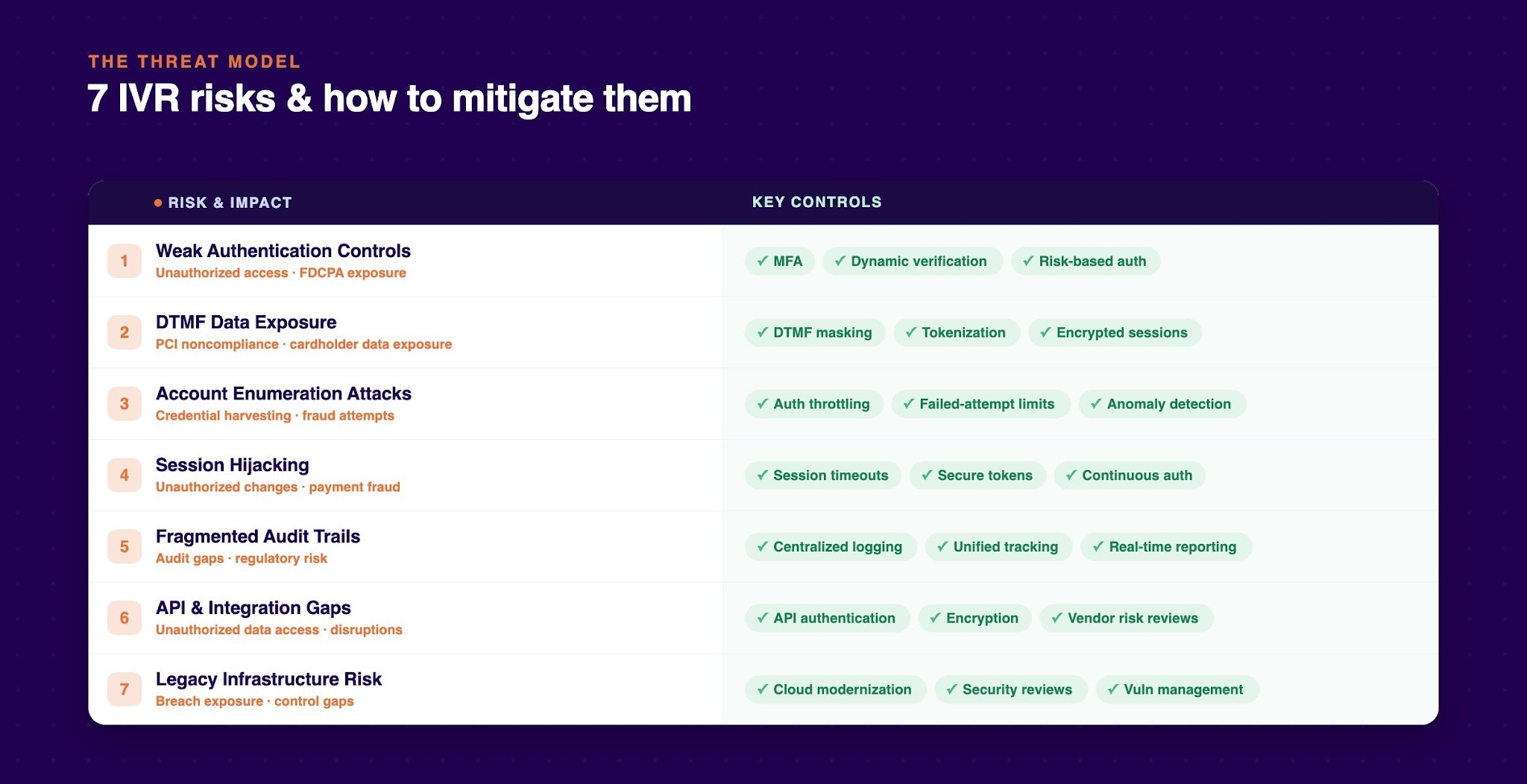
Inbound IVR systems sit at the intersection of consumer authentication, payment processing, and account servicing. While they improve scalability and self-service adoption, they also introduce security, compliance, and operational risks that collection agencies must actively manage.
These are explained in more detail below:
Authentication failures remain one of the most significant risks in inbound collections. Poor identity verification can expose protected account information and increase third-party disclosure risk.
Impact on collection operations:
Mitigation strategies:
Unsecured DTMF tones can expose payment card information during self-service payment transactions. Threat actors may exploit weaknesses in legacy payment environments.
Impact on collection operations:
Mitigation strategies:
Attackers may use IVR systems to validate account information through repeated authentication attempts. This technique is often used before broader fraud activity.
Impact on collection operations:
Mitigation strategies:
Compromised IVR sessions can allow unauthorized users to access account information or payment workflows. The risk increases in poorly secured servicing environments.
Impact on collection operations:
Mitigation strategies:
Disconnected systems often create gaps in payment, servicing, and communication records. Missing audit data can weaken compliance oversight.
Impact on collection operations:
Mitigation strategies:
Tratta helps reduce audit-trail fragmentation by centralizing consumer communications, payment activity, and servicing records within a single environment. Centralized reporting also makes it easier to investigate account activity throughout the recovery lifecycle. Schedule a demo today.
Modern IVR platforms exchange data across payment processors, CRMs, and servicing systems. Weak integration security can expand the attack surface.
Impact on collection operations:
Mitigation strategies:
Older IVR environments often lack modern security architecture and monitoring capabilities. Legacy systems can become compliance and cybersecurity liabilities.
Impact on collection operations:
Mitigation strategies:
Managing these risks requires balancing security, compliance, consumer privacy, and operational efficiency. In the next section, we examine both the advantages and limitations of inbound IVR systems within modern collection operations.
Suggested Read: The IVR Payment Gap: What Most Debt Collectors Are Missing in 2026
Inbound IVR systems help agencies manage payment servicing, account inquiries, authentication workflows, and consumer interactions at scale. However, maximizing the value of IVR technology requires balancing operational efficiency with security, compliance, and consumer experience considerations.

Pros and cons include:
Not every IVR challenge stems from technical vulnerabilities. Many security gaps develop through weak governance, inconsistent monitoring, and outdated operational practices.
Collection agencies can strengthen their inbound IVR environment by focusing on the following areas:
Tratta helps agencies manage inbound payment servicing through a secure and centralized IVR environment. Its platform combines payment workflows, communication tracking, reporting visibility, and consumer self-service capabilities within a single collections ecosystem. Call us to learn more.
Inbound IVR systems now support a wide range of servicing, payment, and authentication workflows across collection operations. Advanced IVR environments help agencies reduce servicing friction, improve payment accessibility, strengthen security controls, and scale account resolution activity without increasing operational complexity.
These are popular uses for IVR in debt collection:
Inbound IVR systems allow consumers to complete payment transactions through automated servicing workflows. This reduces live-agent dependency while supporting PCI-conscious payment handling.
Common use cases include:
Authentication workflows help protect account information before servicing activity begins. Strong verification controls also reduce third-party disclosure exposure.
Organizations often use IVR for:
Collection agencies often support consumers across multiple languages and regions. Multilingual IVR environments improve accessibility during inbound account resolution workflows.
Typical applications include:
The effectiveness of inbound IVR infrastructure depends on how it is integrated into broader servicing and payment workflows. As inbound servicing environments become more dependent on self-service infrastructure, IVR security becomes increasingly important across payment and account-resolution workflows.
Weak IVR security controls can expose collection agencies to payment fraud, unauthorized account access, compliance violations, and consumer data risks. As inbound servicing and self-service payment adoption continue growing, outdated security practices can create operational and regulatory challenges that are difficult to manage at scale.
Tratta helps collection agencies strengthen IVR security through secure self-service payment infrastructure, consumer authentication controls, centralized reporting, and compliance-focused servicing workflows. Its platform combines payment accessibility, operational visibility, and digital account resolution features.
Explore how Tratta supports secure self-service payment workflows for collection operations. Schedule a free demo.
An IVR system can support PCI DSS compliance when it uses appropriate security controls such as DTMF masking, encryption, tokenization, and secure payment processing infrastructure. Compliance depends on how the system is configured and managed.
DTMF masking prevents sensitive keypad entries, such as card numbers, from being exposed during payment transactions. It helps protect payment data from agents, recordings, and unauthorized access.
Most organizations conduct security reviews at least annually. Higher-risk environments may require more frequent assessments, vulnerability testing, and configuration audits.
Yes. Modern IVR environments can integrate SMS verification, one-time passcodes, and other authentication methods to strengthen account protection during inbound servicing interactions.
Important metrics include authentication failure rates, payment completion rates, fraud incidents, unauthorized access attempts, IVR containment rates, and security-related consumer complaints.