Are your collection professionals spending more time juggling fragmented systems than actually recovering debt?
For agencies, multiple tools, manual follow-ups, and unclear reporting can make even skilled team members less efficient. In an industry where over 70 million adults in the U.S. have debt in collections and average agency recovery rates often sit around 20–30%, every interaction can affect agency performance and profitability.
Without the right support, valuable payment opportunities may be missed, and agent productivity can suffer. This blog explores the importance of collection professionals in debt recovery, the challenges they face, and how agencies can support their teams in improving workflows, consumer engagement, and overall performance.
Collection professionals are the experts who manage overdue accounts, communicate with consumers, and execute recovery strategies. They combine operational knowledge, negotiation skills, and compliance awareness to ensure debt is recovered efficiently while maintaining professional standards.
For agency leaders, such as owners, collection professionals are the backbone of daily recovery operations. Their efficiency, decision-making, and ability to handle high volumes of accounts directly impact agency performance, reporting clarity, and the success of scaling outreach and payment efforts.
Once the role is clear, the next step is understanding the skills that help collection professionals manage accounts with accuracy, confidence, and consistency.
Also Read: Average Collection Period Calculator
Collection professionals need more than persistence to manage overdue accounts effectively. For collection agencies, the right skills can improve debtor communication, agent efficiency, reporting accuracy, and payment outcomes.
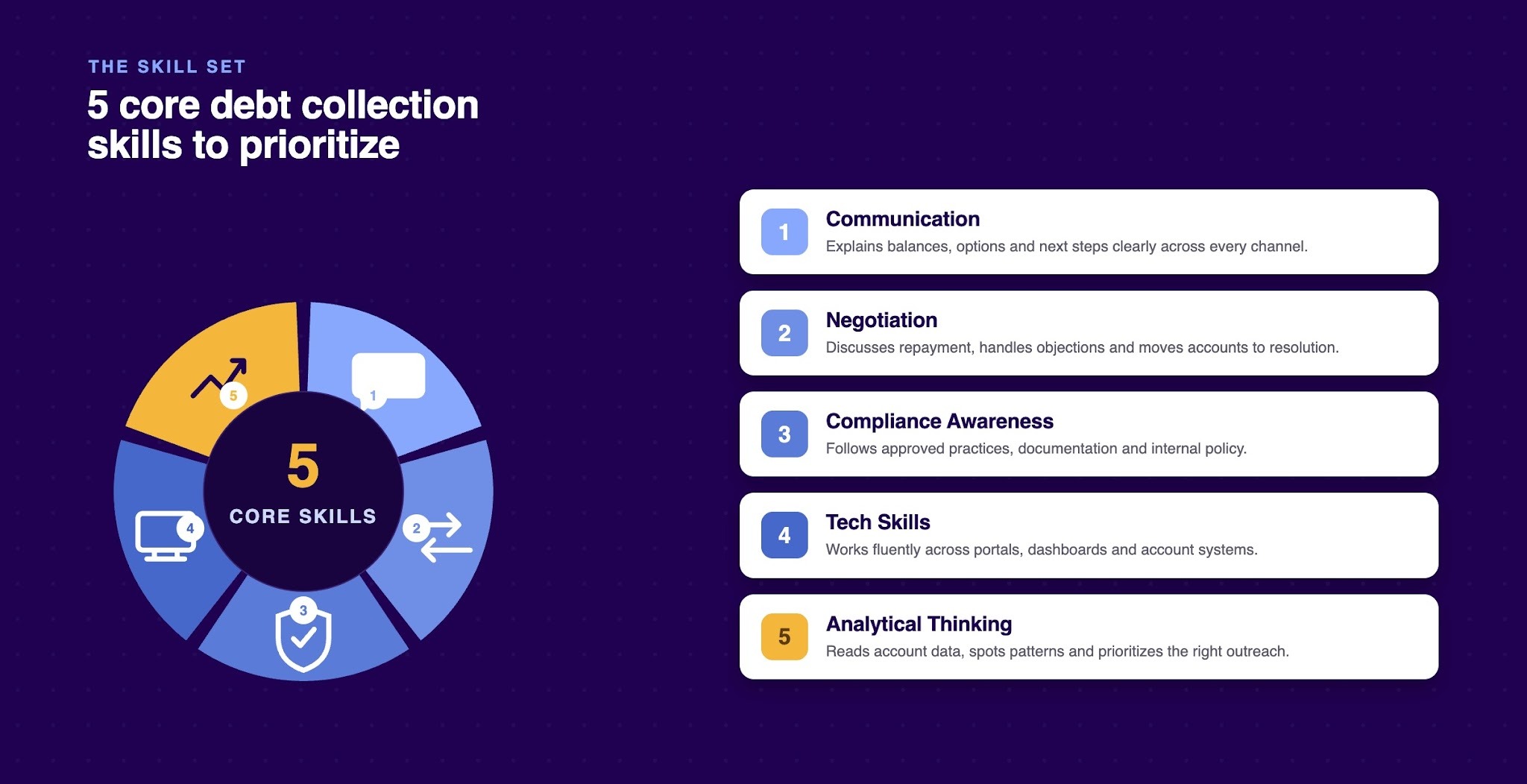
Here are five core debt collection skills agencies should prioritize:
1. Communication: Clear communication helps collection professionals explain balances, payment options, and next steps without confusion. It also supports more professional interactions with debtors across calls, emails, letters, and digital channels.
2. Negotiation: Strong negotiation skills help agents discuss repayment options, handle objections, and move accounts toward resolution. This is especially important when debtors are willing to pay but need a workable arrangement.
3. Compliance Awareness: Collection professionals should understand approved communication practices, documentation needs, and internal policies. This helps agencies maintain more consistent and controlled workflows in a compliance-sensitive environment.
4. Tech Skills: Modern collection work depends on payment portals, reporting dashboards, account systems, and communication tools. Agents who can use these tools well spend less time switching systems and more time managing accounts.
So, how do these tools support daily recovery work?
Tratta brings payments, digital outreach, reporting, integrations, and flexible workflows into one debt collection platform. This helps reduce disconnected processes, improve visibility, and give agents better support as they manage overdue accounts.
5. Analytical Thinking: Agents need to read account data, spot payment patterns, and prioritize outreach. This helps agencies focus time and resources on accounts that need the right follow-up at the right time.
Next, let's explore the responsibilities of collection professionals.
Collection professionals manage overdue accounts, contact debtors, discuss repayment options, resolve account questions, and help move past-due balances toward payment. For debt collection agencies, their role is not limited to reaching out to debtors; they also help keep recovery workflows organized, documented, and aligned with internal processes.
Here are the key responsibilities collection professionals handle in day-to-day agency operations:
When these professionals have clear workflows, reliable account data, and easy payment options, they can spend less time dealing with manual friction and more time moving accounts toward resolution.
Their daily responsibilities may seem operational, but their importance reaches across recovery performance, cash flow, compliance-sensitive workflows, and agency efficiency.
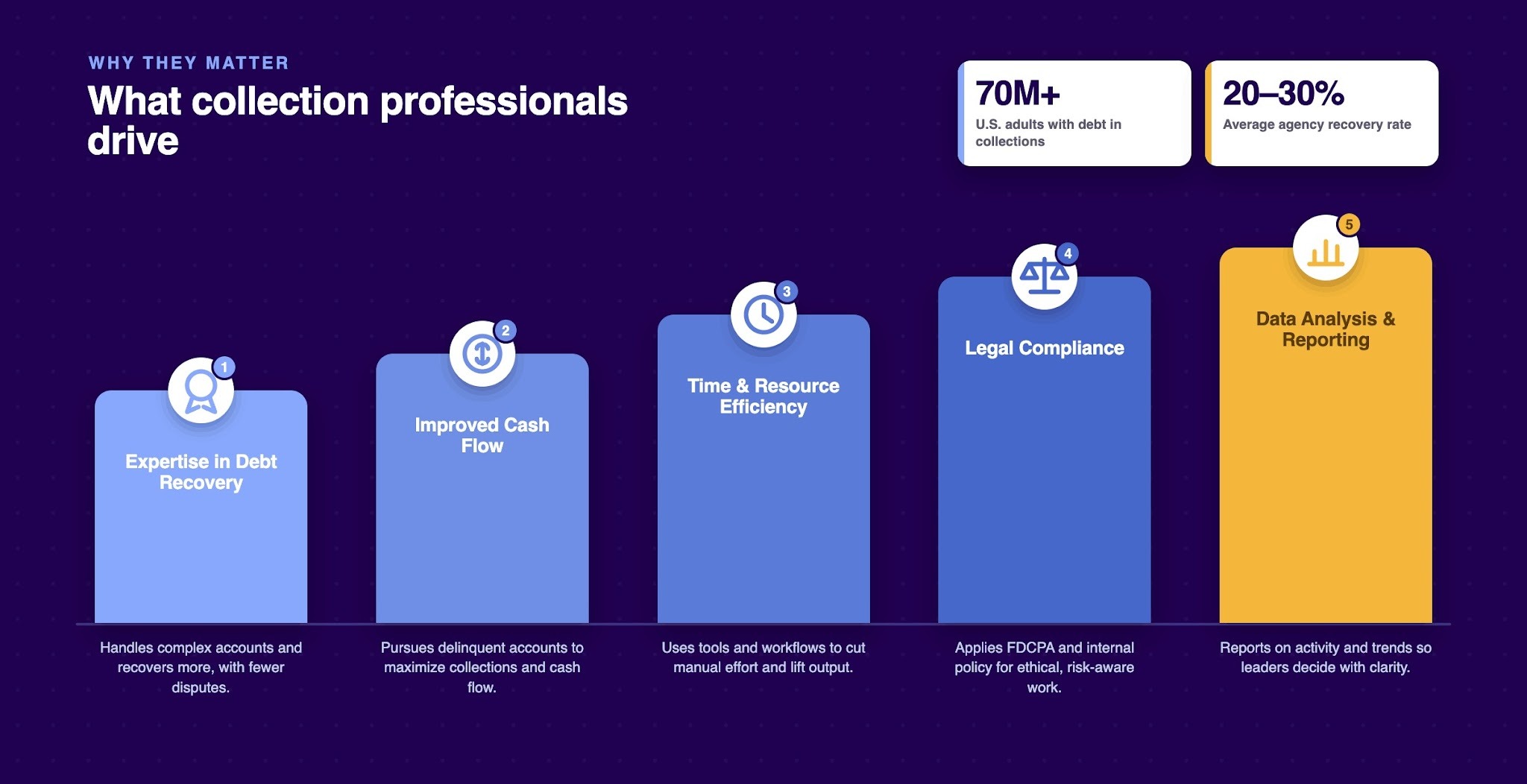
Collection professionals are essential to the success of debt recovery, ensuring overdue accounts are managed efficiently while supporting compliance, reporting, and operational performance.
Here are the key reasons why collection professionals are critical:
But how can agencies make reporting easier when data is spread across different systems?
Tratta’s Reporting and Analytics tools provide real-time dashboards, custom reports, data exports, payment plan and schedule analytics, settlement offer engagement, email and SMS channel metrics, and consumer journey analytics. This helps collection leaders track performance, identify trends, and make more informed recovery decisions without relying only on spreadsheets or disconnected reports.
Because debt recovery varies across portfolios, let's explore various types of debt collection professionals.
Collection professionals may specialize in different portfolios or industries, but their core goal remains helping agencies recover overdue balances efficiently and professionally. For debt collection agencies, understanding these types ensures the right expertise is applied to each account.
Here are the types of collection professionals that agencies commonly work with:
After understanding the different types of collection professionals, it is also important to consider tips that help them perform well in their daily recovery work.
Also Read: Solve Low Recovery with Omnichannel Debt Collection for Healthcare
Successful collection professionals combine account knowledge, clear communication, data skills, and compliance awareness. For debt collection agencies, these habits help agents work more efficiently, improve reporting visibility, and move accounts toward resolution with less manual friction.
Here are practical tips that can help collection professionals perform better in daily recovery workflows:
Review account history, balance details, payment activity, and prior communication before contacting a debtor. This helps agents understand the situation and choose the right approach instead of using the same message for every account.
Clear goals help collection professionals stay focused and measure progress. Agencies should set targets based on account type, age of debt, payment behavior, and available debtor information, rather than using a single fixed goal for every portfolio.
A strong strategy helps agents decide when to call, when to send written communication, when to offer payment options, and when to escalate an account. This supports more consistent outreach and helps agencies reduce scattered, manual follow-ups.
Collection professionals should understand applicable debt collection rules, approved communication practices, and the agency’s internal policies. This helps support more controlled workflows in a compliance-sensitive environment.
Reports should track account status, payment activity, outreach attempts, disputes, and results. Accurate reporting helps owners, COOs, and operations leaders see what is working, which accounts need attention, and where workflow gaps exist.
Not every overdue account has the same barrier. Some debtors may have disputes, missed notices, payment confusion, or financial hardship. Strong problem-solving helps agents adjust the next step while staying within the agency’s approved process.
Modern collection work depends on account systems, payment tools, reporting dashboards, and digital communication channels. Agents who use these tools effectively can reduce manual work, track debtor engagement, and provide leaders with better operational visibility.
Collection professionals should know how payment schedules, account updates, refunds, and balance adjustments work. This helps reduce errors, improve payment processing, and keep recovery workflows moving smoothly.
Even skilled professionals can struggle when outdated systems, high account volumes, and unclear payment workflows slow down their work.
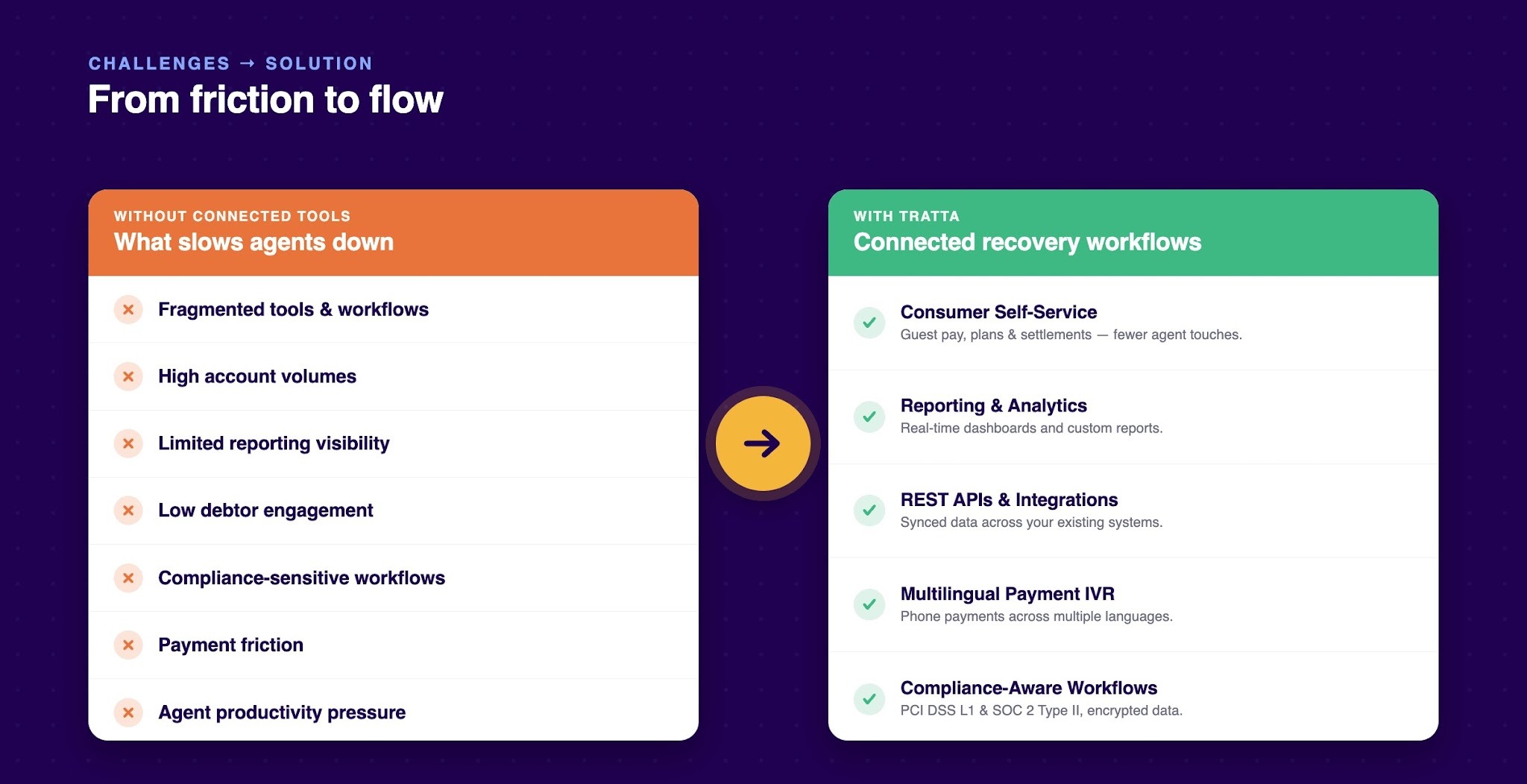
Collection professionals work under pressure to recover overdue balances while managing high account volumes, complex workflows, and strict process requirements. These challenges can affect agent efficiency, payment activity, reporting visibility, and overall recovery performance.
Here are the common challenges collection professionals face in daily debt recovery operations:
To reduce these challenges, agencies need tools that enable clearer data, easier payment options, and more connected workflows.
Collection professionals often waste time when account data, payment activity, reporting, and communication workflows are spread across separate systems. This can create manual work, limited visibility, and delayed follow-ups.
Tratta is debt collection software built for agencies, law firms, credit issuers, and debt buyers. It brings key recovery functions into a single platform, enabling collection teams to manage payments, reporting, integrations, and compliance-aware workflows with greater control.
Here’s how Tratta supports debt recovery for collection professionals:
Our Consumer Self-Service Platform gives consumers a secure, mobile-friendly way to access account information and make payments independently. It supports features such as guest payment options, flexible payment plans, settlement offers, payment history, document access, and notification preferences.
This can reduce direct agent intervention and give collection professionals more time to focus on accounts that need personal attention.
Our reporting and analytics tools offer real-time visibility into performance, engagement, payment trends, and outreach activity.
Its dashboards and custom reporting features help collection leaders track what is working, review account activity, and make more informed operational decisions without relying only on spreadsheets or disconnected reports.
Tratta supports REST APIs, webhooks, and debt-collection integrations that connect to existing systems and internal tools.
For collection professionals, this helps keep data synced across workflows, reduces manual updates, and supports more accurate account handling.
Our multilingual payment IVR helps agencies support consumers through phone-based payment options. It includes multi-language support, real-time account updates, SMS-enabled access, and cross-channel tracking.
For collection professionals, this can reduce call burden while giving debtors another way to make payments.
Our security and compliance features support debt collection teams working in a sensitive regulatory environment. The platform includes security standards such as PCI DSS Level 1 and SOC 2 Type II, and encrypted and monitored payment data. This helps agencies maintain more controlled payment and data workflows.
Collection professionals play a critical role in debt recovery because they connect strategy, communication, payment handling, reporting, and compliance-aware processes. Their work directly affects how overdue accounts are prioritized, how debtors are engaged, and how efficiently payments are resolved. With the right skills, clear workflows, and accurate account data, these professionals can reduce manual friction and support stronger agency performance.
Tratta supports this by bringing key debt recovery functions into a single platform for collection agencies. Our platform is built to replace disjointed tools with consumer self-service payments, reporting and analytics, integrations, multilingual payment IVR, and compliance-aware workflows, helping agencies improve account coverage and give collection teams better operational control.
If your team is ready to reduce fragmented workflows and support agents with better tools, schedule your demo today!
Collection professionals are important because they manage the daily work of recovering overdue balances. They help agencies contact debtors, discuss payment options, document account activity, and keep recovery workflows moving.
They support better debt recovery by prioritizing accounts, contacting debtors at the right time, explaining repayment options, and tracking every step of the recovery process. Their work helps agencies reduce delays and move accounts toward resolution.
Training helps collection professionals handle difficult conversations, follow approved workflows, use collection software correctly, and maintain accurate records. This can improve agent efficiency and support more consistent recovery operations.
They update account notes, payment activity, dispute details, and outreach results. Accurate updates give agency owners, COOs, and operations leaders a clearer view of account status, agent performance, and recovery trends.
Modern debt recovery depends on account systems, payment portals, dashboards, IVR tools, and digital communication channels. Technical skills help agents reduce manual work, avoid switching systems, and manage accounts more efficiently.