9 Strategies for Reducing the Cost of Collection in 2026
Industry & Trends
9 Strategies for Reducing the Cost of Collection in 2026
Published on:
August 3, 2026
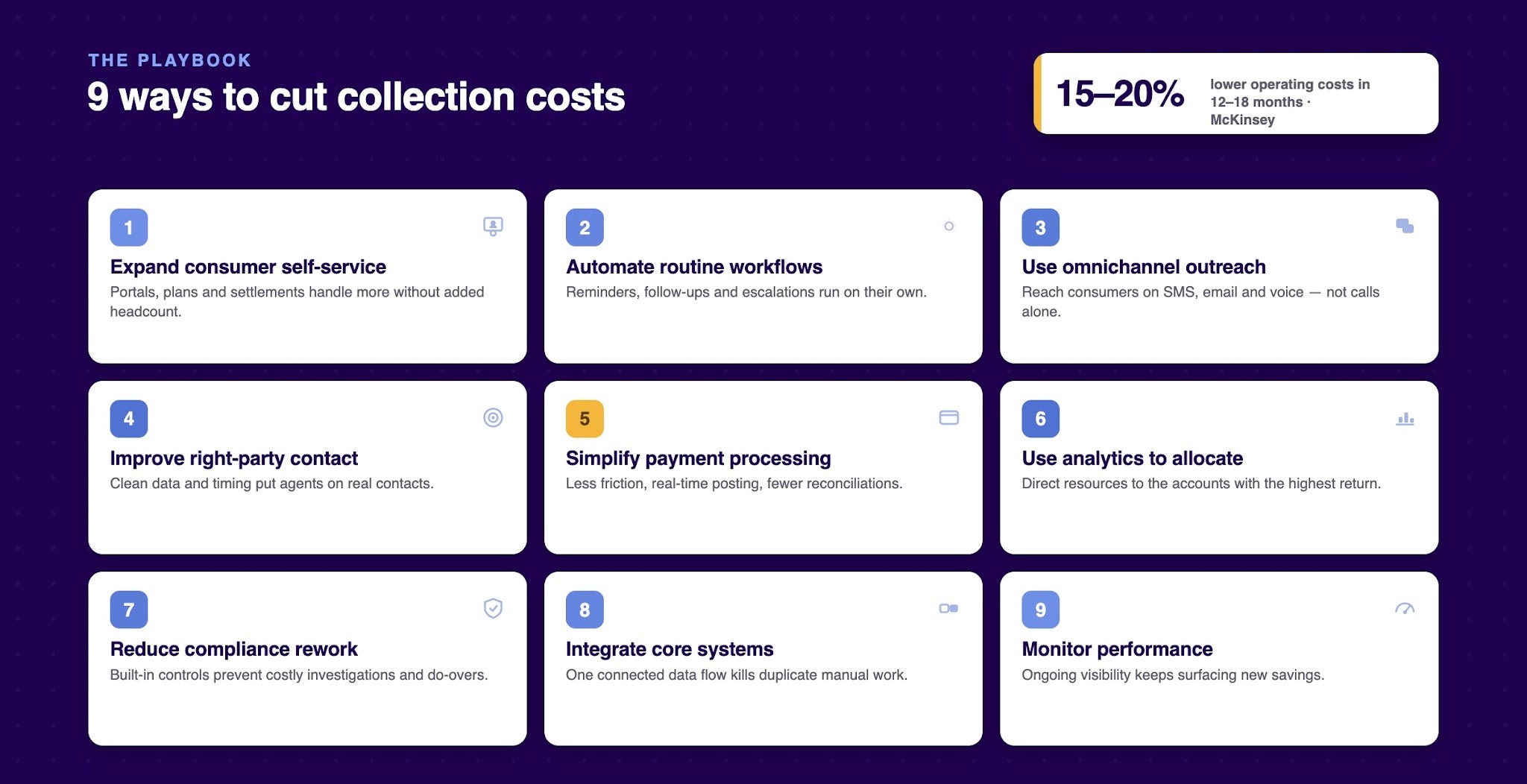
Collection costs can quietly erode recovery performance and agency profitability. Rising labor expenses, compliance demands, and manual processes make the challenge even harder. According to McKinsey, technology-enabled automation can reduce operating costs by 15% to 20% within 12 to 18 months.
Debt collection agencies know they need greater efficiency, but many struggle to identify where costs originate. The good news is that meaningful savings do not always require major operational changes. This guide explores 9 practical strategies for reducing the cost of collection while maintaining compliance, consumer experience, and recovery outcomes.
Brief look:
Collection costs increase when agencies depend on manual processes, disconnected systems, inefficient outreach, and limited self-service options.
Nine cost-reduction strategies include self-service tools, automation, omnichannel outreach, better contact rates, streamlined payments, analytics, compliance controls, system integrations, and performance monitoring.
Bad debt prevention requires stronger placement data, better account prioritization, effective segmentation, early risk identification, and optimized account routing.
Key performance metrics include cost per dollar collected, cost per account worked, recovery rate, right-party contact rate, and payment conversion rate.
Long-term efficiency depends on continuously improving workflows, consumer engagement, resource allocation, and operational visibility.
What Drives Collection Costs in Third-Party Debt Collection?
Many agencies focus on recovery rates when assessing performance. However, collection costs can have an equally significant impact on profitability. Understanding where those costs originate is the first step toward reducing them.
High Contact Volumes: Reaching consumers through phone calls alone can increase labor, telecom, and operational expenses.
Compliance Management: Monitoring communication rules, disclosures, and audit requirements often requires additional resources.
Payment Processing Inefficiencies: Failed payments, reconciliation issues, and disconnected systems create extra administrative work.
Disconnected Technology Systems: Teams spend more time moving data between platforms when systems do not communicate effectively.
While some costs are unavoidable, many can be reduced through process improvements and technology investments. In the next section, we will explore nine practical strategies that can help agencies lower collection costs while improving operational efficiency.
9 Practical Ways to Reduce Collection Costs Without Sacrificing Recovery Performance
Reducing the cost of collection requires more than cutting expenses. The most effective agencies focus on improving efficiency across the entire collections lifecycle.
These are the top strategies to cut costs while improving recovery rates:
1. Expand Consumer Self-Service Options
Many consumers prefer resolving accounts independently. Self-service tools reduce the need for agent involvement and make account resolution more convenient. They also allow agencies to handle higher volumes without increasing headcount.
McKinsey's 2024 Digital Payments Survey found that 92% of U.S. consumers used some form of digital payment during the past year.
Consider investing in:
Online payment portals
Self-service payment plans
Digital settlement acceptance
Account management tools
Mobile-friendly payment experiences
Tratta helps agencies expand self-service capabilities through a consumer payment portal that supports payments, payment plans, settlements, disputes, and document uploads. Consumers can manage accounts independently from any device, reducing reliance on agent-assisted interactions. Schedule a free demo today.
2. Automate Routine Collection Workflows
Manual processes often consume valuable staff time. Automation helps agencies complete repetitive tasks consistently and at scale. It also reduces the risk of human error.
Common opportunities include:
Payment reminders
Follow-up communications
Account segmentation
Payment scheduling
Workflow triggers and escalations
3. Use Omnichannel Communication Strategies
Consumers respond differently to various communication channels. Relying on phone calls alone can increase outreach costs and limit engagement. Omnichannel strategies help agencies connect more efficiently.
Focus on channels such as:
SMS messaging
Email campaigns
Voice outreach
Self-service portals
Two-way digital communications
4. Improve Right-Party Contact Rates
Unsuccessful contact attempts increase costs without generating results. Better account data and targeted outreach improve contact efficiency. This allows agents to spend time on higher-value interactions.
Key tactics include:
Data validation
Contact preference management
Account segmentation
Behavioral targeting
Optimized outreach timing
5. Simplify Payment Processing
Payment friction can increase administrative costs and reduce recoveries. Simplifying the payment experience encourages faster account resolution. Efficient payment operations also reduce reconciliation workloads.
Areas to optimize include:
Payment acceptance channels
Payment plan management
Real-time payment posting
Failed payment monitoring
Reconciliation workflows
6. Use Analytics for Resource Allocation
Not all accounts require the same collection strategy. Analytics help agencies identify where resources generate the greatest return. Better visibility supports more informed decision-making.
Useful insights include:
Channel performance
Consumer engagement trends
Settlement acceptance rates
Payment plan performance
Recovery outcomes by segment
7. Reduce Compliance-Related Rework
Compliance mistakes often create avoidable expenses. Investigations, disputes, and corrective actions can quickly increase operating costs. Strong controls help agencies prevent issues before they occur.
Important measures include:
Communication controls
Audit trails
Consent tracking
State-specific disclosures
Policy enforcement workflows
8. Integrate Core Collection Systems
Disconnected systems often lead to duplicate work. Staff may spend unnecessary time transferring or validating data. Integrated platforms improve operational efficiency and data accuracy.
Integration priorities include:
Collection software
Payment platforms
CRM systems
Reporting tools
Communication platforms
9. Monitor Performance Continuously
Cost reduction is not a one-time project. Agencies need ongoing visibility into operational performance and collection outcomes. Regular monitoring helps identify new improvement opportunities.
Track metrics such as:
Cost per account
Cost per dollar collected
Recovery rates
Payment conversion rates
Agent productivity
Reducing collection costs is only part of the equation. Agencies must also understand whether their efficiency initiatives are delivering measurable results. In the next section, we will examine the key metrics that help track collection cost performance.
Key Metrics for Measuring Collection Cost Efficiency
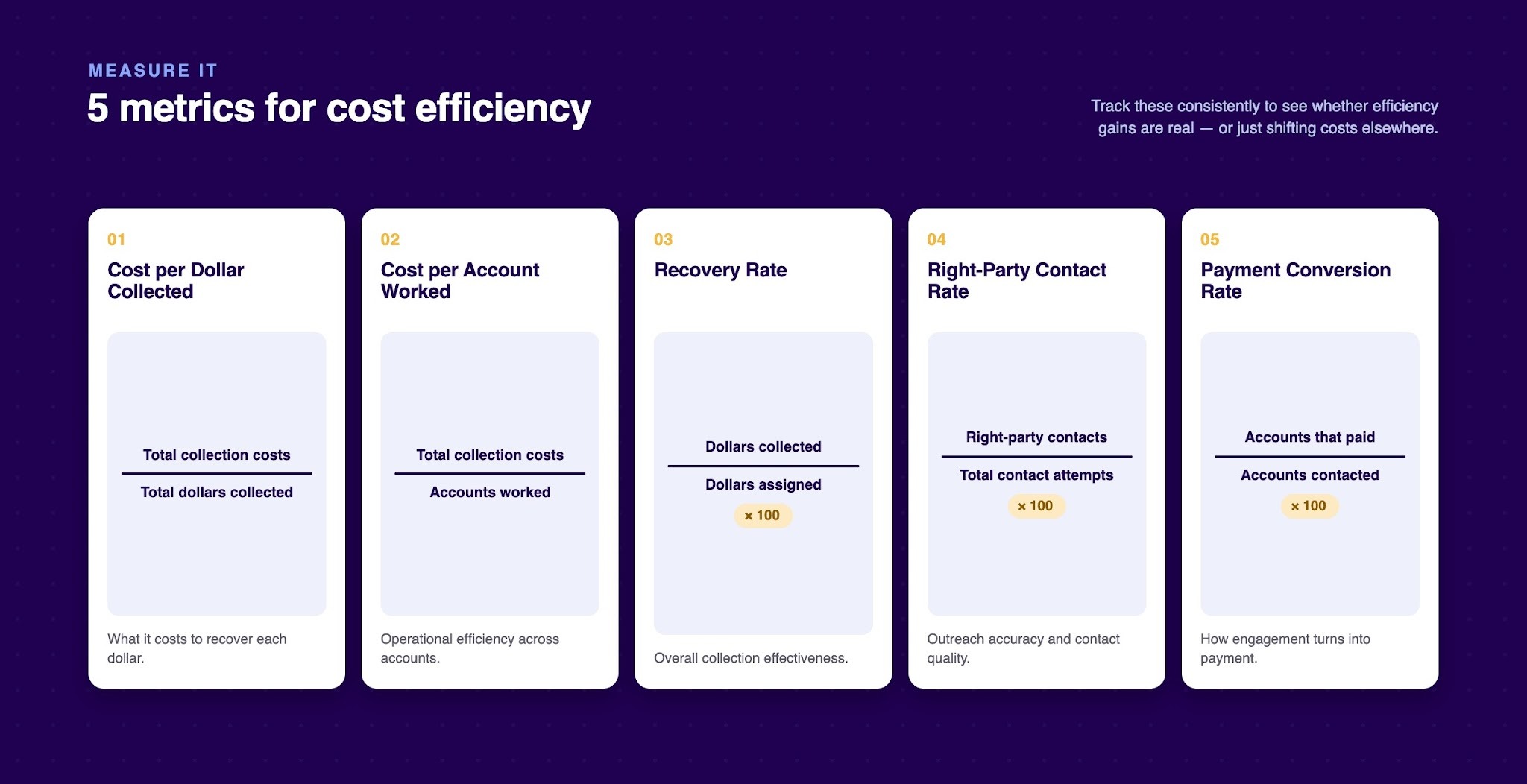
The right metrics reveal whether efficiency initiatives are improving performance or simply shifting expenses elsewhere. Monitoring these indicators consistently helps collection leaders make informed operational decisions.
Table showing top metrics:
Metric
Formula
Why It Matters
Cost Per Dollar Collected
Total Collection Costs / Total Dollars Collected
Measures the cost required to recover each dollar.
Cost Per Account Worked
Total Collection Costs / Number of Accounts Worked
Evaluates operational efficiency across assigned accounts.
Recovery Rate
Total Dollars Collected / Total Dollars Assigned × 100
Indicates overall collection effectiveness.
Right-Party Contact Rate
Right-Party Contacts / Total Contact Attempts × 100
Measures outreach accuracy and contact quality.
Payment Conversion Rate
Accounts That Made a Payment / Accounts Contacted × 100
Shows how effectively engagement turns into payments.
While these metrics provide a strong foundation, they should not be viewed in isolation. Agencies that successfully lower collection costs often monitor broader operational indicators that reveal hidden inefficiencies and opportunities for improvement.
Pay close attention to:
Workflow Bottlenecks: Track where accounts spend the most time during the collection lifecycle.
Repeat Contact Requirements: High follow-up volumes may indicate ineffective outreach strategies.
Resource Allocation Efficiency: Compare staffing levels against portfolio performance and account volume.
Tratta helps agencies monitor these operational trends alongside traditional collection metrics. Real-time dashboards, reporting tools, and analytics provide visibility into consumer behavior, outreach performance, payment activity, and recovery outcomes. Contact us to learn more.
Tips for Reducing Bad Debt in Third-Party Collections
As accounts age and engagement declines, recovery becomes more difficult and expensive. Every unrecovered account represents a missed recovery opportunity and a lower return on collection resources.
Consider these approaches:
Prioritize Accounts With the Highest Recovery Potential Using account characteristics and historical performance data helps agencies focus resources where recoveries are most likely. This approach can improve liquidation rates while controlling operating costs.
Improve Placement Data Quality Collection outcomes often depend on the quality of information received at placement. Inaccurate contact information and incomplete account records can lead to wasted outreach attempts. Regular data validation helps improve contact efficiency and recovery performance.
Segment Accounts More Effectively Treating all accounts the same can reduce overall recovery rates. Segmentation allows agencies to tailor outreach strategies based on account balance, age, engagement history, and other factors. More targeted strategies often produce better results at a lower cost.
Identify Declining Recovery Probability Early The likelihood of recovery typically decreases as accounts age. Monitoring engagement trends, payment activity, and communication outcomes helps agencies identify accounts that may require alternative strategies. Early intervention can prevent further deterioration in recovery potential.
Optimize Account Routing and Workflows Assigning the right accounts to the right workflows can improve operational efficiency. Some accounts may respond well to digital outreach, while others may require agent engagement. Strategic routing helps agencies maximize recoveries without increasing collection costs.
Agencies must understand which accounts deserve attention, which strategies are producing results, and where resources can generate the greatest return. In the next section, we will explore how analytics can improve collection decision strategies and support smarter recovery efforts.
How to Improve Collection Decision Strategies with Analytics?
Collection decisions are only as effective as the information behind them. Without reliable data, agencies may invest resources in low-performing accounts while overlooking stronger recovery opportunities. Analytics helps collection teams replace assumptions with evidence-based decision-making.
The following analytics-driven practices can help agencies improve collection decision strategies:
Identify High-Value Recovery Opportunities: Analytics helps agencies recognize account characteristics associated with stronger recovery outcomes. This allows collection efforts to focus on accounts with the greatest likelihood of payment.
Optimize Outreach Channel Selection: Different account segments often respond differently to phone calls, SMS, email, and digital channels. Analytics helps agencies determine which channels produce the best results for specific account groups.
Refine Account Segmentation Models: Advanced segmentation creates more targeted collection strategies. Agencies can group accounts based on balance, age, engagement history, payment behavior, and other performance indicators.
Improve Workforce Allocation: Analytics helps managers understand where agent involvement creates the most value. Resources can then be directed toward higher-impact activities while lower-value tasks are automated.
Data becomes most valuable when it is accessible and actionable. Agencies that can monitor performance in real time are often better positioned to improve recovery outcomes while controlling costs.
Use Tratta for More Efficient and Cost-Effective Collections
Tratta is a cloud-based collections platform designed to help third-party collection agencies manage consumer interactions, payments, communications, and reporting from a single system.
Reducing collection costs often requires more than operational changes. Technology can help agencies automate workflows, improve consumer engagement, reduce manual effort, and gain greater visibility into performance.
Tratta offers several features that can support lower collection costs:
Consumer Self-Service Payment Portal: Allows consumers to make payments, enroll in payment plans, review settlement offers, and manage accounts without agent assistance. This can reduce inbound call volumes and lower servicing costs.
Reporting and Analytics: Provides real-time visibility into recovery performance, consumer engagement, and operational trends. Better insights help agencies identify inefficiencies and allocate resources more effectively.
Multilingual Payment IVR: Enables consumers to resolve accounts through an automated phone experience. Self-service phone payments can reduce agent workload and expand payment accessibility.
Omnichannel Communications: Supports consumer engagement across SMS, email, voice, and digital channels. Reaching consumers through preferred channels can improve response rates while reducing outreach costs.
Tratta's Campaigns: Automates communication strategies using targeted workflows and segmentation. This reduces manual campaign management and helps agencies scale outreach efficiently.
Contact Center: Centralizes consumer communications and account interactions in one environment. Teams spend less time switching between systems and searching for information.
Payments and Merchant Services: Support integrated payment acceptance and management workflows. Streamlined payment operations can reduce administrative effort and reconciliation workloads.
Security and Compliance: Embeds compliance controls directly into collection workflows. Preventing errors before they occur can reduce rework, disputes, and regulatory exposure.
Integrations: Connects with collection systems, payment providers, and other operational platforms. Integrated data flows reduce manual data entry and duplicate work.
Customization and Flexibility: Allows agencies to configure workflows, permissions, communications, and business rules. Flexible configuration helps teams adapt processes without expensive development projects.
Rather than focusing on a single part of the collection process, Tratta brings together communications, payments, compliance, and analytics in one platform. This connected approach helps agencies operate more efficiently while creating a smoother experience for both team and consumers.
Conclusion
Reducing collection costs is not simply about spending less. Agencies that rely on manual processes, disconnected systems, and inefficient workflows often face rising operating expenses, lower recovery rates, and reduced profitability. Over time, these challenges can make it difficult to scale operations while maintaining compliance and performance.
Tratta helps agencies address these challenges through automation, self-service payments, omnichannel communications, integrated compliance controls, and real-time analytics. By bringing key collection functions into a single platform, Tratta helps teams reduce manual effort, improve operational visibility, and support more cost-effective recovery strategies.
Looking for ways to lower collection costs without sacrificing recovery performance? Schedule a demo today.
Frequently Asked Questions
1. What is the most effective way to reduce the cost of collection?
The most effective approach combines automation, self-service payment options, data-driven decision-making, and efficient consumer engagement strategies. Reducing manual work while improving recovery rates typically delivers the greatest impact.
2. How do collection agencies measure collection costs?
Many agencies track metrics such as cost per dollar collected, cost per account worked, recovery rate, payment conversion rate, and right-party contact rate. These metrics help evaluate both operational efficiency and recovery performance.
3. Can automation reduce collection costs?
Yes. Automation can reduce the time and resources required for routine tasks such as outreach, payment reminders, account segmentation, and reporting. This allows agencies to handle larger volumes without proportionally increasing staffing costs.
4. Why is consumer self-service important for reducing collection costs?
Self-service tools allow consumers to make payments, enroll in payment plans, review settlement offers, and manage accounts independently. This reduces agent workload and lowers the cost of servicing accounts.
5. How can collection software help reduce the cost of collection?
Modern collection platforms can automate workflows, centralize communications, simplify payment processing, improve compliance management, and provide real-time analytics. These capabilities help agencies operate more efficiently while supporting stronger recovery outcomes.
Note: This information is not legal advice. Tratta recommends that you consult with your legal counsel to make sure that you comply with applicable laws in connection with your collection and outreach activities.
Sign up for our monthly newsletter
Debt collection insights that keep you compliant and competitive.
Thank you! Your submission has been received!
Oops! Something went wrong while submitting the form.