Best Debt Collection Software for Law Firms in 2026: Pricing Guide
Industry & Trends
Best Debt Collection Software for Law Firms in 2026: Pricing Guide
Published on:
June 29, 2026
When your team is juggling spreadsheets, scattered notes, and disconnected payment systems, even simple collection cases start slipping through the cracks. Missed follow-ups, incomplete audit trails, and inconsistent communication do not just slow recovery; they also increase compliance risk under laws such as the FDCPA.
As caseloads grow, these inefficiencies compound. The commercial collection legal services market is projected to grow at a 6% CAGR through 2033, indicating greater volume and heightened scrutiny. Without structured systems, scaling becomes risky and resource-heavy.
This is where debt collection software for law firms becomes essential. In this article, we break down the top platforms and how to evaluate them for legal collections.
Brief look:
Generic tools fail law firms: Without legal-specific workflows, firms face compliance risks, fragmented case handling, and slower recovery.
Debt collection software for law firms pricing varies widely: Entry-level tools typically range from $75 to $500+ per month, while advanced platforms scale significantly based on users, volume, and features.
Platforms compared in this guide are Tratta, JST Collect, Latitude (Genesys), Collect!, and Simplicity Collect. Each serves different legal collection needs.
Fit matters more than features: The right system should align with legal workflows, payment handling, and compliance requirements.
Modern systems improve control and scale: The right platform reduces manual work, centralizes data, and strengthens compliance across legal collections.
Why Do Legal Collections Require Specialized Software
Legal collections fail because workflows are fragmented, documentation is inconsistent, and compliance is reactive instead of structured. When accounts move from pre-legal to litigation, most generic systems cannot maintain continuity. That gap creates risk, slows recovery, and increases manual overhead.
To operate effectively, law firms need systems built for both collections performance and legal defensibility:
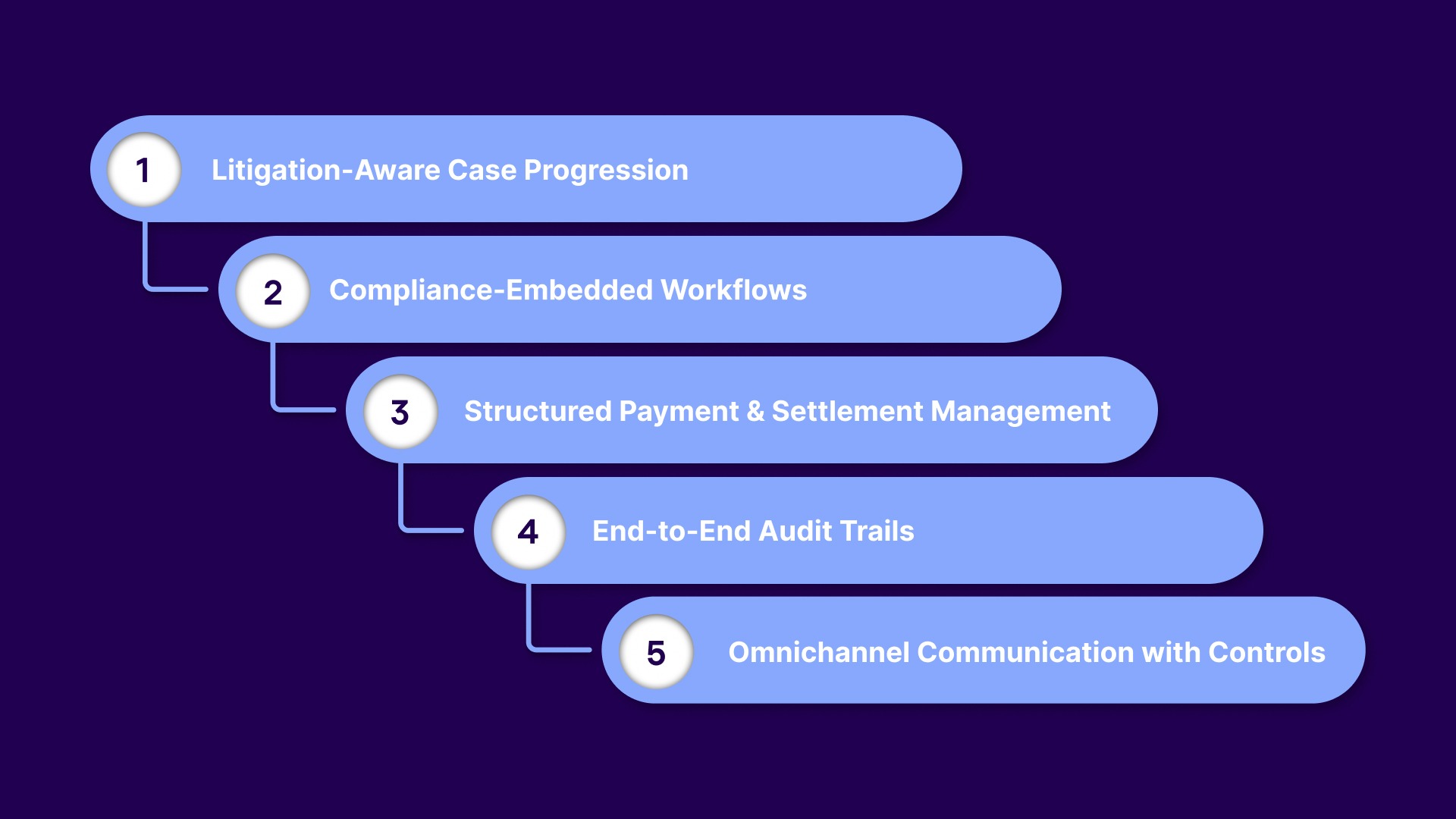
Litigation-Aware Case Progression: Moves accounts from pre-legal to legal stages without losing data, context, or history
Compliance-Embedded Workflows: Aligns communication, disclosures, and timelines with regulations like the Fair Debt Collection Practices Act
Structured Payment & Settlement Management: Supports settlements, payment plans, and balance tracking with legal enforceability in mind
End-to-End Audit Trails: Maintains detailed records for disputes, court filings, and regulatory audits
Omnichannel Communication with Controls: Enables outreach across channels while enforcing frequency, timing, and consent rules
These features ensure that recovery efforts are not just efficient but also legally sound and scalable. In the next section, we examine the pricing structures and cost drivers shaping these platforms in the US.
How Much Does Debt Collection Software for Law Firms Cost in the US?
Pricing for debt collection software varies widely because it depends on volume, compliance needs, and the depth of integration with legal workflows. Most platforms follow either a per-user SaaS model or tiered enterprise pricing tied to accounts and payment volume.
Tratta operates on a modern SaaS structure, typically ranging from $500 to $10,000+ per month, driven by payment volume and feature depth. Simplicity Collect sits in the mid-market, with predictable tiers ranging from $399 to $1,999 per month, making it easier for growing firms to budget.
More traditional systems, such as Comtech Systems, follow an annual pricing model, ranging from $2,590 to $12,590 per year, depending on edition and scale.
In practice, law firms handling debt collection should expect costs to increase based on:
number of accounts and users
compliance and audit requirements
payment processing volume
automation and communication capabilities
The key is not just cost, but how well the system supports legal workflows, compliance, and recovery efficiency at scale. In the next section, we compare leading platforms used in legal collections and how they differ in real-world use.
Comparison of Leading Platforms Used in Legal Collections
We examine five debt collection platforms commonly used in legal recovery and how they differ in approach. Each tool is evaluated based on its support for legal workflows, compliance requirements, and recovery operations. This gives you a clear view of where each platform fits in a law firm’s collection process.
Top tools are:
1. Tratta
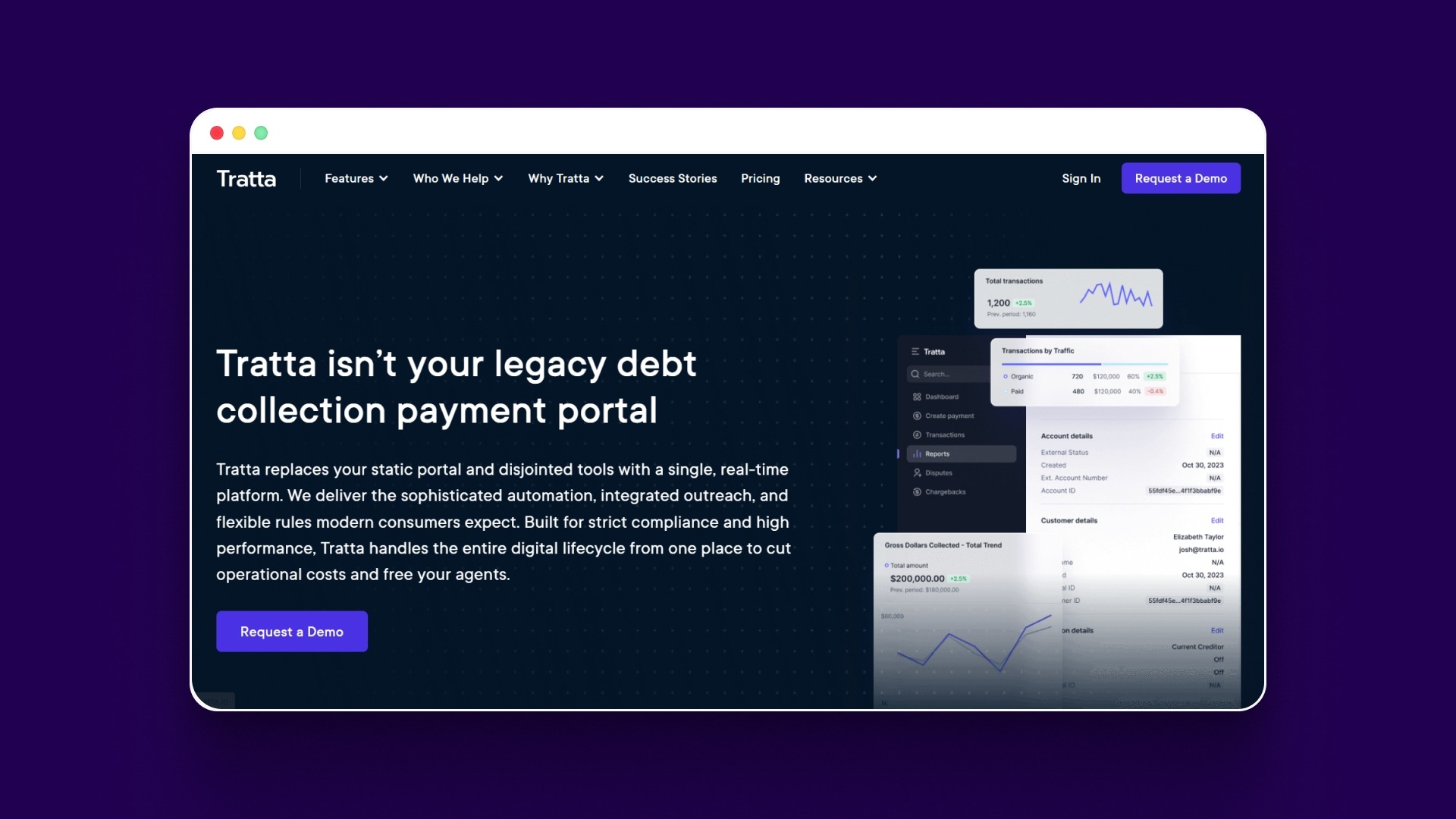
Tratta is a cloud-based debt collection platform designed for agencies, creditors, and law firms. It combines payments, communication, and workflow management into a single system. The platform supports account management, communication, and transaction processing across the collections lifecycle.
Why We Picked It
Consumer Self-Service: Enables account access, payment plan setup, and resolution workflows without manual intervention, reducing operational burden on legal teams managing high account volumes
Payments: Centralizes settlement execution, installment tracking, and reconciliation, which is critical for managing legally structured recoveries and court-aligned agreements
Campaigns: Enables structured outreach strategies, ensuring consistent follow-ups and reducing the risk of missed communication
Reporting: Delivers visibility into recovery performance, payment activity, and operational metrics needed for legal and operational oversight
Integrations: Connects with external legal, financial, and operational systems to ensure continuity across workflows
Security & Compliance: Maintains controls for secure data handling and regulatory alignment, supporting audit readiness and reducing compliance risk
Pros
Aligns payment handling with structured legal recovery workflows
Reduces manual effort through automation and centralized operations
Supports compliance through controlled communication and documentation
Limitations
Strong reliance on digital and self-service channels may not align with firms that prioritize agent-led or litigation-heavy processes
Limited native litigation or court management features, requiring complementary legal systems for full case handling
2. JST CollectMax
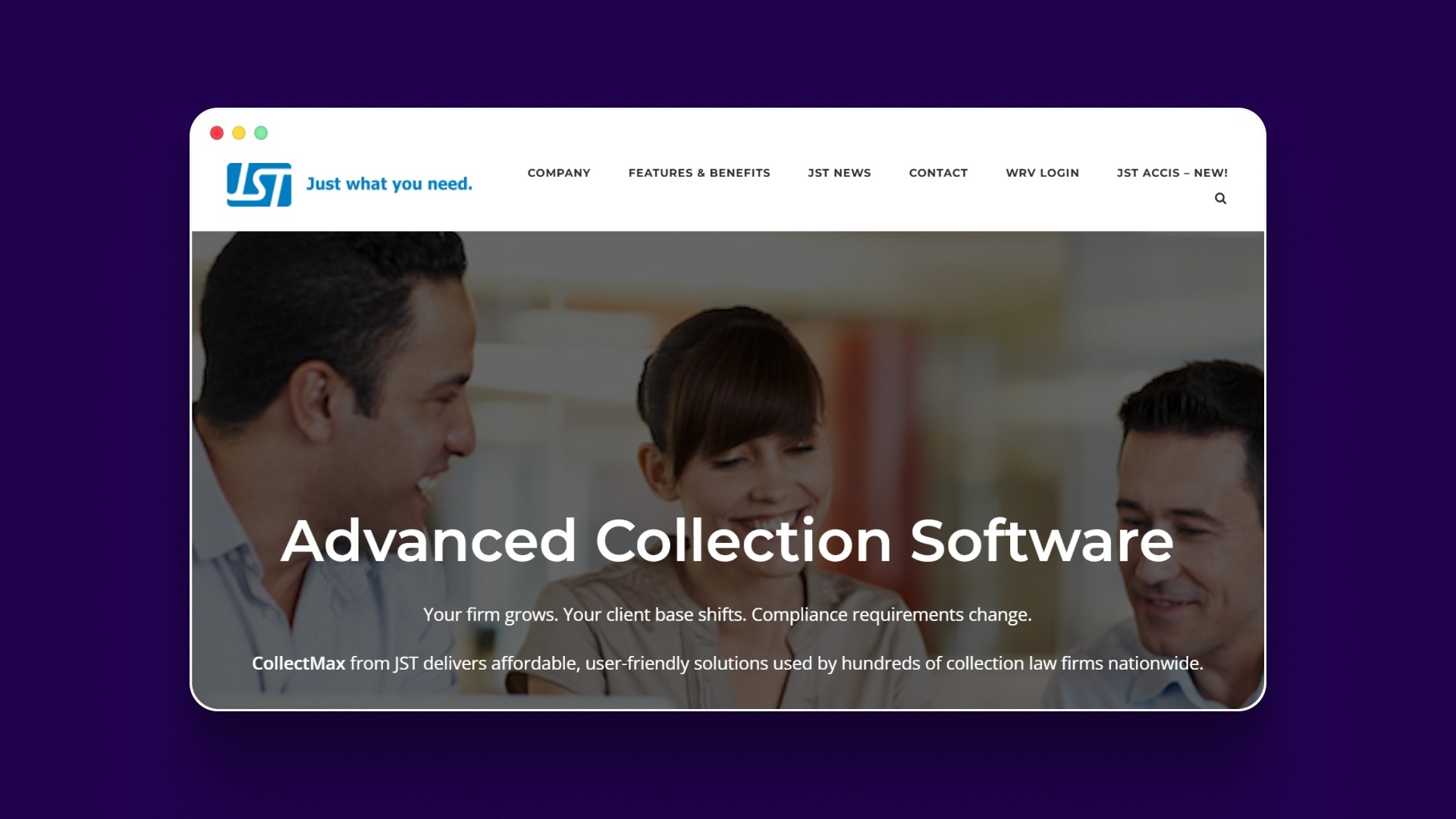
JST CollectMax is a debt collection software platform designed for collection agencies and law firms. It supports account management, payment tracking, and legal collections workflows within a single system. The platform is used to manage pre-legal and legal recovery processes, including litigation tracking and case handling.
Why We Picked It
Account Management: Centralizes debtor records, balances, and account activity, enabling law firms to manage large volumes of cases without fragmented systems
Payment Processing: Tracks payments, settlements, and balances across accounts, supporting structured recovery and financial reconciliation
Legal Case Management: Supports litigation workflows by tracking legal status, court actions, and case progression within the same system
Document Management: Stores and organizes legal documents, correspondence, and case files required for litigation and compliance
Reporting: Provides visibility into recovery performance, account status, and operational activity for better oversight
Pros
Strong alignment with legal collections and litigation workflows
Handles both pre-legal and legal recovery within one system
Supports structured case tracking and documentation
Limitations
Interface and workflows may require training for new users
Customization and deployment can increase implementation time
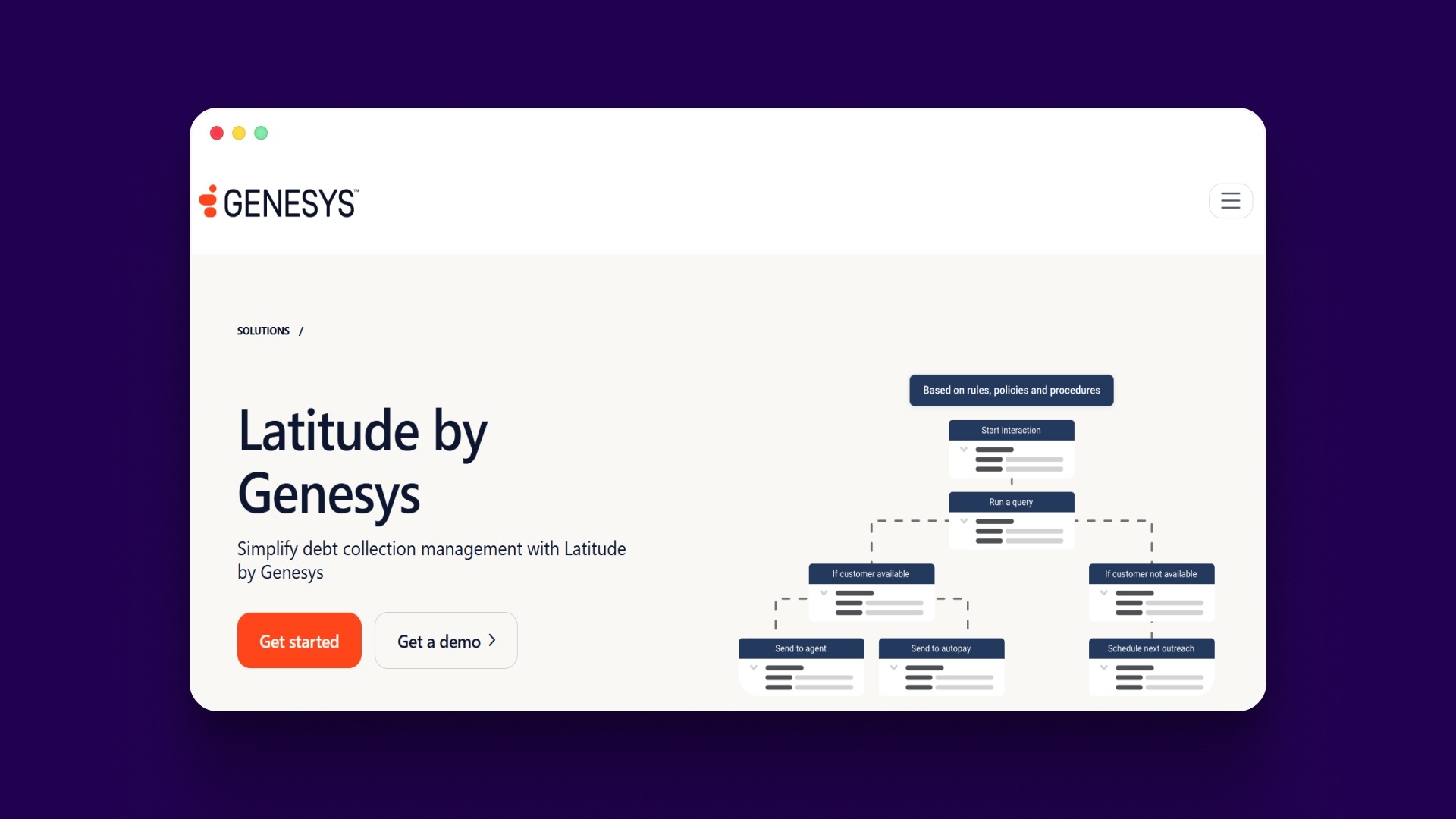
3. Latitude by Genesys
Latitude is a debt-collection platform developed by Genesys to manage recovery operations across agencies, creditors, and legal environments. It combines account management, communication workflows, and payment handling within a unified system.
Why We Picked It
Omnichannel Communication: Supports voice, SMS, email, and digital channels, allowing law firms to manage outreach across multiple touchpoints while maintaining communication records
Workflow Automation: Automates account progression, task assignment, and follow-ups, helping reduce manual workload across high-volume legal portfolios
Account Management: Centralizes account data, communication history, and activity tracking within a single system
Compliance Management: Maintains communication controls and record-keeping aligned with regulations like the Fair Debt Collection Practices Act
Pros
Strong communication infrastructure for high-volume outreach
Scales effectively for large portfolios and enterprise operations
Supports structured workflows and compliance tracking
Limitations
Relies on Genesys Cloud CX for full functionality
Primarily communication-driven, with limited native support for litigation or court-specific case management
4. Collect! by Comtech Systems
Collect! is a debt collection software platform developed by Comtech Systems for agencies and legal recovery operations. It provides tools for managing accounts, tracking payments, and handling collection workflows. The platform supports both pre-collection and recovery processes within a configurable system.
Why We Picked It
Debtor Database: Maintains detailed debtor records, account history, and contact information, supporting long-term case tracking across legal recovery cycles
Transaction Ledger: Records payments, adjustments, interest, and fees with full traceability, which is critical for financial accuracy in legal collections
Collection Queues: Organizes accounts into queues for follow-ups and actions, helping firms manage workloads without automated workflow engines
Letter & Notice Generation: Generates collection letters and notices using templates, supporting standardized communication required in legal processes
System Configuration: Allows firms to customize fields, screens, and processes to match internal collection and legal handling requirements
Pros
Flexible system that can be adapted to legal collection workflows
Supports both early-stage and recovery-phase collections
Limitations
Interface may feel dated compared to newer platforms
Advanced capabilities depend on setup and customization
5. Simplicity Collect by Finvi
Simplicity Collect is a cloud-based debt collection software platform developed by Finvi. It is designed for collection agencies, creditors, and law firms to manage accounts, payments, and communication workflows. The platform supports end-to-end collection operations, including account tracking and recovery management.
Why We Picked It
Cloud-Based Platform: Provides centralized access to accounts, payments, and activity from any location, supporting distributed legal teams and remote case handling
Integrated Payment Processing: Handles payments, settlements, and transaction tracking within the system, helping law firms manage financial workflows without external tools
Configurable Workflows: Supports task automation and process configuration, allowing firms to structure collection activities around internal legal processes
Communication Tracking: Logs interactions across channels, maintaining records needed for compliance and dispute resolution
Client & Portfolio Management: Organizes multiple creditor portfolios and client accounts, enabling firms to manage third-party collections across different clients within one system
Pros
Balanced feature set for mid-sized legal collection operations
Combines account, payment, and workflow management in one system
Easier to deploy compared to enterprise-heavy platforms
Limitations
May require configuration for complex legal workflows
Not as specialized in litigation workflows as some legal-first systems
In the next section, we look at where generic collection systems fall short and why they often create more challenges than they solve for law firms.
Challenges Law Firms Face with Generic Collection Systems
Generic collection systems are not built for the realities of legal recovery. They may handle basic account tracking and communication, but they break down once cases move into structured, compliance-heavy workflows.
Key challenges include:
Fragmented Case Handling: Legal and collection activities are often split across multiple systems, making it difficult to maintain continuity as cases move into litigation
Limited Compliance Controls: Generic platforms lack built-in safeguards aligned with regulations like the Fair Debt Collection Practices Act, increasing exposure to violations
Inadequate Audit Trails: Missing or incomplete records make it harder to support disputes, audits, or court proceedings
Manual Workflows: Heavy reliance on manual tracking, follow-ups, and updates slows down operations and increases the risk of errors
Poor Payment Integration: Payments, settlements, and balances are often managed outside the system, leading to reconciliation issues
These limitations make it difficult for law firms to scale recovery operations while maintaining control and compliance. In the next section, we break down practical tips to help you choose the right software based on your specific operational needs.
Tips for Picking the Right Debt Collection Software for Law Firms
Selecting the right platform is not about ticking feature boxes. It is about choosing a system that fits how your firm actually handles recovery, from early-stage collections to litigation.
Here are five practical tips to guide your decision:
Map Your End-to-End Workflow: Understand how cases move from intake to recovery to litigation, and choose software that supports this flow without requiring workarounds
Make Compliance Non-Negotiable: Ensure the system enforces communication and record-keeping aligned with laws like the Fair Debt Collection Practices Act
Evaluate Payment Handling Closely: Look at how settlements, payment plans, and reconciliation are managed, since this directly impacts recovery outcomes
Test for Real-World Scalability: Choose a platform that can handle increasing case volumes without adding manual processes or operational complexity
Assess Total Cost and Integration Fit: Consider long-term costs, including integrations and usage-based fees, and ensure the system fits into your existing legal and financial setup
Choosing the right system comes down to fit. The closer the alignment with your legal collection workflows, the easier it becomes to scale recovery while maintaining control and compliance.
Conclusion
Choosing the wrong system can create more problems than it solves for law firms handling debt collection. Disconnected workflows, weak audit trails, and inconsistent communication increase compliance risk. These gaps slow recovery, complicate litigation, and make it harder to manage third-party collections at scale.
This is where Tratta stands out. Built for third-party collection law firms and agencies, it brings payments, communication, and workflow management into a single system. That alignment helps firms maintain control, improve recovery efficiency, and reduce operational friction across legal collections.
If your current setup is creating gaps, it is time to evaluate a system built for legal recovery. Start with a platform that aligns with how your firm actually works. Request a free demo today.
Frequently Asked Questions
1. Do law firms need different software for pre-legal and legal collections?
No, but the software should support both stages within a single system. Switching between tools creates data gaps, while unified platforms maintain continuity as cases move into litigation.
2. How does debt collection software help during litigation?
It maintains structured records of communication, payments, and account history. This documentation supports filings, disputes, and court proceedings without relying on external tracking.
3. Can debt collection software integrate with legal case management systems?
Some platforms offer direct integrations, while others rely on APIs. This is important for aligning collection workflows with legal case handling and avoiding duplicate work.
4. What role does automation play in legal collections?
Automation reduces manual follow-ups, task tracking, and communication scheduling. This helps law firms manage higher case volumes without increasing operational overhead.
5. Is data security a major concern in debt collection software?
Yes. Law firms handle sensitive financial and personal data, so the platform must support secure storage, controlled access, and compliance with industry standards.
Note: This information is not legal advice. Tratta recommends that you consult with your legal counsel to make sure that you comply with applicable laws in connection with your collection and outreach activities.
Sign up for our monthly newsletter
Debt collection insights that keep you compliant and competitive.
Thank you! Your submission has been received!
Oops! Something went wrong while submitting the form.