Recovering more debt does not always mean making more collection attempts. Many agencies struggle with misallocated resources, ineffective contact strategies, and limited visibility into what drives successful recoveries. Meanwhile, the volume of debt requiring collection continues to grow.
According to the Federal Reserve Bank of New York, total U.S. household debt reached $18.8 trillion in Q1 2026. This is increasing the pressure on agencies to maximize recovery performance through smarter operations.
If you are trying to improve recovery outcomes without increasing costs or compliance risk, you may be facing the same challenge as many collection organizations. In this article, we define accurate debt recovery as the ability to consistently identify, prioritize, and recover collectible accounts using data-driven collection strategies.
Brief look:
Recovery performance is not determined by collection volume alone. According to McKinsey, leading institutions are using advanced analytics and machine learning to improve segmentation, treatment strategies, and collections performance.
As collection portfolios become more complex, agencies that rely on data-driven decision-making are often better positioned to improve liquidation outcomes and operational efficiency.
Some of the key benefits include:
Achieving these outcomes requires more than setting recovery goals. Agencies must understand the operational factors that directly influence recovery accuracy across the collection lifecycle. In the next section, we will examine the key drivers that determine whether recovery strategies consistently produce results.
Suggested Read: Collections Strategy in 2026: What Actually Works (Based on Real Agency Data)
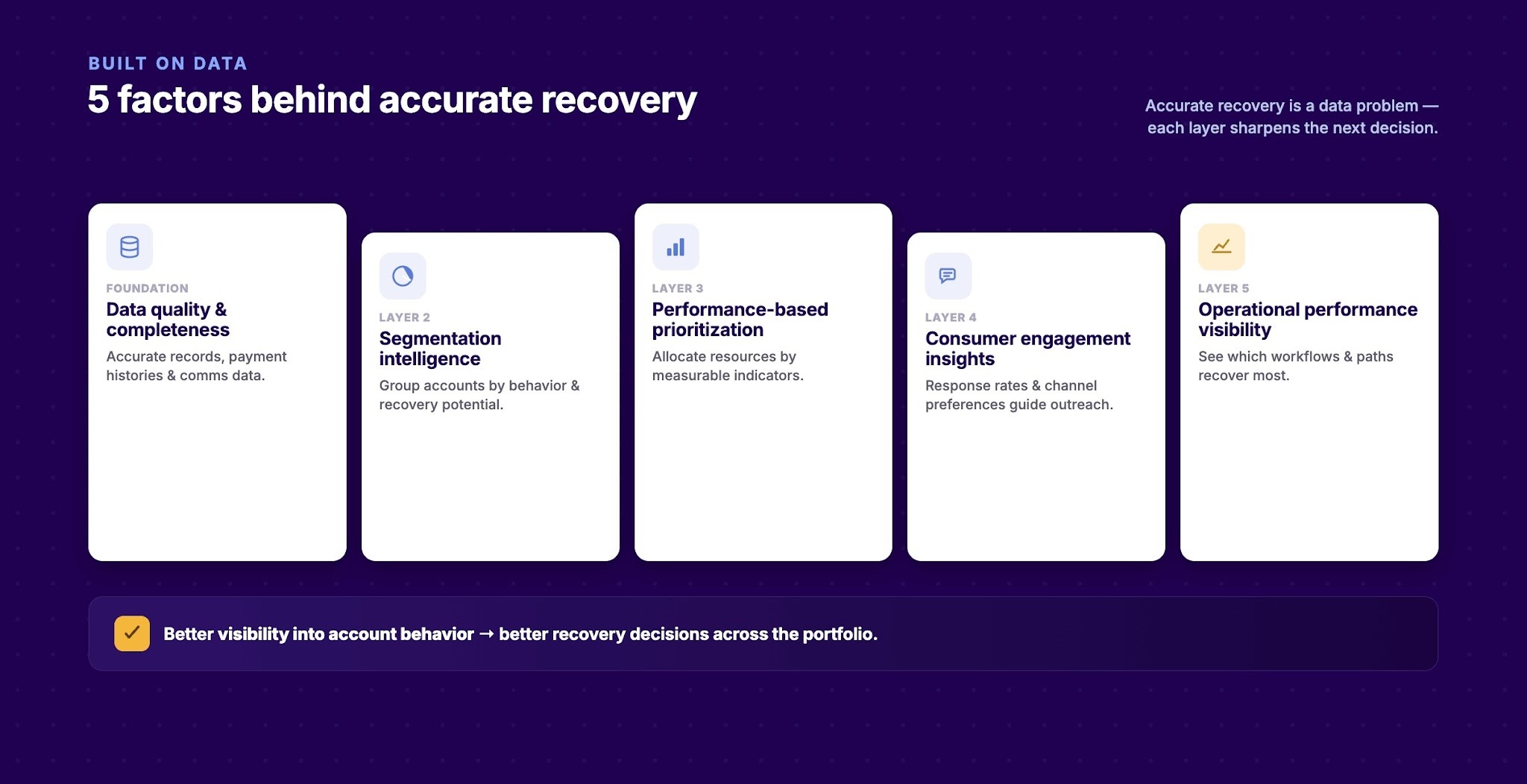
Accurate debt recovery is ultimately a data problem. Agencies that make better recovery decisions typically have better visibility into account behavior, portfolio performance, and operational outcomes. The ability to collect, analyze, and act on data often determines whether collection efforts produce meaningful results.
The most important factors include:
These factors help agencies understand where recovery opportunities exist. In the next section, we will explore data-driven strategies that transform these insights into more accurate and consistent recovery performance.
Suggested Read: 6 Proven Digital Collections Strategies to Recover More Debt
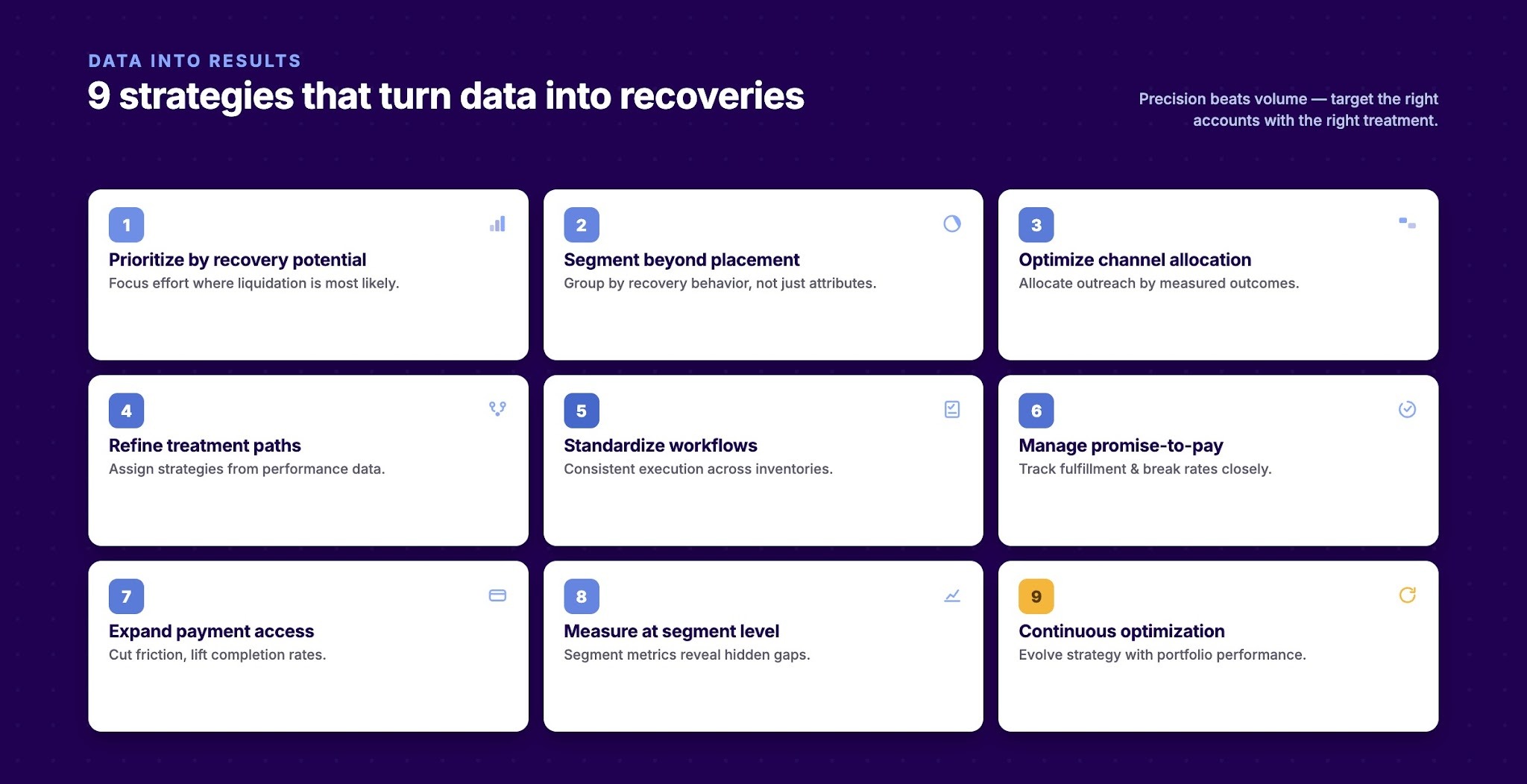
Third-party collection agencies generate significant amounts of operational and portfolio data. The challenge is converting that information into measurable liquidation performance.
The following strategies focus on using collection intelligence to improve account selection, treatment allocation, operational efficiency, and recovery outcomes.
Not all placements warrant the same level of collector effort. Recovery-focused prioritization helps agencies allocate resources where they are most likely to produce liquidation results.
Focus on indicators such as:
Effective prioritization requires continuous performance measurement. Tratta offers Reporting & Analytics feature helps agencies evaluate liquidation outcomes, identify high-performing account segments, and refine prioritization methodologies using operational data. Schedule a free demo today.
Portfolio segmentation should reflect recovery behavior rather than simple account classifications. More granular segmentation supports more precise treatment allocation and resource deployment.
Consider segmentation factors such as:
Channel performance often varies across portfolio segments. Agencies should allocate outreach efforts based on measurable recovery outcomes rather than channel assumptions.
Evaluate channel effectiveness using:
Treatment strategies should be assigned using performance data rather than static business rules. Different account populations often require different recovery approaches.
Review treatment performance using:
Operational inconsistency often creates performance variation across portfolios. Standardized workflows help ensure treatment strategies are executed consistently.
Areas suitable for standardization include:
Execution quality directly impacts recovery performance. Tratta helps agencies standardize treatment paths, automate operational processes, and maintain consistency across large account inventories. Contact us to learn more.
Promise-to-pay commitments provide valuable indicators of future recovery outcomes. Agencies should actively monitor commitment performance across portfolios.
Track metrics such as:
Payment friction can reduce liquidation opportunities. Agencies should continuously evaluate the accessibility and convenience of payment channels.
Focus on improving:
Couch Lambert used Tratta's automated communication campaigns to support consumer outreach and payment engagement efforts. The firm noted that regulatory-compliant email campaigns became a strategic channel because they could track which messages generated consumer interaction.
Portfolio-wide metrics often conceal operational inefficiencies. Segment-level analysis provides more actionable recovery intelligence.
Monitor metrics such as:
Recovery strategies should evolve alongside portfolio performance. Agencies that continuously evaluate operational outcomes often achieve more sustainable results.
Optimization initiatives should review:
These strategies can improve recovery accuracy and operational performance. However, many agencies encounter structural obstacles that limit execution. In the next section, we will examine the most common barriers to increasing debt recovery operations and how agencies can address them.
Suggested Read: Advanced Debt Segmentation: How Top Agencies Improve Recovery
Many collection agencies understand what drives recovery performance. The challenge is executing consistently across large portfolios while maintaining operational efficiency and compliance.
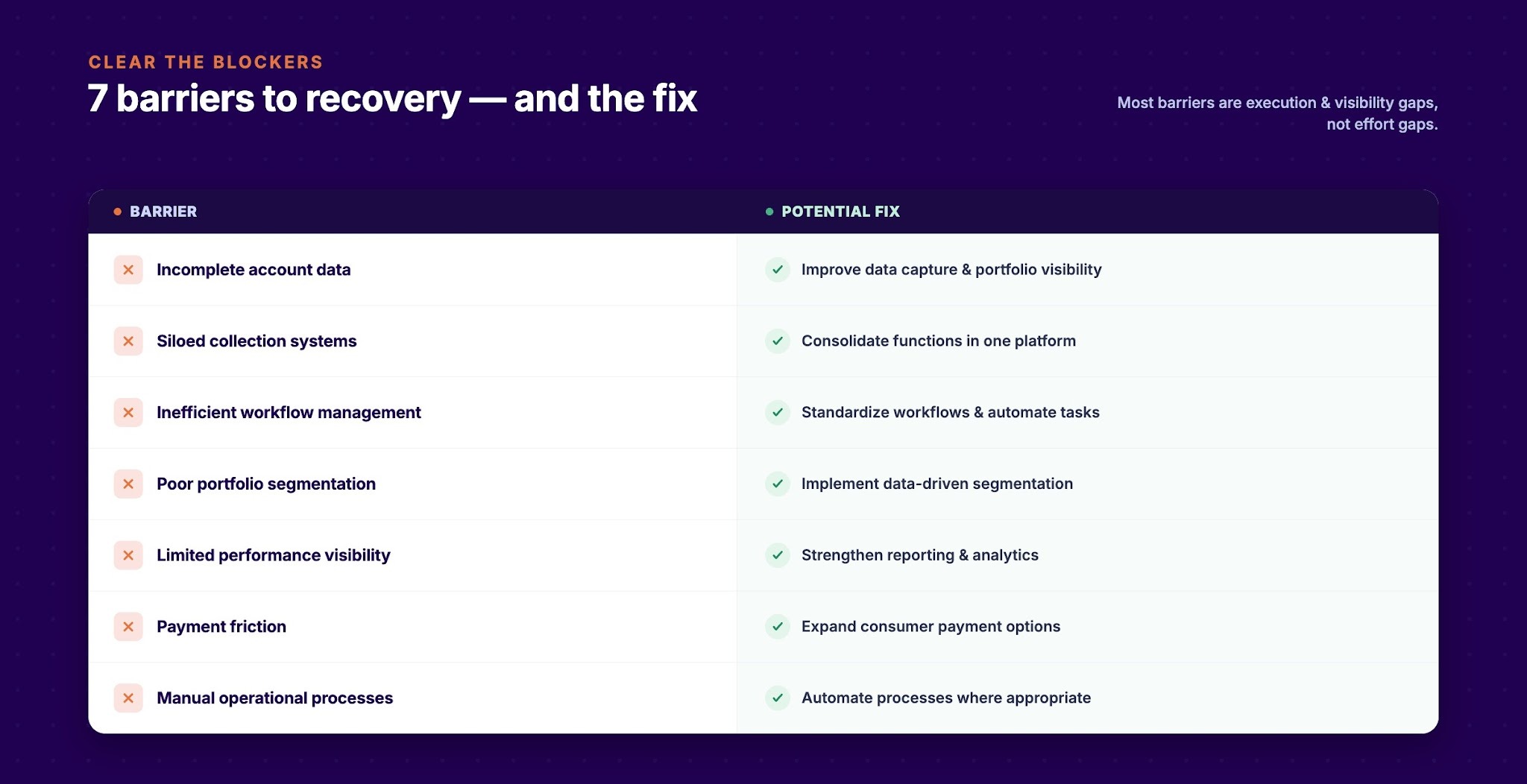
Several common barriers can prevent agencies from achieving higher liquidation rates and scalable growth:
Addressing these barriers often begins with improving operational discipline and visibility. Agencies should focus on a few high-impact areas before attempting large-scale process changes:
As collection operations become more data-driven, agencies need technology that supports visibility, consistency, and scalability. The right debt collection software can help eliminate operational bottlenecks while supporting more effective recovery strategies.
Suggested Read: Using SMS for Debt Collection Guide
Tratta is a debt collection software platform built for collection agencies, debt buyers, law firms, and credit issuers. It helps organizations centralize collection operations through communications, payments, workflows, reporting, and compliance capabilities.
Core features include:
Consumers can review account information, verify identities, manage payment arrangements, and resolve balances through a branded self-service experience. This helps reduce collector workload while improving payment accessibility.
Embedded payment capabilities allow agencies to accept digital payments, settlements, and payment plan transactions within the collection workflow. This reduces payment friction and supports higher conversion opportunities.
Consumers can make payments through an automated IVR system designed to support multiple languages. This expands payment accessibility while reducing operational overhead.
Agencies can engage consumers across multiple communication channels while maintaining a consistent collection experience. This supports broader outreach strategies and improved engagement rates.
Campaign automation helps agencies manage payment reminders, settlement offers, and account outreach activities at scale. This supports more consistent execution across large account inventories.
Reporting and Analytics provides visibility into portfolio performance, payment behavior, recovery trends, and operational outcomes. These insights help agencies evaluate strategy effectiveness and identify improvement opportunities.
Collection organizations can configure the platform to support their operational requirements, workflows, and business processes. This flexibility helps agencies adapt the system to different portfolio types and recovery models.
Integration capabilities allow agencies to connect Tratta with existing collection systems, account databases, and operational tools. This improves data flow and reduces manual administrative effort.
Security and Compliance features help agencies protect sensitive account information while supporting regulatory requirements. This creates a more controlled operating environment for collection teams.
The Contact Center feature supports collector productivity through centralized communication management and operational visibility. This helps teams manage high account volumes more effectively.
This impact is reflected in the experience of the Multi-Service Fuel Card. After implementing Tratta's self-service payment capabilities, debit card payments grew to nearly 40% of total payments, generating an additional $650,000 in collections within seven months. The results demonstrate how a more accessible payment experience can contribute directly to stronger recovery performance.
Accurate debt recovery does not happen by chance. Agencies that rely on broad treatment strategies, incomplete data, or inconsistent workflows often experience lower liquidation rates, higher operational costs, and inefficient resource allocation.
Tratta helps third-party collection agencies build more data-driven recovery programs. Its platform combines workflows, reporting and analytics, omnichannel communications, payment solutions, compliance controls, and consumer self-service capabilities within a unified collection environment.
Every recovery decision is stronger when it is backed by reliable data and effective execution. Schedule a demo to see how Tratta can support your recovery strategy.
A good debt recovery rate varies by portfolio type, account age, and placement source. Agencies should benchmark performance against similar portfolios rather than relying on industry-wide averages.
Most agencies review recovery performance monthly and conduct deeper strategy evaluations quarterly. High-volume portfolios may require more frequent analysis.
Recovery rate measures the percentage of outstanding debt collected. Liquidation rate typically measures the percentage of placed inventory recovered during a specific period.
Performance analytics can reveal treatment paths, portfolio segments, communication channels, or collector activities that consistently generate weaker recovery outcomes.
Consumer self-service solutions allow individuals to review accounts, make payments, and manage payment arrangements independently, helping agencies increase payment accessibility and reduce operational workload.