Recovery has become harder even for experienced collection agencies. Consumers are slower to respond, payment timelines are longer, and traditional outreach methods deliver weaker results. At the same time, delinquency pressure remains elevated across several credit categories.
In Q3 2025, 9.4% of aggregate student loan balances were reported as 90+ days delinquent. This only highlights the growing challenge of moving overdue accounts toward resolution. Strategies built around call volume and manual follow-ups are no longer sufficient.
Agencies need structured approaches that improve engagement consistency, reduce payment friction, and support scalable recovery. This guide outlines fifteen practical collection strategy tips you can apply to improve debt recovery performance in 2026.
Brief look:
A collections strategy defines how your agency engages delinquent accounts, moves them toward repayment, and maintains compliance throughout the recovery process. It determines when outreach happens, how payment options are presented, and how accounts progress from delinquency to resolution.
Collection strategies need to adapt because:
Adapting the best collection practices requires a repeatable framework for recovery execution. In the next section, we introduce the major components of a successful collections strategy.
Suggested Read: Steps to Improve Debt Collection Optimization Strategies
The 3 Cs provide a simple framework for agencies to evaluate whether their strategy supports sustainable recovery performance.
These are:
The next step is applying a collections contact strategy to daily execution. In the next section, we look at tips to increase engagement and workflow for better recovery rates.
Suggested Read: Proven Debt Collection Techniques for Higher Recovery Rates
Many recovery issues come from inconsistent follow-ups, unclear ownership, or delayed engagement, rather than a lack of effort.
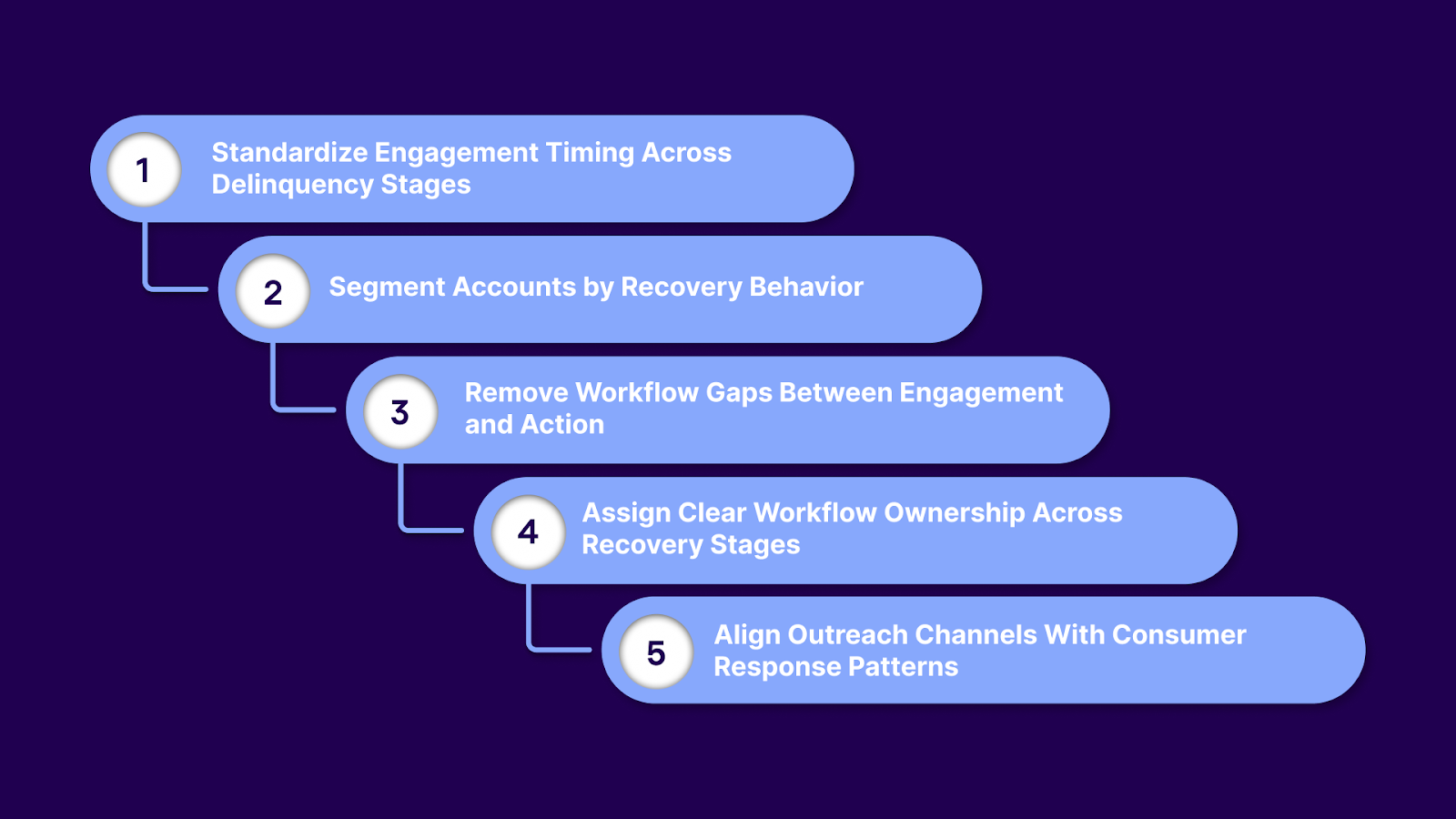
The following strategies focus on improving execution discipline across engagement and workflow stages:
Recovery outcomes often vary because engagement timing depends on individual agent decisions. Standardizing outreach timing ensures accounts receive consistent attention as they age through delinquency stages.
The following steps help establish structured engagement timing:
Collection Strategy Example:
An agency implemented rule-based outreach intervals tied to delinquency age across all portfolios. Early-stage accounts received automated follow-ups within defined windows, while nonresponsive accounts were automatically escalated.
Balance-based segmentation alone often overlooks repayment intent. Accounts with similar balances may respond very differently based on prior engagement or payment activity.
The following actions help operationalize behavioral segmentation:
Collection Strategy Example:
A collection agency introduced segmentation based on engagement frequency and prior payment activity. Responsive accounts were routed to higher-frequency workflows, while inactive accounts shifted to automated sequences.
Many accounts stall after initial engagement because the next step is unclear or delayed. Consumers who agree to resolve accounts often disengage if payment or settlement options are not immediately available.
The following steps help eliminate execution gaps:
Collection Strategy Example:
An agency reduced settlement abandonment by linking engagement workflows directly to payment execution. This shortened the time between agreement and payment. This improved completion rates and reduced the need for repeat engagements.
Accounts often move between teams or agents as delinquency progresses. Without clear ownership, follow-ups become inconsistent, and accountability weakens. Defined ownership ensures each stage of recovery has a clear responsibility.
The following practices help maintain workflow ownership:
Collection Strategy Example:
A multi-client agency introduced stage-based ownership rules tied to delinquency brackets. Accounts automatically reassigned when inactivity thresholds were reached. Managers gained visibility into stalled accounts.
Using the same communication channel for all accounts limits the effectiveness of engagement. Different consumers respond to different channels at different times and with different preferences.
The following steps help optimize channel usage:
Collection Strategy Example:
An agency analyzed response data across communication channels and adjusted sequencing based on engagement outcomes. Accounts that were unresponsive to voice outreach were automatically redirected to digital channels.
Tratta supports these engagement and workflow strategies by enabling agencies to automate campaign timing and connect engagement directly to payment execution. Its workflow-driven approach reduces execution gaps while maintaining operational visibility. Schedule a free demo today.
Many agencies lose recovery momentum after initial agreement because payment execution introduces friction or delay.
The following approaches improve payment conversion and reduce stalled accounts.
Payment completion rates drop when there is a delay between agreement and execution. Consumers are less likely to follow through if payment steps require additional contact or approvals. Shortening this window improves resolution reliability.
The following steps help reduce execution delays:
Collection Strategy Example:
An agency reduced settlement fallout by enabling real-time payment execution immediately after agreement. Settlement acceptance triggered automated payment workflows without agent intervention. This shortened payment timelines and increased completion rates by removing delays between agreement and transaction execution.
Payment plans often fail when installment structures do not align with consumer capacity. Structuring plans based on realistic repayment behavior improves completion rates and reduces re-default. Resolution strategies should prioritize sustainability over short-term recovery gains.
The following practices improve payment plan performance:
Collection Strategy Example:
A collection agency analyzed failed payment plans and identified early missed payments as a strong indicator of default. Payment plans were restructured with shorter initial intervals and automated reminders. Completion rates improved as plans aligned more closely with observed repayment behavior across similar account segments.
Further Insight: Debt Collection and Secure Payment Portal
Settlement timing significantly affects acceptance rates. Offering settlements too early reduces recovery value, while offering them too late reduces engagement. Structured timing improves both acceptance and recovery efficiency.
The following steps help optimize settlement presentation:
Collection Strategy Example:
An agency introduced rule-based settlement eligibility tied to delinquency age and engagement activity. Settlement offers were triggered after repeated engagement attempts rather than immediately. This increased acceptance rates while preserving recovery value by aligning settlement timing with consumer readiness.
Payment plans often fail due to missed follow-ups rather than an unwillingness to pay. Early intervention improves recovery outcomes and prevents accounts from re-entering delinquency cycles.
The following steps help reduce payment plan failures:
Collection Strategy Example:
A collection agency implemented automated monitoring for active payment plans. Missed payments triggered immediate follow-up workflows instead of manual review queues. Early intervention reduced broken arrangements.
Tratta helps prevent payment plan drop-offs by automating follow-up workflows within Campaigns. Payment activity changes can trigger reminders and escalation paths without manual intervention. Learn more.
Consumers differ in how they prefer to resolve delinquent accounts. Providing multiple structured resolution paths improves conversion without increasing operational complexity.
The following practices support flexible resolution:
Collection Strategy Example:
An agency introduced multiple resolution paths based on prior payment behavior. Accounts with partial payment history were routed toward installment options, while inactive accounts received structured settlement offers.
The next section explores the data-driven strategies shaping collections performance in 2026.
Suggested Read: Understanding Digital Debt Collections and Its Impact
Data-driven strategies allow agencies to identify patterns earlier, remove operational delays, and improve recovery outcomes without increasing effort.
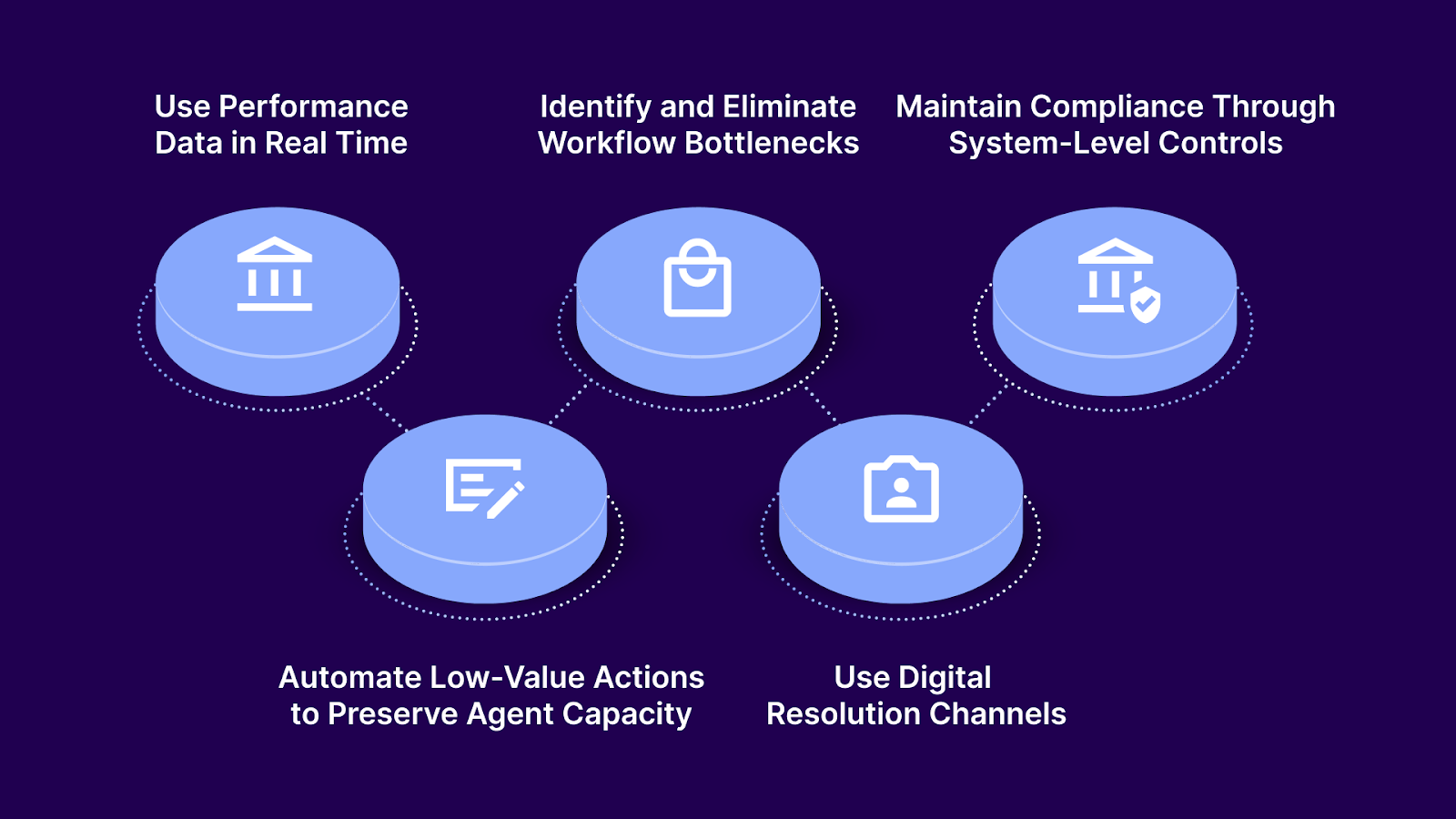
The following strategies focus on using data and technology:
Static recovery strategies often continue long after performance declines. Data-driven adjustments allow agencies to respond to engagement and payment trends as they emerge. This prevents prolonged inefficiencies across active portfolios.
The following actions help operationalize real-time strategy adjustment:
Collection Strategy Example:
An agency introduced daily performance monitoring across engagement channels and payment outcomes. Underperforming workflows were automatically adjusted based on response data. This reduced wasted outreach attempts and improved recovery efficiency.
Agents often spend time on repetitive tasks that do not directly improve recovery outcomes. Automating routine engagement and follow-up actions allows agents to focus on negotiations and complex accounts.
The following steps support automation effectively:
Collection Strategy Example:
A collection agency automated early-stage follow-ups and reminder workflows while reserving agent involvement for negotiation-stage accounts. This reduced manual workload and increased agent productivity.
Recovery delays often occur between engagement and payment rather than during outreach itself. Analytics helps identify where accounts stall and why resolution slows. Removing bottlenecks improves recovery velocity without increasing the number of contact attempts.
The following steps help identify workflow friction:
Collection Strategy Example:
An agency analyzed resolution timelines and identified delays caused by manual settlement approvals. After automating approval thresholds, the time between agreement and payment shortened significantly. Accounts progressed faster through recovery stages, improving overall resolution rates without increasing engagement volume.
Consumers increasingly resolve accounts outside traditional call interactions. Digital payment and self-service channels enable repayment at the moment of intent. This reduces abandonment between engagement and payment.
The following practices improve digital resolution performance:
Case Study Example — Multi-Service Fuel Card:
After implementing Tratta’s self-service payment capabilities, Multi Service Fuel Card nearly doubled debit card payments to almost 40 percent and generated an additional $650,000 in collections within seven months. The shift reduced agent dependency while increasing payment completion through digital resolution channels.
Further Insight: 6 Proven Digital Collections Strategies to Recover More Debt
Technology-driven controls ensure communication rules and documentation requirements are enforced automatically. This reduces risk while allowing agencies to scale outreach safely.
The following steps help embed compliance into operations:
Collection Strategy Example:
A national agency embedded compliance rules directly into engagement workflows, preventing non-compliant outreach from being executed. Automated logging reduced audit preparation time and improved operational confidence as outreach volume increased across multiple client portfolios.
Data-driven strategies improve recovery only when they can be executed consistently across engagement, payments, and compliance workflows. The next section looks at how these strategies can be implemented in practice.
Suggested Read: Key Performance Indicators for Debt Collection Metrics
Tratta is a debt collection software platform built for collection agencies to operationalize engagement, payment, and compliance workflows at scale. It provides the infrastructure agencies use to apply collection strategies reliably while maintaining visibility and control over recovery performance.
Tratta supports modern collections strategies through the following core features:
These features can help you execute collection strategies consistently and with control. You can gain better visibility across engagement, payments, and recovery performance.
Recovery efforts become reactive and inconsistent without a clear collections strategy. Accounts age unnecessarily, engagement loses focus, and payment opportunities are missed. Over time, operational effort increases while recovery performance becomes harder to predict or improve.
Tratta helps you execute collections strategies through structured workflows that connect engagement, payments, and compliance. You can apply recovery strategies consistently across portfolios while maintaining operational control.
If you want stronger recovery outcomes, start by evaluating how your current workflows support strategy execution. Get in touch with us to explore how your agency can improve recovery performance.
The most successful collection strategy combines early engagement, structured follow-ups, flexible resolution options, and consistent workflow execution. Agencies achieve better results when engagement, payment, and compliance processes operate together rather than independently.
The 7-7-7 rule limits call attempts to seven calls per account, per week, per phone number. Agencies use this guideline to manage contact frequency and reduce the risk of excessive or noncompliant outreach.
A collection strategy defines how delinquent accounts are engaged, managed, and resolved. It includes outreach timing, payment options, compliance controls, and workflows that guide accounts from delinquency toward payment or settlement.
Strong communication, negotiation ability, and compliance awareness are essential skills. Collection officers must engage consumers professionally, guide payment discussions effectively, and follow regulatory requirements while supporting recovery objectives.
Collection strategies should be reviewed regularly as consumer behavior, compliance expectations, and portfolio performance change. Many agencies reassess strategy quarterly to ensure engagement workflows and payment approaches remain effective.