.png)
Collection agencies handle thousands of conversations every month, but manually reviewing calls to identify compliance risks, training opportunities, and consumer concerns is nearly impossible at scale. If your team is relying on random call sampling, valuable insights may be slipping through the cracks.
The opportunity is significant: the global Speech Analytics Technology Market is projected to reach USD 8.16 billion by 2031. This reflects a growing demand for conversation intelligence tools.
Agencies today need better visibility into what is happening across every interaction. In this guide, you will learn what speech analytics software for debt collectors is, how it works, its key features, benefits, and practical use cases.
Quick look:
Debt collection agencies generate a large volume of consumer conversations every day. Hidden within those interactions are valuable insights about payment intent, consumer concerns, compliance risks, and agent performance. The challenge is that manually reviewing thousands of calls is time-consuming and often impractical.
Speech analytics is a technology that uses artificial intelligence (AI), natural language processing (NLP), and speech recognition to analyze recorded or live conversations at scale. It converts spoken interactions into searchable data, helping agencies identify patterns, track keywords, measure sentiment, monitor compliance, and uncover opportunities to improve collection outcomes.
While many agencies already use call recording or call monitoring tools, speech analytics goes a step further by automatically extracting insights from conversations instead of simply storing or reviewing them.
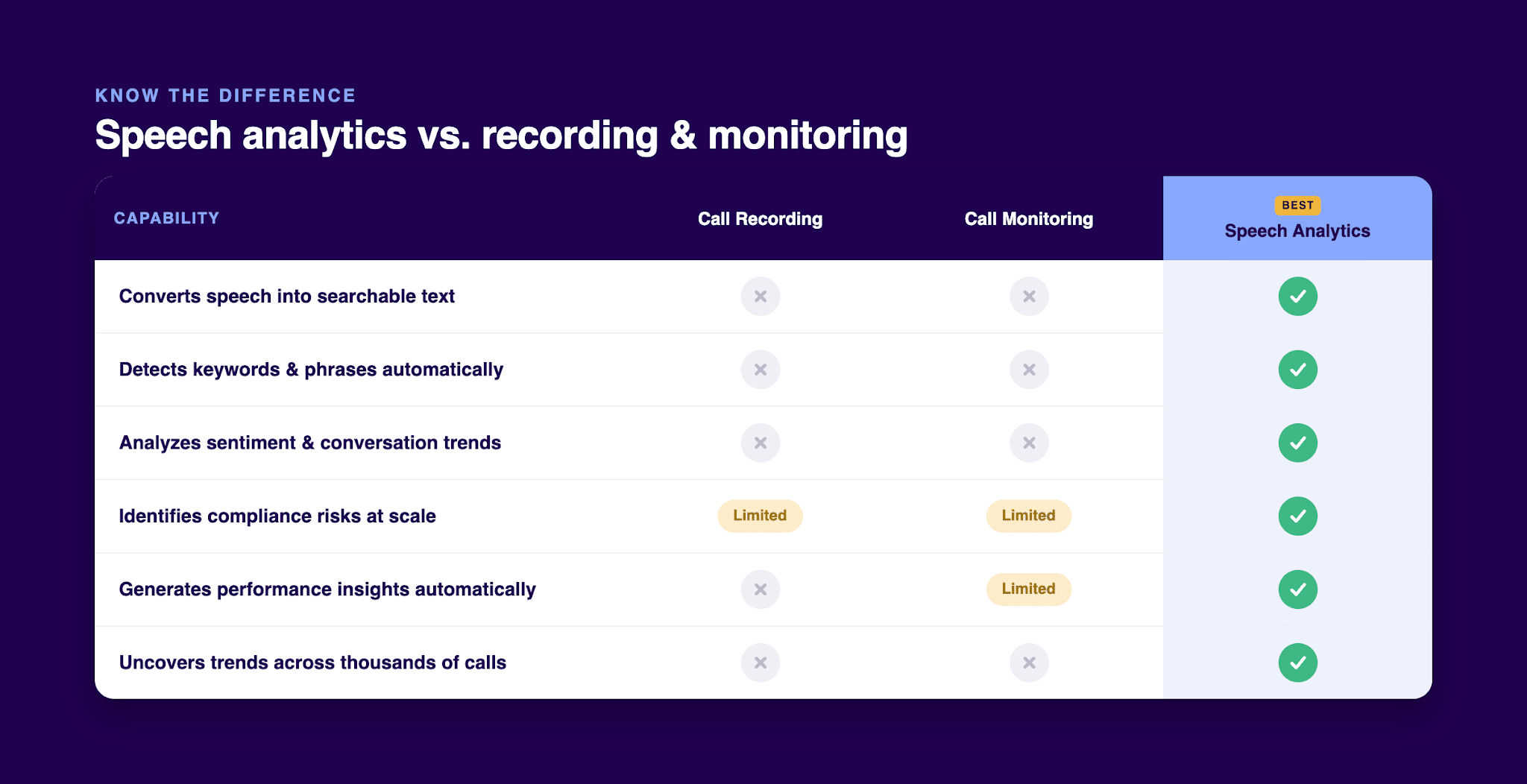
Table showing the differences between speech analytics vs. call recording and monitoring:
Speech analytics changes conversations into actionable intelligence. It allows agencies to move beyond simply listening to calls and begin understanding what those interactions reveal about performance, compliance, and consumer behavior.
In the next section, we will explore the specific benefits it brings to debt collection agencies and how those insights can improve day-to-day collection operations.
Suggested Read: 13 IVR Analytics Metrics That Reveal Gaps in Debt Collection Workflows
The greatest value of speech analytics comes from the ability to uncover patterns across thousands of interactions and turn those findings into strategic improvements. Rather than relying on assumptions, managers gain access to data that can influence compliance programs, workforce development, operational planning, and recovery strategies.
Some of the most impactful benefits include:
In the next section, we will examine how speech analytics software works in third-party debt collection, from capturing call data to transforming conversations into actionable intelligence.
Suggested Read: How Advanced Analytics Improves Credit Risk and Debt Recovery
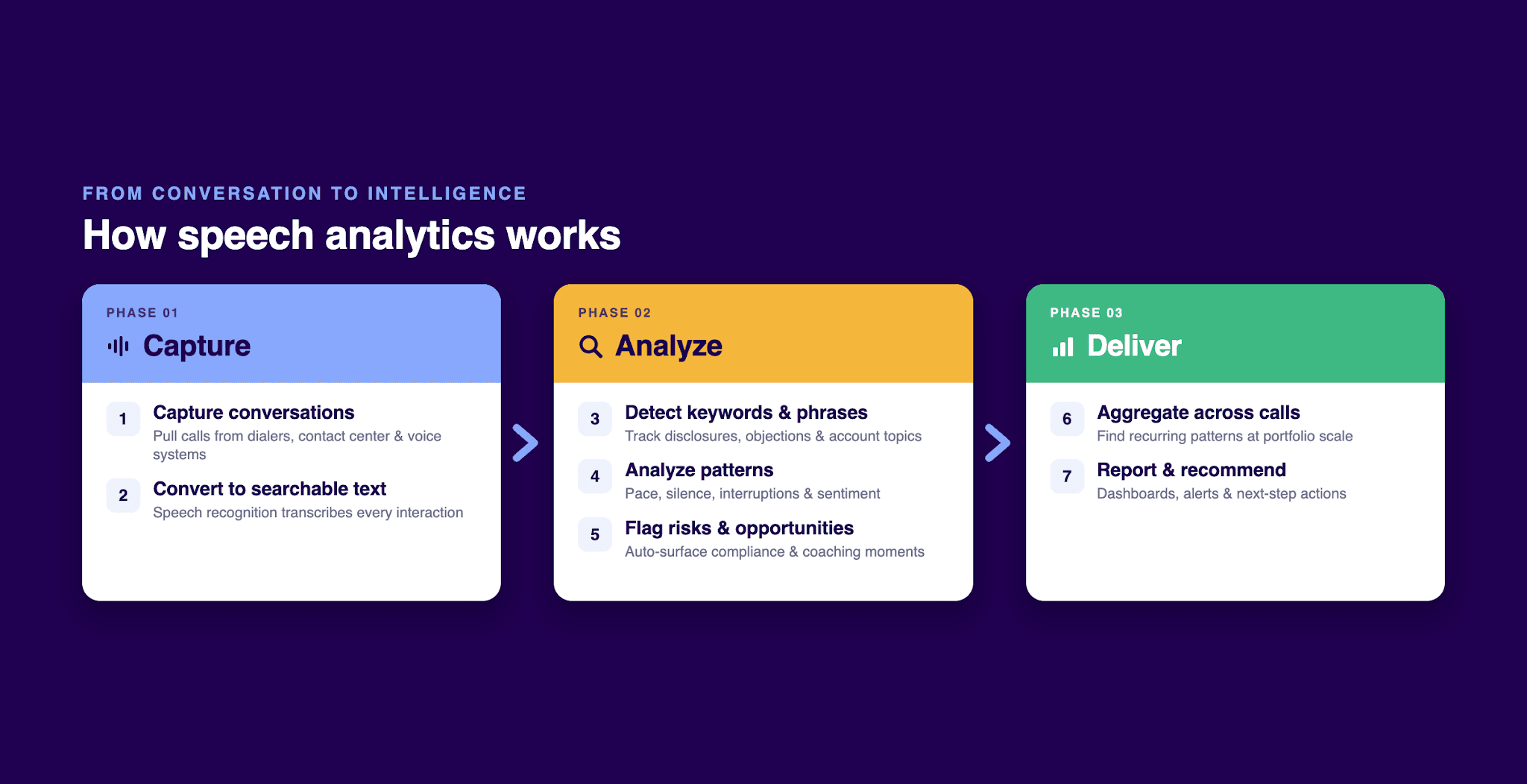
Collection agencies generate thousands of consumer interactions across portfolios, channels, and collector teams. Reviewing those conversations manually would require significant time and resources. Speech analytics for collections software automates much of this process.
The process typically follows these steps:
Some platforms focus primarily on transcription, while others provide deeper intelligence and operational insights. In the next section, we will explore the key features to look for in speech analytics software for debt collectors.
The right solution should help you move beyond listening to calls and start understanding what those conversations reveal.
When evaluating providers, pay close attention to the following features:
Speech analytics begins with accurate transcription. If conversations cannot be converted into reliable text, every downstream insight becomes less valuable. Look for solutions that make large call libraries easy to search and analyze.
Key capabilities include:
Collection agencies operate in a highly regulated environment. Identifying potential compliance issues manually can be difficult when reviewing thousands of interactions. Strong platforms continuously monitor conversations for risk indicators.
Important features include:
Words alone do not tell the full story. Consumer tone, frustration levels, and engagement patterns often provide additional context. Conversation intelligence helps agencies understand how interactions unfold.
Look for:
Top-performing agencies use conversation data to improve collector effectiveness. Analytics should support coaching efforts, not just reporting. The best solutions help managers identify specific development opportunities.
Useful features include:
Individual calls matter, but management teams often need a broader operational view. Analytics platforms should uncover patterns across entire portfolios. This helps leaders make better strategic decisions.
Look for:
Speech analytics should fit into existing collection operations. Standalone insights have limited value if teams cannot act on them efficiently. Integration capabilities often determine long-term success.
Consider features such as:
In the next section, we will look at several speech analytics platforms commonly used in collections and regulated contact center environments.
Suggested Read: Understanding Debt Collection Analytics And Its Role In Recovery
Several speech analytics providers offer features that help agencies analyze conversations, monitor compliance, and improve collector performance. While many of these platforms serve multiple industries, they are commonly used in collections and other highly regulated contact center environments.
Here are three widely recognized solutions.
CallMiner is one of the most established speech analytics platforms in the collections industry. It uses AI-powered conversation intelligence to analyze interactions, identify compliance risks, monitor agent performance, and uncover operational trends. The platform also has a strong track record among third-party collection agencies and accounts receivable management organizations.
Best For: Agencies seeking a collections-focused speech analytics solution with strong compliance and coaching capabilities.
Verint provides speech analytics, transcription, conversation monitoring, and compliance intelligence for contact centers. Its platform helps organizations identify trends across large volumes of interactions while supporting quality assurance and regulatory oversight. Verint is frequently used in financial services and other industries with strict compliance requirements.
Best For: Large organizations that require enterprise-scale analytics and compliance monitoring.
NICE combines speech analytics with broader contact center intelligence capabilities. The platform helps organizations identify conversation trends, measure agent performance, and improve operational efficiency through data-driven insights. Its analytics tools are widely used across customer service, financial services, and collections environments.
Best For: Contact centers seeking speech analytics as part of a larger workforce and customer experience platform.
Speech analytics tools can help agencies understand what is happening inside collector-consumer conversations. However, identifying patterns is only part of the process. Collection agencies also need a platform that helps them act on those insights through outreach, payment resolution, workflow automation, and compliance-focused operations.
Tratta provides the operational infrastructure agencies need to execute collection strategies. With omnichannel communications, payment IVR, consumer self-service tools, campaign management, reporting, and compliance-focused workflows, Tratta helps agencies turn insights into action across the collections lifecycle. Learn more.
The value of speech analytics extends beyond compliance monitoring and call reviews. Collection agencies use these platforms to improve decision-making, strengthen operations, and gain a clearer understanding of consumer interactions at scale.
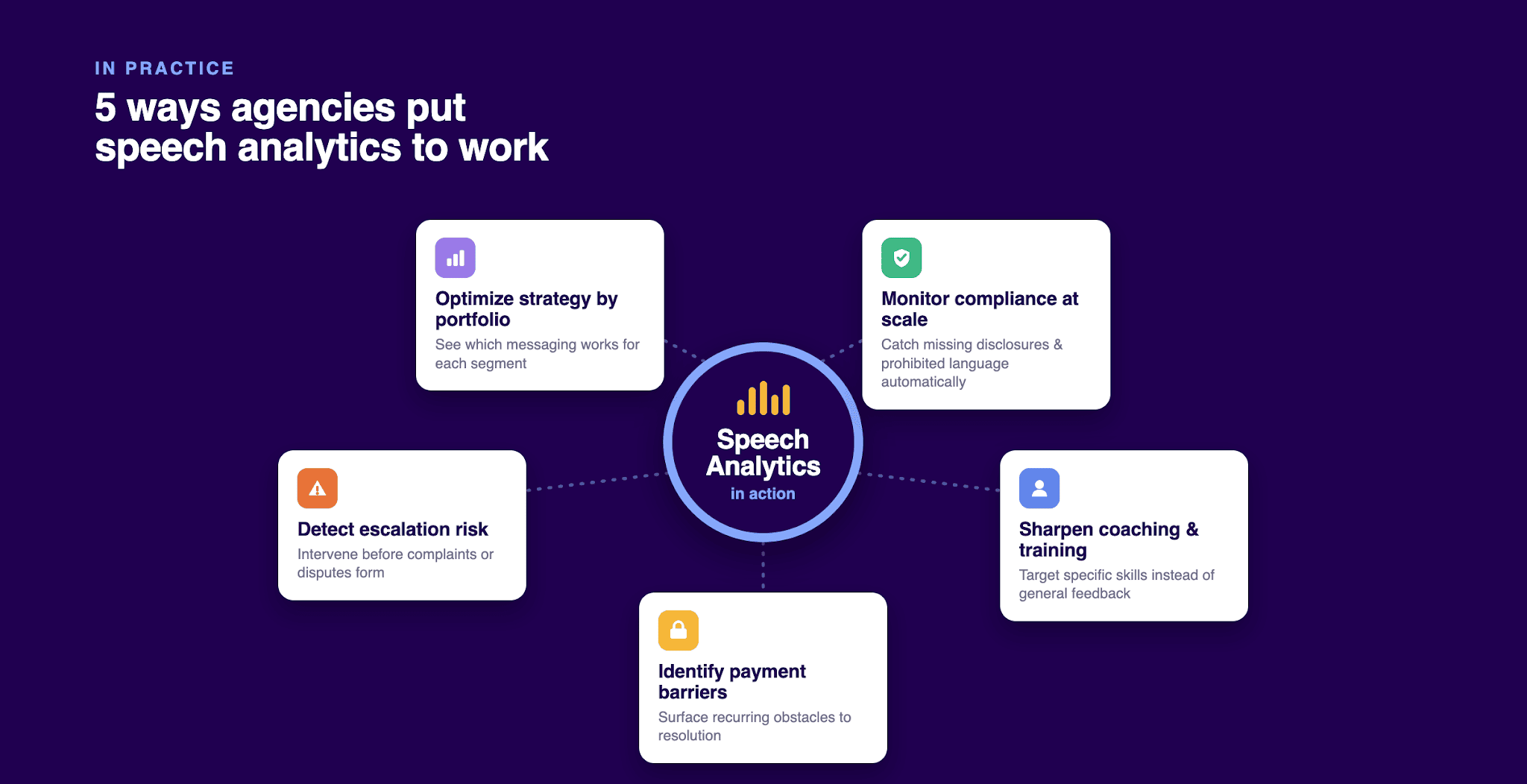
Some of the most common applications include:
These use cases demonstrate how speech analytics can improve visibility into collection operations. However, insights alone do not drive recoveries.
Agencies also need systems that help translate those findings into consumer engagement, payment opportunities, and operational action. In the next section, we will explore how to support speech analytics with the right collection operations platform.
Tratta is a cloud-based debt collection platform built for third-party collection agencies, debt buyers, law firms, and creditors. It helps organizations execute communication, payment, compliance, and workflow strategies after speech analytics identifies opportunities for improvement.
When paired with speech analytics, Tratta helps agencies operationalize insights instead of leaving them trapped inside reports and dashboards. Teams can turn conversation intelligence into measurable actions that support recovery performance, consumer engagement, and compliance goals.
These features include:
Speech analytics helps agencies understand the conversations happening across their portfolios. Collection operations platforms help agencies act on those insights. Together, they create a stronger base for improving consumer engagement, operational efficiency, compliance oversight, and recovery performance.
Without visibility into consumer conversations, collection agencies often make decisions based on assumptions rather than evidence. Compliance risks can go unnoticed, coaching opportunities may be missed, and recurring payment barriers can remain unresolved. These issues can affect recovery performance, operational efficiency, and the consumer experience.
Speech analytics helps agencies understand what is happening across thousands of interactions. However, insights alone do not improve outcomes. Agencies also need the ability to turn those findings into action.
Tratta provides the operational framework to do exactly that. It helps through omnichannel communications, self-service payments, campaign management, reporting, and compliance-focused workflows.
See how a single collections platform supports consumer engagement and payment resolution. Request a demo to explore how Tratta fits into your collections strategy.
Speech analytics software for debt collectors uses AI, speech recognition, and natural language processing to analyze collection calls. It helps agencies identify compliance risks, monitor agent performance, uncover payment barriers, and gain insights from consumer conversations at scale.
Speech analytics for collections can automatically detect keywords, phrases, and conversation patterns associated with compliance risks. This allows agencies to review more interactions, identify potential issues earlier, and strengthen quality assurance processes.
Key features include call transcription, keyword detection, sentiment analysis, compliance monitoring, agent coaching tools, reporting dashboards, and integrations with collection platforms. The best solutions also provide portfolio-level insights that support operational decision-making.
Yes. Speech analytics can reveal common payment objections, negotiation challenges, and communication trends across consumer interactions. Agencies can use these insights to refine outreach strategies, improve collector training, and create more effective payment resolution processes.
Call recording stores conversations for future review, while speech analytics for collections automatically analyzes those interactions. Speech analytics can identify trends, track compliance, measure sentiment, and generate actionable insights without requiring extensive manual review.