2026 Guide to Modern Messaging Compliance in Debt Collection
Compliance
2026 Guide to Modern Messaging Compliance in Debt Collection
Published on:
August 3, 2026
A single text message can create a compliance issue if consent records, disclosures, or opt-out processes are missing. As collection communications expand across digital channels, managing compliance becomes increasingly difficult. Regulators are already seeing the impact.
In 2025, they received about 113,000 robotext and robocall complaints each month and secured more than$178 million in enforcement penalties. Collection agencies face growing pressure to document communications and maintain consumer preferences.
Modern messaging compliance is no longer limited to phone calls. This guide explains the biggest compliance gaps, the risks they create, and practical strategies for strengthening communication governance across collection operations.
Quick look:
Digital communication compliance extends beyond calls. Collection agencies must manage compliance across SMS, email, voice, and other consumer communication channels.
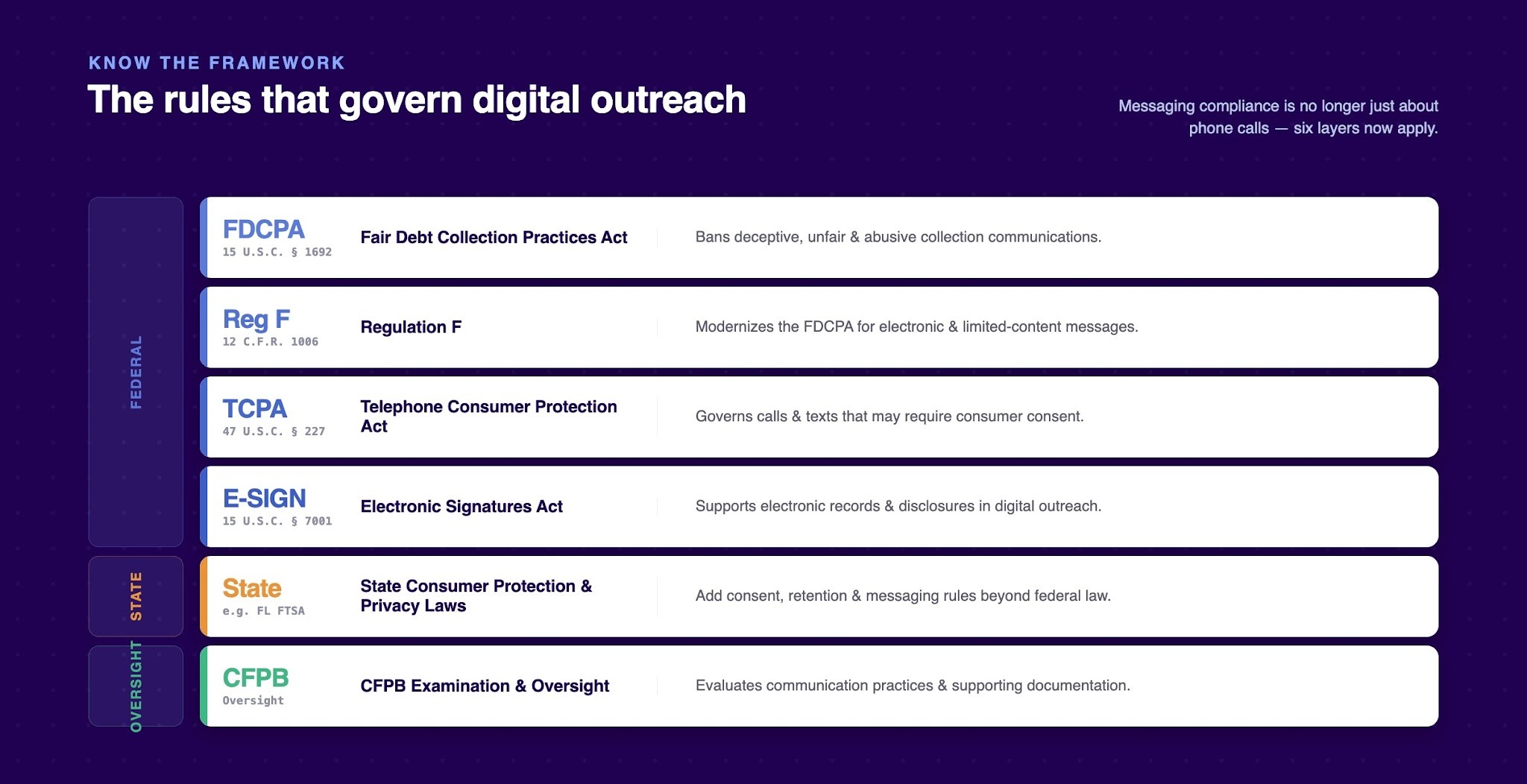
Several regulations govern collection messaging. The FDCPA, Regulation F, TCPA, E-SIGN Act, and state laws all affect digital outreach practices.
Consent, opt-outs, and recordkeeping remain common risk areas. Missing documentation and inconsistent processes can increase compliance exposure.
Strong communication governance reduces operational risk. Standardized workflows, monitoring, audits, and staff training help support compliant outreach.
Technology improves oversight and documentation. Centralized communications, reporting, automation, and audit trails can strengthen compliance management across collection operations.
What Digital Communication Compliance Means for Collection Agencies
Digital communication compliance refers to the rules governing consumer outreach through SMS, email, voice, and other digital channels. Collection agencies must follow these requirements while maintaining accurate records and respecting consumer preferences.
Key elements of digital communication compliance include:
Consent Management: Agencies should document consent before sending communications through regulated channels.
Opt-Out Processing: Consumer opt-out requests should be captured and honored promptly.
Required Disclosures: Collection communications should contain appropriate disclosures when regulations require them.
Communication Frequency Controls: Outreach activity should align with applicable contact restrictions.
Recordkeeping and Documentation: Agencies should maintain communication records for audits and regulatory reviews.
Consumer Preference Management: Communication preferences should remain consistent across channels.
Communication Monitoring: Agencies should review outreach activity to identify potential compliance issues.
Communication compliance touches every stage of consumer outreach. Specific requirements vary across regulations, making a clear understanding of the governing rules essential. In the next section, we examine the regulations shaping digital collection messaging requirements for collection agencies.
Regulations Shaping Digital Collection Messaging Requirements for Collectors
Digital collection communications are governed by multiple federal and state regulations. Each rule affects how collection agencies manage outreach, consent, disclosures, and consumer preferences.
Regulations are:
Fair Debt Collection Practices Act (FDCPA) (15 U.S.C. § 1692 et seq.) TheFDCPA establishes standards for third-party debt collection communications. It prohibits deceptive, unfair, and abusive collection practices.
Regulation F (12 C.F.R. Part 1006) Regulation F modernized FDCPA implementation for today's communication environment. It addresses electronic communications, limited-content messages, and consumer communication preferences.
Telephone Consumer Protection Act (TCPA) (47 U.S.C. § 227) TheTCPAregulates calls and text messages that may require consumer consent. Strong consent management processes can help reduce exposure to TCPA-related disputes.
Electronic Signatures in Global and National Commerce Act (E-SIGN Act) (15 U.S.C. § 7001 et seq.) The E-SIGN Act supports electronic records and disclosures in digital interactions. Collection agencies using electronic communications should maintain proper documentation practices.
State Consumer Protection and Privacy Laws States continue introducing messaging and privacy requirements beyond federal regulations. These rules can affect consent management, record retention, and communication practices. For instance, the Florida Telephone Solicitation Act (FTSA) remains a key compliance consideration for text messaging programs.
Consumer Financial Protection Bureau (CFPB) Oversight CFPB examinations often evaluate communication practices and supporting documentation. Agencies should maintain records demonstrating compliance controls and operational oversight.
Regulatory obligations continue expanding as digital communication channels change. Tracking requirements across multiple systems can create unnecessary complexity.
Tratta helps collection agencies centralize communication records, manage consumer preferences, and document outreach activity. Its omnichannel communications, reporting, and audit trail capabilities support stronger communication governance across collection operations.Schedule a free demo today.
The Biggest Modern Messaging Compliance Gaps in Debt Collection
Most compliance failures occur when communication processes fail to keep pace with digital outreach. As collection agencies adopt more communication channels, maintaining consistent compliance becomes increasingly difficult.
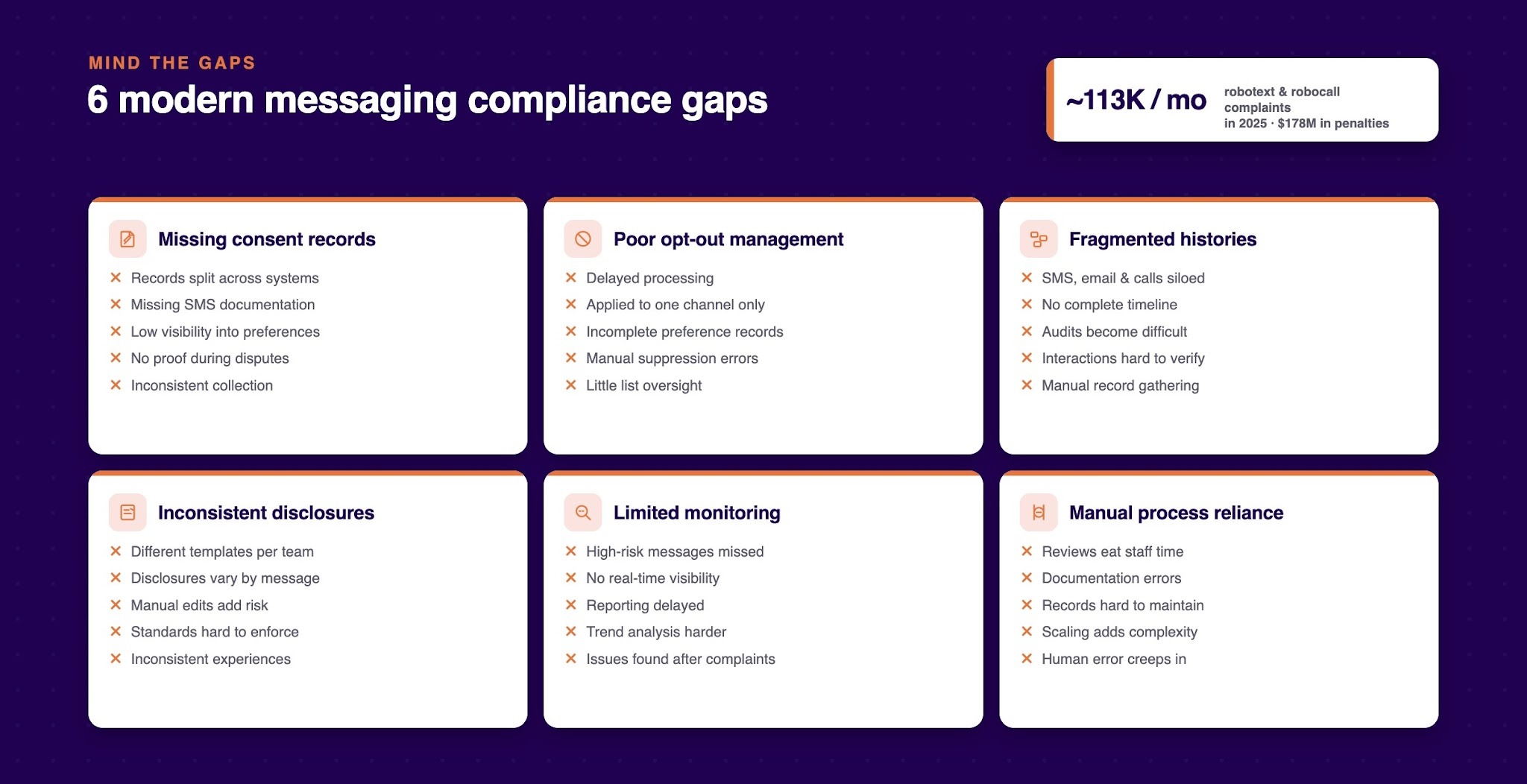
These are the top compliance gaps in modern debt collection messaging:
1. Missing or Incomplete Consent Records
Common consent management challenges include:
Consent records stored across multiple systems.
Missing documentation for SMS communications.
Limited visibility into consumer communication preferences.
Difficulty proving consent during disputes or audits.
Inconsistent consent collection procedures.
2. Poor Opt-Out Management
Several issues contribute to this gap:
Delayed processing of opt-out requests.
Opt-outs applied to one channel but not others.
Incomplete consumer preference records.
Manual tracking processes that increase errors.
Limited oversight of suppression lists.
3. Fragmented Communication Histories
Communication records often become disconnected:
SMS, email, and call records remain in separate systems.
Teams lack a complete communication timeline.
Documentation becomes difficult during audits.
Consumer interactions are harder to verify.
Compliance reviews require manual record gathering.
These gaps often develop gradually as communication programs expand. Unfortunately, even small weaknesses can create significant compliance exposure. In the next section, we examine the risks associated with non-compliant consumer outreach for collection agencies.
Risks Associated With Non-Compliant Consumer Outreach for Agencies
Non-compliant communications can create consequences beyond regulatory scrutiny. A single oversight may trigger complaints, litigation, operational disruption, and reputational damage. Recent TCPA litigation involving unwanted text messages resulted in a$1.99 million settlement affecting more than 71,000 consumers.
Key risks include:
FDCPA Lawsuits and Statutory Damages: Violations of the FDCPA (15 U.S.C. § 1692k) can result in statutory damages, legal expenses, and increased scrutiny. Communication errors often become central issues in consumer lawsuits.
TCPA Litigation Exposure: The TCPA (47 U.S.C. § 227) remains one of the most litigated communication statutes. Missing consent records or improper text messaging practices can increase legal risk.
Regulation F Compliance Violations: Regulation F establishes requirements for modern collection communications. Documentation gaps can make compliance efforts difficult to demonstrate.
Consumer Complaints and Regulatory Investigations: Communication issues can generate complaints to regulators and consumer protection agencies. Investigations frequently require extensive documentation and record production.
Operational Disruptions: Compliance failures often require policy reviews, workflow changes, and corrective actions. These efforts can divert resources from core collection activities.
Reputational Damage: Consumer complaints and enforcement actions can affect agency credibility. Trust becomes more difficult to maintain when communication practices are questioned.
The good news is that many of these risks are preventable. Strong communication governance, documentation practices, and operational controls can reduce compliance exposure significantly. In the next section, we examine best practices for managing compliant collection communications.
7 Best Practices for Managing Compliant Collection Communications
Compliance programs are most effective when they combine policies, processes, and technology. Collection agencies should build communication controls that support consistency across every outreach channel.
The following practices can help strengthen communication and governance and reduce regulatory risk.
Maintain Comprehensive Consent Records: Consent documentation should be accessible, accurate, and easy to verify. Centralized records can simplify audits and dispute resolution.
Standardize Communication Templates: Approved templates help promote consistency across SMS, email, and other channels. Standardization can also reduce manual messaging errors.
Honor Opt-Out Requests Promptly: Consumer preferences should be updated without delay. Effective opt-out management helps reduce communication-related complaints.
Centralize Communication Histories: A complete communication record improves visibility and accountability. Centralized records also support regulatory reviews and investigations.
Conduct Regular Compliance Audits: Routine audits can identify gaps before they become larger issues. Ongoing reviews support continuous improvement efforts.
Use Automated Compliance Controls: Automation can reduce reliance on manual processes. It also helps promote greater consistency across collection operations.
Document Policies and Procedures: Written policies provide a framework for communication activities. Documentation also demonstrates a commitment to compliance management.
Communication compliance depends on more than policies alone. Collection agencies also need visibility into how outreach occurs across channels.
Tratta helps centralize consumer communications, reporting, and operational workflows within a single platform. This allows teams to review communication activity more efficiently, maintain documentation, and support audit readiness as outreach volumes grow.Contact us to learn more.
8-Step Digital Communication Compliance Checklist for Collection Agencies
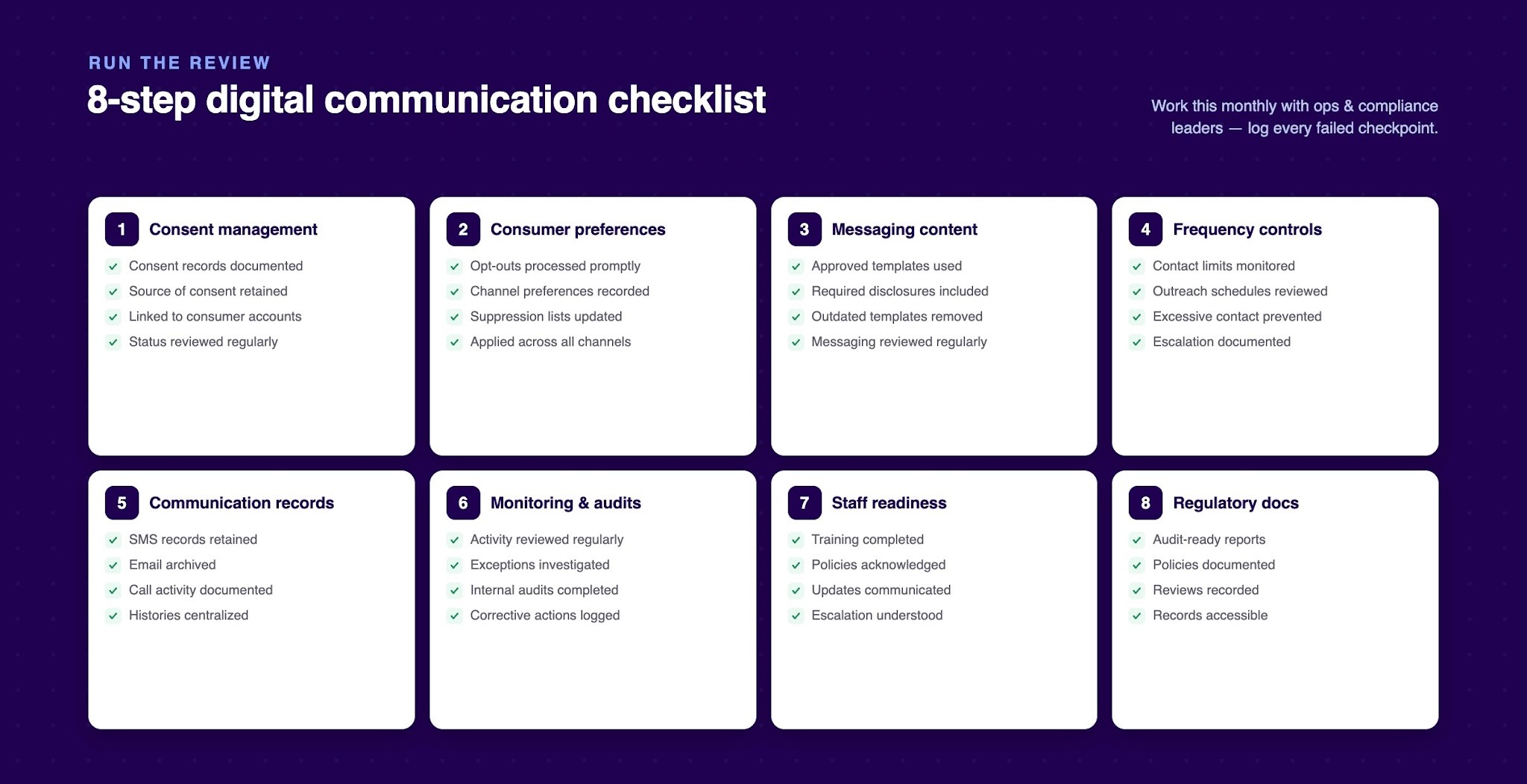
Communication compliance requires consistent execution across every channel. Thischecklist can help collection managers review whether the agency's messaging program aligns with operational and regulatory expectations. It covers the core areas that should be monitored on an ongoing basis.
Checklist:
Step
Compliance Area
Checklist Items
1
Consent Management
✓ Consent records documented
✓ Source of consent retained
✓ Records linked to consumer accounts
✓ Consent status regularly reviewed
2
Consumer Preferences
✓ Opt-out requests processed promptly
✓ Channel preferences recorded
✓ Suppression lists updated
✓ Preferences applied across all channels
3
Messaging Content
✓ Approved templates used
✓ Required disclosures included
✓ Outdated templates removed
✓ Messaging reviews conducted regularly
✓ Audit-ready reports available
✓ Policies documented
✓ Compliance reviews recorded
✓ Supporting records easily accessible
The checklist should become part of routine compliance reviews. Consistent use can help identify weaknesses before they develop into larger compliance issues.
You should:
Review checklist results monthly with operations and compliance leaders.
Document any failed checkpoints and assign corrective actions.
Prioritize high-risk communication issues for immediate remediation.
Track recurring findings across review periods.
Communication compliance is easier to manage when expectations are clear and measurable. The right technology can also improve visibility across messaging activities. In the next section, we examine how Tratta helps improve communication compliance across channels for collection agencies.
Tratta Helps Improve Communication Compliance Across Channels for Collectors
Tratta is a debt collection software platform built for third-party collection agencies. The platform combines communications, payments, workflows, reporting, and consumer engagement tools in a centralized environment. This helps agencies manage communication activity more consistently across multiple outreach channels.
Key features that support communication compliance include:
Omnichannel Communications: Manage SMS, email, voice, and other communication channels from a single platform. Centralized outreach improves visibility into consumer interactions.
Tratta Campaigns: Create and manage communication campaigns using structured workflows. Standardized processes can help reduce inconsistencies across outreach programs.
Consumer Self-Service Portal: Allow consumers to engage through a secure digital experience. Self-service interactions are documented within the platform.
Multilingual IVR Payment Solutions: Provide consumers with secure payment options through automated voice technology. Automated workflows help maintain consistency across payment-related interactions.
Contact Center: Give agents access to communication tools and account information within one system. Improved visibility supports more informed consumer interactions.
Reporting and Analytics: Monitor communication activity through configurable reporting tools. Greater visibility can help identify trends and potential compliance concerns.
Payments and Merchant Services: Consolidate payment-related activity within the collection workflow. Centralized records improve operational transparency.
Security and Compliance: Support data protection efforts through security controls and compliance-focused infrastructure. Secure systems help protect consumer information.
Integrations: Connect collection operations with external systems and data sources. Consistent data flow can reduce recordkeeping challenges.
Customization and Flexibility: Configure workflows, communication processes, and operational settings to match agency requirements. Greater flexibility helps teams implement compliance controls that align with internal policies and regulatory obligations.
Communication compliance becomes more challenging as outreach channels multiply. Agencies need visibility, documentation, and operational consistency to manage risk effectively. Tratta brings communications, workflows, reporting, and consumer interactions together to support stronger communication governance across collection operations.
Conclusion
Communication compliance gaps can create significant challenges for collection agencies. Missing consent records, poor documentation, inconsistent disclosures, and unmanaged opt-outs can increase regulatory and legal exposure. As communication channels continue expanding, maintaining oversight becomes increasingly difficult.
Tratta helps collection agencies manage communications, workflows, reporting, and consumer interactions within a centralized platform. Its omnichannel communication capabilities, automation tools, audit trail visibility, and reporting features support stronger control.
Communication compliance requires more than periodic reviews. It requires ongoing visibility, documentation, and control. Request a free demo to help strengthen communication governance across every consumer touchpoint.
Frequently Asked Questions
1. What is modern messaging compliance in debt collection?
Modern messaging compliance refers to following regulatory requirements when communicating with consumers through SMS, email, voice, and other digital channels. It includes consent management, opt-out processing, recordkeeping, disclosures, and communication monitoring.
2. Which regulations affect digital communications in debt collection?
Several regulations affect digital collection communications, including the FDCPA, Regulation F, TCPA, E-SIGN Act, and various state consumer protection laws. Collection agencies should also monitor state-specific messaging requirements.
3. Why is consent management important for collection agencies?
Consent records help demonstrate that communications were sent appropriately. Poor consent documentation can increase regulatory scrutiny and litigation risk, especially for text messaging programs.
4. What are the biggest modern messaging compliance challenges for collection agencies?
Common challenges include managing consent records, honoring opt-out requests, maintaining communication histories, monitoring outreach activity, and keeping pace with changing regulations.
5. How can collection agencies improve communication compliance across channels?
Collection agencies can improve compliance by centralizing communication records, standardizing messaging processes, conducting regular audits, monitoring outreach activity, and using technology to support communication governance.
Note: This information is not legal advice. Tratta recommends that you consult with your legal counsel to make sure that you comply with applicable laws in connection with your collection and outreach activities.
Sign up for our monthly newsletter
Debt collection insights that keep you compliant and competitive.
Thank you! Your submission has been received!
Oops! Something went wrong while submitting the form.