Debt collection seasonal trends directly shape recovery performance, yet many collection agencies still operate as if each month presents the same recovery dynamics. In reality, consumer payment behavior shifts predictably throughout the year, creating both challenges and opportunities for agencies that plan around these cycles.
During tax season, for example, millions of consumers receive refunds that temporarily increase their ability to resolve outstanding balances. In FY 2024 alone, the IRS issued over $256 billion in tax refunds, highlighting the scale of liquidity entering households within a short window. For third-party agencies, this means a concentrated window where:
The challenge is planning agency operations around them. Staffing, payment infrastructure, campaign timing, client reporting, and payment options all need to align with when consumers are most likely to have the capacity and willingness to resolve balances.
This article breaks down how third-party collection agencies can plan campaigns, payment options, self-service workflows, staffing, and client reporting around the key seasonal recovery periods that drive performance.
Seasonality does more than shift collection volume. It directly affects how, when, and how much you recover. For operations leaders, understanding these patterns is critical to setting realistic targets and maintaining control over performance.
Recovery rates fluctuate throughout the year because consumer ability and willingness to pay are not constant. Payment behavior is closely tied to income cycles, expenses, and external events. Tax season increases liquidity and drives higher settlement rates, while post-holiday periods reduce disposable income and slow recovery. Summer months tend to lower engagement and push payments further out.
The practical implication is that the same outreach strategy can produce very different results depending on when it's deployed. Recovery timelines for similar accounts may vary by season, not by account quality. A portfolio may show stronger recovery in Q1 compared to Q3, not because the accounts are better, but simply because consumers have more available funds earlier in the year.
Seasonal recovery patterns directly influence cash flow predictability for both collection agencies and creditors. When recovery slows, incoming cash decreases even if account volume stays stable. During peak periods, cash inflow can surge within a short window, creating uneven cycles that are difficult to plan around.
This matters for two reasons. First, agencies must manage operating costs despite inconsistent recovery cycles. Second, creditors depend on predictable remittance timelines for financial planning. Neither can afford to treat average performance as a reliable baseline. Staffing, vendor costs, and payment processing capacity all need to be aligned with anticipated peaks and dips, not month-over-month averages.
Ignoring seasonality can lead to incorrect conclusions about performance, strategy, and team effectiveness. Without seasonal context, a dip in recovery may be mistaken for poor execution, while a spike gets over-attributed to a strategy improvement. The result is KPIs being evaluated inconsistently across months, leading to decisions based on noise rather than signal.
Consider a common scenario: an operations leader adjusts outreach strategy in July after seeing lower recovery rates, when the decline is driven entirely by seasonal engagement patterns, not process failure. The intervention wasn't needed, but without the seasonal lens, it looks like a reasonable response.
To avoid this, performance benchmarking should be period-adjusted, comparing year-over-year by month rather than month-over-month within the same year. Strategy changes should be tested against seasonal baselines, not short-term fluctuations that may have nothing to do with execution.
Seasonal financial stress patterns are also reflected in national data. According to the Federal Reserve, household debt service ratios (DSR) and financial obligations (FOR) show consistent quarterly variation, with obligations typically rising through the year as expenses accumulate and easing in earlier quarters when liquidity improves.
This pattern aligns with collection cycles, with stronger recovery during early-year liquidity windows and tighter consumer capacity later, reinforcing why performance should be evaluated in a seasonal rather than monthly context
Suggested Read: What is Collection Analytics? Benefits and Insights, to increase the accuracy of your data-driven decisions.
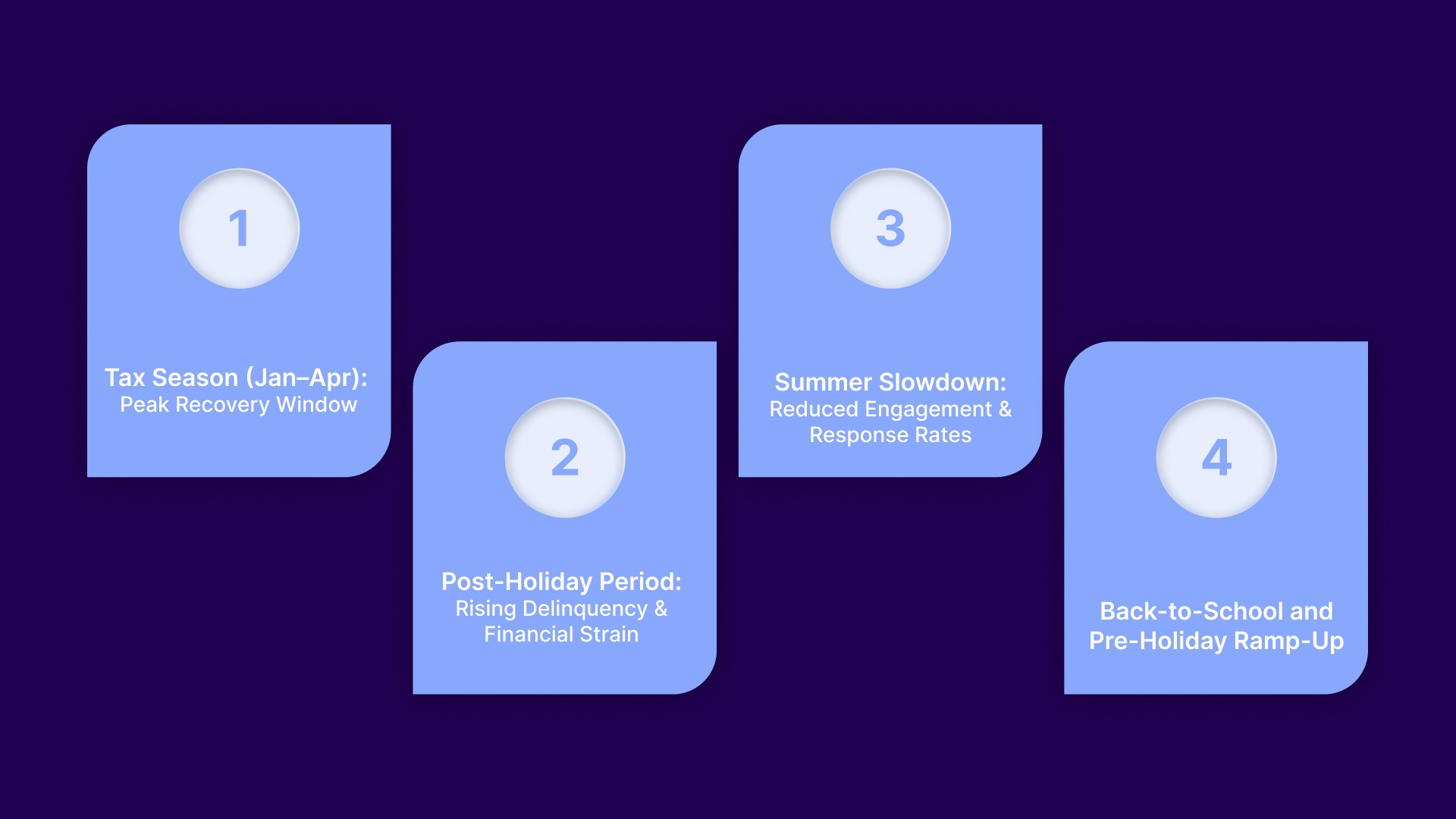
Debt collection seasonal trends follow predictable points in the calendar where consumer cash flow and attention shift. For operations leaders, these cycles define when recovery efforts are most effective and when strategy needs to adjust to avoid wasted effort.
Tax season is typically the strongest recovery period due to increased consumer liquidity from refunds.
Between January and April, many consumers receive federal and state tax refunds. This creates a short but high-impact window where:
Operational implications:
After the holiday season, delinquency increases as consumers deal with higher spending and reduced liquidity.
In January, many consumers face:
This leads to increased account inflow but weaker immediate recovery performance.
Operational implications:
Retail-linked portfolios often see a surge in delinquencies post-holidays, with lower early engagement unless messaging is adjusted toward flexible repayment options.
Summer months typically bring lower engagement due to lifestyle changes and reduced availability.
From June through August:
Operational implications:
Outbound call campaigns may see declining right-party contact rates despite consistent dialing effort.
Late Q3 and early Q4 introduce competing financial priorities that reduce payment consistency.
During this period:
Operational implications:
Portfolios with a high concentration of family households may show reduced payment activity in August and September due to back-to-school expenses.
The real value of understanding seasonality is translating that knowledge into operational strategy. Here is how agencies can move from recognizing seasonal trends to planning around them:
Rather than applying a one-size-fits-all strategy year-round, match outreach intensity and payment offerings to when consumers are most likely to have the ability to pay:
Not all accounts respond the same way to seasonal trends. Use historical data to identify:
This segmentation helps agencies focus effort where it matters most and avoid wasting contact attempts on accounts unlikely to respond in the current season.
Peak recovery windows, like tax season, are time-sensitive. Outdated or incomplete contact data means calls go unanswered, messages fail to reach consumers, and high-intent payment opportunities are missed.
Best practice: Treat data hygiene as a pre-season operational task. Refresh contact records ahead of known high-liquidity periods. Scheduling campaigns around known refund deposit windows can meaningfully improve engagement without increasing campaign cost.
Seasonal demand shifts often create a mismatch between workload and operational readiness. The solution is proactive planning, not reactive staffing:
One of the most valuable benefits of seasonal planning is better client communication. Rather than presenting month-to-month KPIs, provide clients with:
Many agencies recognize these patterns but struggle with execution. See how Tratta helps teams turn seasonal insights into consistent, measurable results.
Seasonal trends do not impact all portfolios the same way. Payment behavior varies by industry depending on billing cycles, consumer obligations, and revenue patterns.
Insurance deductibles reset in January, pushing new balances into the system as patients absorb a larger share of costs. This creates a surge in early-stage accounts with delayed payments, not low intent.
Post-holiday outreach should prioritize payment plans. Tax season is the key window for resolving larger balances.
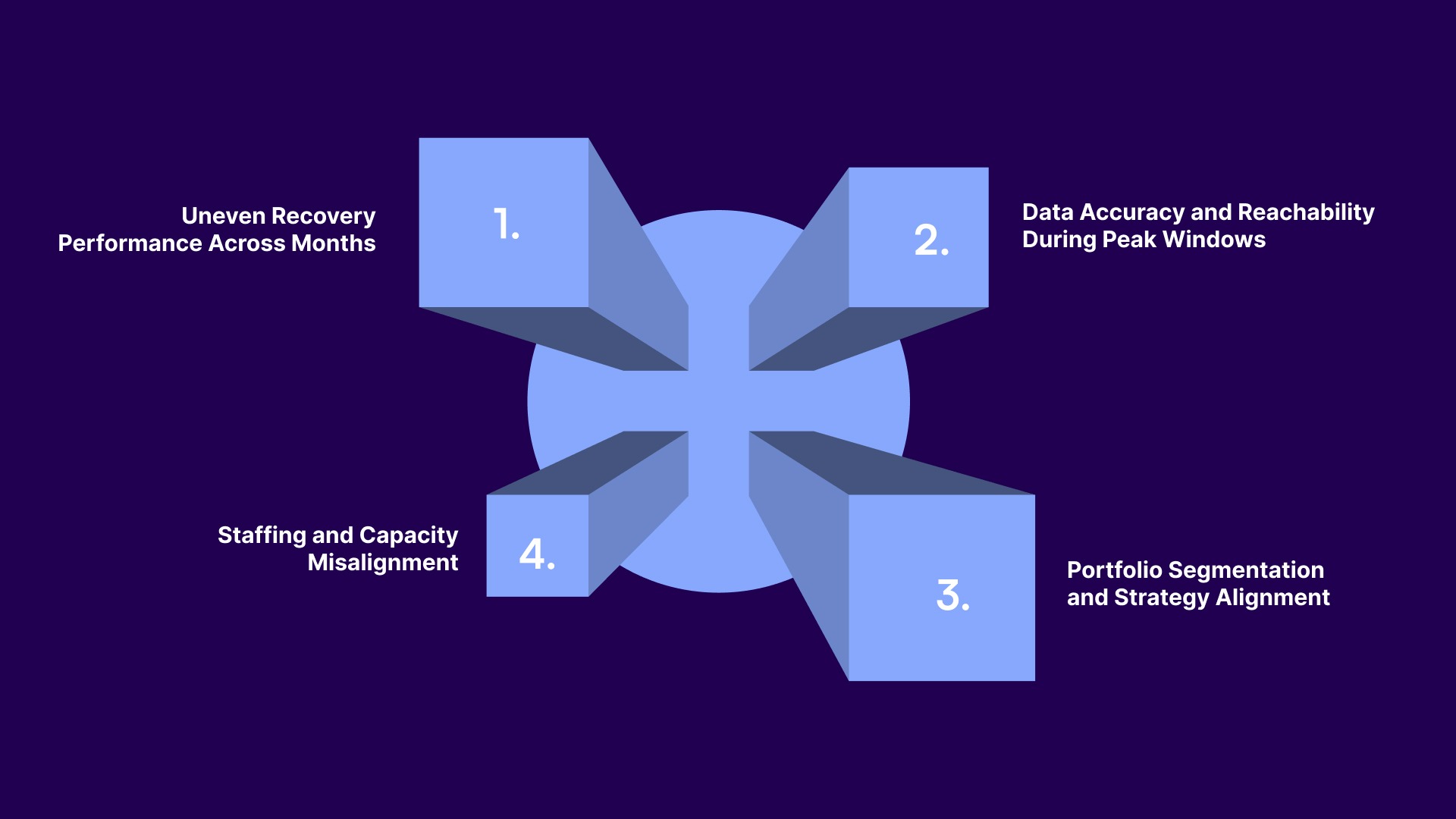
Seasonal shifts introduce operational strain across recovery workflows. The challenge for collection agencies is not recognizing seasonality, but managing its impact without losing consistency or control. Below are the key pressure points and how to address each one.
Recovery rates, right-party contact rates, and liquidation metrics can fluctuate significantly depending on the time of year, not just portfolio quality. This makes month-to-month KPIs difficult to interpret, forecasting less reliable, and can lead teams to overcorrect strategy based on short-term dips or spikes.
To address this, outreach should align with when consumers are most likely to have the ability to pay, not just when accounts enter collections:
This improves response rates without increasing overall outreach volume and makes performance benchmarks more meaningful when viewed in seasonal context.
Peak recovery windows such as tax season are time-sensitive. Outdated or incomplete contact data means calls go unanswered, messages fail to reach consumers, and high-intent payment opportunities are missed.
A portfolio with stale phone or email data may underperform during tax season, even when consumers are financially capable of resolving balances.
Agencies should treat data hygiene as a pre-season operational task, ensuring contact records are refreshed ahead of known high-liquidity periods.
Scheduling SMS and email campaigns around known refund deposit windows, with accurate data in place, can meaningfully improve engagement without increasing campaign cost.
Not all accounts respond the same way to seasonal trends, and applying a uniform strategy across a portfolio reduces efficiency. Agencies that use historical data to identify which accounts respond during tax season, which segments are sensitive to financial strain periods, and which require long-term arrangements can apply more targeted outreach and reduce unnecessary contact attempts.
A practical segmentation approach:
Payment strategies should also reflect seasonal shifts in consumer financial flexibility. During high-liquidity periods, settlement offers and lump-sum options are more feasible.
During constrained periods such as post-holidays, smaller installments and extended plans tend to perform better. Aligning the offer to the consumer's likely capacity reduces drop-off rates during payment negotiations.
Suggested Read: Guide to Predictive Scoring and Segmentation For Debt Recovery
Seasonal demand shifts often create a mismatch between workload and operational readiness. During high-volume periods, teams may be understaffed to handle increased engagement and payment processing systems may face bottlenecks.
During slower periods, resources may be underutilized, and outreach efforts lose efficiency. An agency may increase outreach during tax season but lack the internal capacity to handle inbound payment requests quickly, leading to drop-offs.
Staffing and system capacity should be planned proactively against expected seasonal demand rather than adjusted reactively. Agencies can anticipate:
Increasing agent availability and confirming payment systems are fully operational before peak windows prevents missed recovery opportunities and ensures a more consistent consumer experience throughout the year.
Understanding seasonal trends is one thing; executing consistently around them is another. Tratta provides collection agencies with the operational infrastructure, visibility, and data-driven workflows needed to manage multiple client portfolios through seasonal recovery cycles effectively.
Tratta's reporting helps agencies contextualize performance data by season rather than making month-to-month comparisons that obscure seasonal patterns. Agencies can:
This enables agencies to confidently explain expected performance dips to clients rather than scrambling to account for unexpected changes.
Tratta’s consumer self-service portal captures payments 24/7 when consumers are ready to pay, particularly outside business hours. It reduces payment friction, handles summer slowdowns, and decreases inbound call volume by routing straightforward payment requests away from agents. This frees them for complex negotiations.
Tratta Campaigns allow agencies to schedule outreach aligned with seasonal behavior, customize messaging by season (tax refund windows, post-holiday periods), test messaging strategies, and track what resonates in each period. This moves agencies beyond one-size-fits-all approaches.
Payments and Merchant Services options reduce friction by simplifying checkout, enabling faster completion during peak windows, supporting multiple payment methods, and reducing abandonment. All of these are critical during high-volume periods where completion rate improvements compound across thousands of transactions.
Tratta provides visibility into portfolio performance across clients and seasons, staffing bottlenecks during peak periods, and operational metrics that distinguish seasonal factors from execution issues. This enables data-driven decision-making and confident client communication.
See how Tratta helps you plan around seasonal recovery cycles: Book a Demo.
Debt collection seasonal trends refer to predictable patterns in consumer payment behavior throughout the year, driven by factors like tax refunds, holiday spending, and income cycles. These trends influence when consumers are more likely to engage and make payments.
Recovery rates fluctuate because consumer financial capacity is not constant. Periods like tax season increase liquidity and improve payment rates, while post-holiday months often reduce disposable income, slowing recovery.
Agencies should align outreach timing, payment options, and communication channels with seasonal behavior. For example, prioritize settlements during high-liquidity periods and offer flexible payment plans during financially constrained periods.
Tax season typically delivers the highest recovery, while post-holiday and summer periods often see lower engagement. Pre-holiday months can also impact payment consistency due to competing financial priorities.
Technology platforms like Tratta help centralize reporting, enable consumer self-service payments, and support more controlled, compliance-aware workflows. This improves visibility and helps teams plan and execute strategies aligned with seasonal trends.