7 Risky Mistakes Agencies Make Under Bill Collectors Laws in 2026
Strategies for Debt Collection
7 Risky Mistakes Agencies Make Under Bill Collectors Laws in 2026
Published on:
August 3, 2026
Compliance is where most collection agencies start losing control. Quietly at first, then all at once. A missed disclosure, an extra call, or an untracked consent can quickly turn into complaints and legal exposure. According to the Consumer Financial Protection Bureau, over207,800 debt collection complaints were filed, accounting for nearly 7% of all complaints.
For collection agencies, this reflects the pressure of operating within bill collectors laws, strict collection regulations, and defined consumer rights. Even minor inconsistencies in workflows, communication, or documentation can create risk.
This blog breaks down the most common compliance failures, why they occur, what they cost, and how agencies are fixing them.
Quick look:
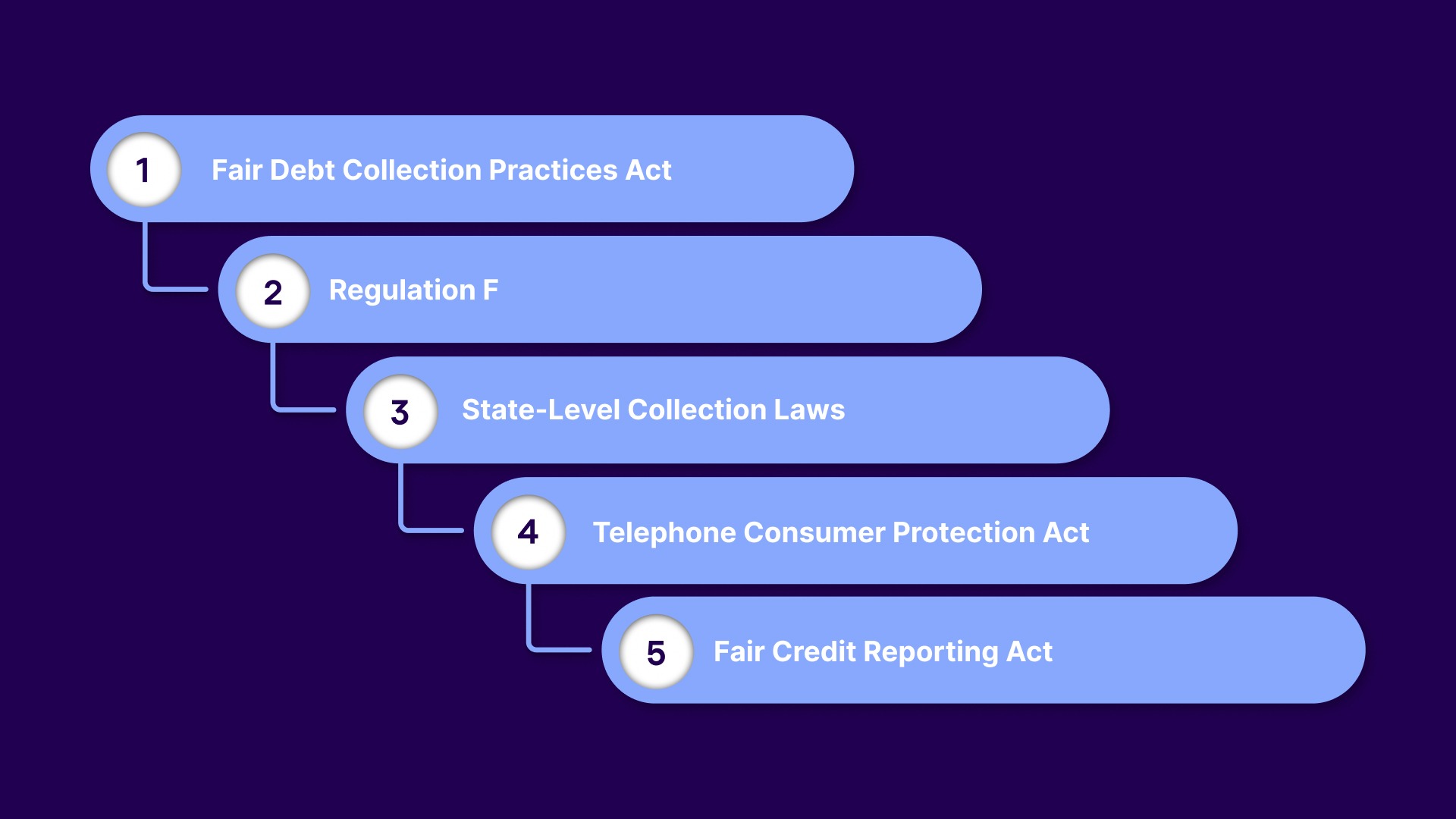
Bill collectors laws are not a single rule. Agencies operate under multiple laws like FDCPA, Regulation F, TCPA, FCRA, and state-level requirements that govern communication, validation, payments, and reporting.
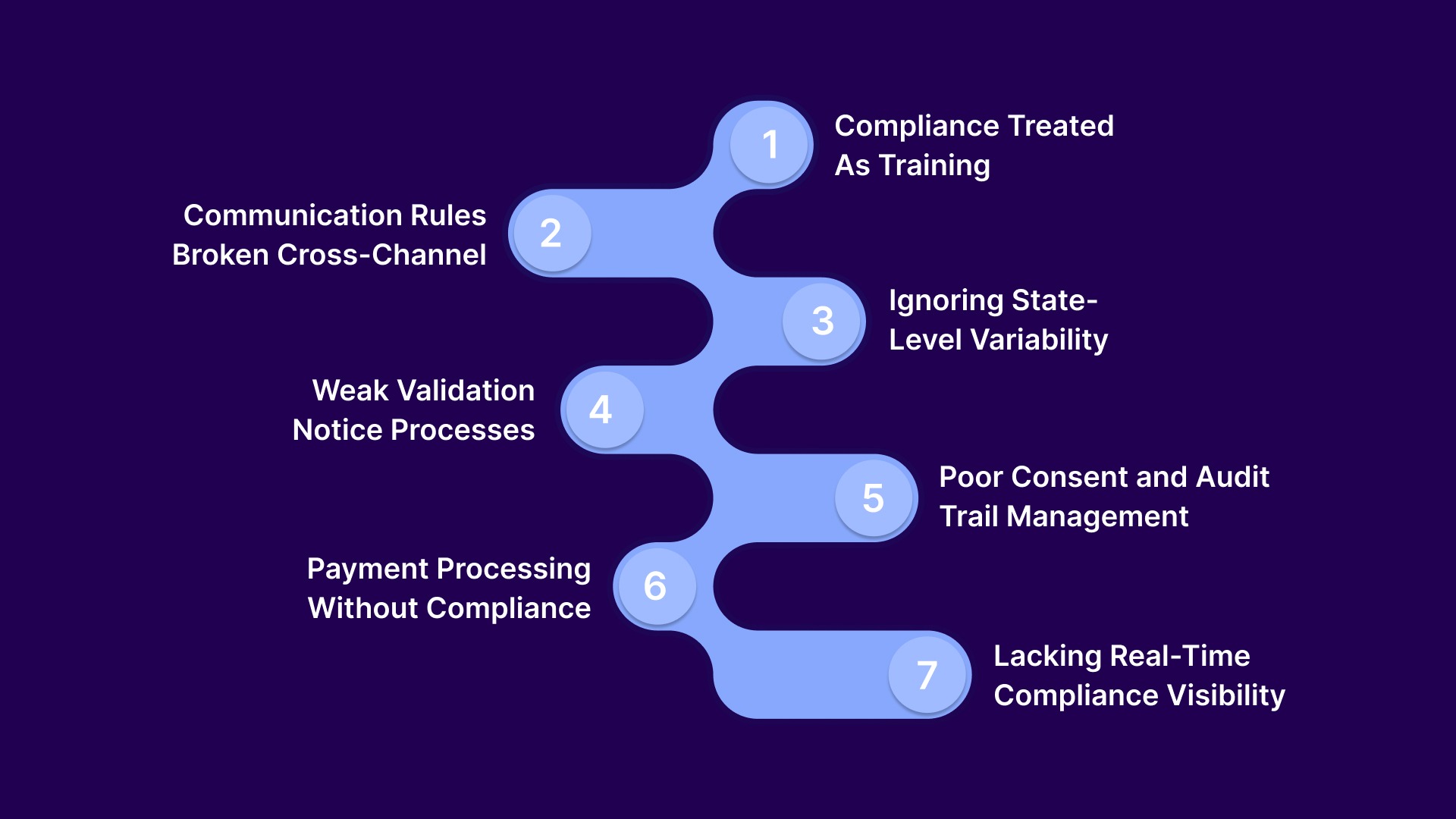
7 key compliance mistakes drive most violations. These include poor communication tracking, ignoring state differences, weak validation processes, missing consent records, payment errors, and a lack of real-time monitoring.
Systemic gaps make compliance harder. Fragmented tools, manual processes, and a lack of centralized visibility create repeated compliance breakdowns.
Workflows must be restructured, not patched. Agencies need unified communication tracking, automated notices, consent capture, state-level logic, and controlled payment processes.
Technology enables consistent compliance. Platforms like Tratta embed compliance into workflows, reduce manual errors, and help agencies operate within legal requirements at scale.
How Agencies Function Within Bill Collectors Law in 2026
Bill collection laws are not a single statute. They reflect a layered framework of federal statutes, regulatory rules, and state-level requirements that collectively govern collection activity.
For collection agencies, this means that every action in their debt collection policy regarding calls, notices, payments, and reporting must align with multiple legal obligations simultaneously.
Regulation F operationalizes the FDCPA for modern communication and introduces enforceable limits.
Agencies must:
Limit telephone contact to 7 calls within 7 consecutive days per debt (12 CFR § 1006.14(b)(2))
Not call within 7 days after having a telephone conversation about that debt
Provide a validation notice with itemized debt information (12 CFR § 1006.34)
Include opt-out instructions for electronic communications (12 CFR § 1006.6(e))
Maintain records of communication and compliance
3. State-Level Collection Laws
Commercial collection laws by state expand on federal requirements and often impose stricter compliance obligations. These vary by jurisdiction and directly impact multi-state operations.
Agencies are expected to:
Obtain and maintain licenses where required
Follow state-specific disclosure and notice requirements
Comply with additional consumer protection standards
Adapt communication practices to state-level restrictions
For instance, under the California Rosenthal Fair Debt Collection Practices Act (Cal. Civ. Code § 1788 et seq.), agencies must:
Prohibit threats or coercive tactics beyond FDCPA standards
Provide additional consumer disclosures in communications
Comply with broader definitions of “debt collector,” extending rules to original creditors in some cases
The Telephone Consumer Protection Act (47 U.S.C. § 227) governs calls, texts, and the use of automated systems. It protects consumer rights in debt collection.
Agencies must:
Obtain prior express consent for calls and SMS
Avoid using autodialers or prerecorded messages without consent
Honor opt-out requests immediately
Restrict calls to between 8 a.m. and 9 p.m. local time
These requirements do not fail in isolation. They break down in execution across calls, messages, notices, and systems, where consistency is hardest to maintain. In the next section, we examine where these breakdowns occur most often and how they translate into real compliance failures for collection agencies.
7 Compliance Mistakes Agencies Continue to Make in 2026
Compliance failures stem from breakdowns in the application of legal requirements across workflows, systems, and communication channels.
Mistakes include:
1. Treating Compliance as Training Instead of Infrastructure
Agencies continue to rely on agent judgment instead of enforcing rules at the system level, creating inconsistency at scale.
This leads to:
Variations in how disclosures are delivered
Missed validation notice timelines
Inconsistent handling of cease communication requests
Gaps in documentation across accounts
Tratta addresses this by embedding compliance directly into workflows, ensuring rules are enforced automatically across every interaction. It standardizes disclosures, tracks communication limits, and maintains complete audit trails without relying on manual execution.Schedule a free demo.
2. Breaking Communication Rules Across Channels
Managing calls, emails, and SMS without unified controls leads to frequent violations of contact limits and consent requirements.
This results in:
Exceeding call frequency limits under Regulation F
Sending messages without proper opt-out mechanisms
Contacting consumers after cease requests
Failing to track prior interactions across channels
3. Ignoring State-Level Variability
What works in one state may be non-compliant in another, especially where licensing, disclosures, and communication rules differ.
This creates:
Non-compliant disclosures in certain states
Licensing violations in regulated jurisdictions
Misalignment with stricter state-level consumer protections
Increased exposure in multi-state operations
4. Weak Validation Notice Processes
Improper handling of validation notices remains one of the most common and legally sensitive compliance gaps. Errors here directly affect a consumer’s right to dispute a debt and can make accounts difficult to enforce.
This leads to:
Delayed or missing validation notices
Incomplete or incorrect debt information
Lack of proof of delivery
Increased dispute rates
5. Poor Consent and Audit Trail Management
Without centralized systems, agencies struggle to capture, store, and retrieve proof of consent and communication history. This creates gaps in defensibility when disputes or regulatory reviews arise.
This results in:
Missing consent records for calls and messages
Incomplete communication histories
Weak legal defense in disputes
Increased regulatory scrutiny
6. Payment Processing Without Compliance Controls
Payment workflows often operate separately from compliance systems, leading to errors in how transactions, settlements, and consumer authorizations are handled.
This leads to:
Acceptance of overpayments
Unauthorized or unclear settlements
Lack of transparency in payment allocation
Increased consumer disputes
7. Operating Without Real-Time Compliance Visibility
Agencies lack continuous monitoring of compliance across workflows, making it difficult to detect violations as they occur and respond before they escalate.
This creates:
Delayed detection of violations
No proactive risk monitoring
Inability to identify systemic issues
Poor audit readiness
These mistakes directly translate into regulatory exposure, financial penalties, and legal risk. In the next section, we break down how these failures translate into enforcement actions, fines, and long-term impact on collection agencies.
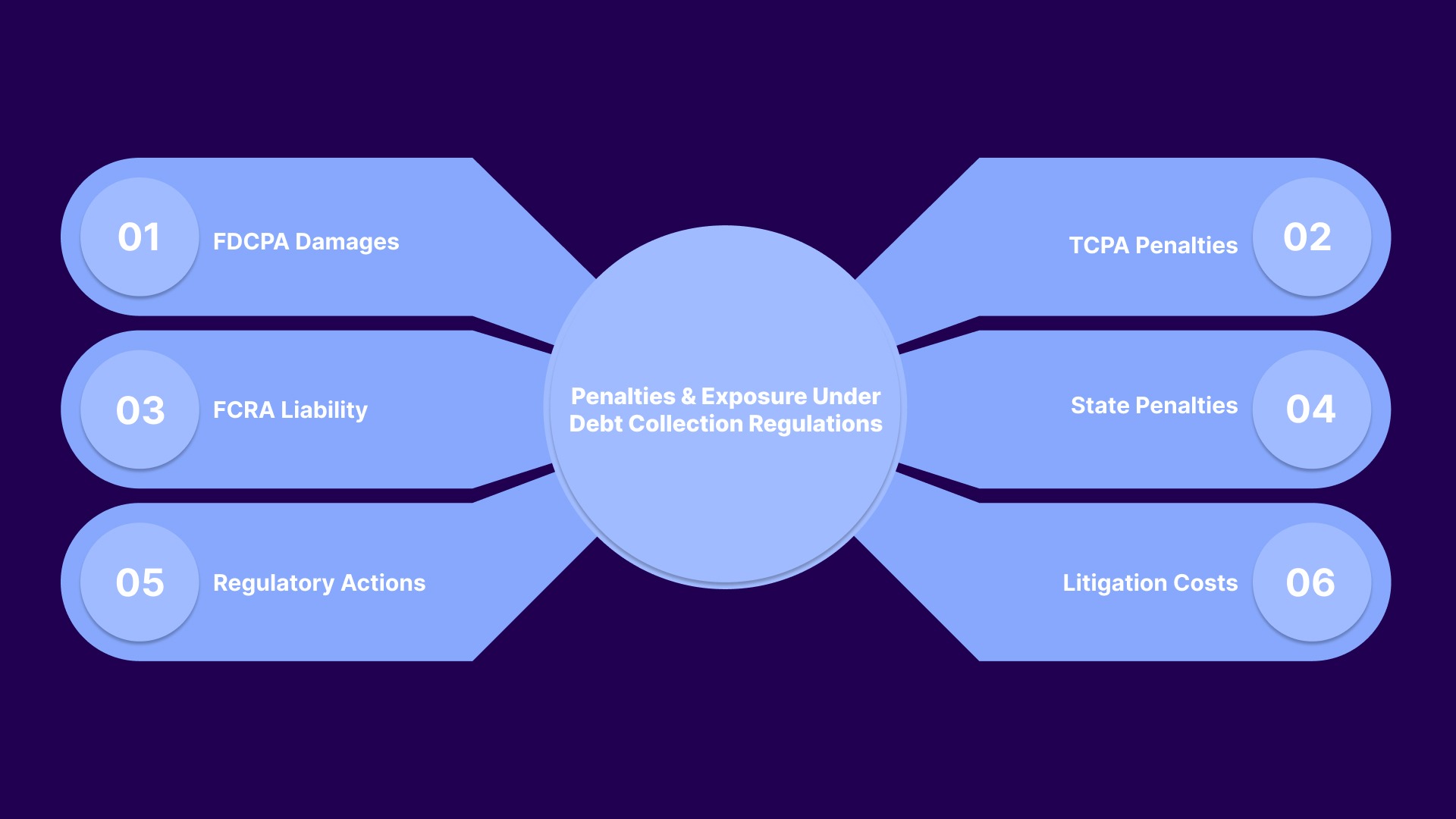
Penalties and Exposure Under Debt Collection Regulations in 2026
Regulatory frameworks are designed to respond to violations with clear, enforceable outcomes. The impact is structured, measurable, and often immediate.
Statutory penalties and enforcement risks include:
FDCPA Damages Under 15 U.S.C. § 1692k, agencies face up to $1,000 per individual lawsuit, along with actual damages and attorney’s fees. In class actions, liability can reach the lesser of $500,000 or 1% of the agency’s net worth. Even minor violations, when repeated, can add up to significant financial exposure.
TCPA Penalties The Telephone Consumer Protection Act (47 U.S.C. § 227) imposes a $ 500-per-violation penalty, increasing to $1,500 for willful violations. Each non-compliant call or message counts as a separate violation, which quickly compounds in high-volume operations. This makes communication mismanagement one of the costliest risk areas.
FCRA Liability Under 15 U.S.C. § 1681n and § 1681o, agencies may be liable for actual damages, punitive damages, and legal fees for inaccurate reporting or failure to investigate disputes. Errors in credit reporting can trigger prolonged disputes and regulatory scrutiny. These cases often extend beyond initial violations due to ongoing data inaccuracies.
State Penalties State-level collection laws introduce additional fines, licensing consequences, and enforcement risks. Some states impose per-violation penalties, while others may suspend or revoke licenses entirely. Multi-state agencies face compounded exposure when compliance gaps exist across jurisdictions.
Regulatory Actions Enforcement by the Consumer Financial Protection Bureau can result in consent orders, monetary penalties, and mandated operational changes. These actions often require agencies to overhaul processes, systems, and reporting structures. The cost extends beyond fines into long-term operational disruption.
Litigation Costs Legal defense, settlements, and attorneys’ fees frequently exceed statutory penalties. Even when cases are resolved early, the cost of defense can be substantial. Repeated claims also increase reputational risk and attract further scrutiny.
Tratta addresses this through a compliance-by-code model, where legal requirements are built directly into system logic rather than managed manually. It embeds statutory rules into workflows so communication, validation, and payment processes are automatically governed in real time.Contact us to learn more.
Systemic Compliance Gaps Driving Violations Across Collection Agencies
Compliance issues rarely originate from isolated errors. They are driven by structural gaps in how systems, workflows, and controls are designed to handle legal requirements at scale.
These gaps include:
Fragmented Systems: Disconnected tools for calling, messaging, payments, and reporting prevent a unified view of compliance. This makes it difficult to enforce rules consistently across channels.
Lack of Rule Enforcement: Compliance rules exist as policies, not as system-level controls. Without embedded enforcement, execution depends on manual adherence.
Channel Silos: Communication channels operate independently, leading to duplicated outreach and missed tracking of contact limits or consent.
Static Workflows: Processes are not designed to adapt to jurisdictional differences or regulatory updates. This creates rigidity in environments that require flexibility.
Limited Audit Visibility: Agencies lack centralized logs and real-time monitoring, making it difficult to identify and address compliance risks proactively.
These gaps are not tied to individual actions. They are embedded in how operations are structured. In the next section, we examine how agency workflows must change to align with regulatory requirements and reduce compliance risk at scale.
How Agency Workflows Must Change to Stay Compliant in 2026
Adding oversight does not resolve compliance issues. They are resolved by structuring workflows so that required actions happen automatically and consistently.
Agencies need to:
Automate Validation Notices Validation notices should be generated and sent immediately after the first contact to meet statutory timelines. Systems must track delivery, store notice content, and link it to the account for future reference.
Capture Consent at Source Consent must be recorded at the point of collection and tied directly to the communication channel used. This requires storing timestamps, consent type, and source, with the ability to retrieve them instantly during disputes.
Apply State Rules Automatically Workflows should adjust based on the consumer’s location without manual intervention. This includes triggering the correct disclosures, applying communication limits, and enforcing state-specific restrictions at the account level.
Control Payment Execution Payment processes must follow predefined rules for authorization, settlement terms, and allocation. Systems should validate amounts, prevent overpayments, and ensure all terms are clearly documented before processing.
Maintain Complete Account Records Every action taken on an account should be recorded in a structured and time-stamped format. This includes communication, notices, payments, disputes, and status changes in a single accessible history.
These changes are difficult to sustain manually at scale. The right technology enables agencies to apply these controls consistently across every workflow. In the next section, we look at how this is achieved in practice.
Tratta Reduces Compliance Risk Across Collection Agency Workflows
Tratta is a data-driven debt collection platform built for collection agencies, law firms, and debt buyers. It centralizes communication, payments, reporting, and compliance into a single system, allowing teams to manage the entire recovery lifecycle without relying on disconnected tools.
What sets Tratta apart is its compliance-by-code architecture. Instead of relying on agents to manually follow rules, the platform applies predefined compliance rules within workflows to guide actions. This reduces reliance on manual execution and improves consistency across interactions.
Its secure debt collection compliance software is designed to keep agencies aligned with the law at every step. It standardizes disclosures, tracks consent, maintains audit-ready records, and adds controls to help prevent non-compliant actions, such as overpayments or restricted transactions, across operations.
Beyond compliance, Tratta offers a full suite of features that make it a complete operating system for modern collection agencies:
Consumer Self-Service Payment Portal Consumers can access their accounts, view balances, and resolve debts independently through a secure, mobile-friendly interface. This reduces inbound volume while improving payment completion rates and maintaining compliant interactions.
Payments and Merchant Services Tratta supports multiple payment methods, settlements, and plans within a secure, tokenized environment. This ensures transactions are compliant, traceable, and protected from fraud or overpayment risks.
Multilingual Payment IVR Automated IVR systems allow consumers to make payments in multiple languages without agent involvement. This improves accessibility while ensuring consistent, compliant communication.
Omnichannel Communications Agencies can manage calls, SMS, and email within a unified system. This enables better tracking of communication frequency, consent, and interaction history across channels.
Campaign Management Automated campaigns allow agencies to segment accounts and trigger communication workflows based on behavior or account status. This ensures outreach remains timely, relevant, and within compliance limits.
Reporting and Analytics Real-time dashboards provide visibility into performance, payments, and compliance activity. This allows agencies to identify trends, monitor risk, and make data-driven decisions.
Customization and Flexibility Workflows, messaging, and rules can be configured to match agency policies and regulatory requirements. This ensures compliance is maintained without sacrificing operational flexibility.
Integrations Secure REST APIs and system integrations connect Tratta with CRMs, accounting platforms, and existing tech stacks. This eliminates data silos and ensures consistent information across systems.
Security and Compliance The platform meets PCI DSS Level 1 and SOC 2 Type II standards, with built-in encryption, tokenization, and access controls. This reduces data risk while supporting regulatory compliance requirements.
Tratta is designed to reduce compliance risk without adding operational burden. It replaces fragmented processes with controlled, system-driven workflows that scale with your business. With structured onboarding, guided implementation, and dedicated support, agencies can deploy quickly and start operating within a compliant framework from day one.
Conclusion
Compliance failures in collections rarely stay contained. Small gaps in communication, validation, or documentation can escalate into complaints, audits, fines, and litigation, often compounding across accounts and jurisdictions. This increases financial exposure and also impacts client trust, licensing, and long-term operational stability.
Tratta addresses this by embedding compliance directly into workflows, ensuring that every interaction, notice, and payment aligns with legal requirements in real time. Centralizing operations and enforcing rules at the system level enables agencies to reduce risk, maintain audit readiness, and scale without compromising compliance.
Reduce compliance risk before it turns into enforcement action.Schedule a free demo to operate with control, consistency, and confidence as per bill collectors laws.
Frequently Asked Questions
1. Do consumers legally have to pay a debt collector?
Consumers are required to pay valid debts, but only when collection activity complies with applicable collection laws and proper validation has been provided. Agencies must ensure accuracy and documentation before pursuing recovery.
2. What is the 7-7-7 rule for debt collectors?
The “7-7-7 rule” under Regulation F limits agencies to 7 call attempts within 7 consecutive days per debt, with no calls allowed for 7 days after a conversation. These collection call limits are critical for avoiding communication violations.
3. What happens if a consumer disputes a debt?
When a consumer disputes a debt, agencies must pause collection efforts until the debt is properly validated. This includes providing accurate documentation and verification in line with the Fair Debt Collection Practices Act (FDCPA).
4. What is the lowest amount a debt collector will sue for?
There is no statutory minimum, but agencies typically evaluate cost versus recovery. Decisions are influenced by internal debt collection policy, account documentation, and jurisdiction-specific requirements.
5. What laws govern collection agencies in the U.S.?
Collection agencies operate under federal statutes like the FDCPA and TCPA, along with state-level collection agency laws and regulations. These frameworks define how agencies communicate, validate, and recover debt.
6. Are collection agencies allowed to contact consumers freely?
No, collection agencies are allowed to contact consumers only within defined limits on timing, frequency, and consent. These restrictions are governed by federal law and state-level collection agency rules.
7. How do state laws impact collection agency operations?
State-specific rules add complexity through licensing, disclosures, and communication limits. For example, commercial collections laws and collection laws by state can impose stricter requirements than federal standards.
8. What role does credit reporting play in collections?
Agencies must follow credit and collection laws when reporting accounts to bureaus. Errors or failure to investigate disputes can lead to liability under the Fair Credit Reporting Act.
9. What are the biggest compliance risks in debt collection?
Common risks include communication violations, improper validation, and poor documentation. These issues often arise when collection agency regulation is not consistently enforced across workflows.
10. How can agencies reduce compliance risk in 2026?
Agencies must move toward structured workflows that align with collection rules and regulatory requirements. Embedding compliance into systems helps ensure consistency across communication, payments, and documentation.
Note: This information is not legal advice. Tratta recommends that you consult with your legal counsel to make sure that you comply with applicable laws in connection with your collection and outreach activities.
Sign up for our monthly newsletter
Debt collection insights that keep you compliant and competitive.
Thank you! Your submission has been received!
Oops! Something went wrong while submitting the form.