Recovering more debt has become increasingly difficult. Collection agencies must manage growing account volumes, changing consumer expectations, and tighter compliance requirements, often while working with limited resources. As a result, many organizations are turning to advanced technologies to improve decision-making and efficiency.
In fact, the AI debt collection market is projected to reach $15.9 billion by 2034, highlighting the industry's growing investment in intelligent recovery tools. Among these innovations, debt collection machine learning is helping agencies identify opportunities, prioritize accounts, and optimize outreach strategies.
This article explores its key benefits, practical applications, implementation strategies, and the role it may play in the future of collections.
Brief look:
Debt collection machine learning uses algorithms to analyze large amounts of collection data and identify patterns. These systems learn from past outcomes and improve their predictions over time.
Machine learning is the subset of artificial intelligence (AI) focused on algorithms that can “learn” the patterns of training data and, subsequently, make accurate inferences about new data.
- IBM
For third-party collection agencies, machine learning helps prioritize accounts, guide outreach efforts, and support better recovery decisions. Rather than relying only on fixed rules, agencies can use data-driven insights to allocate resources more effectively.
Some of the key benefits include:
Machine learning does not rely on a single technology. It combines several components that work together to generate insights and recommendations. In the next section, we will examine the core components of machine learning in debt collection and how each contributes to smarter recovery strategies.
Machine learning systems rely on several components to generate predictions and recommendations. Each component plays a role in turning collected data into actionable insights. For third-party agencies, understanding these building blocks helps explain how machine learning supports smarter recovery strategies.
Some of the most important components include:
While machine learning generates insights, agencies still need the right platform to act on them.
Tratta helps agencies execute recovery strategies through omnichannel communications, automated campaigns, and self-service payment options. Combined with robust reporting, integrations, and compliance controls, these capabilities help agencies turn data-driven decisions into measurable recovery outcomes. Schedule a free demo today.
Suggested Read: Applications And Use Cases of Machine Learning In Finance
Machine learning can support collection activities from account placement through final resolution. By analyzing historical and real-time data, agencies can make more informed decisions at every stage of the recovery process.
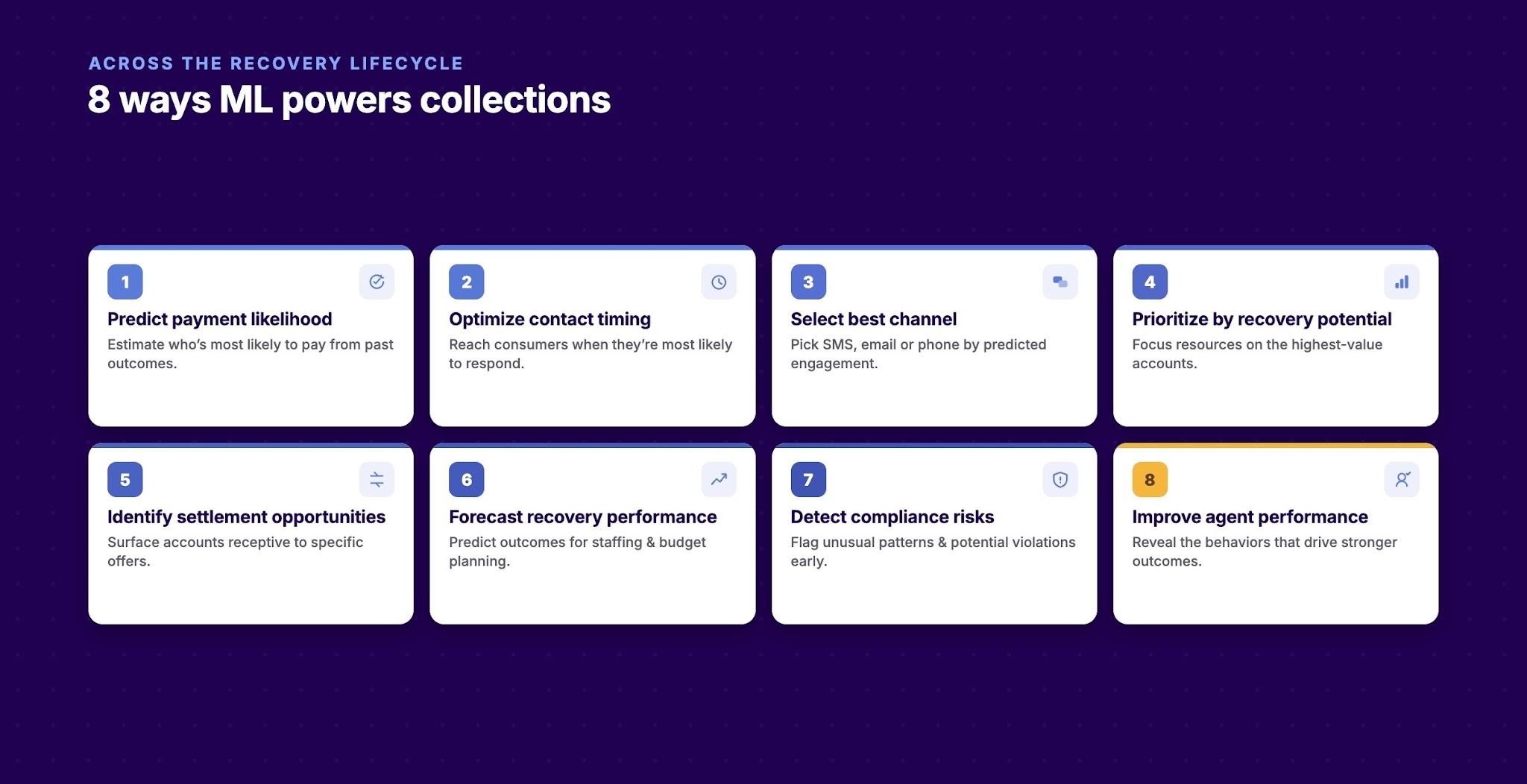
Below are some of the most common applications across the collection lifecycle.
Not every account has the same chance of repayment. Machine learning models analyze historical outcomes to estimate which consumers are most likely to pay. This helps agencies prioritize their efforts more effectively.
Key benefits include:
The timing of outreach can significantly affect engagement rates. Machine learning helps identify when consumers are most likely to respond based on previous interactions. This can improve contact effectiveness without increasing outreach volume.
Key benefits include:
Different consumers prefer different communication methods. Machine learning can identify whether SMS, email, phone, or another channel is most likely to generate engagement. This allows agencies to tailor outreach strategies.
Key benefits include:
Some accounts offer stronger recovery opportunities than others. Machine learning evaluates account characteristics and historical performance to identify high-value opportunities. Agencies can then focus resources where they are most likely to generate results.
Key benefits include:
Consumers often respond differently to settlement offers. Machine learning can identify accounts that may be more receptive to specific settlement strategies. This supports more targeted negotiation efforts.
Key benefits include:
Accurate forecasting helps agencies plan staffing, budgets, and operational strategies. Machine learning uses historical data and current trends to predict future recovery outcomes. This improves decision-making across the organization.
Key benefits include:
Large communication volumes can make compliance monitoring difficult. Machine learning helps identify unusual patterns, potential policy violations, and emerging risks. This supports stronger compliance oversight.
Key benefits include:
Machine learning can reveal which behaviors contribute to stronger recovery outcomes. Managers can use these insights to refine coaching and training programs. This helps teams improve performance over time.
Key benefits include:
These applications demonstrate what machine learning can accomplish across collection operations. However, different methodologies power these capabilities behind the scenes. In the next section, we will explore the top machine learning methodologies used in debt collection and how they support these outcomes.
Suggested Read: Benefits and Advantages of Using Conversational AI in Debt Collection
Different machine learning methodologies support different collection objectives. Some focus on prediction, while others identify patterns or automate decision-making. Understanding these approaches helps agencies evaluate how machine learning can support recovery operations.
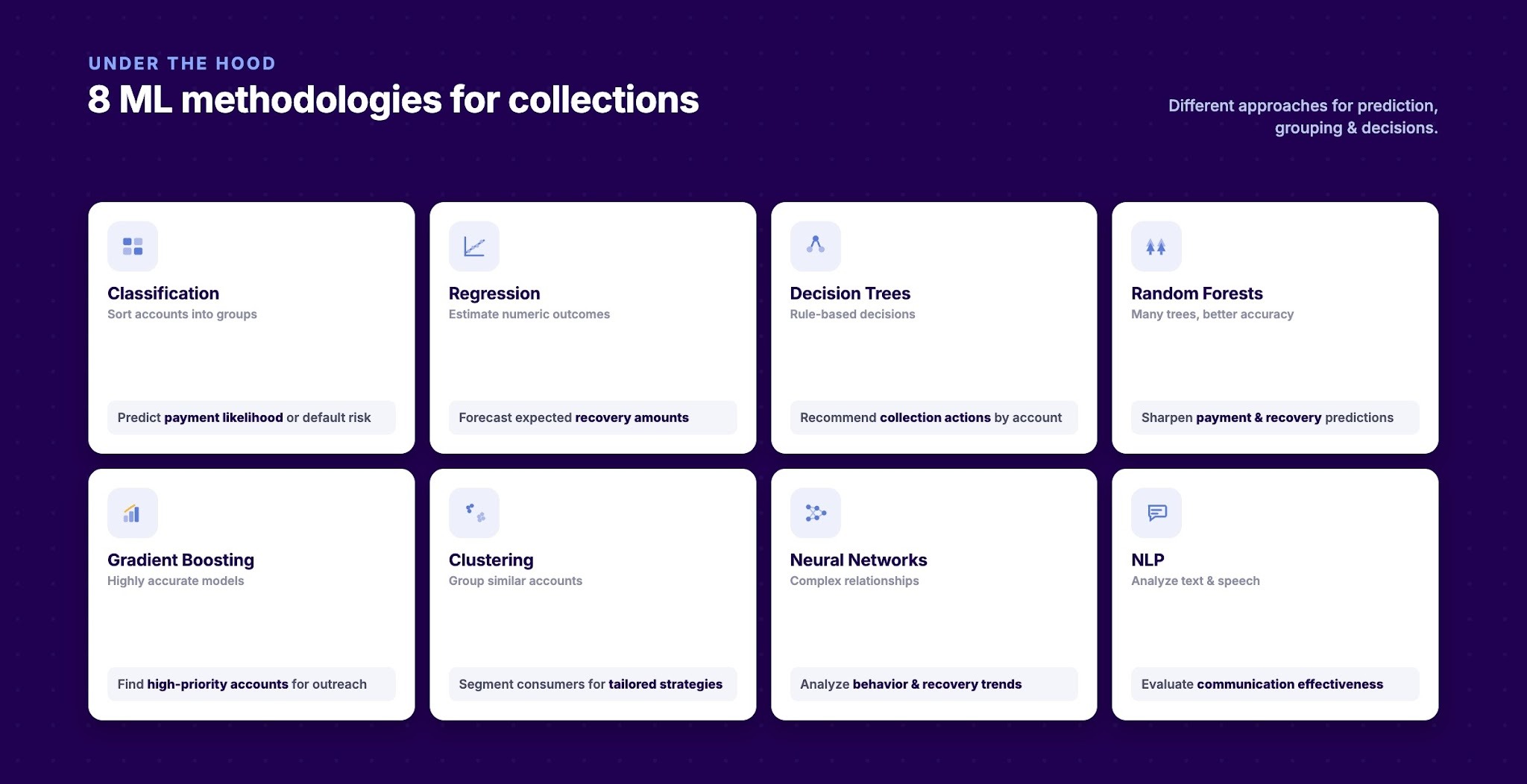
Before exploring implementation strategies, it helps to understand the methodologies commonly used in collections:
The methodology itself is only one part of the equation. Success depends on how effectively agencies implement, monitor, and refine these systems over time. In the next section, we will explore strategies for successful adoption of machine learning in debt collection.
Implementing machine learning requires more than selecting the right model. Agencies must build the right processes, data foundations, and governance practices.
These strategies can help maximize value while reducing implementation risks.
Focus on the data essentials:
Target areas with clear value:
Maintain appropriate oversight through:
Create a framework that includes:
Track outcomes and improvements through:
Research published by ScienceDirect highlights the importance of ongoing monitoring and refinement for machine learning systems. Model performance can change as data, consumer behavior, and operating conditions evolve.
Tratta helps agencies maintain strong operational foundations through reporting and analytics, integrations, compliance controls, and omnichannel engagement features that support data-driven collection strategies. Contact us to learn more.
Machine learning offers significant potential for third-party collection agencies. However, successful adoption requires overcoming several operational and technical challenges.
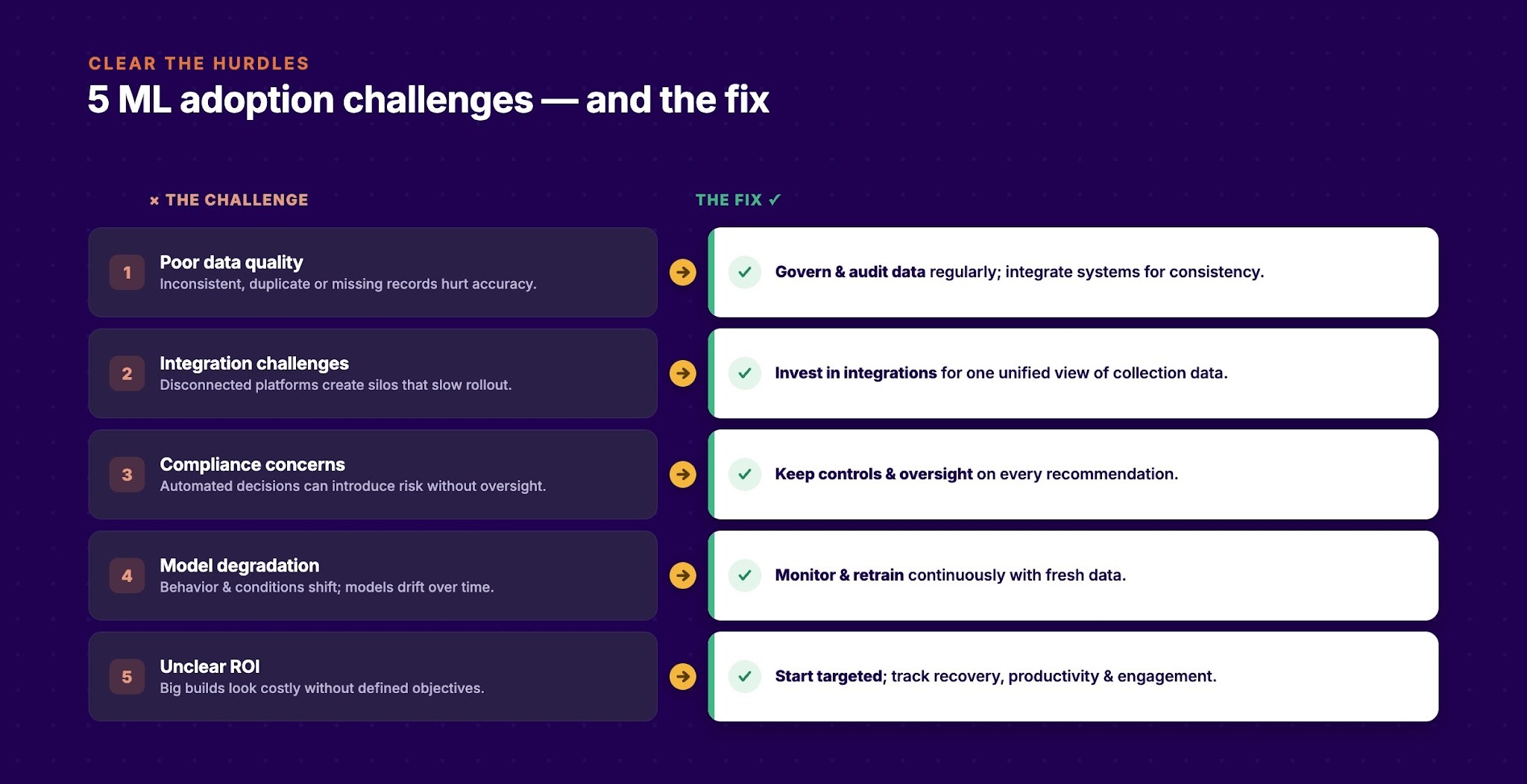
Understanding these obstacles can help agencies build more effective implementation plans.
Machine learning models depend on accurate and complete information. Inconsistent records, duplicate accounts, and missing data can reduce prediction accuracy and limit business value.
Fix: Establish data governance standards, conduct regular audits, and integrate systems to improve data consistency.
Machine learning tools often need data from multiple systems. Disconnected platforms can create data silos and slow implementation efforts.
Fix: Invest in integration capabilities and create a unified view of collection data.
Automated decision-making can introduce compliance risks if not properly monitored. Agencies must maintain transparency and accountability throughout the collection process.
Fix: Establish governance controls and ensure all recommendations remain subject to compliance oversight.
Consumer behavior and economic conditions change over time. Models that perform well today may become less effective in the future.
Fix: Continuously monitor results and retrain models using updated data.
Large-scale implementations can seem expensive without clear business objectives. Agencies may struggle to measure success if goals are not defined upfront.
Fix: Begin with targeted projects and track metrics such as recovery rates, productivity, and consumer engagement.
While these challenges are real, they are becoming easier to address as technologies mature and best practices evolve. At the same time, machine learning and artificial intelligence continue to unlock new opportunities for collection agencies. In the next section, we will explore the future of intelligent collections using machine learning and AI.
Suggested Read: How Advanced Analytics Improves Credit Risk and Debt Recovery
Machine learning and AI are expected to play a larger role in debt collection strategies over the coming years. These technologies can help agencies make faster decisions, improve efficiency, and personalize consumer engagement. However, the future is unlikely to be fully automated.
Several trends are shaping the next generation of collections:
There is also growing evidence that AI works best when it supports, rather than replaces, human collectors. Research featured by Yale Insights found that borrowers contacted by AI collectors repaid less than those contacted by humans. Researchers suggested that commitments made to AI may feel less binding than promises made to another person.
For third-party collection agencies, success will come from balancing technology with human expertise. Agencies that combine intelligent tools with strong operational processes will be better positioned to improve recoveries, maintain compliance, and deliver better consumer experiences.
Machine learning can deliver meaningful advantages for collection agencies. However, success is not guaranteed. Poor data quality, weak implementation planning, and limited oversight can reduce accuracy and create operational risks. Agencies that treat machine learning as a standalone solution may struggle to achieve sustainable results.
Tratta helps third-party collectors build the operational foundation needed for data-driven collections. With omnichannel communications, automated campaigns, reporting and analytics, self-service payment options, integrations, and compliance-focused workflows, agencies can act on insights more effectively. The platform helps turn collection strategies into consistent execution across the recovery lifecycle.
See how Tratta can help your agency improve efficiency, strengthen consumer engagement, and support smarter recovery strategies. Schedule a demo today to explore how the platform fits your collection workflows.
Debt collection machine learning uses algorithms to analyze collection data, identify patterns, and generate predictions. Third-party agencies use these insights to prioritize accounts, improve outreach strategies, and support recovery decisions.
Machine learning in debt collection can help agencies predict payment likelihood, optimize contact timing, segment consumers, forecast recoveries, and identify compliance risks. These applications support more efficient collection operations.
Common methodologies include classification models, regression models, decision trees, random forests, clustering algorithms, and natural language processing. Each serves different purposes, from predicting outcomes to identifying consumer behavior patterns.
Current evidence suggests that machine learning works best alongside human collectors. AI can automate analysis and routine tasks, while agents provide judgment, empathy, and negotiation skills for complex situations.
Agencies should focus on data quality, integration capabilities, compliance oversight, performance monitoring, and staff training. A strong operational foundation is essential for achieving long-term value from machine learning initiatives.