In collections, prior written consent is often treated as a document that lives somewhere in the file until someone later needs to prove it. That is usually when the trouble starts. An outreach step gets questioned.
A self-service action cannot move forward cleanly. A record looks incomplete, outdated, or hard to trace across systems. For collections operations teams, the problem is rarely the phrase itself. It is what happens when consent status is unclear inside a live recovery workflow.
In this context, prior written consent is not only a legal term. It is part of how outreach, consumer self-service, and account-level actions stay documented and controllable in a TCPA- and FDCPA-sensitive recovery environment.
This article explains what prior written consent means here, where it tends to break down, and what operations teams should review if they want cleaner records, better workflow visibility, and fewer avoidable interruptions later.
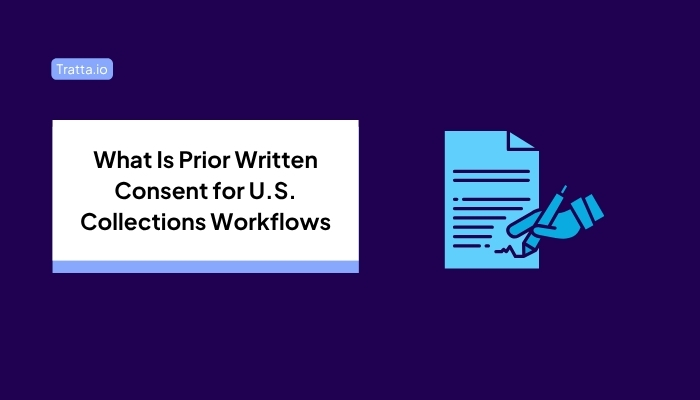
Prior written consent in collections is not just a legal phrase; it affects how U.S. recovery teams handle outreach, self-service, and workflow visibility.
In a U.S. recovery context, prior written consent generally means documented permission given in advance for a specific action or type of communication.
The exact standard can vary depending on the communication involved and the applicable rules, but the practical point is simple: the organization needs a record showing that the consumer agreed before that step proceeds.
For collections operations teams, the value of that record is not only in its wording. It is in being able to show what the consumer agreed to, when the record was captured, and what part of the workflow it applies to.
That is why prior written consent matters as an operating record, not just a legal term. It can shape how teams handle communications, consumer-facing actions, and follow-up reviews when questions come up later.
Prior written consent becomes operationally relevant when a recovery workflow depends on a clear record to proceed to the next step.
In collections, that often starts with digital communications tied to account outreach. Teams may need a clear record before a message, follow-up path, or consumer-facing action can move forward.
It also shows up in payment-related steps, especially when the consumer is trying to act without waiting for an agent.
The same is true in self-service paths, where the workflow may depend on whether the system can reflect the current consent status clearly.
Consent can also matter during account-level updates or other action-taking moments. In these cases, the issue is not just whether a record exists. It is whether that record is visible at the point in the workflow where it is needed.
For example, a consumer may click from a digital outreach into a self-service payment path, but the workflow may stall if the consent record is unclear, outdated, or not visible in the system handling the next step.
What should have been a routine account action can then turn into a manual review, follow-up, or a delayed consumer experience.
The breakdown usually starts when consent records are scattered across systems or stored in ways that are hard to review later. A team may be able to find a record, but still lack enough context to use it confidently in the workflow.
The problem gets worse when revocation or updates do not carry through properly. One system may reflect the change while another still allows outreach, self-service activity, or account handling to continue as if nothing changed.
That creates inconsistent treatment and leaves teams trying to piece together which status actually applies when the workflow moves forward.
There is also unnecessary friction when the workflow depends too heavily on agent memory or manual checking for actions that should be trackable in the system.
Instead of cleanly supporting the next step, the record gap leads to extra checking, escalations, and avoidable breaks in the consumer path.
A better consent workflow does not stop at storing a yes-or-no record. It needs to capture the details behind that record and keep them visible where the workflow actually depends on them.
At a minimum, teams should be able to track:
The workflow should also connect that record to the right account or consumer record. Beyond the initial capture, teams need visibility into revocation or update status and a record of when the status changed and how it changed.
A simple way to think about it is this:
In practice, updates, replacements, or revocations should carry through the workflow without relying on staff to reconcile separate records by hand each time the account moves forward.
That status should remain visible in the workflow, rather than forcing teams to check separate systems or manually rebuild the history. Changes should remain traceable over time, and the record should remain reviewable when questions arise later.
That operational model becomes even more important when the consumer is not relying entirely on an agent to move the journey forward.
By this point, the issue is no longer whether consent matters. The real question is whether your current setup can handle it cleanly once records start affecting live workflows.
A useful review should focus on how well the approach holds up in day-to-day operations, not just whether it stores consent somewhere.
The strongest setup is not the one with the longest feature list. It is the one that keeps consent records usable when teams and consumers depend on them.
For collections operations teams, that is the point where platform design starts to matter.
Tratta supports a more connected recovery workflow across consumer self-service, payment-related actions, reporting visibility, integrations, and controlled workflow handling.
That can make it easier to keep consent-driven actions tied to the account journey without adding more manual checking across systems.
Prior written consent creates problems when it is treated as something to store rather than as something the workflow must reflect.
For collections operations teams, the real question is not whether a record exists somewhere. It is whether that record stays connected to outreach, self-service, and account-level actions in a way that is easy to review later. That is what makes the difference between a record that sits in the background and one that actually supports the work.
If this is becoming a live workflow issue for your team, explore how Tratta supports more connected recovery workflows across consumer-facing actions, payment paths, and operational visibility.
In collections, prior written consent generally means documented permission tied to a specific communication or action before that step moves forward. The important part for operations teams is not just the wording. It is whether the record is usable and connected to the right account and workflow
It gets harder when records sit in different systems, updates are not reflected everywhere, and teams have to rely on manual checks to confirm status. The issue is usually not captured alone. It is keeping the record visible and usable once the workflow is active.
Yes, in many cases they can. A digital self-service path can support cleaner documentation when the workflow is designed to capture the action clearly and keep the record tied to the account.
Teams should be able to see the source, timestamp, channel, purpose, account linkage, and whether the status was updated or revoked later. That gives them enough context to understand what the record supports and whether it is still current.
No. It can also affect self-service actions, payment-related steps, and other account-level actions where the workflow depends on a clear, documented record before moving forward.
They should look at whether records are easy to review, whether the status remains tied to the workflow, whether updates and revocations are carried through clearly, and whether the setup remains manageable as volume grows.