Do You Need FDCPA Call Recording Disclosure? What Agencies Miss in 2026
Industry & Trends
Do You Need FDCPA Call Recording Disclosure? What Agencies Miss in 2026
Published on:
August 3, 2026
Collection agencies managing multi-state portfolios often face uncertainty around call handling requirements, especially when federal guidance is not explicit. According to the CFPB 2025 annual report, 207,800 debt collection complaints were filed, many linked to communication practices and consumer understanding.
The Fair Debt Collection Practices Act does not explicitly address call recording disclosure, which leaves room for inconsistent interpretation across teams and systems. In environments where compliance depends on execution, that ambiguity can create exposure.
In this blog, we examine what the FDCPA call recording disclosure implies, where obligations originate, and how agencies should approach them in practice.
Quick look:
FDCPA does not require disclosure. The law does not explicitly mandate call recording disclosure for collection agencies.
Disclosure is governed by state laws. Consent requirements depend on jurisdiction, especially in all-party consent states.
Communication standards still apply. FDCPA provisions on transparency and fairness influence how recording practices are evaluated.
Inconsistent execution creates risk. Gaps across calls, systems, and states can lead to compliance exposure.
Technology enables consistency. Structured workflows help standardize disclosure and reduce variability across interactions.
Does the FDCPA Require Call Recording Disclosure for Collection Agencies?
The Fair Debt Collection Practices Act (FDCPA) does not explicitly require collection agencies to disclose call recording. The statute does not contain any provision addressing recording consent or mandating a disclosure at the start of a call.
For agencies, this creates a gap between what is assumed and what is actually required under federal law. At the same time, the FDCPA establishes clear standards governing how communication with consumers must be conducted.
This lack of explicit guidance can create challenges in the following areas:
Multi-State Variation: Agencies operating across jurisdictions must account for different consent standards, making uniform disclosure practices difficult to maintain.
Workflow Inconsistency: Disclosure handling can vary across agent-led calls, inbound systems, and payment interactions, leading to uneven application.
Consumer Interpretation: When the recording is not clearly communicated, it can affect how consumers perceive and respond to the interaction.
Complaint Exposure: Communication-related issues continue to drive complaints, where lack of clarity is often a contributing factor.
Audit Scrutiny: Regulators evaluate the overall transparency of interactions, not just whether a specific requirement is explicitly defined.
To understand how these risks are evaluated under federal law, it is important to examine the FDCPA standards that govern consumer communication in more detail.
FDCPA Standards That Influence Call Recording Practices
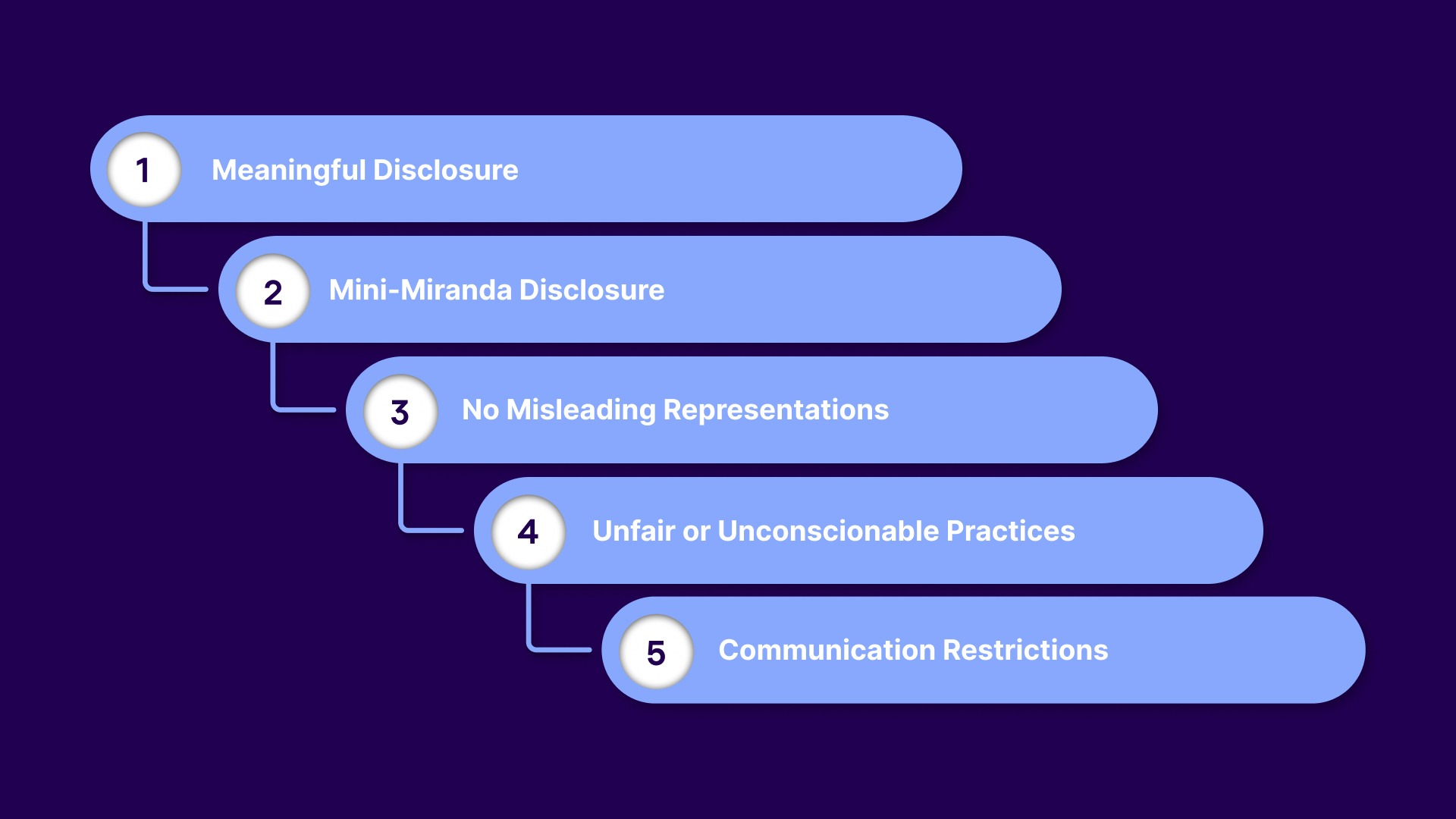
Call recording practices are evaluated through the FDCPA’s broader communication requirements. Even without direct rules on recording, these standards define how information must be presented, disclosed, and understood during consumer interactions.
These statutes include:
1. Meaningful Disclosure
The FDCPA requires that the identity of the caller (debt collector) be clearly communicated to the consumer. This ensures that the interaction is not ambiguous or misleading from the outset.
Provide disclosure at the start of the interaction
Avoid any ambiguity in identity
Ensure the consumer understands who is communicating
2. Mini-Miranda Disclosure
The FDCPA requires disclosure of the purpose of the communication and how consumer information will be used. This establishes transparency around the intent of the interaction.
State that the communication is from a debt collector
Disclose that the information will be used for collection
Provide this in the initial communication
Adjust disclosure appropriately in follow-up interactions
3. No Misleading Representations
The FDCPA prohibits any form of deception in consumer communication. This includes both explicit statements and omissions that could mislead the consumer.
The FDCPA places limits on when and how collectors can communicate with consumers. These restrictions ensure that interactions remain appropriate and within defined boundaries.
Tratta enables agencies to apply FDCPA communication standards within structured inbound interaction environments. IVR and payment workflows can be configured to align with statutory requirements. This supports consistent, audit-ready consumer communication. Request a free demo.
What Governs Call Recording Disclosure in Debt Collection?
While the Fair Debt Collection Practices Act does not explicitly require disclosure of call recordings, other legal frameworks define when and how it must be applied. These frameworks regulate consent, privacy, and communication practices across jurisdictions, shaping how agencies handle recorded interactions in practice.
These are:
State Consent Laws Call recording is regulated under state wiretapping and privacy statutes, which define whether one-party or all-party consent is required. Laws such as the California Invasion of Privacy Act and the Florida Security of Communications Act require all-party consent before recording a conversation. This requires collection agencies to provide disclosure before recording begins in applicable jurisdictions.
One-Party Consent Frameworks In one-party consent states, recording is permitted if at least one participant consents to the communication. This is defined under statutes such as New York Penal Law § 250.00, which allow recording where at least one party consents. However, agencies must still align practices with the governing jurisdiction and avoid applying a uniform standard across states.
Federal Communication Standards Regulation F establishes requirements for false, deceptive, or misleading communication, even though it does not mandate call recording disclosure. Under 12 C.F.R. § 1006.18, debt collectors must ensure that interactions are not misleading or confusing to the consumer. This influences how recording practices are evaluated within broader communication standards.
Applying these requirements consistently across jurisdictions is where most challenges emerge for collection agencies. In the next section, we examine how gaps in recorded call practices can lead to compliance exposure in real-world operations.
Why Recorded Calls Create Compliance Risk for Collection Agencies
Recorded calls introduce compliance exposure when disclosure, consent, and communication standards are not applied consistently. For collection agencies, these risks are evaluated against both federal communication standards and state-level consent laws.
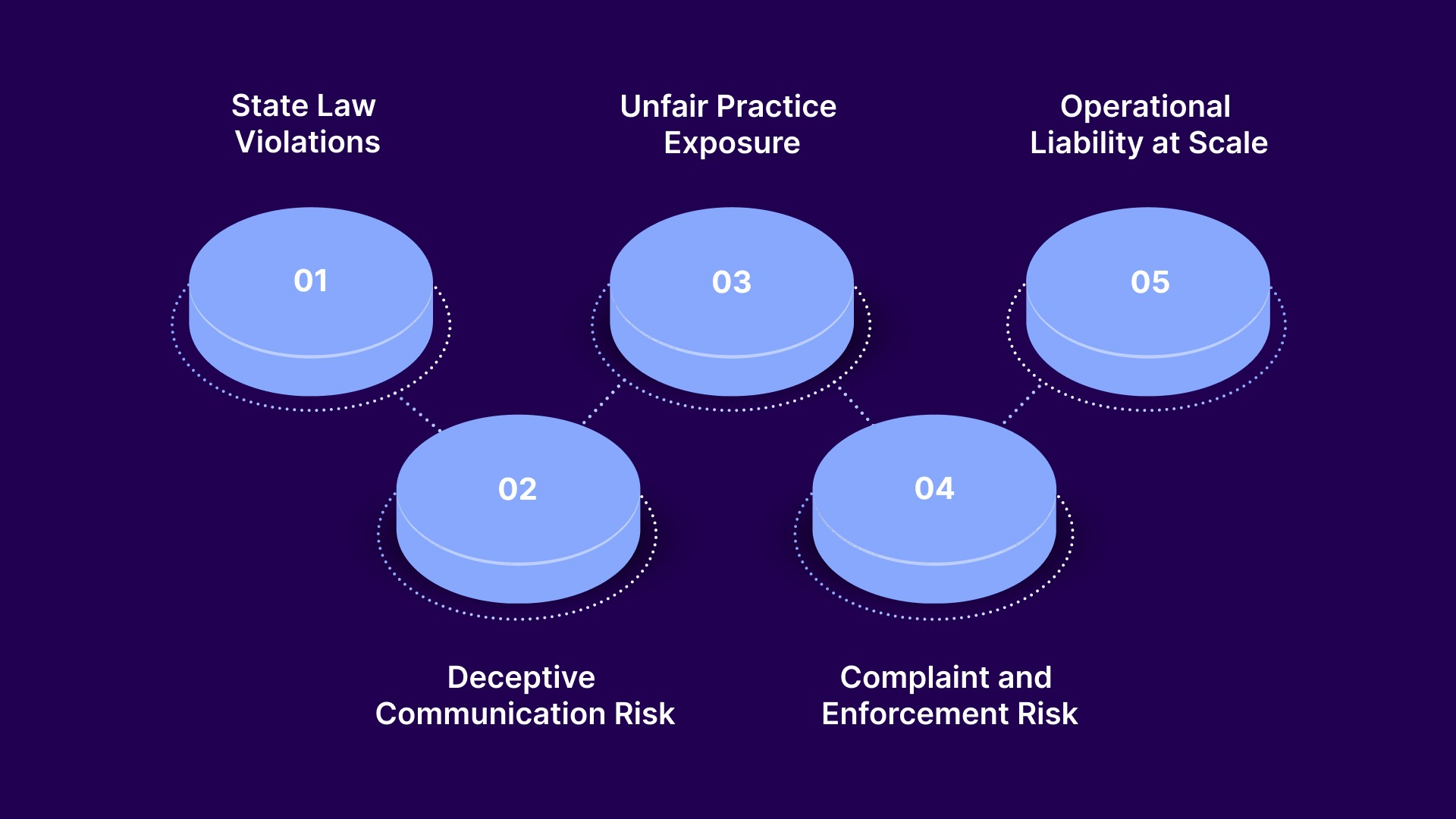
Regulatory risks include:
State Law Violations Failure to disclose recording in all-party consent states can violate statutes such as the Pennsylvania Wiretapping and Electronic Surveillance Control Act. This law requires consent from all parties before any interception or recording of a communication. Violations can result in criminal and civil liability with statutory damages of $100 per day per violation or $1,000 (whichever is higher), plus actual damages, punitive damages, and attorney’s fees.
Deceptive Communication Risk An undisclosed recording may be evaluated under 15 U.S.C. § 1692e of the Fair Debt Collection Practices Act, which prohibits false, deceptive, or misleading representations. If a consumer is unaware that they are being recorded, the interaction may be perceived as lacking transparency. This can increase the risk of disputes, complaints, and regulatory review.
Unfair Practice Exposure Recording practices that are not clearly communicated may also fall under 15 U.S.C. § 1692f, which prohibits unfair or unconscionable conduct. This applies where the method of communication creates an imbalance or lack of clarity for the consumer. Enforcement actions may consider how the interaction was experienced, not just what was stated.
Complaint and Enforcement Risk Communication-related issues continue to drive complaints reviewed by the Consumer Financial Protection Bureau. Gaps in disclosure can contribute to consumer dissatisfaction and regulatory attention. Repeated issues may lead to investigations, consent orders, or supervisory actions.
Operational Liability at Scale Inconsistent disclosure practices across high call volumes can create systemic compliance gaps. Small errors in scripting or workflow design can multiply across thousands of interactions. This increases exposure to class actions, aggregated damages, and reputational risk.
Tratta helps agencies reduce variability in how recorded interactions are handled by standardizing inbound IVR and payment workflows. Disclosure can be embedded into configured call flows rather than relying on manual execution. This improves consistency in areas that directly impact compliance risk. Get in touch to learn more.
What Agencies Commonly Get Wrong About FDCPA Call Recording Disclosure
Missteps around the FDCPA call recording disclosure typically occur at the execution level, not in policy design. Collection agencies often have general compliance frameworks in place, but gaps emerge in how disclosure is applied across calls, systems, and jurisdictions.
Table showing common operational mistakes:
What Agencies Do
What Actually Applies
Impact on Agencies
Use a single disclosure script across all states
Consent requirements vary by jurisdiction
Exposure to violations in all-party consent states
Omit disclosure in inbound IVR or payment calls
Disclosure applies to all recorded interactions
Incomplete compliance across consumer touchpoints
Apply disclosure only on agent-led calls
Recording may occur across multiple systems
Gaps between live calls and automated workflows
Rely on the agent's discretion for disclosure
Disclosure must be consistent and standardized
Inconsistent execution and audit failures
Assume one-party consent applies to all calls
Jurisdiction depends on the consumer’s location
Misapplication of consent rules in multi-state portfolios
These mistakes typically arise when legal requirements are not translated into controlled, repeatable workflows across all interaction channels.
Best practices to avoid these mistakes:
Standardize disclosure language across all recorded interactions
Apply the strictest applicable consent standard across jurisdictions
Align agent scripts, IVR flows, and payment interactions
Document disclosure as part of audit-ready workflows
Regularly review and update communication practices
Consistently applying these practices across high-volume environments requires structured systems and controlled execution. In the next section, we examine how technology enables agencies to standardize disclosure and reduce variability in call handling.
Standardizing Disclosure and Reducing Risk Through Technology
Maintaining consistent disclosure across recorded calls requires more than policy alignment. Agencies need system-level controls that ensure disclosure is applied across call environments, teams, and jurisdictions.
Features that help:
Omnichannel Communication Controls: Centralizes how consumer interactions are managed across voice, IVR, and digital channels. Ensures disclosure standards are consistently applied regardless of the communication channel.
Advanced IVR Configuration: Enables structured call flows where disclosure can be embedded at the start of interactions. Reduces dependency on agents for compliance-critical steps.
Dynamic Script Management: Allows real-time updates and enforcement of agent scripts. Ensures disclosure language remains consistent across teams and campaigns.
Jurisdiction-Aware Rule Engines: Applies disclosure logic based on consumer location and applicable laws. Helps agencies align with varying state consent requirements.
Compliance Monitoring and Audit Trails: Tracks interaction data, call flows, and communication patterns. Provides visibility into whether disclosure practices are applied consistently.
Tratta supports standardized inbound consumer interactions through its multilingual payment IVR and configurable workflows. Agencies can embed disclosure within structured call flows and track interactions across channels. This allows consistent execution within environments that are directly controlled by the platform.
Conclusion
Gaps in call recording disclosure emerge when legal requirements are not consistently applied across call environments, systems, and jurisdictions. In multi-state operations, small inconsistencies in disclosure can trigger regulatory scrutiny, complaints, and legal exposure.
Tratta gives agencies greater control over how consumer interactions are structured and delivered across inbound channels. By embedding compliance into system-driven workflows, disclosure becomes part of the interaction design rather than a manual step. This enables more reliable execution across high-volume environments.
Inconsistent disclosure creates risk. See how Tratta helps you enforce consistency across every recorded interaction. Schedule a free demo today.
Frequently Asked Questions
1. Does call recording disclosure apply to inbound IVR calls in debt collection?
Yes, disclosure requirements apply to any recorded interaction, including inbound IVR calls. If a call is recorded and the applicable jurisdiction requires consent, disclosure must be provided before recording begins.
2. Which state laws require all-party consent for call recording?
Several states, including California, Florida, Pennsylvania, and others, require all-party consent before recording a call. Agencies must follow the strictest applicable law based on the consumer’s location.
3. Can failing to disclose call recording lead to FDCPA violations?
The Fair Debt Collection Practices Act does not explicitly require disclosure, but failure to disclose may be evaluated under provisions related to misleading or unfair communication practices.
4. How should agencies handle call recording disclosure across multiple states?
Agencies should apply a standardized approach that aligns with the strictest consent requirement across jurisdictions. This reduces the risk of misapplying state-specific laws in multi-state operations.
5. What is the safest way to implement call recording disclosure in debt collection?
The safest approach is to provide clear disclosure at the start of every recorded interaction, regardless of jurisdiction. This ensures consistency and reduces the risk of non-compliance across different environments.
Note: This information is not legal advice. Tratta recommends that you consult with your legal counsel to make sure that you comply with applicable laws in connection with your collection and outreach activities.
Sign up for our monthly newsletter
Debt collection insights that keep you compliant and competitive.
Thank you! Your submission has been received!
Oops! Something went wrong while submitting the form.