Communication Best Practices

Top 7 Debt Collection Call Scripts Built for Compliance and Results

Published on:
May 6, 2026

The CFPB received approximately 207,800 debt collection complaints in 2024, nearly double the volume from the year before. A significant share of those complaints came down to how calls were conducted: wrong disclosures, aggressive language, or no clear process.

If you run a collection agency, manage receivables for a credit issuer, or oversee outreach operations at a debt buyer, the scripts your agents use are not just a means of communication. They are a compliance document, a recovery driver, and the first real touchpoint with a consumer who may be anxious, defensive, or genuinely unable to pay.

This guide provides practical, FDCPA-compliant debt-collection call scripts for the scenarios your team faces every day, including initial contact, payment-plan negotiations, hardship situations, disputes, and follow-ups. You will also find guidance on what makes scripts fail and how to structure your overall call process to support both recovery and compliance.

What Is a Debt Collection Call Script?

A debt collection call script is a pre-written framework that guides agents through conversations with consumers about outstanding balances. It is not a rigid word-for-word read but a structured outline that ensures every call covers required disclosures, stays compliant, and moves toward a resolution.

Scripts are used across collection agencies, law firms handling debt-related matters, AR teams at credit issuers, and debt buyers managing purchased portfolios. The use case is the same across contexts: provide agents with a consistent, legally sound starting point they can adapt to as the consumer responds.

What separates a good script from a bad one is not length. It is structured. A well-built script ensures agents never skip the mini-Miranda, always verify identity before disclosing account details, offer realistic payment options, and document the outcome of every call.

FDCPA Rules Every Collection Call Script Must Follow

Before you build or use any collection call script, you need to understand the legal floor. The Fair Debt Collection Practices Act (FDCPA) sets specific requirements for every consumer contact, and scripts must be built around them.
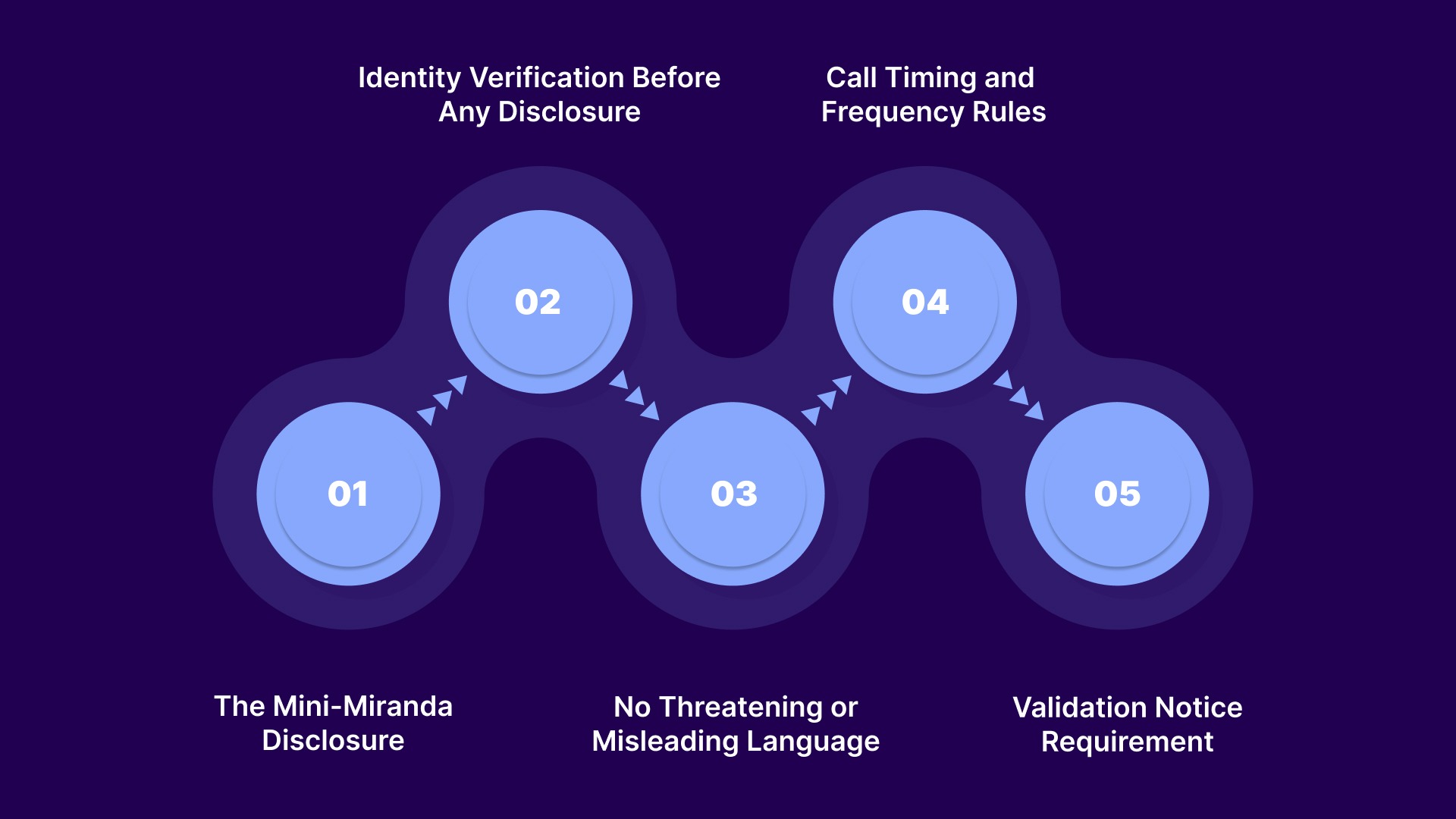
The Mini-Miranda Disclosure

On the initial contact with a consumer, every collector must state that the communication is an attempt to collect a debt and that any information obtained will be used for that purpose. This is required whether the contact is by phone, voicemail, text, or email. In subsequent calls, collectors must still identify themselves as a debt collector, even if the full mini-Miranda is not repeated.

Standard Mini-Miranda Language: "This is an attempt to collect a debt, and any information obtained will be used for that purpose."

Identity Verification Before Any Disclosure

You must confirm you are speaking with the right person before disclosing any account information. Never state the balance, creditor name, or any account details until you have verified identity. This is not just good practice - it is an FDCPA requirement to prevent third-party disclosure.

No Threatening or Misleading Language

Scripts must not imply that legal action will be taken if it is not actually planned or permitted. Threatening to sue, arrest, or garnish wages when those actions are not authorized is an FDCPA violation. Language that misrepresents the legal status of a debt, including time-barred accounts, is also prohibited.

Call Timing and Frequency Rules

Under Regulation F, collectors are limited to seven call attempts per week per debt. Calls are not permitted before 8 AM or after 9 PM in the consumer's local time zone. Scripts should reflect this by confirming with agents that timing has been checked before dialing.

Validation Notice Requirement

Within five business days of initial contact, you must send a written validation notice that includes the debt amount, creditor name, and information about the consumer's right to dispute the debt. Your call scripts should prompt agents to confirm that this notice will follow the call. 

FDCPA Requirement

What It Means for Your Script

Mini-Miranda on initial contact

Include it at the opening of every first-contact script

Identity verification before disclosure

Verify name, DOB, or last 4 SSN before stating any account details

No misrepresentation of legal status

Do not threaten litigation unless it is an actual, planned next step

Regulation F call limits (7 in 7 days)

Track call frequency; scripts alone do not manage this - your system must

Validation notice within 5 business days

Prompt agents to confirm that the written notice will follow the call

Time-barred debt rules

Do not imply legal action is possible if the statute of limitations has expired


Suggested Read: Essential Debt Collection Software Features Your System Needs

Key Components of an Effective Debt Collection Call Script

Every scenario calls for a slightly different script, but the building blocks stay the same. Here is what every effective collection call script needs to include:

  • Opening and identification: State your name, company, and that you are a debt collector. Do this before anything else.
  • Call recording disclosure: If the call is being recorded, disclose this at the start. Some states require it regardless of which party is recording.
  • Identity verification: Confirm the consumer's name and at least one identifying detail (DOB, the last 4 digits of the SSN, or address) before sharing any account information.
  • Mini-Miranda (on initial contact): Deliver the required FDCPA disclosure clearly and early.
  • Purpose of call: State why you are calling. Be direct but non-threatening.
  • Account details: Once identity is confirmed, state the amount owed and the creditor's name.
  • Payment options: Offer realistic paths to resolution - full payment, payment plan, or settlement if applicable.
  • Handling objections: Prepare agents for common responses: disputes, hardship claims, requests for more time.
  • Next steps and documentation: End every call with a clear next step and log the outcome immediately.

Strong scripts balance structure with adaptability to guide conversations toward resolution. Each component ensures clarity, compliance, and a higher chance of successful recovery. 

Suggested Read: How to Stay Compliant With the Fair Debt Collection Practices Act

Effective Debt Collection Call Script Samples for Common Scenarios

The scripts below are structured around FDCPA requirements. Your agents should treat these as frameworks to adapt - not word-for-word reads. The goal is consistency in compliance and flexibility in tone.

Script 1: First Contact - Consumer Owes an Overdue Balance

Use this for outbound debt collection calls when your team is contacting the consumer for the first time.

Sample First-Contact Collection Call Script

Agent: Good morning. May I speak with [Consumer Full Name]?

Consumer: Yes, this is [Name].

Agent: Thank you. Before we proceed, I need to verify your identity. Could you please confirm your date of birth or the last four digits of your Social Security Number?

Consumer: [Provides verification]

Agent: Thank you. I'm [Agent Name] calling from [Company Name]. This call may be recorded for quality and training purposes. I'm required to inform you that this is an attempt to collect a debt, and any information obtained will be used for that purpose.

Agent: Our records show an outstanding balance of [$Amount] owed to [Creditor Name]. I'd like to discuss your options for resolving this balance today. Are you in a position to make a payment?

Consumer: [Responds]

Agent: I understand. We have a few options we can look at together - full payment today, a payment plan, or I can walk you through what a settlement might look like. Which would work better for your situation?


Script 2: Consumer Requests a Payment Plan

This script is for consumers who acknowledge the debt but say they cannot pay in full. Use it to negotiate manageable installments and document commitments.

Sample Payment Plan Negotiation Script

Agent: I understand you are not able to pay the full amount today. Let us see what we can work out. Based on your situation, what monthly amount could you realistically set aside toward this balance?

Consumer: Maybe $[Amount] a month.

Agent: That is a reasonable starting point. Let me confirm a plan: $[Amount] on the [Date] of each month for [X months]. Does that work for you?

Consumer: Yes, that works.

Agent: Great. I will document this agreement, and you will receive a written confirmation of these terms. Is the best number to reach you still [Phone Number] in case we need to follow up?

Note for agent: Log the agreed terms immediately after the call. Send written confirmation within one business day.


Script 3: Consumer Claims Financial Hardship

When a consumer indicates they are facing serious financial difficulty, job loss, medical emergency, or other hardship, your script must shift to active listening and empathy without abandoning the goal of finding a resolution.

Sample Hardship Collection Call Script

Agent: I hear you, and I appreciate you being upfront about your situation. We are not looking to make this harder for you. What I can do is note the hardship on your account and look at what options might be available.

Agent: In some cases, we can work with a temporary reduced payment or pause formal next steps while you get more stable. Can you give me a sense of when your situation might change?

Consumer: Maybe in a few months.

Agent: That is helpful to know. Let me flag this account for a follow-up in [X weeks] and note our conversation today. In the meantime, please do not ignore future communications; it is better for everyone if we stay in contact.

Note for agent: Document hardship details. Do not make promises about outcomes without supervisor approval.


Script 4: Consumer Disputes the Debt

If a consumer says they do not recognize the debt, believe it is incorrect, or request validation, you must stop collection activity immediately and honor the dispute process.

Sample Dispute Handling Script

Agent: I understand you are disputing this balance. You have the right to request validation of this debt in writing within 30 days of this notice. If you do, we will pause collection activity until we provide documentation.

Agent: The best next step is to submit your dispute in writing - I can give you the mailing address or email right now. In the meantime, we will note this call and the dispute on your account.

Consumer: Okay, give me the address.

Agent: [Provides mailing or email address]. You should receive a written validation notice from us within five business days of this call if you have not already. Once we validate, we will follow up.

Note for agent: Log the dispute immediately. Flag the account to pause outreach until validation is complete.


Script 5: Follow-Up After a Missed Payment Commitment

When a consumer promised to pay on a specific date, and the payment did not come through, your follow-up script should be firm but not aggressive.

Sample Follow-Up Collection Call Script

Agent: Hi, may I speak with [Consumer Name]? This is [Agent Name] from [Company].

Consumer: Yes, speaking.

Agent: Thank you. I'm following up because we had an arrangement for a payment of [$Amount] on [Date], and our records show it has not been received yet. I want to make sure everything is okay on your end.

Consumer: [Responds]

Agent: I understand. Can we reschedule that payment today? We want to keep this arrangement on track for you. What date works?

Note for agent: If the consumer refuses to reschedule, note the refusal and escalate per internal protocol.


Script 6: Leaving a Voicemail (Compliant)

Voicemails count as initial communications under the FDCPA and must include compliant language. At the same time, they must not disclose the existence of the debt to an unknown third party. This creates a narrow window for what you can say.

Sample FDCPA-Compliant Voicemail Script

Agent: This message is for [Consumer Full Name]. If you are not [Consumer Full Name], please disregard this message. This is [Agent Name] from [Company Name] at [Phone Number]. Please return my call at your earliest convenience. Thank you.

Note for agent: Do not state the purpose of the call, balance owed, or creditor name in a voicemail. Call back the number if the consumer responds to confirm identity before disclosing anything.


Script 7: Payment Reminder Call (Warm Outreach)

This applies to AR teams at credit issuers or original creditors reaching consumers who are mildly overdue but have a positive payment history. The tone here should be conversational and low-pressure.

Sample Payment Reminder Call Script

Agent: Hi [Consumer Name], this is [Agent Name] from [Company]. I am calling regarding your account ending in [Last 4 Digits]. We noticed a payment of [$Amount] that was due on [Date] and has not come through yet. Is everything okay on your end?

Consumer: [Responds]

Agent: No problem. Can we take care of that over the phone today, or would it be easier to set up an online payment? I can walk you through either option right now.

Note for agent: This collection call script example applies to in-house collections in which the original creditor is calling on its own account. The full mini-Miranda is not required for original creditors, but verify your compliance obligations with your legal team.


These debt collection call-script examples are structured to align with FDCPA‑driven compliance expectations when the caller is a third‑party debt collector. Your agents should treat them as flexible frameworks to adapt, not word‑for‑word reads.

The goal is to maintain consistency in compliance while allowing flexibility in tone. When using these scripts for original‑creditor or in‑house collections, verify your specific disclosure and calling‑rule obligations with your legal team, because FDCPA‑style requirements apply differently in those contexts. 

Managing payment commitments, follow-ups, and compliance across hundreds of accounts manually is a heavy lift.

Tratta's consumer self-service platform gives your team a structured way to track payment arrangements and consumer interactions in one place. See how it works at tratta.io

Suggested Read: SMS Compliance Laws and Regulations

How to Structure Your Collection Call Process?

Scripts work best when they are embedded within a consistent call process. Without that structure, even good scripts get skipped, shortened, or delivered inconsistently. Here is what an effective outbound collection call process looks like from start to finish.
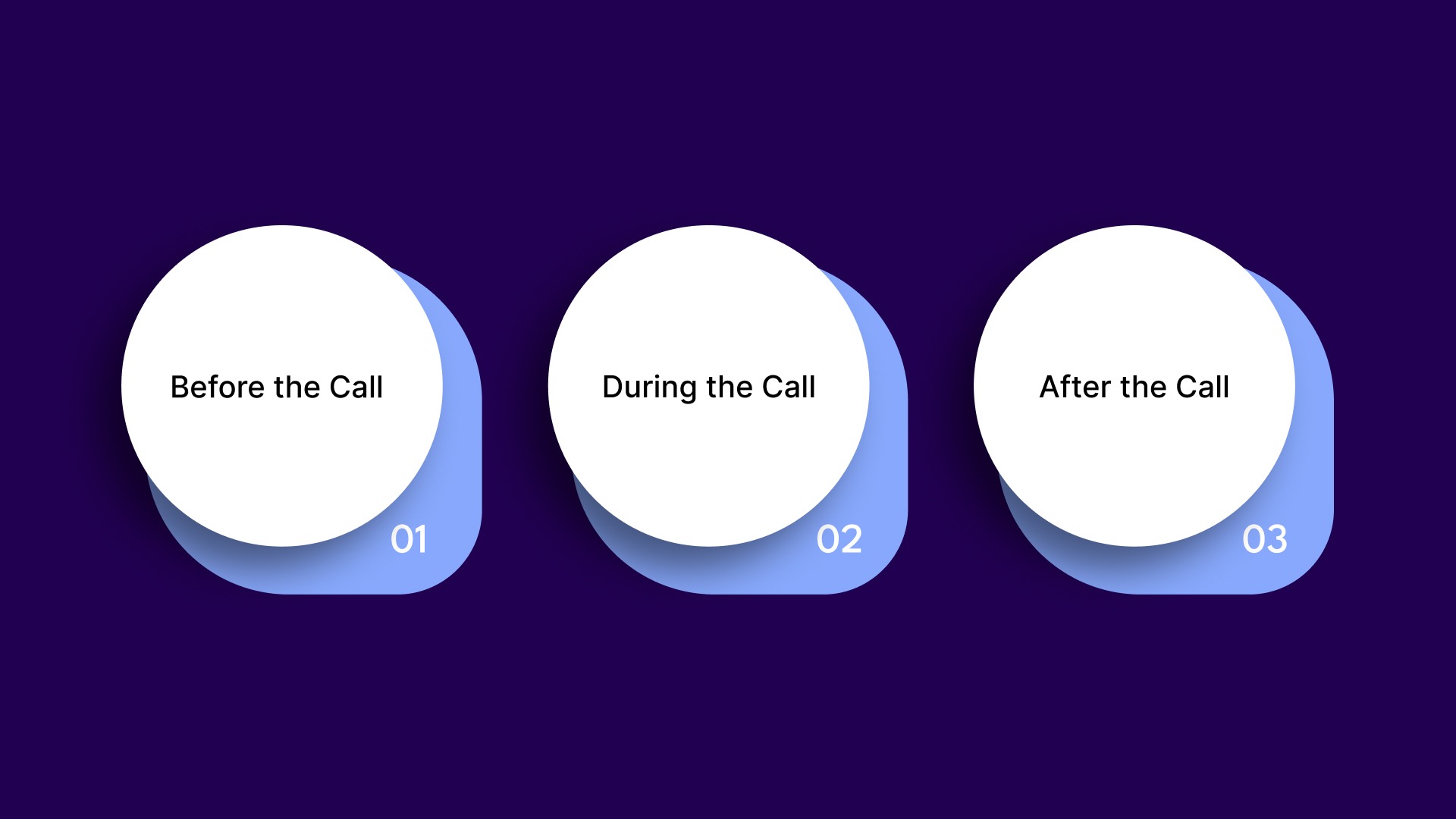
Before the Call

  • Pull the full account history: Balance, previous contacts, payment history, and any disputes on file.
  • Confirm contact timing: Check Regulation F call limits and verify it is within permitted hours for the consumer's time zone.
  • Check enforcement status: For agencies and law firms, confirm whether the account is still within the statute of limitations before calling. Time-barred accounts require different handling.
  • Decide your objective for this call: Full payment, payment arrangement, dispute intake, or updated contact information.

During the Call

  • Follow the script framework but stay conversational. Consumers respond better when agents do not sound like they are reading.
  • Let the consumer talk. Active listening is not a soft skill - it reveals whether the consumer is disputing, in hardship, or simply procrastinating.
  • Do not rush to the payment ask. Establish the debt first, confirm understanding, then offer options.
  • Never threaten what you cannot deliver. Empty threats about lawsuits or wage garnishment are FDCPA violations.

After the Call

  • Log every call immediately: outcome, next step agreed, any hardship or dispute flags.
  • Send required written notices within five business days of initial contact if not already done.
  • Schedule follow-ups with specific dates, not vague reminders.
  • Escalate accounts that show dispute indicators or repeat hardship claims to your compliance or legal team.

Process alignment ensures agents act with context, turning isolated calls into part of a coordinated recovery workflow across the entire account lifecycle. 

Suggested Read: CFPB Credit Card Late Fee Lawsuits and Legal Developments 2026

Script Adjustments for Different Collector Types

The right script tone and language shifts depending on who is calling and who they represent. Here is how the approach differs across common collection contexts.

Collector Type Key Script Considerations
Third-party collection agency Full FDCPA mini-Miranda required. Must identify the company and verify identity before disclosing any account details.
Collection law firm Agents must still follow FDCPA rules. If the firm is engaged in litigation, do not imply legal action is imminent unless it is. Document every call for audit readiness.
Original creditor/credit issuer Mini-Miranda is generally not required (FDCPA applies to third-party collectors). However, many original creditors include similar disclosures as a best practice. Check your state-level obligations.
Debt buyer You are a third-party collector under the FDCPA. Scripts must include full mini-Miranda and identity verification. Be prepared to validate the debt if the consumer requests it - portfolio data gaps are common.
AR team (B2B) FDCPA does not apply to business debt. Tone can be more direct, but script structure still matters for consistency and documentation.

Tips on Handling Common Consumer Objections

Accounts receivable call scripts break down most often when agents hit objections they were not prepared for. Here are the most common ones and how to respond effectively.

Objection 1: 'I already paid this.'

Do not argue. Ask the consumer for the date and method of payment, log it, and tell them you will verify with your records and follow up. If the payment is confirmed, update the account immediately. If it is not confirmed, walk through the validation process.

Objection 2: 'I cannot afford to pay anything right now.'

Acknowledge the situation without offering anything you are not authorized to. Ask what their timeline looks like. Offer to note the hardship on the account and schedule a follow-up. Even a small commitment - a callback date, a partial payment - is better than ending the call with nothing documented.

Objection 3: 'This is not my debt.'

Do not pressure the consumer to pay on a disputed account. Log the dispute, explain their right to request validation in writing, and pause outreach activity until the debt is validated. This is a legal requirement, not an option.

Objection 4: 'Stop calling me.'

If a consumer requests in writing that you cease contact, you must stop. If the request is verbal, document it and check your legal obligations in the relevant state. Some state laws treat verbal cease-and-desist requests as binding. When in doubt, flag the account for your compliance team.

Objection 5: 'I want to talk to your supervisor.'

Escalation requests should be handled without hesitation. Document the request, transfer, or schedule the callback, and note the reason for escalation. Refusing or delaying supervisor escalation can be characterized as a harassment tactic under the FDCPA.

Why Even Good Collection Call Scripts Break in Practice?

Most collection call scripts are built correctly. The breakdown occurs during execution, when scripts are used without alignment with real workflows, account context, and system support.

Here is where they fail:
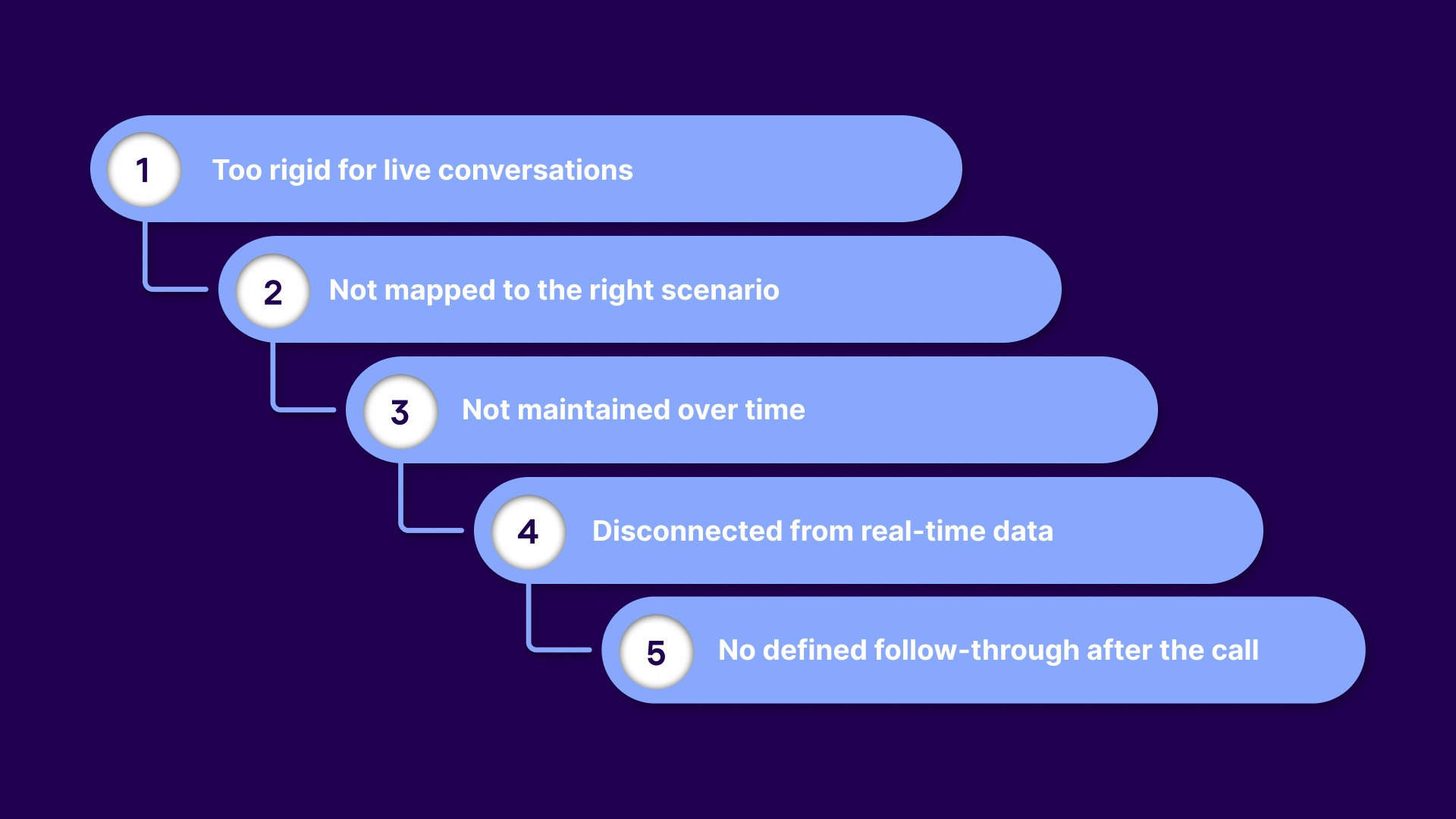
  • Too rigid for live conversations: Agents who rely on fixed wording struggle when calls move off-script. Scripts should guide structure, not restrict responses.
  • Not mapped to the right scenario: Using the same script across first contact, follow-ups, and missed payments reduces effectiveness. Each stage requires a different approach.
  • Not maintained over time: Scripts that are not reviewed regularly fall out of sync with current regulations and internal processes.
  • Disconnected from real-time data: Without access to current account status, prior interactions, or contact updates, agents cannot consistently execute scripts.
  • No defined follow-through after the call: Outcomes depend on what happens next. Missed logging, delayed notices, or weak follow-up processes limit results.

Strong scripts support the conversation. Consistent outcomes depend on how well they are integrated into the surrounding system.

State-Level Requirements for Collection Call Compliance

Federal FDCPA requirements set the baseline, but several states have stricter rules that affect how you script and conduct collection calls. If you are operating in high-volume states, these are worth knowing.

State Key Considerations
California The Rosenthal Act extends FDCPA-style protections to original creditors. More detailed disclosure requirements apply.
New York State-level debt collection rules and city-level requirements (NYC) add layers beyond federal law. Consumer credit transactions are subject to a three-year statute of limitations.
Texas Strict rules around call timing and verification. Texas debt collectors must register with the state.
Florida Specific rules on voicemails and digital communications. State law aligns closely with FDCPA but has additional prohibitions.
Illinois The Collection Agency Act imposes licensing and conduct requirements in addition to those of federal law.

Important: This table is informational. Confirm your obligations with qualified legal counsel before building scripts for specific state markets.

Suggested Read: Debt Collection Compliance: Essential Regulations and Guidelines to Know

Scripts Work Best When the System Behind Them Does Too

A well-written debt collection call script solves the conversation problem. But it does not solve what happens around it: tracking call attempts against Regulation F limits, logging outcomes, sending validation notices on time, managing payment arrangements, and keeping compliance-sensitive account activity documented.

For most collection agencies, debt buyers, and law firms, those operational gaps exist not because teams do not know better, but because they are working across disconnected tools. Call notes in one place, payment data in another, follow-ups managed manually. When volume increases, those gaps become a risk.

Tratta is debt collection software that brings payments, digital communications, reporting, and workflow management into one platform. Your agents can focus on the call while the system handles what comes before and after it.

Here is where Tratta supports the work your scripts set in motion:

  • Consumer Self-Service Platform: Consumers who prefer not to engage by phone can resolve balances on their own schedule, reducing inbound call volume and improving payment rates.
  • Embedded Payments: Payment commitments made during calls can be processed securely in the same platform, without agents switching between tools.
  • Multilingual Payment IVR: For portfolios with Spanish-speaking or other non-English consumers, IVR support in multiple languages helps extend outreach without adding headcount.
  • Reporting and Analytics: Track call outcomes, payment arrangements, and recovery performance across your full portfolio in one dashboard.
  • Omnichannel Communications: Coordinate follow-up across phone, email, and text from a single place so nothing falls through after a call ends. 

Instead of managing compliance, tracking, and payments across disconnected tools, with Tratta, your team operates with full visibility and control from a single platform. 

Conclusion

Effective collection call scripts are not defined by what is written, but by how consistently they are executed across every interaction. The difference shows up in outcomes, not intent.

Teams that treat scripts as part of a larger operational system can maintain control, improve consistency, and scale performance without adding friction.

Tratta supports this by bringing communication, payments, and workflows into one place, keeping execution consistent as operations grow.

To improve collection outcomes with better control and consistency, book a demo and see how Tratta works in practice.

FAQs

1. What is a debt settlement script in collections?

A debt settlement script guides agents in negotiating reduced payoff amounts by confirming balances, assessing affordability, and proposing terms while maintaining compliance and a structured conversation flow.

2. What is a collection message script for SMS or email?

A collection message script is used for SMS or email reminders, including account reference, payment link, and opt-out instructions, while avoiding sensitive disclosures to maintain compliance requirements.

3. What is a collection phone call script used for?

A collection's phone call script helps agents structure conversations, verify identity, explain balances, and guide consumers toward payment or resolution while maintaining compliance and consistency across calls.

4. How do outbound debt collection call script samples help agents?

Outbound debt collection call script samples provide structured conversation flows for first contact, follow-ups, and negotiations, helping agents stay compliant and focused on achieving payment outcomes.

5. What is a collection call script sample used for in training?

A collection call script sample is used in agent training to demonstrate compliant language, objection handling, and call flow, helping new collectors conduct effective, consistent conversations.

Related stories

Ready to Get Started?
Schedule a personal tour of Tratta and see our debt collection software in action.
Request a Demo