7 Top Collection Platforms With Self-Serve Debt Tools in 2026
Industry & Trends
7 Top Collection Platforms With Self-Serve Debt Tools in 2026
Published on:
August 3, 2026
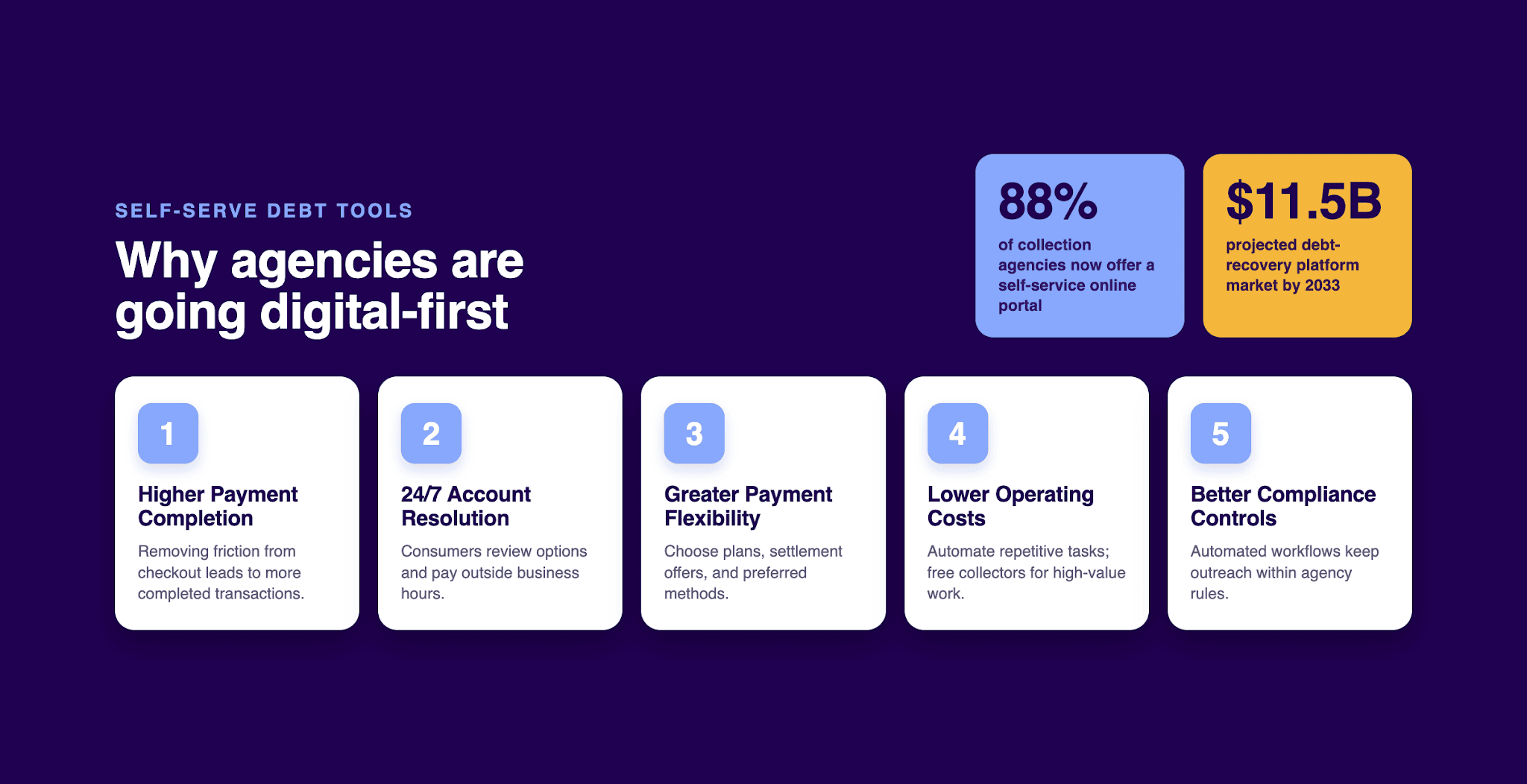
Collection agencies face a growing challenge: consumers increasingly expect to resolve debts on their own schedule, yet many agencies still rely on agent-heavy processes that create friction and slow recoveries. As digital engagement becomes a competitive advantage, the global Debt Recovery Platform market is projected to reachUSD 11.5 billion by 2033.
If you are evaluating ways to improve consumer experience while reducing operational workload, you are not alone. In this guide, we compare the top collection platforms with self-serve debt tools, examining the features, payment options, and self-service features.
Quick look:
Self-serve debt tools allow consumers to resolve accounts independently. Common capabilities include payments, settlements, payment plans, account access, and digital account management.
The best platforms combine self-service with recovery operations. Features such as workflow automation, communications, compliance controls, and analytics help agencies maximize results.
Not all self-service tools offer the same experience. Some focus on payments, while others support complete end-to-end account resolution without agent involvement.
Agencies should evaluate technical capabilities carefully. Real-time account updates, omnichannel engagement, security controls, reporting, and configurable workflows are key selection criteria.
Tratta, InterProse ACE, C&R Debt Manager, Artiva RM, Simplicity Collect, Collect!, and Quantrax RMEx are among the leading options. Each platform offers self-service functionality, but their automation, compliance, and consumer engagement features differ significantly.
What Are Self-Serve Debt Tools in Debt Collection?
Self-service debt collection allows consumers to manage and resolve accounts without needing direct assistance from a collector. These tools are typically delivered through online portals, mobile-friendly interfaces, virtual agents, payment IVRs, and automated communication channels.
88% of debt collection companies now offer a self-service online portal, according to TransUnion's Debt Collection Industry Report.
Instead of waiting for office hours or speaking with an agent, consumers can review account information, make payments, accept settlement offers, enroll in payment plans, and update contact information whenever it is convenient.
Some of the key benefits include:
Higher Payment Completion Rates: Removing friction from the payment process often leads to more completed transactions.
24/7 Account Resolution: Consumers can access account information, review options, and make payments outside normal business hours.
Greater Payment Flexibility: Many platforms allow consumers to choose payment plans, settlement options, and preferred payment methods.
Lower Operating Costs: Agencies can automate repetitive tasks and allocate collectors to higher-value recovery activities.
Better Compliance Controls: Automated workflows help ensure communications and payment processes follow agency rules and regulatory requirements.
In fact, research fromMcKinsey found that consumers who digitally self-serve resolve their debts at higher rates and are significantly more likely to pay in full.
In the next section, we examine how to choose the best self-serve debt tools for your agency and identify the features that have the greatest impact on recovery performance.
How to Choose the Best Debt Collection Platform for Your Agency?
To select the right platform, agencies should evaluate how effectively the technology supports recovery performance, compliance requirements, consumer engagement, and operational scalability.
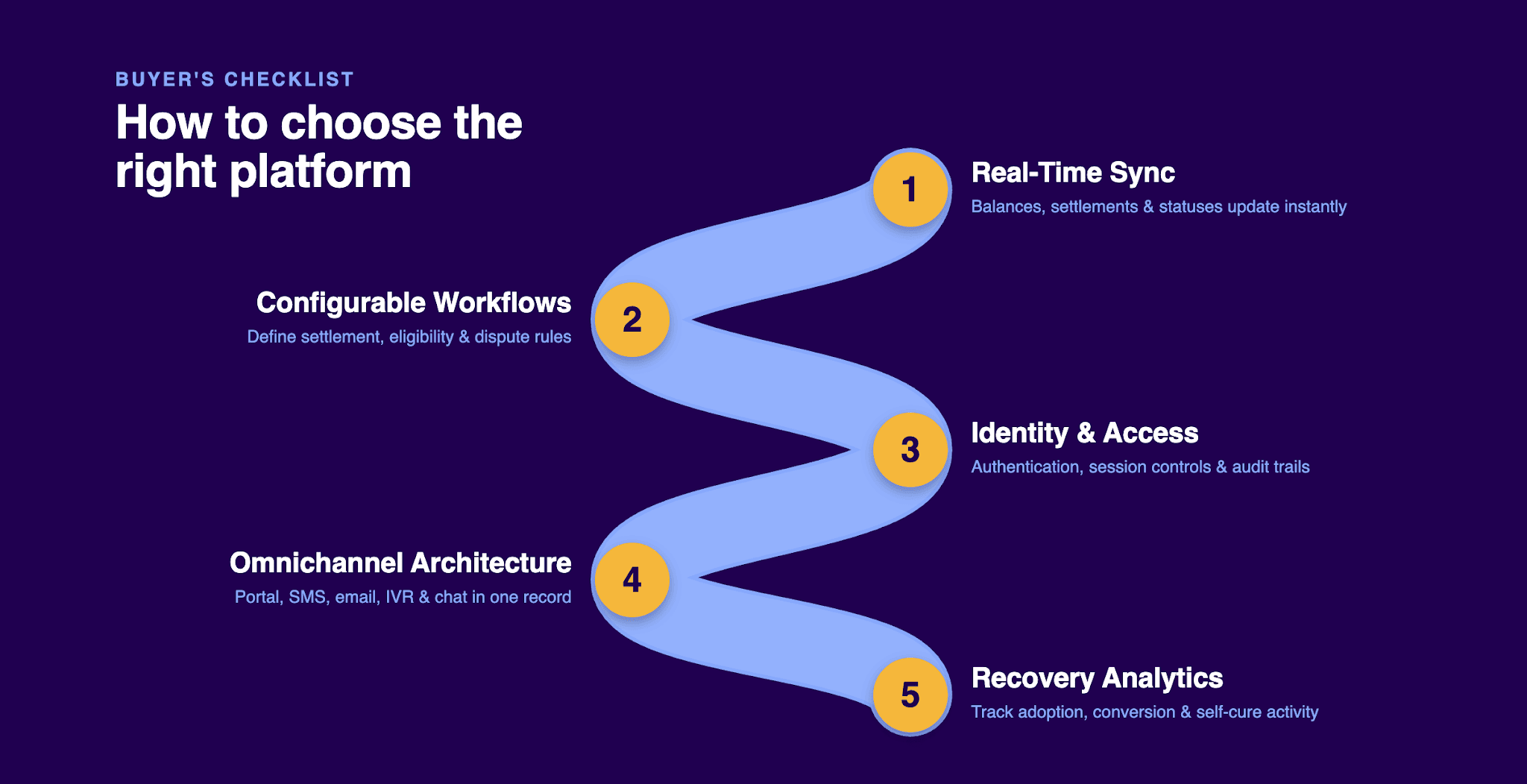
Focus on these five areas during your evaluation:
Real-Time System-of-Record Synchronization Self-service actions should update balances, settlements, payment plans, disputes, and account statuses instantly. Delayed synchronization can create compliance issues, duplicate work, and inconsistent consumer experiences.
Configurable Resolution Workflows Look for platforms that allow agencies to define settlement rules, payment-plan eligibility, hardship options, dispute handling, and communication logic without requiring custom development.
Identity Verification and Access Controls Consumer-facing portals should include robust authentication, session controls, audit trails, and permission management to protect sensitive account information and support compliance obligations.
Omnichannel Self-Service Architecture The strongest platforms allow consumers to move seamlessly between portals, SMS, email, IVR, chat, and agent-assisted interactions while maintaining a single account history and activity record.
Recovery Analytics and Adoption Tracking Agencies should be able to measure portal utilization, payment conversion rates, settlement acceptance rates, self-cure activity, and digital recovery performance to determine whether self-service investments are generating measurable results.
The best self-service platforms do more than process payments. They create a secure, compliant, and consumer-friendly resolution experience that scales alongside agency growth while reducing operational friction.
With those evaluation criteria in mind, let's examine the top collection platforms with consumer service debt tools in 2026 and see how they compare.
Best Collection Platforms Offering Self Serve Debt Tools
Self-service capabilities have evolved from simple payment portals into comprehensive account-resolution environments. The leading platforms now combine consumer self-service, digital communications, payment processing, workflow automation, and compliance controls to help agencies recover more while reducing operational effort.
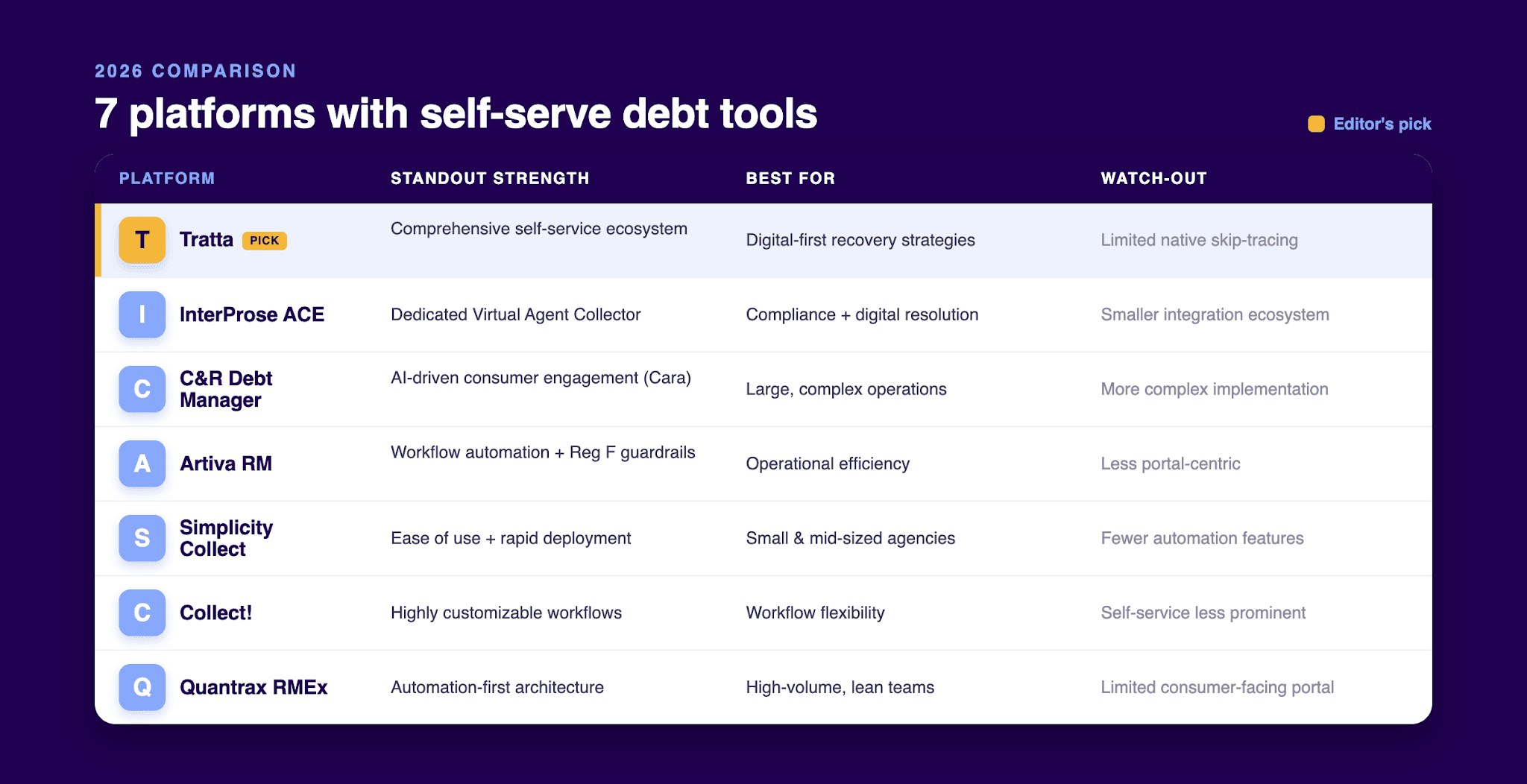
The table below provides a high-level comparison of the leading collection platforms with self serve debt tools before we examine each solution in detail.
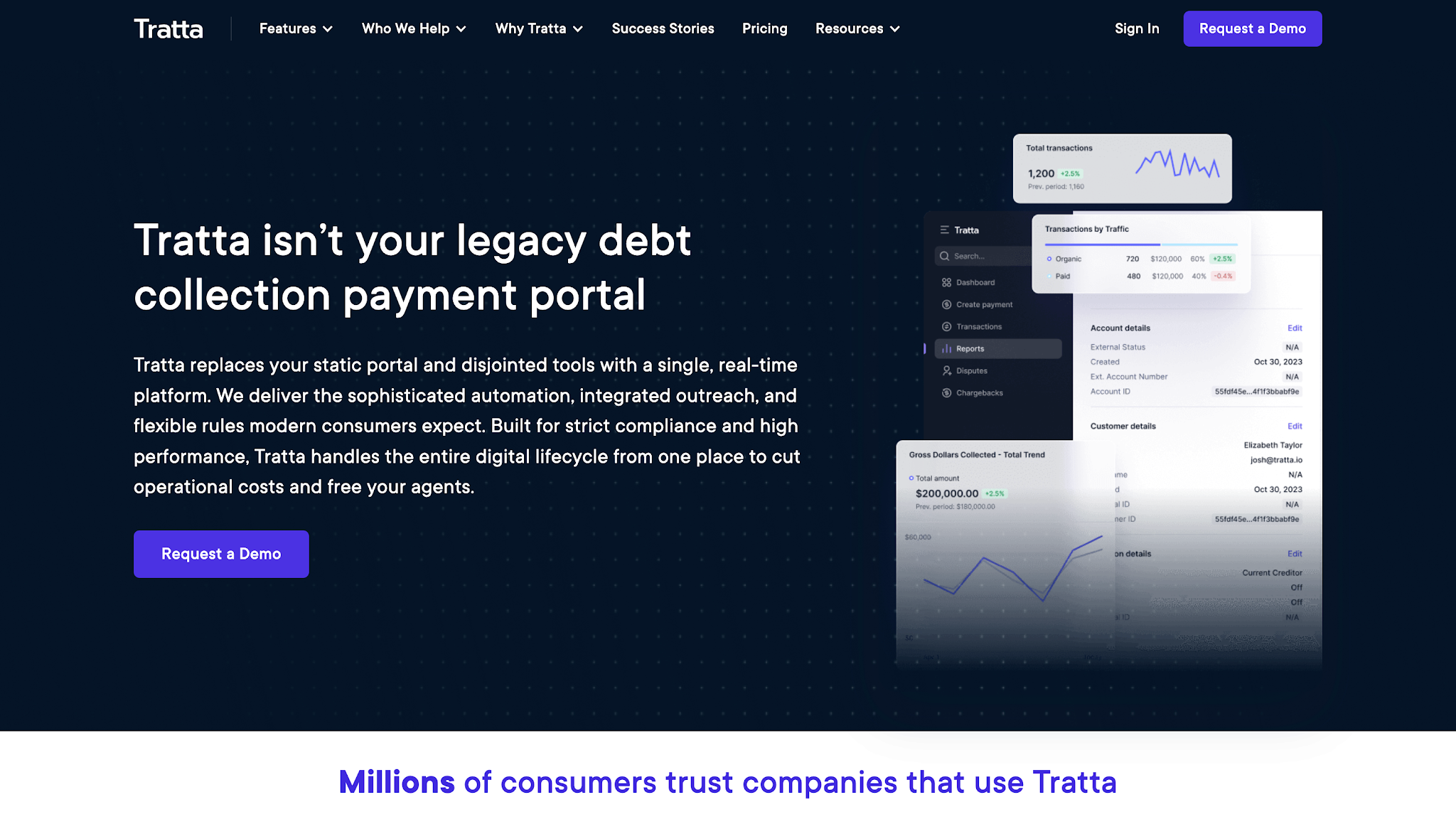
Tratta is a cloud-based collections platform built specifically for collection agencies, debt buyers, creditors, and collection law firms. Rather than treating self-service as an add-on, the platform places consumer-driven account resolution at the center of its recovery strategy. It combines digital engagement, payments, communications, compliance controls, analytics, and workflow automation within a unified ecosystem.
Key Features
Consumer Self-Service Portal Consumers can review balances, access documents, accept settlements, enroll in payment plans, submit disputes, and make payments without contacting an agent. The portal is mobile-friendly, white-labeled, and designed to support end-to-end account resolution.
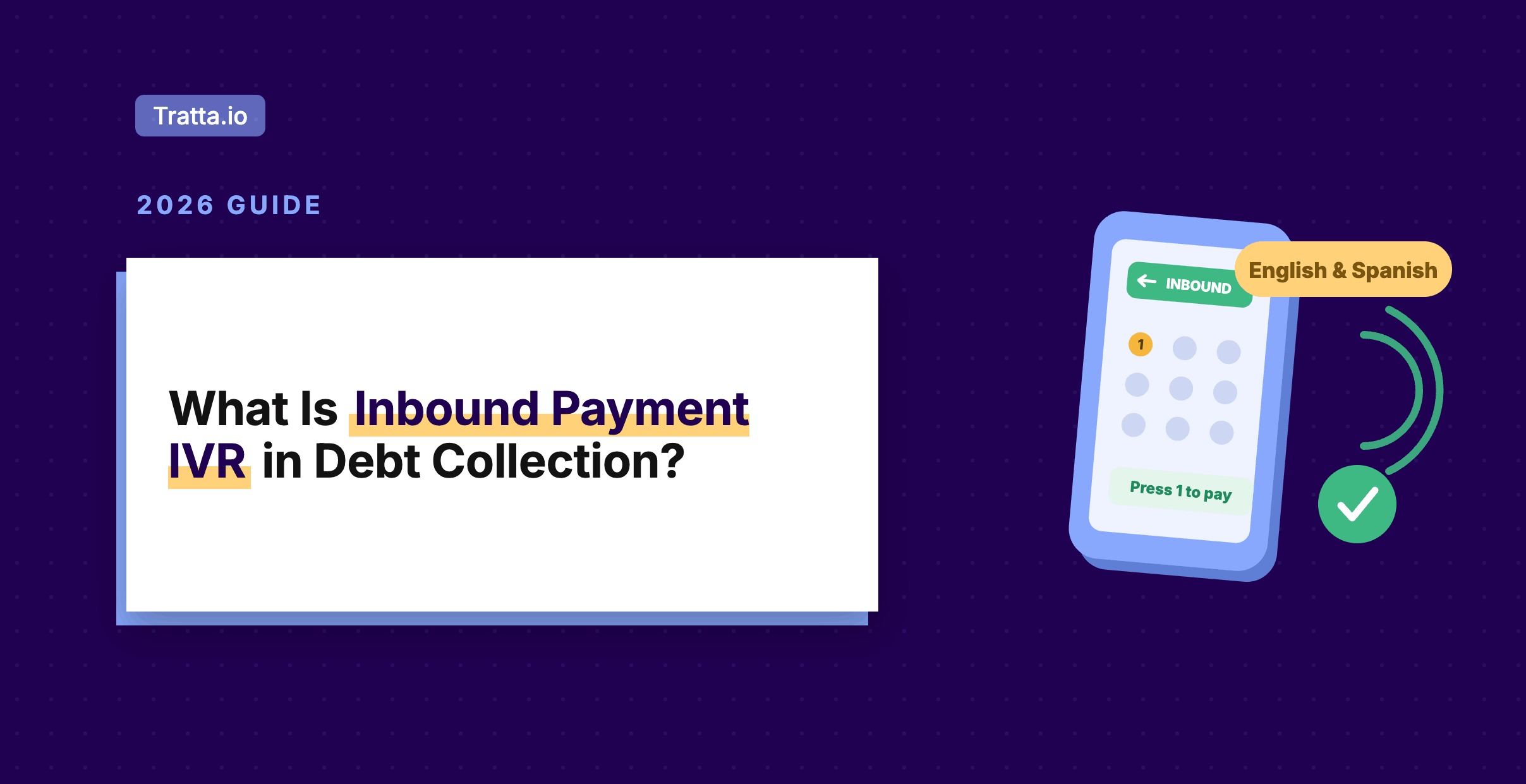
Multilingual Payment IVR The IVR system allows consumers to make payments and manage accounts through an automated phone experience. This extends self-service availability beyond web-based channels and supports after-hours recovery efforts.
Omnichannel Communications Agencies can engage consumers through SMS, email, phone, and digital campaigns from a single platform. Communication preferences and activity remain connected to the account record for consistent engagement.
Integrated Payments and Settlements Tratta supports payment plans, settlement offers, recurring payments, and multiple payment methods. Consumer actions update directly within the platform, reducing manual processing and reconciliation work.
Reporting and Analytics Real-time reporting provides visibility into portal adoption, payment activity, campaign performance, and recovery trends. Agencies can use these insights to refine digital engagement and recovery strategies.
What Sets It Apart
Self-service drives the entire recovery workflow.
Consumer portal and IVR work together.
Fully white-labeled consumer experience.
Limitations
No native skip-tracing capabilities.
Limited litigation-specific functionality.
Digital-first approach may not suit all agencies.
Best For
Tratta is best suited for agencies that want self-service to become a primary recovery channel rather than a secondary payment option. Its combination of consumer portals, IVR, digital communications, payments, and analytics makes it particularly valuable for agencies pursuing scalable, digital-first collection strategies.
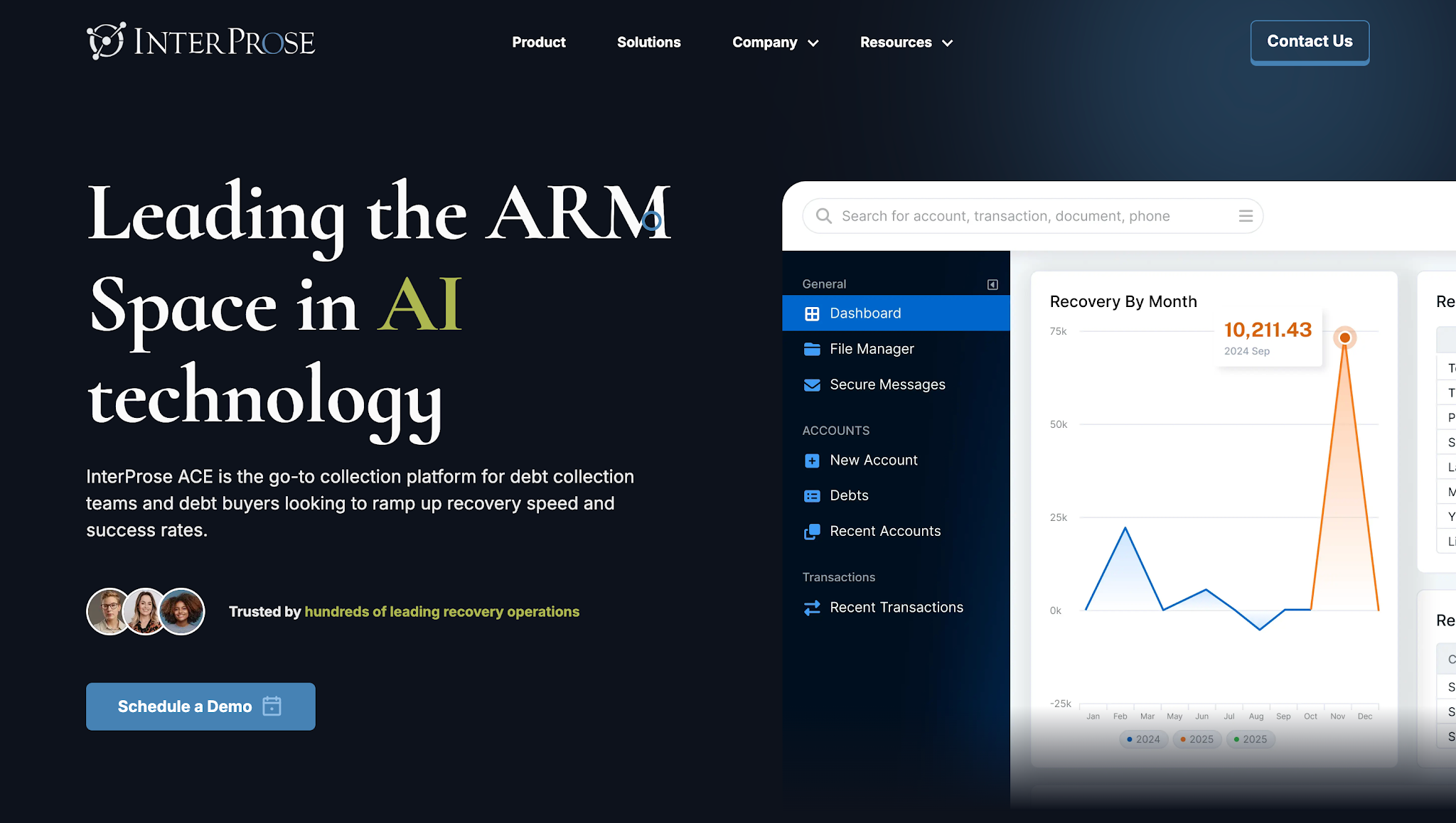
InterProse ACE is a cloud-based collections platform designed for third-party collection agencies, debt buyers, and servicers. The platform combines account management, consumer engagement, compliance controls, workflow automation, and self-service functionality within a single environment. Its Virtual Agent Collector and consumer-facing applications place a strong emphasis on digital account resolution.
Key Features
Consumer Self-Service Applications: Consumers can access account information, make payments, review options, and resolve accounts through self-service tools. These capabilities are available without requiring direct agent involvement for routine interactions.
Virtual Agent Collector: The platform's web-based self-service application allows consumers to make payments and enroll in payment plans. Decision-tree logic helps agencies automate account resolution paths while maintaining control over available options.
Compliance and Consent Management: ACE includes controls for managing consumer communication preferences, consent records, and compliance requirements. These safeguards help agencies maintain oversight across digital engagement channels.
Omnichannel Consumer Engagement: Agencies can engage consumers through multiple communication channels while maintaining centralized account histories and activity records. This supports a more consistent consumer experience across touchpoints.
Audit Trails and Reporting: Detailed reporting and audit capabilities help agencies track activity, monitor performance, and support compliance reviews. Operational visibility remains available across consumer interactions and workflows.
What Sets It Apart
Includes a dedicated virtual collector.
Strong compliance and consent controls.
Built specifically for third-party collections.
Limitations
User interface feels less modern.
Smaller integration ecosystem.
Reporting can require customization.
Best For
InterProse ACE is best for agencies that want consumer self-service alongside strong compliance oversight and workflow automation. Its Virtual Agent Collector, web payment capabilities, and compliance-focused architecture make it particularly attractive for agencies seeking a balanced approach to digital collections.
C&R Debt Manager is an enterprise collections and recovery platform used across multiple industries and debt types. The platform combines workflow automation, digital engagement, analytics, payment management, and AI-powered collections capabilities within a cloud-native environment. Its self-service offering is powered by Cara AI, which allows consumers to manage accounts without direct agent assistance.
Key Features
Cara AI Self-Service Assistant: Cara AI enables consumers to check balances, review account information, make payments, and update details through an automated interface. The tool is available 24/7 and integrates directly with account data for real-time interactions.
Digital Payment Management: Consumers can complete payments and manage obligations through digital channels. The platform supports automated account servicing while reducing routine agent workload.
FitComms Communication Tools: Agencies can engage consumers through personalized communications across multiple channels. Messaging can be tailored to account status and recovery strategies.
Workflow Automation: Debt Manager automates account handling, routing, prioritization, and recovery processes. Agencies can configure workflows without extensive development resources.
Enterprise Reporting and Analytics: Real-time reporting, dashboards, and performance insights help agencies monitor portfolio activity and optimize collection strategies. The platform is designed to support high-volume operations.
What Sets It Apart
Dedicated AI-powered self-service assistant.
Supports complex recovery environments.
Strong security and compliance posture.
Limitations
More complex implementation process.
Enterprise focus increases platform complexity.
Smaller agency needs may be excessive.
Best For
C&R Debt Manager is best for agencies managing large portfolios and complex recovery operations. Its combination of Cara AI self-service, workflow automation, analytics, and enterprise-grade controls makes it well-suited for agencies seeking advanced digital engagement capabilities alongside robust operational management.
Artiva RM is a collections platform built for third-party collection agencies seeking to automate workflows, improve consumer engagement, and strengthen compliance oversight. The platform combines event-driven automation, omnichannel communications, payment management, and recovery analytics within a single environment.
It is important to note that the self-service capabilities are less portal-centric than some competitors. However, the platform emphasizes consumer-driven account resolution through digital engagement and payment tools.
Key Features
Self-Service Payments: Consumers can resolve accounts through integrated payment experiences and digital engagement channels. The platform is designed to reduce friction throughout the payment journey.
Event-Driven Workflow Automation: Artiva RM automates repetitive collection activities through configurable workflows and triggers. This helps agencies scale operations while maintaining process consistency.
Omnichannel Consumer Outreach: Agencies can coordinate communications across multiple channels based on consumer preferences and engagement history. This creates a more connected recovery experience.
Compliance Guardrails: Built-in controls help agencies manage communication frequency and support compliance requirements such as Regulation F. Activity tracking also supports audit readiness.
Payment Processing and Reconciliation: Integrated payment capabilities simplify transaction management, reconciliation, and account updates. Automation reduces manual work associated with payment administration.
What Sets It Apart
Strong workflow automation capabilities.
Built-in Regulation F safeguards.
Advanced payment reconciliation tools.
Limitations
Self-service features are less extensive.
The consumer portal is less prominent.
Higher learning curve for administrators.
Best For
Artiva RM is best for agencies that prioritize workflow automation, compliance controls, and payment management. Its combination of digital engagement, automated workflows, and payment processing makes it a strong option for agencies seeking operational efficiency alongside consumer-facing tools.
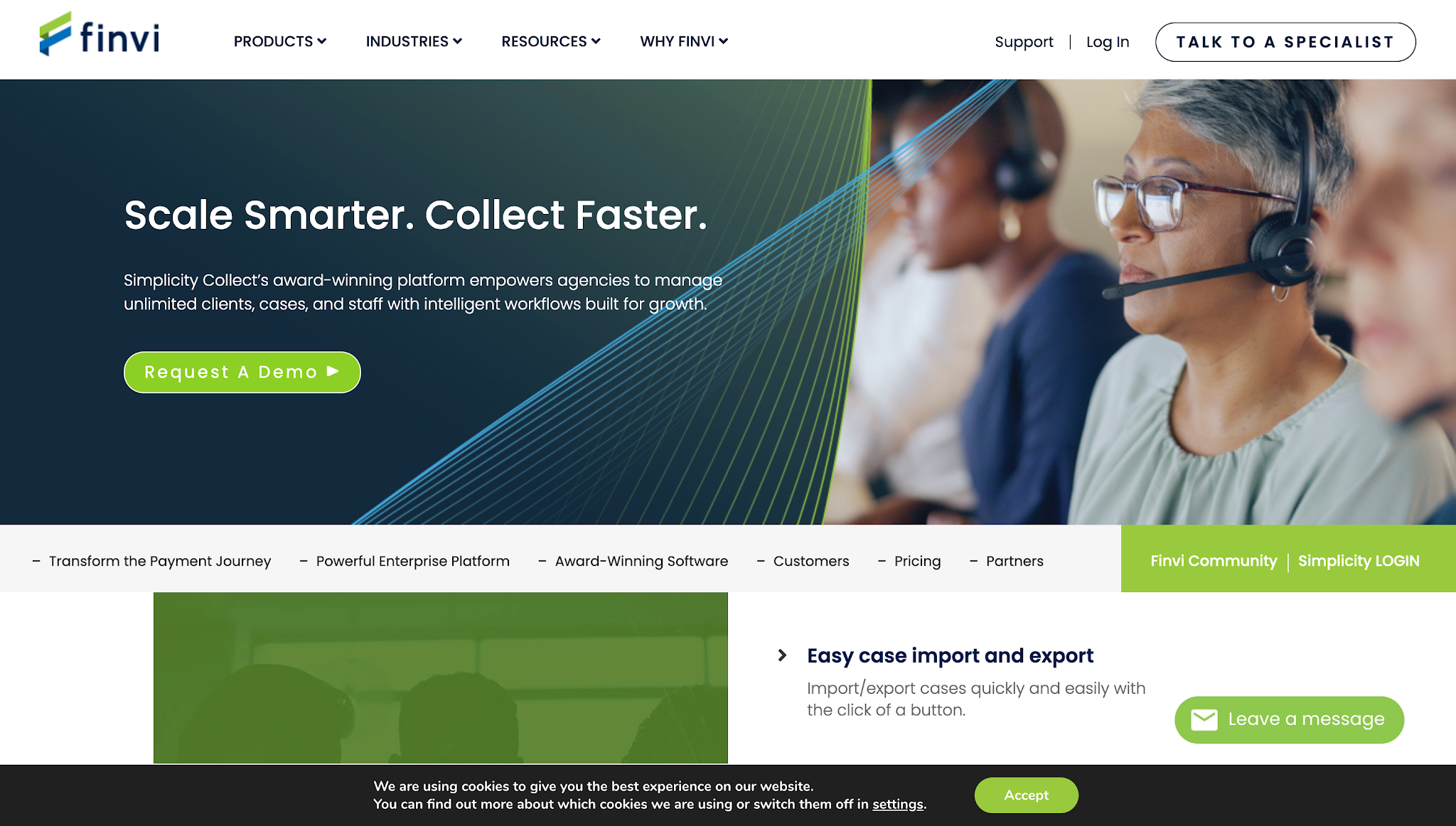
Simplicity Collect is a web-based collections platform designed for small and mid-sized collection agencies. The platform focuses on ease of use, streamlined operations, and consumer payment management while avoiding the complexity often associated with larger enterprise systems. Its built-in consumer portal gives agencies a straightforward way to offer self-service account resolution.
Key Features
Consumer Payment Portal: Consumers can make payments through a dedicated portal using credit cards or ACH. The portal allows agencies to provide digital payment options without requiring collector involvement for every transaction.
Client Portal Access: Clients can review account activity, update collection statuses, submit files, and access reports. This reduces manual requests and improves transparency.
Web-Based Platform: The cloud-based architecture reduces infrastructure requirements and simplifies deployment. Agencies can access the system without maintaining on-premise environments.
Workflow Management Tools: Agencies can manage accounts, workflows, reporting, and case activity through a centralized interface. Automation helps reduce administrative workload.
Custom Reporting Capabilities: Users can build reports based on agency-specific criteria and performance metrics. This supports portfolio oversight and operational decision-making.
What Sets It Apart
Simple implementation and onboarding.
Includes consumer and client portals.
Designed for growing agencies.
Limitations
Fewer advanced automation features.
Limited enterprise-level functionality.
Smaller integration ecosystem.
Best For
Simplicity Collect is best for small and mid-sized agencies that want consumer self-service without the complexity of larger collections platforms. Its combination of consumer payments, client access, workflow tools, and cloud-based deployment makes it a practical option for agencies focused on operational simplicity and digital payment adoption.
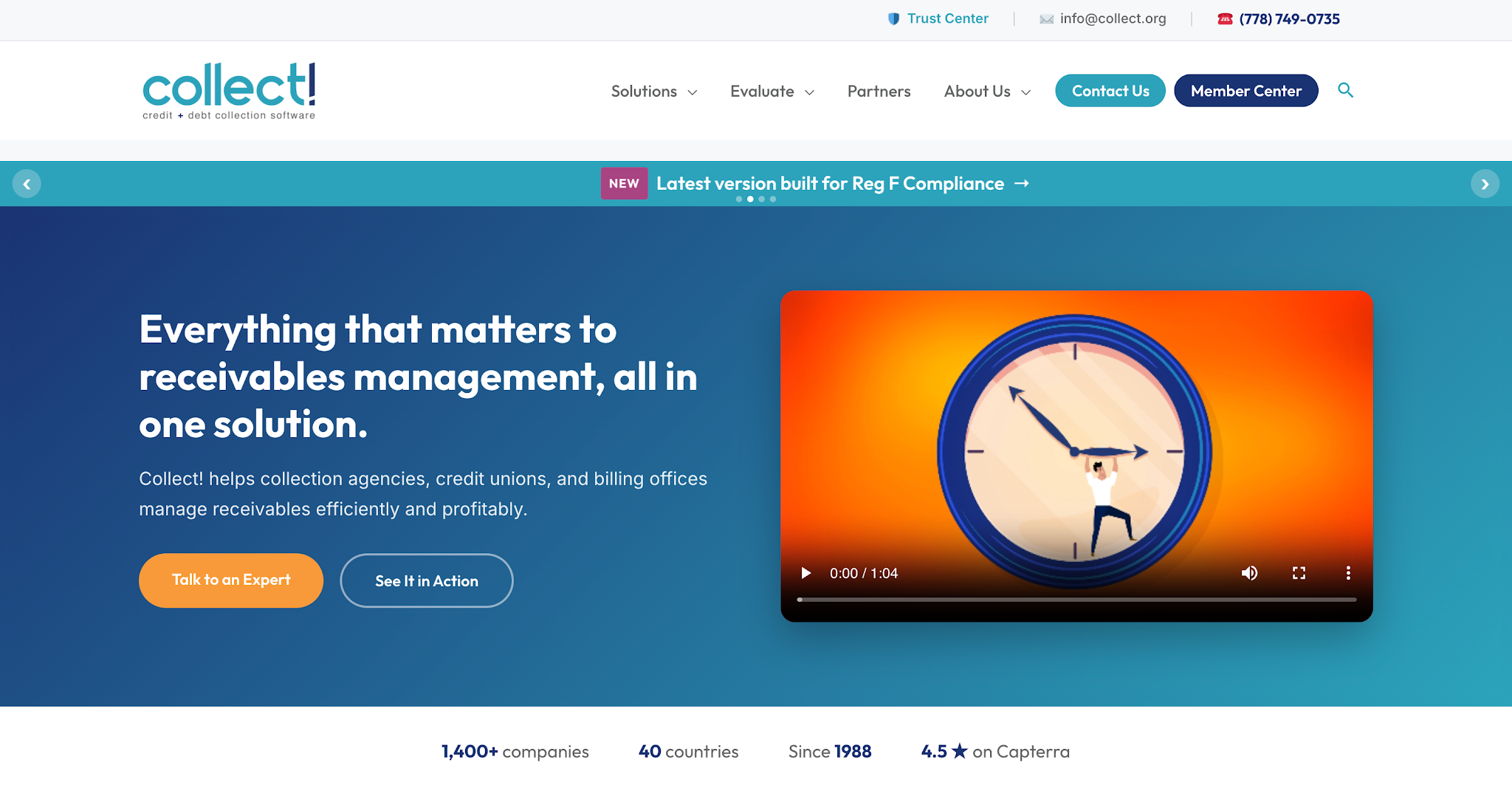
Collect! is a long-established debt collection platform used by collection agencies, credit unions, and receivables management organizations. The software emphasizes flexibility, workflow customization, automation, and integrations, allowing agencies to tailor the platform to their operational requirements. Its modular architecture and self-service features make it suitable for agencies seeking a configurable collections environment.
Key Features
Self-Serve Account Management Tools: Collect! offers self-serve tools that allow agencies to automate account servicing and support consumer-facing collection workflows. These capabilities help reduce manual intervention and streamline recovery processes.
Workflow Automation: The platform automates repetitive collection activities, including reminders, escalations, and account routing. Agencies can improve productivity while maintaining process consistency.
Customizable Business Rules: Users can tailor workflows, account fields, letters, and collection processes to match agency requirements. This flexibility supports a wide range of collection strategies.
Integration Framework: Collect! supports APIs and integrations with accounting systems, CRMs, payment providers, and other operational tools. Agencies can connect existing systems without extensive redevelopment.
Real-Time Reporting: Dashboards and reporting tools provide visibility into portfolio performance, collector productivity, and recovery outcomes. Agencies can use these insights to optimize operations.
What Sets It Apart
Highly customizable collection workflows.
Strong integration flexibility.
Supports agencies of all sizes.
Limitations
User interface feels dated.
Self-service capabilities less prominent.
Requires configuration for optimal value.
Best For
Collect! is best for agencies that prioritize customization and workflow flexibility. Its combination of self-serve tools, automation, integrations, and configurable business rules makes it a strong option for agencies seeking a platform that can adapt to unique operational requirements.
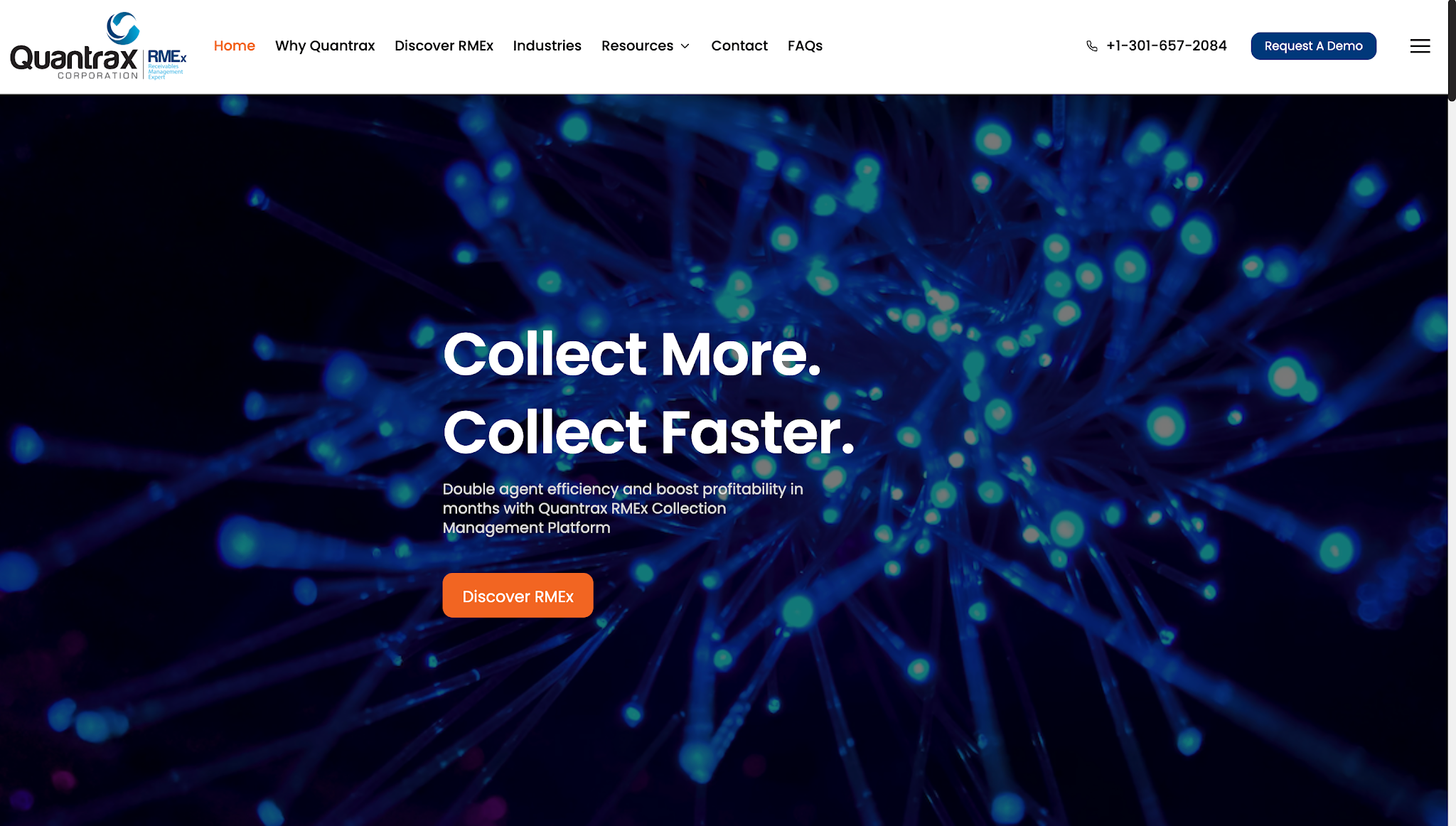
Quantrax RMEx is a collections management platform built exclusively for the accounts receivable management industry. The platform focuses on intelligent automation, compliance controls, omnichannel engagement, and operational efficiency for third-party collection agencies. While its self-service capabilities are less consumer-portal-centric than some competitors, RMEx emphasizes automated consumer interactions and digital engagement to reduce reliance on manual collection activities.
Key Features
Automated Consumer Engagement: RMEx supports omnichannel communication strategies that help consumers engage through their preferred channels. Agencies can automate large portions of the account-resolution process while maintaining compliance controls.
Intelligent Workflow Automation: The platform uses real-time decisioning and automation to route accounts, prioritize actions, and reduce manual work. Agencies can adapt workflows without extensive programming resources.
Compliance Safeguards: RMEx incorporates compliance controls throughout collection workflows, helping agencies prevent errors and document interactions. The platform is designed to keep pace with changing regulatory requirements.
Advanced Security Controls: Role-based permissions, account restrictions, user-level controls, and detailed activity tracking help agencies protect sensitive information. Security features are embedded throughout the platform.
Reporting and Performance Analytics: Agencies gain access to operational data, recovery metrics, and automated stakeholder reporting. These insights help managers optimize collector performance and workflow efficiency.
What Sets It Apart
Automation-first collections architecture.
Deep compliance-focused workflow controls.
Built exclusively for debt recovery.
Limitations
No prominent consumer payment portal.
Interface prioritizes functionality over simplicity.
Self-service features less consumer-facing.
Best For
Quantrax RMEx is best for agencies that prioritize automation, compliance, and operational efficiency over consumer-facing portal experiences. Its combination of intelligent workflows, security controls, analytics, and omnichannel engagement makes it a strong option for agencies managing high account volumes with lean teams.
Self-service debt collection features are often the headline feature, but they are only one part of a successful collections platform. In the next section, we examine the additional features that separate a basic self-service solution from a well-rounded debt collection platform.
Additional Features That Make Collection Software Worth the Investment
Self-service capabilities can improve consumer engagement and reduce collector workload, but they should not be evaluated in isolation. The most effective collection platforms combine self-service with operational, compliance, and recovery tools that help agencies scale efficiently while maintaining control over the collections process.
When comparing solutions, look beyond the consumer portal and evaluate these capabilities:
Workflow Automation: Automated account routing, task creation, prioritization, and communication triggers help agencies manage larger portfolios without increasing headcount.
Payment Processing and Settlement Management: Integrated payments, recurring payment plans, settlement offers, and payment tracking help streamline account resolution and reduce manual effort.
Compliance Controls: Features such as consent management, communication restrictions, audit trails, and Regulation F safeguards help reduce compliance risk.
Open APIs and Integrations: Modern platforms should connect easily with collection systems, payment providers, communication tools, CRMs, and data vendors.
Security and Access Management: Role-based permissions, multi-factor authentication, activity tracking, and encryption help protect sensitive consumer and client information.
Agencies that evaluate the complete technology stack are more likely to choose a solution that delivers measurable recovery improvements rather than simply adding another consumer-facing tool.
Conclusion
Without the right technology, self-service initiatives can create more problems than they solve. Limited functionality, disconnected payment systems, poor consumer experiences, and weak compliance controls can reduce adoption rates, increase operational complexity, and leave recovery opportunities on the table.
Tratta helps agencies deliver a complete self-service experience rather than a basic payment portal. Its consumer self-service tools, multilingual payment IVR, omnichannel communications, integrated payments, reporting, and compliance-focused architecture work together to help agencies improve recovery performance while reducing operational friction.
See how Tratta can help your agency turn self-service into a revenue-generating recovery channel.Schedule a demo to explore how its digital collections platform supports consumer engagement, compliance, and scalable growth.
Frequently Asked Questions
1. What are self-serve debt tools?
Self-serve debt tools allow consumers to manage and resolve accounts without speaking to a collector. Common features include payment portals, settlement acceptance, payment plans, account access, document review, and automated account management.
2. How do self-service debt tools help collection agencies?
These tools reduce call volume, improve consumer engagement, increase payment convenience, and allow agencies to scale recovery operations without adding significant staffing costs. They also support 24/7 account resolution.
3. What features should a self-service debt collection platform include?
The most effective platforms include consumer portals, payment-plan management, settlement workflows, digital communications, reporting, compliance controls, identity verification, and secure payment processing.
4. Can consumers set up payment plans through self-service debt collection software?
Yes. Many modern collection platforms allow consumers to review available options, enroll in payment plans, schedule recurring payments, and manage obligations directly through a portal or digital interface.
5. What is the best collection software with self-serve debt tools?
The best solution depends on your agency's requirements. Platforms such as Tratta, InterProse ACE, C&R Debt Manager, Artiva RM, Simplicity Collect, Collect!, and Quantrax RMEx offer varying levels of consumer self-service, automation, compliance, and recovery management capabilities.
Note: This information is not legal advice. Tratta recommends that you consult with your legal counsel to make sure that you comply with applicable laws in connection with your collection and outreach activities.
Sign up for our monthly newsletter
Debt collection insights that keep you compliant and competitive.
Thank you! Your submission has been received!
Oops! Something went wrong while submitting the form.