A growing share of consumer payment activity now happens digitally, which is changing how collection agencies handle payment authorization, communication records, and consumer consent. The transition toward cashless and instant digital payments continues to accelerate as consumers increasingly expect digital payment experiences by 2028.
At the same time, collection agencies are under pressure to maintain more organized oversight of electronic records, payment interactions, and consumer communication workflows across multiple systems. So the operational challenge is no longer whether electronic agreements are accepted, but whether payment authorizations, consumer acknowledgments, disclosures, and communication records are documented consistently across recovery workflows.
That is where the ESIGN Act becomes operationally important. In this blog, you can find out how the ESIGN Act establishes the legal recognition of electronic records and signatures in the United States, affecting how agencies manage digital payment processes in consumer debt collection environments.
The Electronic Signatures in Global and National Commerce Act (ESIGN Act) is a US federal law that gives electronic signatures and electronic records legal recognition in many business and consumer transactions. Passed in 2000, the law supports the use of digital agreements and electronic documentation instead of relying entirely on paper-based processes.
Under the ESIGN Act, electronic signatures and electronic records can include actions such as:
Suggested Read: How to Create an E-Sign Disclosure and Consent Agreement for Online and Mobile Users?
The challenge is organizing documentation across expanding digital recovery activity, communication history, and consumer acknowledgments as those interactions increase across recovery operations. The ESIGN Act becomes relevant here because electronic records are now directly tied to how agencies manage payment activity, disclosures, and digital consumer interactions operationally.
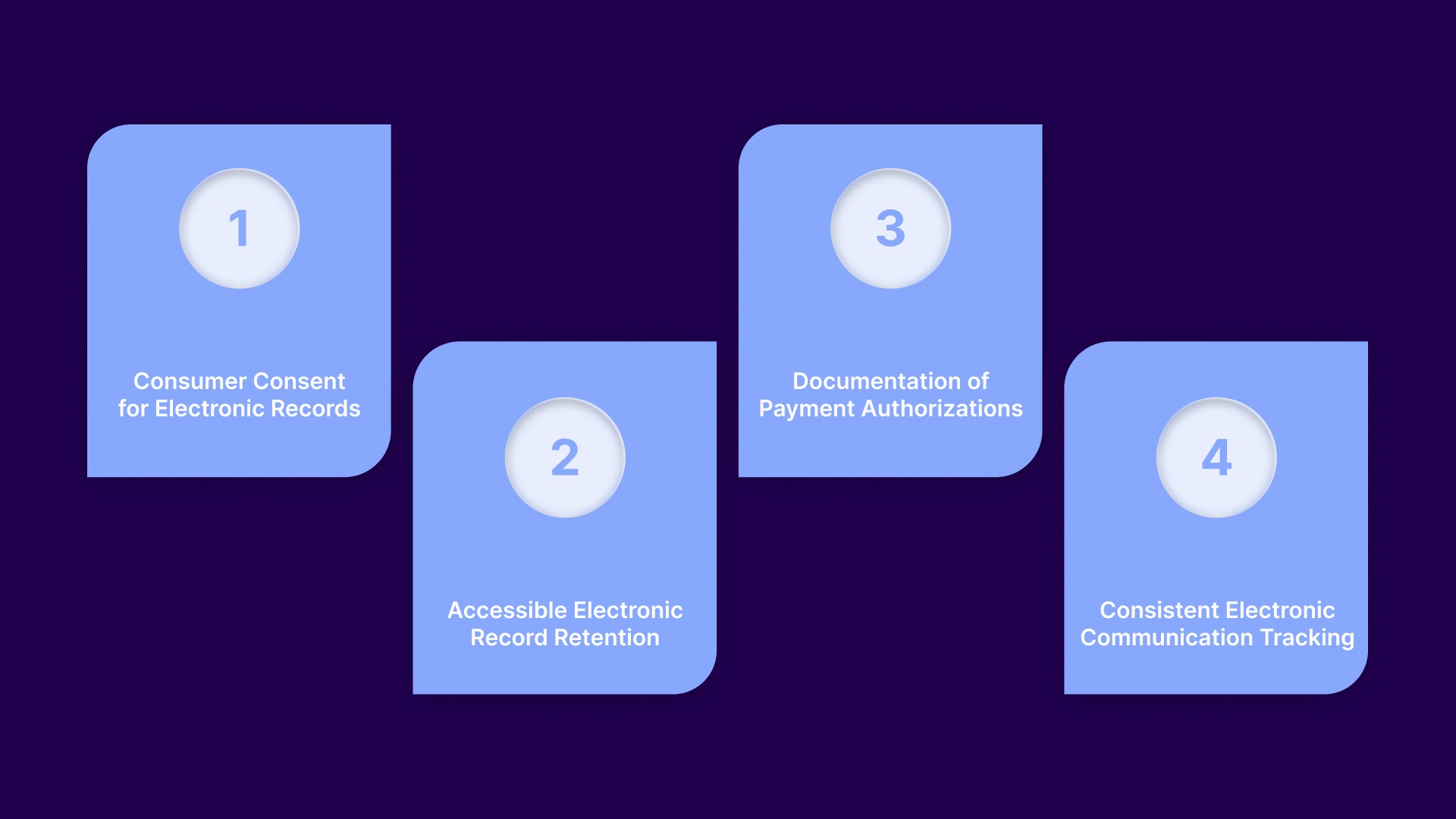
Under the ESIGN Act, consumers must be able to consent to receiving certain records and disclosures electronically. For collection agencies, this can affect workflows involving:
Operationally, agencies often need workflows that clearly document how electronic interactions and acknowledgments are captured during the consumer journey.
Electronic records should remain accessible and capable of being retained accurately after consumer interactions occur. This becomes increasingly important in recovery environments where payment activity, acknowledgments, and communication history may move across multiple operational systems.
Collection agencies often need organized electronic documentation structures that support:
Digital payment workflows frequently involve electronic authorization activity tied to consumer payment arrangements. Agencies handling online payments, self-service activity, or inbound payment interactions may need clearer visibility into:
As digital payment adoption grows, disconnected workflows can make these records harder to track consistently across operations.
Modern recovery operations may involve email communications, digital disclosures, self-service activity, and inbound digital payment interactions occurring across separate platforms. Maintaining aligned documentation across these workflows can become operationally difficult when communication and payment records are stored independently.
Electronic consumer disclosures became more standardized across consumer financial workflows after the Federal Reserve Board adopted rules supporting electronic disclosure delivery under regulations such as Regulation E and Regulation Z. For collection agencies, this reinforced the operational shift toward electronically managed consumer communication and disclosure workflows.
Suggested Read: Understanding The Use Of Electronic Signatures Under The E-Sign Act
A consumer may receive a digital disclosure through one channel, review account information through a self-service portal, and complete payment activity through another workflow entirely. For collection agencies, this increases operational pressure to keep payment activity and consumer interaction history organized across multiple digital channels.

Centralized payment workflows help reduce that fragmentation by connecting payment activity, communication records, and consumer interactions within a more unified operational environment. Tratta’s Embedded Payment and Consumer Self-service Platform capabilities support this workflow structure by enabling agencies to manage consumer payment activity and interaction records within a more unified operational structure instead of coordinating activity manually across separate tools.
When reporting data is distributed across separate platforms, teams may spend additional time manually verifying records or consolidating information for operational reviews.
Tratta’s Reporting and Analytics capabilities centralize operational access across recovery workflows by bringing payment activity, communication data, and workflow reporting into a connected reporting structure. This allows operational teams to review account activity and workflow trends with greater consistency across departments handling payments, communications, and recovery operations.
As agencies scale digital recovery activity, workflow standardization becomes increasingly important for maintaining organized documentation handling across teams and communication channels.
Tratta’s workflow-driven platform structure supports more standardized handling of payment interactions and Consumer Self-service platforms within one operational environment. This can help agencies reduce process inconsistency caused by manual coordination across separate tools.
For agencies, the ESIGN Act has grown beyond its legal roots in electronic signatures. Today, it directly influences the operational handling of payment permissions, consumer confirmations, interaction logs, and digital processes, from how they're captured and stored to how they're accessed and used.
Are disconnected payment records and documentation workflows creating operational visibility challenges across your recovery operations? Schedule a free Tratta demo to explore how centralized payment and communication can support more consistent electronic record management in 2026.
Yes. Collection agencies may store electronic disclosures digitally as part of consumer communication and account management workflows. Many agencies use centralized systems to maintain disclosure records alongside payment activity and communication history for easier operational access.
When payment activity, communication records, and reporting workflows operate across separate systems, operational teams may face delays in locating account history or verifying consumer interaction records. Fragmented workflows can reduce visibility across recovery operations.
Inbound payment IVR interactions may become part of the broader electronic documentation history tied to consumer payment activity. Collection agencies often maintain these records alongside payment and communication workflows for operational visibility.
Recovery operations, payment operations, compliance reviewers, and reporting teams may review electronic consumer interaction records during workflow monitoring, payment tracking, reporting reviews, and account-level operational analysis.
Digital self-service workflows can increase the volume of electronic consumer interactions across payment arrangements, communication activity, and account management processes. This often increases the need for organized workflow tracking and electronic documentation visibility.
Electronic consumer consent is generally tied to the consumer’s ability to receive, review, and acknowledge records electronically. Collection agencies often need workflows that document these interactions clearly and retain associated records in an accessible format.