High-volume SMS campaigns can quickly expose collection agencies to compliance risks when opt-outs are missed or consent is unclear. The Federal Communications Commission (FCC) confirms that text messages are treated as “calls” under the Telephone Consumer Protection Act (TCPA), placing them under strict Do Not Call requirements.
As agencies scale outreach across portfolios, DNC monitoring text messages often becomes fragmented across systems, vendors, and workflows. Suppression delays or incomplete consent records can affect thousands of accounts at once.
In this article, we examine where monitoring breaks down in practice and outline steps agencies can take to stay aligned with SMS compliance requirements.
Brief look:
Do Not Call (DNC) rules govern when and how consumers can be contacted for collection purposes, including through text messages. These requirements originate under the TCPA and are implemented and enforced by the FCC.
The National Do Not Call Registry further restricts outreach to registered numbers unless a valid exemption applies. Regulatory updates and enforcement actions have clarified that SMS falls within this same framework, extending DNC obligations directly to text-based communication.
Each outbound text must align with the following statutory requirements:
These requirements must be enforced consistently across campaigns, systems, and communication channels as outreach scales. In the next section, we examine where these controls commonly break down in real-world agency workflows.
Suggested Read: SMS Compliance Laws and Regulations
SMS compliance issues in collection workflows are rarely isolated. They occur when consent, suppression, and campaign controls are not applied consistently. As outreach scales, these breakdowns become harder to detect and control.
Common gaps are:
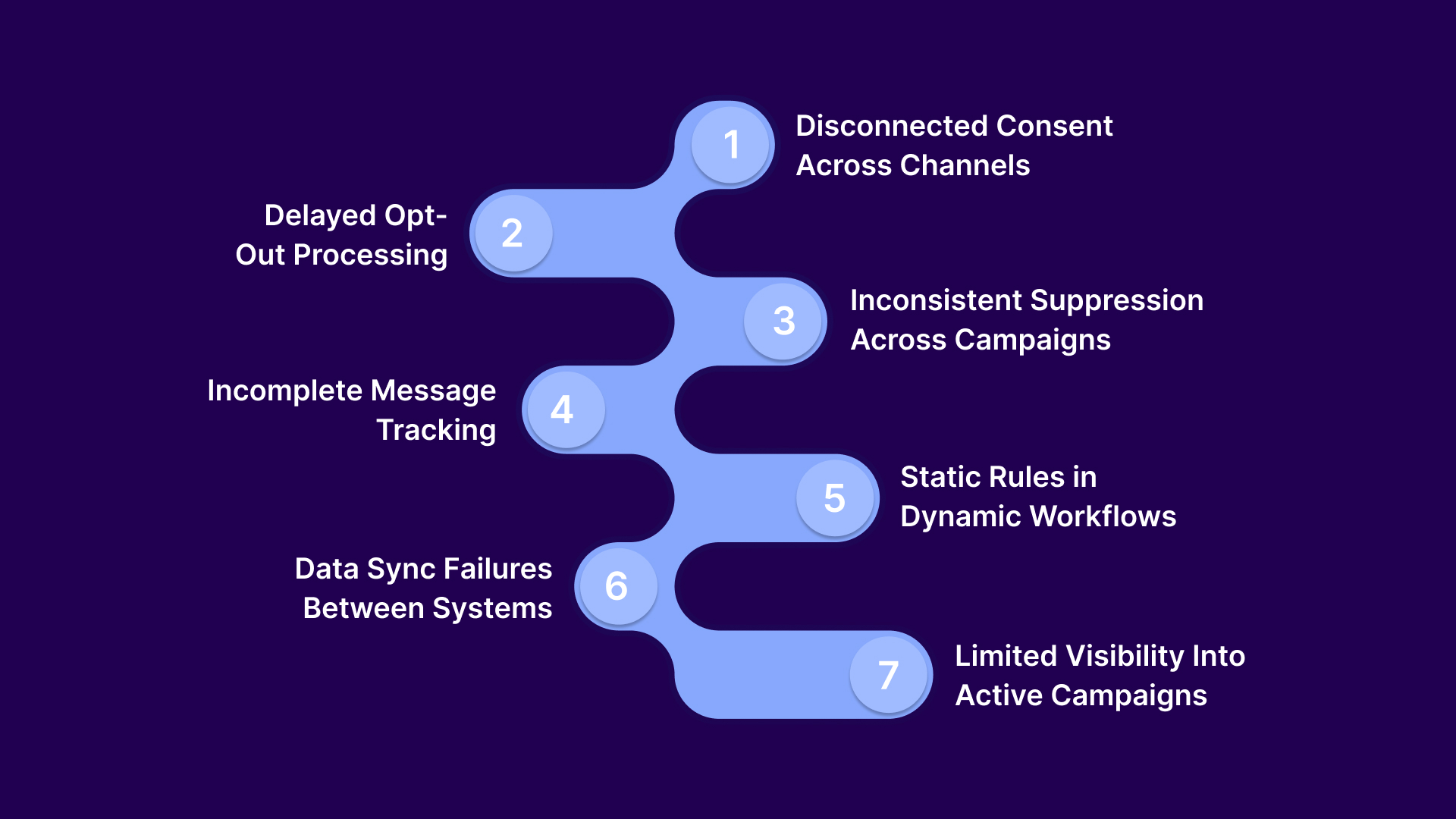
Consent is captured in one channel but used in another without proper mapping. SMS systems may not reflect consent collected via IVR or email. This creates uncertainty around whether outreach is permitted.
This shows where consent tracking breaks in practice:
Opt-out requests are not processed in real time across systems. Text messages may continue after consent is revoked. This creates direct exposure under DNC requirements.
This shows where opt-out handling fails:
Suppression lists are not applied uniformly across all campaigns. Some systems override or ignore centralized controls. This leads to restricted numbers being contacted.
This shows where suppression breaks down:
Tratta enables rule-based campaign execution, allowing agencies to apply consistent communication logic across SMS workflows. This helps standardize how outreach is triggered and managed across campaigns and channels. Schedule a free demo today.
Not all SMS activity is logged or accessible. Agencies may lack a full record of outreach attempts. This limits audit visibility and traceability.
This shows where tracking gaps appear:
Fixed rules are applied to changing outreach scenarios. Campaign logic does not adjust to new consent or suppression data. This creates misalignment over time.
This shows where rule enforcement fails:
Systems do not update data at the same time. Consent and suppression changes may not reflect across platforms. This leads to inconsistent outreach decisions.
This shows where sync issues occur:
Agencies cannot fully see who is being messaged and why. Campaign activity is spread across tools and teams. This reduces control over compliance.
This shows where visibility is lost:
These failure points show where SMS compliance control weakens as outreach scales across systems and campaigns. In the next section, we outline practical steps agencies can take to maintain alignment with DNC requirements.
Sustaining SMS compliance requires building control layers that operate across systems, not just fixing individual workflows. These controls define how decisions are made, validated, and enforced at scale.
Steps to take include:
Ensure all messaging decisions are governed from one place:
Validate compliance at the moment a message is triggered:
Keep compliance logic independent from campaign logic:
Treat consent and opt-outs as triggers, not records:
Maintain a single record of all communication activity:
Focus on where decisions actually happen:
Track when defined controls are not followed:
Tratta brings SMS, IVR, and email workflows into a single coordinated environment, allowing agencies to track interactions and manage outreach from a centralized layer. This supports consistent visibility into communication activity and helps maintain alignment across systems as messaging volume increases. Learn more.
Non-compliant SMS outreach creates direct financial and legal exposure for collection agencies. Because text messages fall under the same framework as calls enforced by the FCC and the TCPA, violations are calculated per message, not per campaign.
As volume increases, even small failures in consent or suppression can escalate quickly and lead to:
These costs compound as outreach scales, especially when compliance controls are not consistently enforced across systems. In the next section, we address common misconceptions that often lead to compliance breakdowns in SMS outreach.
Suggested Read: Using Text Messages for Debt Collection in the United States
Misunderstandings around DNC rules often lead to inconsistent SMS practices in collection workflows. These issues typically arise from how consent is interpreted, how opt-outs are applied, and how outreach is managed across systems.
Common misconceptions include:
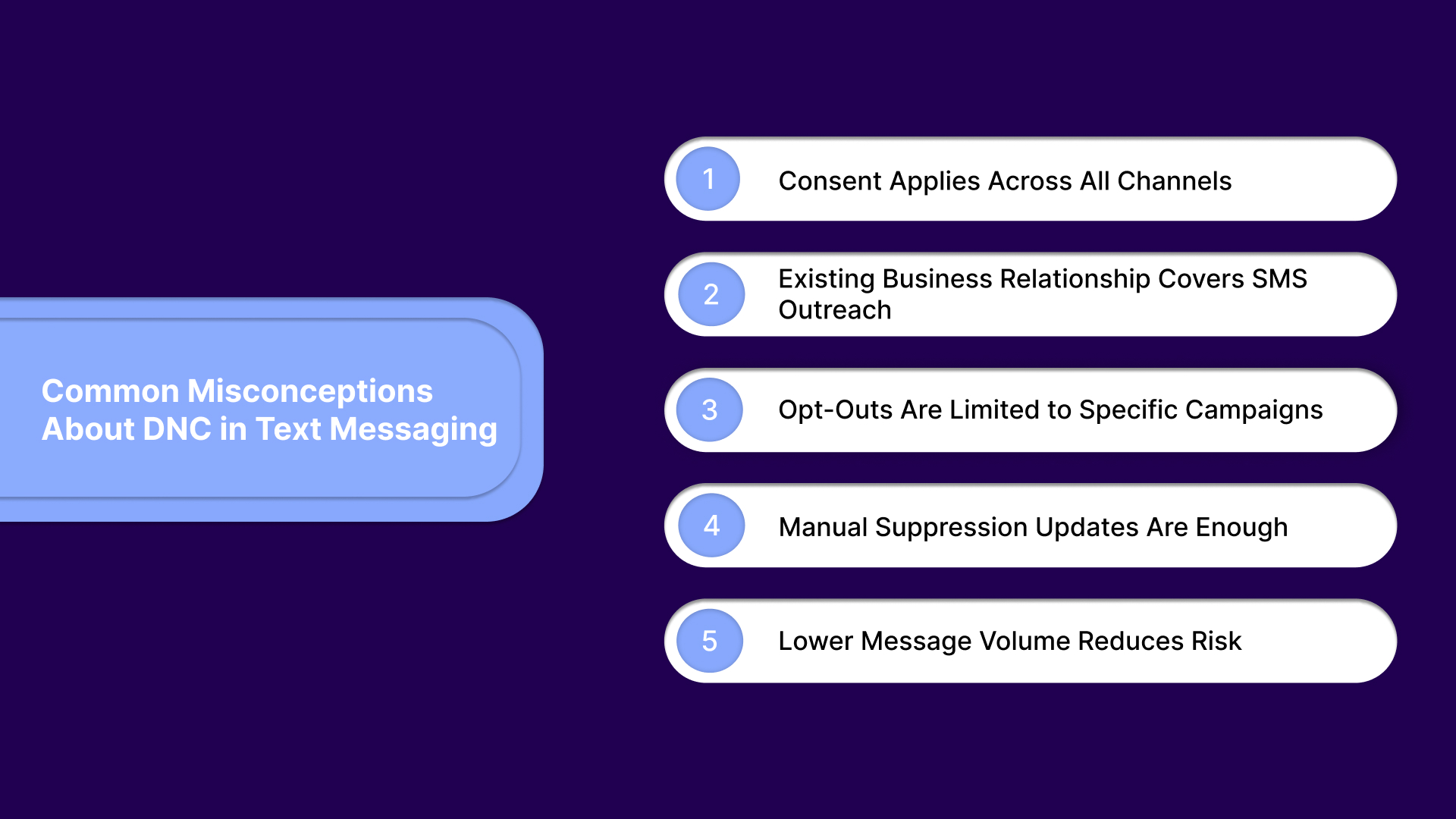
These assumptions can lead to gaps in the application of compliance controls across messaging workflows. In the next section, we look at how coordinated and trackable workflows can support more controlled SMS outreach.
Suggested Read: The Ultimate Guide to SMS Payment Gateways for Collection Agencies
Tratta is an end-to-end debt collections platform built for agencies, debt buyers, and law firms. It brings communication, payments, and account workflows into a single operational layer, allowing teams to manage outreach and consumer interactions without relying on disconnected systems.
For coordinated and trackable SMS outreach, everything comes down to control and continuity. With Campaign Management, agencies can trigger messages based on real account activity, not static lists, so every text has context behind it.
At the same time, Omnichannel Communications ensures those interactions do not stop at SMS. A consumer can move from text to IVR or email without losing the thread, and every touchpoint stays connected. This creates a continuous communication flow in which outreach is tracked, linked, and measurable throughout the entire lifecycle.
There are additional features that support these workflows across the platform:
Tratta brings these elements together to support coordinated and trackable SMS outreach. The implementation is structured and guided around your portfolio, so workflows, campaigns, and communication paths are configured from the start. Instead of building processes manually, you go live with a system that is already aligned with how your outreach operates.
When SMS compliance controls are not consistently applied, small breakdowns can escalate quickly. Messages may be sent without valid consent, opt-outs may not be honored in time, and suppression may fail across campaigns. At scale, this creates compounding exposure where each message adds to potential liability.
Tratta brings communication flows, consumer actions, and tracking into one environment, so outreach is not fragmented across tools. With structured workflows and centralized visibility, agencies can manage SMS campaigns with greater consistency and control as volumes increase.
Explore how a more connected setup can improve visibility and control across your outreach. Schedule a demo today.
Agencies should update internal and external DNC lists regularly, ideally in real time or at least daily. Delays in updating suppression data can lead to continued outreach to restricted numbers, increasing compliance risk.
Agencies may rely on prior consent if it is valid, properly documented, and clearly covers SMS outreach. However, the scope and transfer of consent must be verified before using it for messaging.
DNC monitoring text messages often involves multiple systems, including CRM platforms, dialing systems, SMS tools, and suppression databases. Misalignment between these systems is a common source of compliance issues.
Reassigned numbers can create risk if messages are sent to individuals who did not provide consent. Agencies should use processes or tools to identify reassigned numbers and validate contact data before outreach.
Internal DNC lists contain consumers who have opted out directly with the agency, while the National DNC Registry includes numbers registered at a federal level. Both must be checked and enforced in SMS outreach workflows.