That line came from a paralegal at a law firm, on the record, in a client call, the moment she heard about embedded document signing in the collection portal.
She is not alone. Across Tratta's client conversations, the same theme surfaces repeatedly from law firms and collection agencies alike: the document signing process is broken.
One law firm told us they process over 3,000 documents per month through DocuSign, including consent judgments, payment agreements, and state judgments. The cost is significant, and it is only covering a fraction of what they need signed. As their compliance lead put it: "We have a ton of other use cases that we would use for this. But it's prohibitive for us right now to try to do that through DocuSign."
Another firm described the consumer drop-off problem bluntly: "What we found is we will get a good percentage of people that won't actually go and sign it" when signing requires a separate step, a separate email, a separate system.
And before e-signatures existed in their workflow at all? "We were sending these by mail and who knows when we get them back."
The ask is straightforward. The gap in most collection technology stacks is not.
Every collection agency and law firm handles documents that require signatures. The volume is significant. One mid-size law firm told us they sign over 3,000 documents per month through a third-party e-signature tool, and that number only covers three of the document types they need signed. And in most firms, the document signing process introduces friction at the worst possible moment: when the consumer has already decided to act.
Here is what that friction looks like in practice:
The paper path. Print the document. Mail it. Wait days or weeks for it to return signed, if it returns at all. Scan it. Manually attach it to the account. Every step is a drop-off point. Every day of delay is a day the consumer's intent can cool.
The third-party redirect. Send a DocuSign or Adobe Sign link. Under the ESIGN Act, electronic signatures carry the same legal weight as ink, but the compliance burden of documenting consent and maintaining audit trails still falls on the agency. The consumer clicks out of the portal into a separate signing environment. The signed document lives in a different system. Agents toggle between platforms to verify what was signed and when. The cost scales per envelope, and per-envelope pricing at collection volume adds up fast.
The payment mismatch. One law firm described a pattern every collections attorney recognizes: "We'll set up a stipulation for $200 a month, they go into pay and they set up post-dates for $150." When the agreement and the payment system are disconnected, consumers agree to one thing and do another, and the firm has limited recourse.
The compliance exposure. Paper processes and disconnected signing platforms create documentation gaps. Which version of the agreement was the consumer shown? Was the correct state-specific disclosure included? Where is the audit trail? In an industry where every signed document is a potential audit artifact, "it's in DocuSign somewhere" is not an adequate answer.
The result: agencies lose conversions they already earned, pay for third-party tools that fragment their data, and carry compliance risk from processes that lack a unified audit trail.
Industry bodies like ACA International have increasingly emphasized consumer-facing digital process standards. This is especially true for firms already investing in omnichannel consumer engagement and embedded contact centers. The document signing step is the last remaining gap in an otherwise connected workflow.
The fix is not just "get an e-signature tool." The fix is eliminating the gap between the collection workflow and the signing experience entirely. That means:
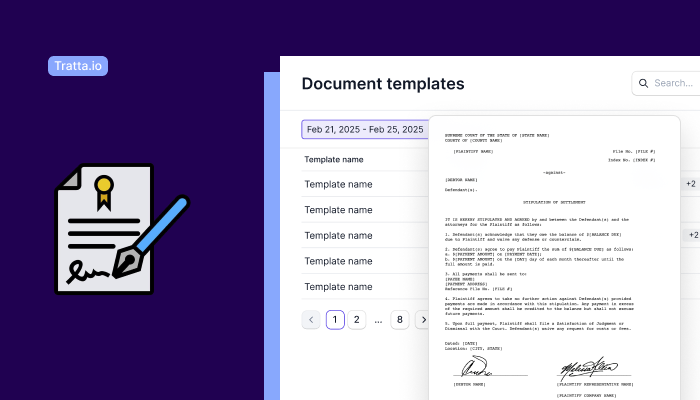
Embedded signing. The consumer never leaves the portal. Documents are presented at the right point in the journey, whether at login or during checkout, pre-filled with account details and signed in the same session.
Automated document matching. The right document is presented to the right consumer based on account status, state, client, and workflow stage. No agent discretion on which form to send. No manual selection errors.
Unified audit trail. Every signature captures who signed, when, from what device, and which version of the document was presented, stored with the account record, not in a separate platform. When legal updates a template, all future signings use the new version. Previously signed documents retain their original version for the record.
No third-party contracts. At collection volume, per-envelope pricing from third-party e-signature vendors becomes a material line item. The cost model should be transparent and bundled with the platform.
This feature shipped because clients asked for it, on record, in our call transcripts. At least 10 firms across law firms, collection agencies, and credit issuers independently requested this capability. One firm volunteered to beta test within minutes of hearing the concept. Another said: "If you guys can find a solution, it will certainly be something we would implement very quickly." The pattern was clear: agencies wanted document signing embedded in the workflow, not bolted on from outside.
Tratta Sign is the result. Here is what it does:
For your team (Console):
For consumers (Portal):
The law firm use case is especially acute. Firms we spoke with are signing three primary document types:
Each requires multiple template variants per jurisdiction, court type, and creditor client. One firm has four consent judgment versions alone: county court, JP court, Mariner-specific, and district court. Another needs status-based suppression because execution-stage accounts cannot be offered a stipulation when a wage garnishment is already in place.
This is not a "one template fits all" problem. The firms that need document signing the most are the ones whose document workflows are the most complex.
Transparency matters. Here is what Tratta Sign does not do today:
In debt collection, the compliance value of embedded document signing goes beyond convenience:
Consistent enforcement. Templates ensure every consumer sees the correct document for their state, status, and account type. No version drift. When legal updates a template, future signings use the updated version automatically.
Complete record. Every signature captures signer identity, timestamp, device, IP, and the exact document version presented. This is stored with the account, not in a separate e-signature platform your compliance team has to cross-reference during an audit.
Defensible process. When a regulator or auditor asks what the consumer agreed to and when, the answer is in the account record. One system. One audit trail. No toggling between platforms.
Tratta Sign is available to all Tratta clients. Setup involves:
Most clients are live within their existing onboarding window, or within a few days for existing production accounts.
If document friction is costing your agency conversions, talk to your Tratta account manager about enabling Tratta Sign, or reach out at tratta.io.
Tratta Sign is included with the Tratta platform. No third-party contracts required.