For third-party collection agencies handling legal-stage consumer debt, operational consistency becomes harder as account volume grows. Recent household debt reporting from the Federal Reserve Bank of New York Household Debt and Credit Report shows sustained debt activity across categories such as credit cards and auto loans, creating more account-management complexity for recovery teams over time.
This pressure exists inside a highly regulated consumer debt environment. According to the CFPB’s most recent FDCPA reporting, debt collection continues to generate substantial volumes of consumer complaints, reinforcing the need for documented communication and consistent operational handling in recovery workflows. Meanwhile, consumer expectations around digital payment flexibility continue growing across financial services.
For many third-party collection agencies, automated legal collections workflows are becoming less about automation itself and more about managing legal-stage consumer debt more consistently across payment activity, communication records, reporting, self-service access, and system integrations.
This guide explains how automated legal collections workflows function inside consumer debt recovery operations and what teams should evaluate before implementing more centralized recovery systems.
Automated legal collections workflows refer to structured operational processes used by collection agencies to manage consumer debt recovery activities involving legal-stage accounts. These workflows connect payment handling, account routing, communication tracking, reporting, and documentation inside a more centralized recovery environment. The goal is operational coordination, not automated legal decision-making.
For example, imagine a consumer with a legal-stage account agrees to a payment arrangement after receiving a notice. In a manual workflow, payment updates may sit in one system, communication notes in another, and legal account status in a separate platform. An operations team member may need to manually verify payment activity, update records, and notify legal recovery teams before the account progresses incorrectly.
In a more connected workflow environment, payment activity, communication records, account updates, and reporting remain easier to track across the recovery lifecycle. Recovery teams can follow account progression more consistently without depending entirely on spreadsheets, separate systems, or manual coordination.
Automation in legal recovery operations helps standardize repetitive operational tasks such as workflow assignment, payment coordination, account updates, and communication tracking. However, legal interpretation, attorney review, dispute evaluation, litigation decisions, and compliance judgment still require human oversight. Legal workflow automation supports operational coordination, not legal strategy or legal advice.
Many collection agencies confuse workflow automation with automated outbound calling systems. In practice, legal collections workflow automation may involve inbound payment IVR, consumer self-service payment options, centralized communication tracking, and account-level workflow coordination rather than outbound robocall activity.
Also Read: 9 Proven Ways to Automate the Collections Process for Higher Recovery
Legal-stage consumer debt recovery often involves multiple teams, communication channels, payment systems, and account updates moving simultaneously across recovery operations. When those activities remain spread across disconnected tools, collection agencies can struggle to maintain workflow consistency, reporting visibility, and payment coordination across growing legal inventories.

Manual workflows often lead to inconsistent communication records, incomplete account notes, and missing payment updates across recovery systems. When documentation lives across emails, spreadsheets, separate payment tools, and case platforms, teams may struggle to maintain clear account histories and communication continuity during legal-stage recovery activity.
Disconnected workflows can delay consumer follow-up, payment coordination, dispute reviews, and internal account progression. Teams may spend additional time moving accounts between systems, checking payment updates manually, or tracking communication history instead of focusing on active recovery operations.
Before vs After Legal Workflow Coordination
As legal placements increase, workflow complexity usually increases with them. Without centralized reporting and workflow tracking, collection agencies may face reduced operational visibility across account status changes, communication activity, payment progress, and legal-stage account handling.
Consumers increasingly expect flexible digital payment options, self-service accessibility, and communication continuity during repayment interactions. Fragmented workflows can create inconsistent experiences when payment systems, communication records, and account updates do not stay connected across recovery operations.
Also Read: Automated Debt Collection: Key Strategies and Insights
Before implementing workflow automation, agencies should assess whether their legal recovery process supports:
Consumer expectations around payment interactions have changed significantly across financial services, including debt recovery environments.
For collection agencies handling legal-stage consumer debt accounts, self-service capabilities can support both operational efficiency and payment accessibility when integrated into broader recovery workflows.
Flexible payment access may include online payment portals, mobile-friendly payment experiences, multilingual accessibility, and inbound payment IVR options that help consumers complete transactions more conveniently during the recovery process.
Collection agencies often spend substantial operational time handling repetitive payment coordination tasks, account updates, and routine consumer payment inquiries. For example:
Before self-service options
Consumers call during business hours to make payments, request account information, or confirm balances. Agents spend significant time handling repetitive payment coordination requests.
After self-service payment access
Consumers can complete payment-related actions independently through inbound payment IVR or self-service channels, helping recovery teams spend more time managing higher-priority account activity.
Legal recovery workflows often involve multiple consumer touchpoints across payment activity, account discussions, notices, and dispute handling. Centralized communication records and connected payment visibility can help agencies maintain more consistent workflow tracking across legal-stage accounts while reducing operational confusion caused by fragmented systems or disconnected documentation.
Legal recovery workflows involve multiple moving parts across payment coordination, communication tracking, reporting, consumer interactions, and account management. When evaluating legal workflow platforms, collection agencies often look beyond basic automation features and focus more on operational visibility, workflow control, and long-term scalability across consumer debt recovery operations.
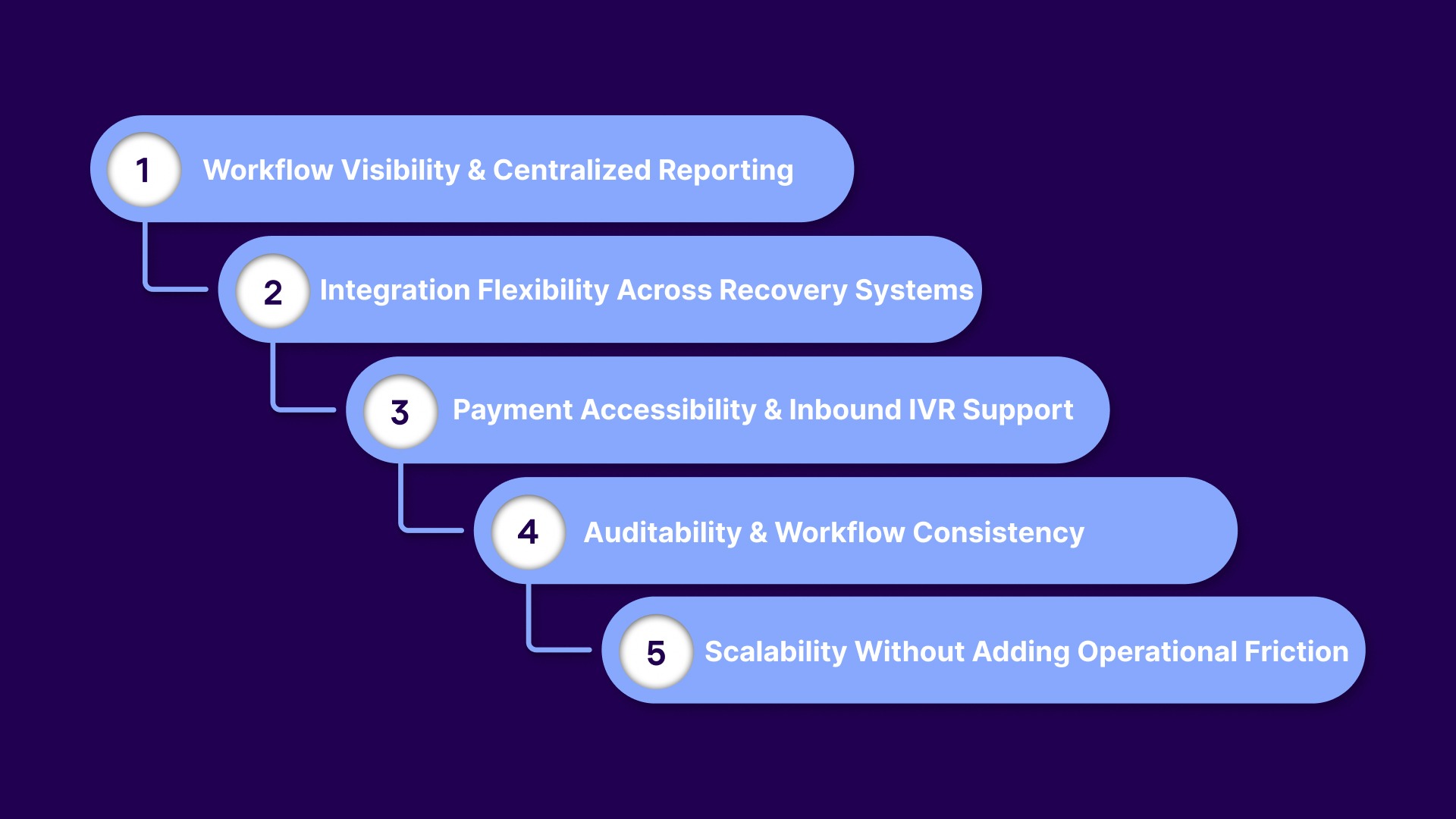
Ask: Can teams quickly understand what is happening across legal-stage accounts without checking multiple systems?
Many agencies struggle to see where payment arrangements stall, which accounts require follow-up, or whether communication activity aligns with account progression. If reporting sits across separate systems, recovery teams often spend time reconciling information instead of acting on it.
Platforms like Tratta provide Reporting and Analytics capabilities that help agencies monitor payment activity, account progression, and recovery performance from a more centralized operational view.
Ask: Will the platform reduce operational silos or create another disconnected system?
Many collection agencies already work across payment processors, communication systems, and case management tools. When those systems fail to connect, teams often manually reconcile payment updates and account activity..
Tratta’s REST API features are designed to support data exchange and workflow coordination across recovery environments without requiring agencies to manage disconnected operational processes manually.
Ask: Can consumers complete payment-related actions without always depending on live-agent coordination?
Consumers increasingly expect flexible repayment experiences, including self-service options and payment accessibility outside standard business hours. Agencies that rely entirely on manual payment coordination may experience higher agent workload and inconsistent payment continuity.
Consumer debt recovery operations increasingly depend on flexible payment accessibility. Tratta supports Embedded Payments for consumer-facing repayment environments. Its Multilingual Payment IVR also supports inbound payment workflows in multiple languages, enabling consumers to complete payment-related actions outside business hours.
Ask: Can the platform help maintain clearer communication records across legal-stage recovery activity?
Legal-stage consumer debt recovery often requires teams to track notices, disputes, payment discussions, and account updates consistently. Missing records or fragmented documentation can create operational confusion across recovery workflows.
Collection agencies often evaluate whether platforms support more controlled communication tracking, payment visibility, and documentation consistency across compliance-sensitive environments.
Ask: Will the platform still support operations as legal inventory grows?
A system that works for smaller legal inventories may create operational drag as account volume increases. Agencies often evaluate whether platforms can support larger recovery workloads without increasing manual coordination, disconnected reporting, or fragmented communication tracking.
Legal workflow discussions frequently focus on case movement and internal process automation while overlooking payment coordination and consumer interaction workflows. In consumer debt recovery operations, agencies still need visibility into payment activity and account progression across legal-stage accounts. When payment workflows remain disconnected from recovery operations, teams often lose operational continuity across the account lifecycle.
For collection agencies, the larger challenge is often operational control rather than automation alone. Recovery teams need connected workflows that bring together consumer payment activity and reporting visibility inside a more centralized operational environment. This creates better visibility into account movement without relying on multiple disconnected systems across teams.
Also Read: Debt Recovery Legal Tracking Automation for High-Volume Collection Agencies
Many collection agencies approach legal workflow automation expecting faster task execution, but the larger operational challenge is usually workflow coordination. Legal-stage consumer debt recovery depends on how consistently agencies can manage account activity across every interaction, especially when payment systems, documentation, and communication records must remain connected throughout the recovery lifecycle.
As consumer expectations around payment accessibility and self-service continue growing, collection agencies are placing greater importance on centralized recovery operations that reduce workflow fragmentation without losing operational control.
To see how Tratta supports consumer payment workflows, reporting visibility, and workflow coordination for collection agencies, Book a Free Demo with the team today.
Many collection agencies still manage payments, communication records, and account updates across disconnected tools. This often creates delays when agents or legal operations teams need to verify payment activity, review consumer communication history, or track account progression during legal-stage recovery. Centralized workflow environments help reduce operational gaps by connecting payment visibility, reporting, and communication tracking inside one recovery workflow.
Manual workflows commonly create issues such as inconsistent account notes, delayed payment coordination, duplicate follow-up activity, fragmented reporting, and missing communication records. As legal inventory grows, agencies may spend more time reconciling information across systems rather than managing active recovery operations. Workflow fragmentation can also reduce visibility across disputes, payment arrangements, and consumer interactions.
Yes, many agencies evaluate workflow automation when legal placements increase beyond what manual coordination can realistically support. Automated workflows can help standardize account routing, payment tracking, communication logging, and reporting visibility across larger recovery inventories. However, operational oversight and legal review still remain necessary for legal-stage consumer debt accounts.
Inbound payment IVR allows consumers to complete payment-related actions through self-service channels without relying entirely on live agents. This can improve payment accessibility for consumers while reducing repetitive coordination work for recovery teams. In legal recovery operations, inbound IVR may also help maintain payment continuity outside standard operating hours.
Legal-stage recovery often involves multiple consumer touchpoints across notices, payment discussions, disputes, and account updates. When communication records remain fragmented across systems, teams may struggle to maintain workflow consistency and account visibility. Centralized communication tracking helps agencies document interactions more consistently across recovery operations.