Rising delinquencies are putting sustained pressure on collections teams. Manual workflows struggle to keep pace as volumes increase, compliance expectations tighten, and consumers expect faster, more convenient ways to resolve debt. When follow-ups are missed or delayed, recovery rates slip and operational costs rise.
Automation directly addresses these gaps. A study on automated payment reminders found that consumers who received reminders were 21% less likely to enter severe delinquency (60+ days past due). They were also 12% less likely to become 30+ days delinquent compared to consumers who received no reminders.
That impact compounds when automation extends beyond reminders. In this article, you will explore nine proven ways to automate the collections process without adding unnecessary complexity.
Brief look:
Collections automation replaces manual, agent-driven tasks with system-driven workflows that execute consistently, on time, and within compliance limits. Instead of relying on individual judgment for every action, automation applies predefined rules across outreach, payments, and follow-ups.
These are a few reasons to consider investing in automation:
These outcomes result from automating the right parts of the collections lifecycle. The next step is learning how to apply it in practical, proven ways across your collections process.
Suggested Read: Main Benefits of Accounts Receivable Automation
Automation works best when it is applied deliberately. Each step below targets a specific friction point in the collections lifecycle where manual effort slows recovery or increases risk.
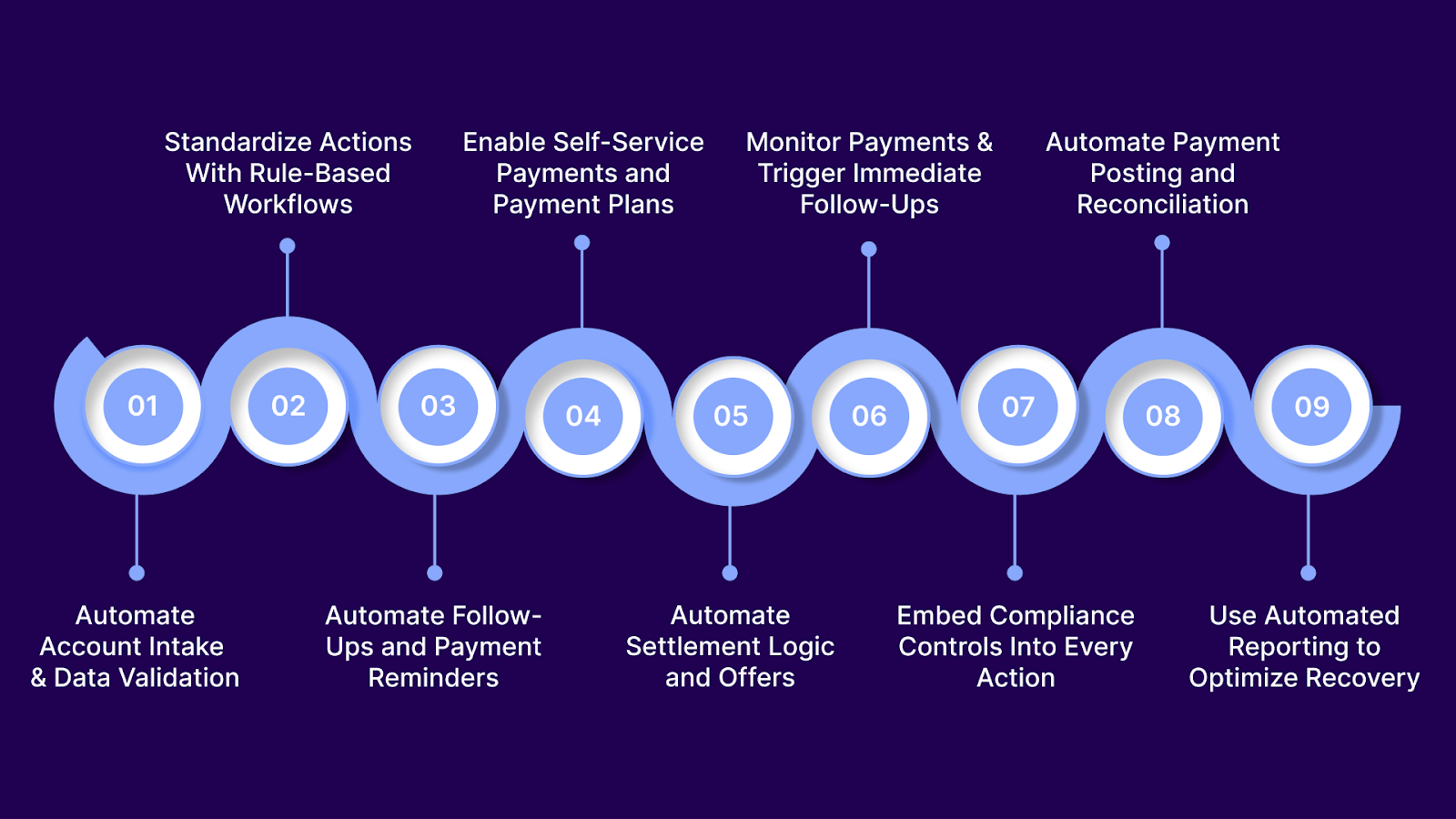
When combined, these steps create a system that moves accounts forward consistently and predictably.
Automation starts the moment an account is placed. Instead of relying on manual checks, balances, and dates, consumer information is validated upfront. This ensures that only consistent, usable data moves into outreach, payment, and reporting workflows.
Operational reality:
Collection teams frequently receive accounts with missing fields, outdated balances, or inconsistent data formats. These intake issues often surface later as disputes, delayed payments, and manual cleanup that pulls agents away from active recovery work.
When intake is automated at the point of placement, it helps to:
Recovery metrics this improves:
Tratta uses secure API and file-based integrations to sync account data accurately at placement. This ensures automation, outreach, and payments run on clean, up-to-date information from the start. Learn more.
Rule-based workflows replace ad hoc decision-making with predefined actions that automatically advance accounts. Instead of relying on individual judgment for routine steps, the next action is determined by account status, age, and recent activity.
Execution challenge:
When the next steps are decided manually, similar accounts often receive very different treatment. Some move quickly, while others stall due to workload, changing priorities, or simple oversight, making recovery performance uneven and hard to explain.
When actions are standardized through automation, it helps to:
Recovery metrics this improves:
Automated follow-ups ensure outreach happens on time, every time, without relying on manual tracking. Reminders are triggered based on account status and prior activity, ensuring consistent communication across large volumes.
Loss of momentum:
Follow-ups often slip during high-volume periods or when staffing is constrained. When reminders are delayed or missed, otherwise recoverable accounts go quiet and continue aging without meaningful engagement.
When follow-ups and reminders are automated, it helps to:
Recovery metrics this improves:
Self-service options allow consumers to resolve balances without waiting for a live agent. Payments, payment plans, and settlements can be initiated at any time, removing timing and availability constraints. This shifts routine resolution activity away from agents while keeping recovery moving forward.
Conversion gap:
Many consumers intend to pay but do not act when resolution requires a call during business hours. That delay often leads to disengagement, even when the willingness to resolve the balance exists.
When self-service payments and plans are enabled through automation, it helps to:
Recovery metrics this improves:
Suggested Read: Top 10 Accounts Receivable Automation Software Solutions
Automated settlement logic presents pre-approved offers based on factors such as balance size, account age, and prior engagement. This removes delays caused by manual approvals and keeps settlement discussions moving while consumer intent is still high.
Resolution friction:
Settlement conversations often slow down when approvals are required. Even short delays at this stage can cause consumers to disengage before resolution is reached.
When settlement logic is automated, it helps to:
Recovery metrics this improves:
Automated payment monitoring tracks scheduled and one-time payments as they occur. When a payment fails or is missed, automatic follow-up actions are triggered. This prevents small issues from escalating into broken payment plans.
Plan instability:
Missed payments often go unnoticed until a payment plan has already failed. By the time the issue is identified, the account has usually lost momentum and requires rework to recover.
When payment monitoring is automated, it helps to:
Recovery metrics this improves:
Automated compliance controls enforce contact limits, disclosures, and timing rules at the moment activity occurs. Instead of relying on memory or post-action checks, guardrails are built directly into workflows. This allows teams to scale activity without increasing regulatory exposure.
Risk exposure:
Compliance failures rarely stop at fines. They disrupt collection activity, trigger account holds, strain client relationships, and force teams into remediation mode rather than recovery work.
When compliance controls are embedded through automation, it helps to:
Recovery metrics this improves:
Automated payment posting ensures payments are applied accurately and reflected in account balances without delay. Reconciliation happens in near real time, reducing reliance on end-of-day or batch-based manual processes. This keeps account data current across consumer interactions and client reporting.
Breakdown in accuracy:
Posting delays and reconciliation errors create balance mismatches that trigger disputes and client escalations. Even short lags can undermine trust and slow recovery when consumers see incorrect amounts owed.
When payment posting and reconciliation are automated, it helps to:
Recovery metrics this improves:
Automated reporting consolidates activity, payments, and outcomes into timely, actionable views. Instead of relying on lagging or manually compiled reports, performance data updates as recovery activity happens. This allows managers to spot issues early and adjust strategy while results are still in flux.
Visibility gap:
When reporting lags behind operations, declining performance often shows up only after recovery has already dropped. By the time trends are visible, accounts have aged, and corrective action becomes harder and more expensive.
When reporting is automated, it helps to:
Recovery metrics this improves:
Tratta brings these automation steps together in a single, purpose-built collections platform. It automates self-service payments, payment plans, settlements, reminders, compliance controls, and real-time reporting without relying on disconnected tools. Schedule your free demo.
Automation can improve recovery and efficiency, but implementation is where many agencies struggle. The challenges usually stem from how automation is introduced into existing processes, data flows, and compliance frameworks.
Table showing how implementation challenges affect recovery workflows:
These challenges often become visible only after automation goes live. To avoid them, agencies need to apply practical implementation discipline alongside automation.
Practical tips for implementing automation successfully:
Automation works best when the underlying technology supports these practices without requiring manual workarounds or disconnected tools.
The next section shows how the right collections platform enables automation that scales cleanly, stays compliant, and improves recovery outcomes.
Suggested Read: AI and Automation In Debt Collection Conversations
Tratta is a modern, all-in-one debt collection platform designed to centralize workflows, automate key processes, and improve recovery performance without sacrificing compliance or consumer experience.
Built for agencies, law firms, and original creditors, Tratta replaces disconnected tools with a single, connected system that manages the entire digital collections lifecycle.
These are the core features:
Tratta’s portal allows debtors to view balances, payment history, and account documents. It supports full, partial, and structured payment plans, as well as settlements, all without live agent involvement. Features such as guest payments, multi-language support, and WCAG compliance further reduce friction.
Tratta integrates payment processing into the platform, ensuring secure, seamless transactions. It supports multiple payment methods (credit, debit, ACH, and real-time validation) and tokenizes card data, so raw payment information is never stored. This protects sensitive data and keeps operations compliant with industry standards.
Interactive Voice Response (IVR) systems are often a separate expense, but Tratta’s platform includes a multilingual, inbound IVR that lets debtors make payments and access account details via phone. This means more conversation channels without manual touch.
Tratta supports automated outreach across voice, email, SMS, and portal notifications. Campaigns can be scheduled, triggered by behavior, and adjusted based on response, so each account’s path is dynamic and data-driven.
Tratta lets teams build automated campaigns with smart scheduling, cohort segmentation, and trigger-based actions that adapt to consumer behavior. This moves accounts systematically instead of waiting for manual instructions.
Tratta’s dashboards and drag-and-drop reporting tools give teams real-time visibility into performance, trends, and outcomes. Custom reports can be scheduled and exported without IT help, and analytics show what strategies and channels are working best.
Every agency and creditor has unique policies and workflows. Tratta lets administrators tailor messaging, settlement logic, payment paths, and workflow rules to match internal business rules and compliance requirements.
Tratta supports REST APIs, secure SFTP, and seamless integrations with existing systems such as CRM or financial software. This eliminates duplicate data entry and keeps records synchronized in real time.
Security and compliance are baked into Tratta’s architecture, not bolted on. The platform is PCI DSS Level 1 and SOC 2 Type II certified, tokenizes payment data, enforces regulatory rules by workflow, and provides detailed audit trails.
The impact of these features becomes clear when looking at real‑world success stories, where agencies have leveraged Tratta’s platform to drive significant gains in collections and reduce operational strain.
Multi Service Fuel Card, a member of the Shell group of companies, achieved remarkable results after adopting Tratta’s automated debt collection workflows. Within just seven months, the issuer reported an additional $650,000 in recovered funds, a significant improvement compared to its prior manual processes.
By shifting to Tratta’s self‑service portal, Multi Service Fuel Card reduced agent interactions. Debit card payments nearly doubled, accounting for 40% of total transactions, while operational costs fell due to fewer agent hours.
This case demonstrates how Tratta’s automation capabilities deliver measurable financial impact, transforming debt collection into a streamlined, compliant, and consumer‑friendly process
Without automation, collections teams spend more time reacting than recovering. Manual follow‑ups slip, data errors multiply, payment plans collapse unnoticed, and compliance risks escalate as volumes grow. The result: higher DSO, inconsistent recovery, and rising costs that are difficult to defend to clients or leadership.
Tratta consolidates payments, self‑service resolution, reminders, settlements, compliance controls, and reporting into one purpose‑built platform for modern collections. By executing across the full lifecycle, the platform enables agencies to recover faster, operate more efficiently, and scale without added complexity.
See how automation works in practice, not in theory. Speak to our team today.
Yes. Most agencies start by automating specific areas such as reminders, payments, or settlements before expanding across the full lifecycle. A phased approach reduces risk and allows teams to measure impact before scaling.
Well-designed automation systems support exceptions and overrides. Routine actions are automated, while complex, sensitive, or high-risk accounts can be routed to agents without breaking the workflow.
No. Modern platforms allow rules, messaging, and settlement logic to be configured by client or portfolio. Automation standardizes execution while still supporting creditor-specific guidelines and reporting needs.
Initial gains, such as faster follow-ups and increased self-service payments, are often visible within weeks. Larger impacts on DSO and recovery consistency typically emerge after automation stabilizes across workflows.
Yes. Early-stage collections benefit from reminders and self-service resolution, while later-stage accounts benefit from structured settlements, payment plans, and tighter compliance controls. The same automation framework can support both stages with different rules.