Recovery teams are under pressure to do more with less. Delinquencies rise, volumes increase, and yet outcomes remain inconsistent despite new tools and data. Many agencies invest in smarter models, but the gap between insight and execution continues to limit results.
At the same time, adoption is accelerating. The AI debt collection market is projected to grow at a compound annual growth rate of nearly 16.90% through 2034, signaling strong industry confidence in its potential.
But growth in adoption has not always translated into better recovery. In this article, we break down where AI delinquency management falls short and what collection agencies need to improve outcomes.
This refers to the use of data models and automated decisioning to identify risk, prioritize accounts, and guide outreach strategies across the recovery lifecycle. Instead of relying on static rules or manual segmentation, agencies use AI to analyze behavioral signals, payment patterns, and historical performance to inform what actions should be taken and when.
At its core, AI supports decision-making, not execution. It highlights which accounts are likely to pay, which require intervention, and which strategies may improve outcomes. The expectation is that better predictions lead to more efficient and effective recovery workflows.
The promise of AI in managing delinquent accounts for collection agencies:
These capabilities position AI as a powerful layer for improving recovery outcomes. In the next section, we examine why these benefits do not always translate into better performance in third-party collection environments.
Suggested Read: Creating Effective AI Debt Payoff Plans
AI has improved how collection agencies assess risk and prioritize accounts, but recovery outcomes have not improved at the same pace. The issue is not the availability of insights. It is the gap between what systems recommend and what actually happens at the point of execution.
This is where AI falls short in addressing third-party accounts:

AI models can identify which accounts to prioritize, but those decisions often do not carry through to actual outreach workflows. Campaigns may still rely on static lists or pre-set rules that do not reflect updated risk signals. As a result, high-value insights are generated but not consistently applied when it matters.
Even with real-time data available, many collection workflows operate on fixed schedules and predefined logic. This prevents agencies from adapting outreach strategies based on changing consumer behavior or account status. Over time, this misalignment reduces the effectiveness of AI-driven recommendations.
AI outputs, communication platforms, and account systems are often not fully integrated. This fragmentation breaks the continuity between decision-making and execution across channels like SMS, IVR, and email. Without coordination, agencies struggle to maintain consistent and compliant outreach.
AI models depend on current data, but many systems operate on delayed or batch updates. By the time a decision is executed, the underlying account conditions may have already changed. This lag reduces the accuracy and impact of AI-driven strategies.
Tratta addresses these gaps by aligning decisioning with execution through automation and data-driven workflows, without adding another AI layer. It allows agencies to apply rule-based logic, coordinate communication workflows, and ensure that outreach aligns with current data and compliance requirements. Call us to learn more.
AI can improve how agencies prioritize delinquent accounts, but it does not remove regulatory constraints. In third-party collections, every decision must still align with laws governing consent, timing, and communication practices. This creates a gap between what AI recommends and what can actually be executed.
Compliance issues with using AI include:
Tratta helps address these compliance challenges by enforcing rule-based controls at the point of execution across communication workflows. It is not an AI decisioning system, but an execution layer that ensures outreach aligns with consent, timing, and suppression requirements in real time. Schedule a free demo today.
Effective delinquency management depends on how consistently agencies execute decisions across systems and channels. It requires structured workflows that translate insights into controlled and compliant actions. The focus is on coordination, validation, and visibility across the recovery process.
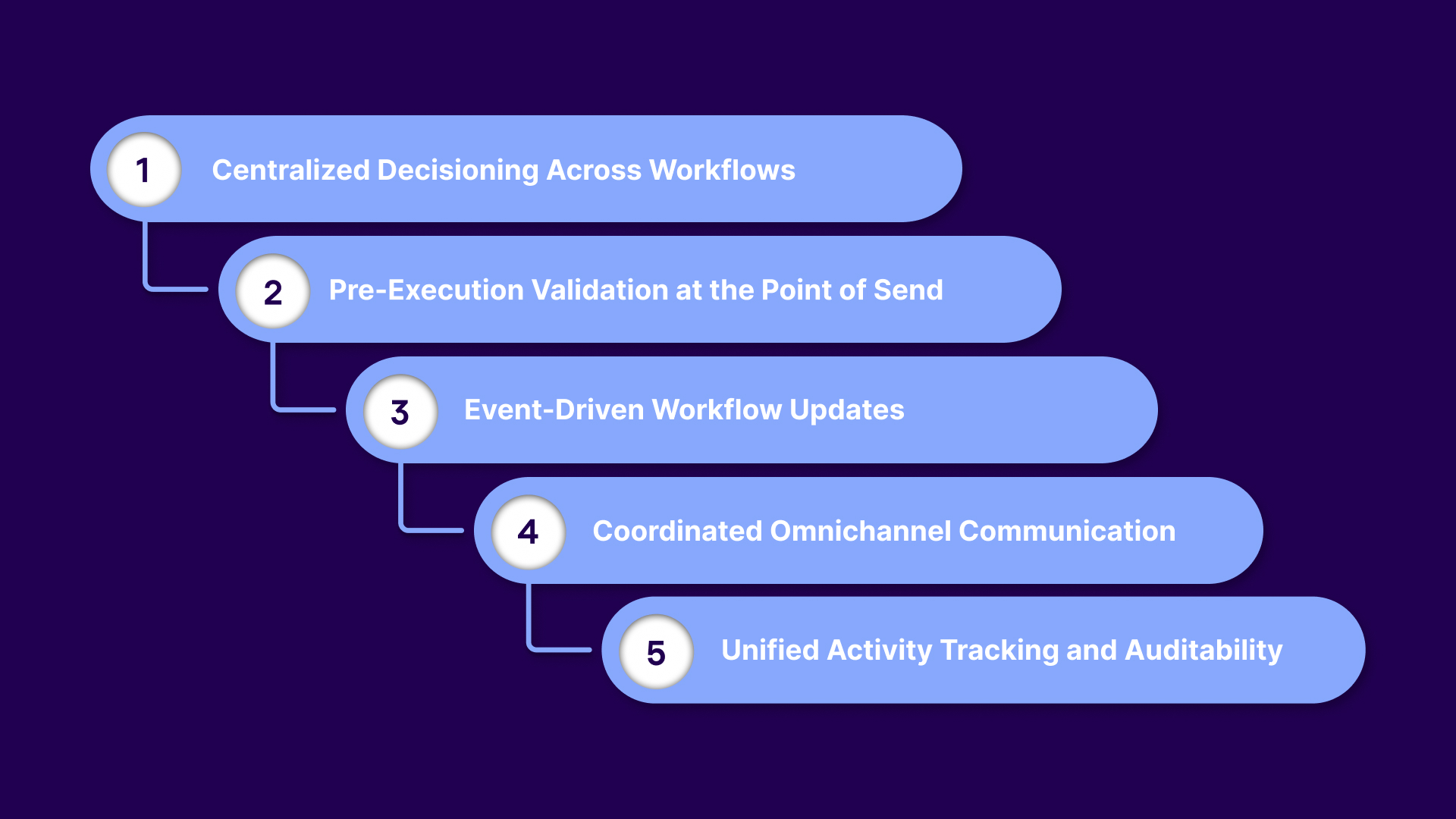
These elements ensure all outreach decisions are governed from a single control point:
These controls ensure every action is validated before execution:
These capabilities ensure workflows respond immediately to changes in account status:
These practices ensure outreach remains consistent across all channels:
These components ensure every action is visible and traceable:
These elements define what structured, execution-driven delinquency management requires. However, many agencies still struggle to realize consistent results, even with AI in place. In the next section, we look at how agencies can better translate AI-driven insights into measurable recovery outcomes.
Suggested Read: The Role of AI in Modern Collections Management Explained
AI can improve recovery outcomes, but only when it is aligned with execution, data, and compliance requirements. Many agencies invest in AI capabilities without addressing the operational layers needed to support them. Getting value from AI depends on how well its outputs are integrated into real collection workflows.
These steps help maximize AI value:
These steps show that AI delivers value only when supported by strong execution and alignment. However, AI alone cannot address the full scope of recovery challenges. Next, we look at the broader capabilities agencies must build to improve outcomes.
Suggested Read: Using AI Chatbots for Debt Collection
AI can improve decision-making, but recovery outcomes depend on how those decisions are executed within day-to-day operations. Collection agencies need systems that automate workflows, enforce consistency, and reduce manual gaps across the recovery process.
These features support scalable and controlled operations:

Choosing the right system is what ultimately determines how well these workflows perform at scale. Without a platform that can automate actions, coordinate channels, and maintain consistency across data and processes, even well-defined strategies struggle to deliver results.
AI can strengthen delinquency management, but relying on it alone creates gaps between prediction and execution. Decisions may be accurate, yet fail to translate into timely, compliant, and coordinated actions across systems. When execution does not keep pace with decisioning, recovery outcomes remain inconsistent and risk increases.
Tratta supports collection agencies by focusing on the execution layer rather than AI-driven decisioning. It enables rule-based automation, coordinated communication workflows, and real-time alignment with data and compliance requirements.
Bring consistency and control to your recovery workflows. Schedule a demo to see how your operations can deliver more predictable outcomes.
AI delinquency management in third-party collections focuses on prioritizing accounts, predicting payment likelihood, and guiding outreach strategies. However, agencies must still validate these decisions against consent, compliance, and system constraints before execution.
Yes, but effectiveness may be limited. Third-party agencies often rely on transferred or incomplete datasets, which can reduce the accuracy of AI models and require additional validation before use.
Timing affects the quality of insights. Accounts placed earlier in the delinquency cycle provide more actionable data, while older accounts may have less reliable signals, impacting AI-driven prioritization.
Reassigned numbers can lead to outreach being directed to the wrong individual. Agencies must validate contact data regularly to avoid compliance risks and ensure communication reaches the intended consumer.
AI provides recommendations, but system-level controls ensure those recommendations are executed correctly. Without coordination, validation, and automation, insights cannot consistently translate into compliant and effective recovery actions.