Traditional IVR falls apart the moment a caller has to do something real. In debt collection, that usually means verifying an account, understanding the next step, or making a payment without getting trapped in a long menu tree that slows everything down.
That friction shows up at the worst possible point in the workflow: when a consumer is actually ready to act. And in a market where debt collection remains one of the CFPB’s most complained-about categories, poor voice experiences are not just annoying.
They add operational drag, create avoidable handoffs, and make self-service harder to complete. The CFPB says it received about 387,400 debt collection complaints in 2025, with roughly 304,700 sent to companies for review and response.
That is where NLP IVR comes into play. Instead of forcing callers through rigid keypad paths, it helps voice systems respond more naturally to intent, reduce menu friction, and make payment and account-resolution flows easier to complete. For US recovery teams, that shift is less about sounding smarter and more about making self-service actually work.
NLP IVR stands for natural language processing interactive voice response. It refers to a voice system that can interpret spoken requests, so callers can say what they need in their own words rather than relying solely on touch-tone input or fixed prompts.
In practice, it allows the IVR to recognize common requests such as making a payment, checking account details, or understanding the next step in the process.
Traditional IVR is built around menu trees. The caller listens to preset options, selects a number, and follows a fixed path based on the system’s logic.
NLP IVR works differently. It uses speech input and intent recognition to route the caller based on what they actually say. That makes the interaction less rigid and better suited for callers who want to complete a task without having to step through multiple menu layers first.
That shift matters in debt collection because most callers are trying to complete a specific action rather than browse options. They may want to verify account details, understand payment options, respond to a notice, or make a payment without waiting for an agent.
When those actions are pushed through long menu paths, the process becomes slower and more frustrating than it needs to be. For recovery teams, that can mean more drop-offs, more avoidable agent transfers, and weaker self-service completion. NLP IVR matters because it helps reduce that friction at the point where a caller is ready to act.
NLP IVR becomes more useful when it supports the parts of the collection work that callers are actually trying to complete and gives agency operations teams a cleaner way to manage those interactions at scale. In this context, the strongest use cases are those that reduce friction in identification, repayment, language access, and follow-up.
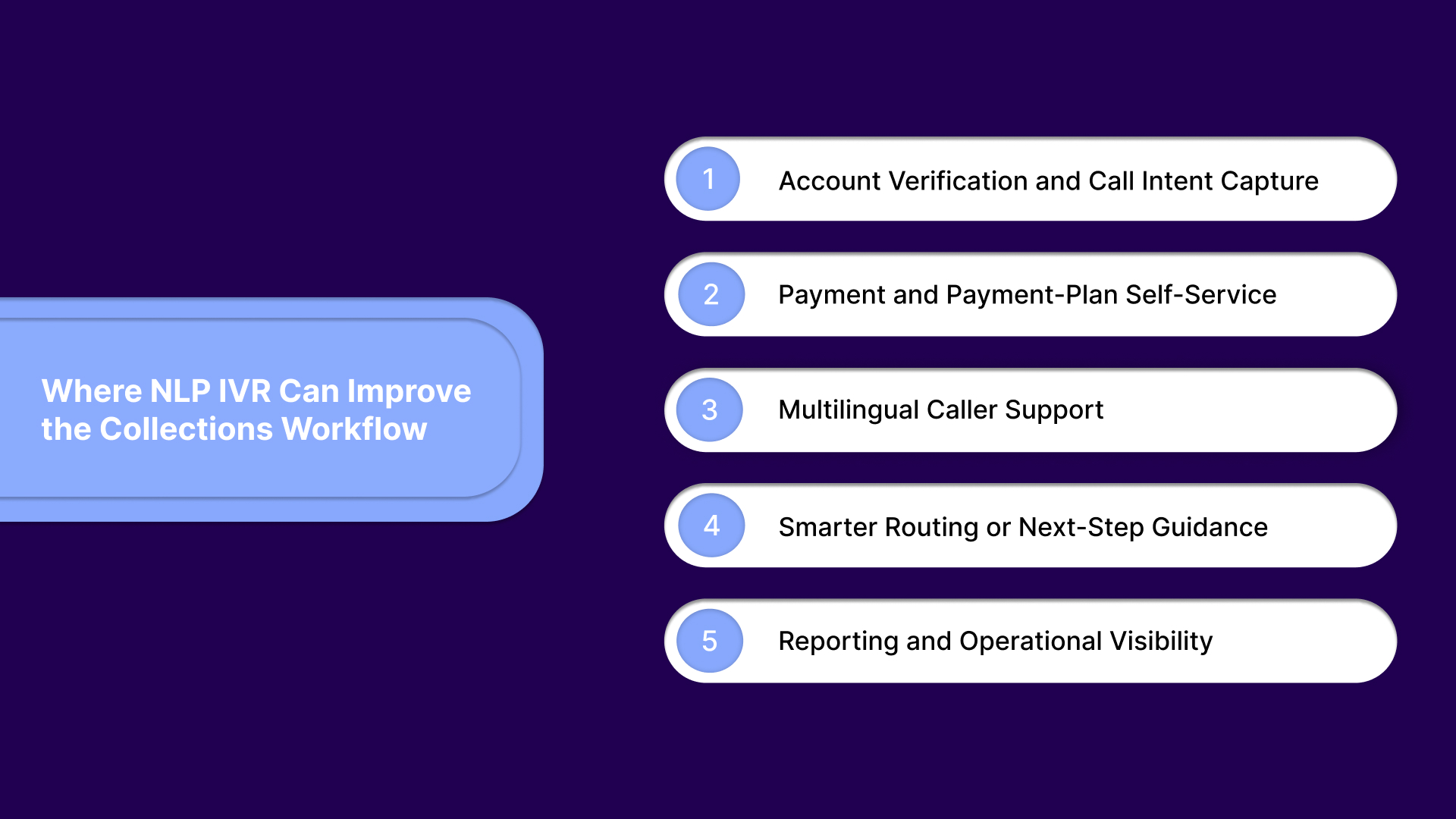
A voice system can be more effective when it helps identify caller intent at the start of the interaction. Instead of pushing every caller through the same path, it can guide people based on whether they want to review an account, respond to a notice, or make a payment.
That early direction helps shorten the path to action and can reduce the number of callers who get stuck before reaching the right workflow.
In collections, one of the most practical uses of IVR is to help callers complete payment-related tasks without waiting for live support. That can include making a one-time payment, reviewing available options, or continuing with a payment plan.
This matters because the value of voice self-service in collections is tied to resolution. The stronger systems are the ones that help callers move from contact to action with fewer unnecessary steps.
Language access directly determines whether self-service is usable. When voice options are available in more than one language, more callers can understand the path ahead and complete actions with less confusion.
For teams serving diverse account populations, this can make voice self-service more accessible and more practical at scale.
Not every caller should follow the same path. Some need payment access right away. Others may need account information or a clearer next step before taking action.
A better IVR workflow can use caller input to guide the caller earlier, reducing avoidable transfers and keeping routine interactions from becoming longer than necessary.
Voice interactions become more useful when they do not sit in isolation. Teams need to understand what happened during the interaction, where the caller moved next, and whether that activity connected to payment or account follow-through.
That makes reporting important. When IVR activity ties back to broader account and workflow visibility, teams are in a better position to review patterns, spot friction points, and improve the self-service path over time.
Need a clearer way to support payment self-service without pushing more routine calls to agents? Explore Tratta’s multilingual payment IVR.
Once the workflow use cases are clear, the next step is to assess whether an NLP IVR system can support them reliably in a collections environment.
The right NLP IVR should do more than sound capable in a demo. It should hold up against the actual workflow, control, and reporting demands of collections operations.
Your current IVR usually shows its limits in the same places where callers are trying to get something done quickly.
Here are some common signs:
When those issues show up regularly, the problem is not just that the IVR feels dated. It is that the voice workflow is adding friction where the process should be getting easier.
NLP IVR matters in collections when it reduces friction around the moments that actually move an account forward. That includes helping callers reach the right path faster, complete routine actions more smoothly, and avoid getting stuck in menu-heavy flows that delay payment or follow-up.
For teams working to improve voice self-service, Tratta offers a multilingual payment IVR within a connected collections platform. Its broader setup ties voice activity more closely to payments, communications, and reporting, which makes it easier to support self-service without treating the IVR as a disconnected tool.
Want better visibility into how voice interactions connect to payments and follow-up activity? Explore Tratta’s reporting and analytics capabilities.
In IVR, NLP stands for natural language processing. It allows the system to interpret spoken requests, so callers can describe what they need instead of relying only on keypad selections or fixed prompts.
Not always. NLP IVR is the underlying capability that helps a voice system understand spoken input. Conversational IVR is the broader experience built around that, where the interaction feels more natural and less menu-driven.
It helps by making common caller tasks easier to start and complete through voice self-service. In collections, that can support account-related actions, payment flows, and faster movement toward the right next step.
No. It is better viewed as a way to handle routine interactions more effectively while giving callers a clearer path forward. More complex or sensitive cases may still need agent involvement.
Agencies should look at whether the IVR supports the languages their account population actually uses, whether the workflow remains clear across those language options, and whether the voice layer connects properly with payment, verification, and reporting systems.