14 Best Mid-Size Debt Collection Recovery Platforms in 2026
Debt Collection & Recovery Software
14 Best Mid-Size Debt Collection Recovery Platforms in 2026
Published on:
February 6, 2026
Manual workflows, rising compliance pressure, and fragmented payment tools are making it harder for mid-size agencies and creditors to recover debt efficiently. As a result, the debt collection software market is projected to grow from$6.56 billion in 2026 to $13.77 billion by 2034.
This is primarily driven by demand for automation, self-service payments, and compliance-first platforms. This guide breaks down the 14 best mid-size debt collection recovery platforms to help you identify solutions built to scale without enterprise complexity.
Quick look:
Mid-size firms face unique challenges. Growing volumes, multiple clients, and regulatory pressure expose the limits of spreadsheets, legacy tools, and AR-focused software.
Digital-first recovery platforms, such as Tratta, Credgenics, Latitude by Genesys, and InterProse, emphasize automation, analytics, and scalable recovery workflows.
Established agency-first systems, including Collect! by Comtech Systems, Nortridge Software, Quantrax, and DAKCS Software Systems, prioritize structured workflows and compliance.
Mid-market recovery tools, like CollectMax by JST, Beyond ARM, and C&R Software (Debt Manager), focus on operational control and consistency for growing agencies.
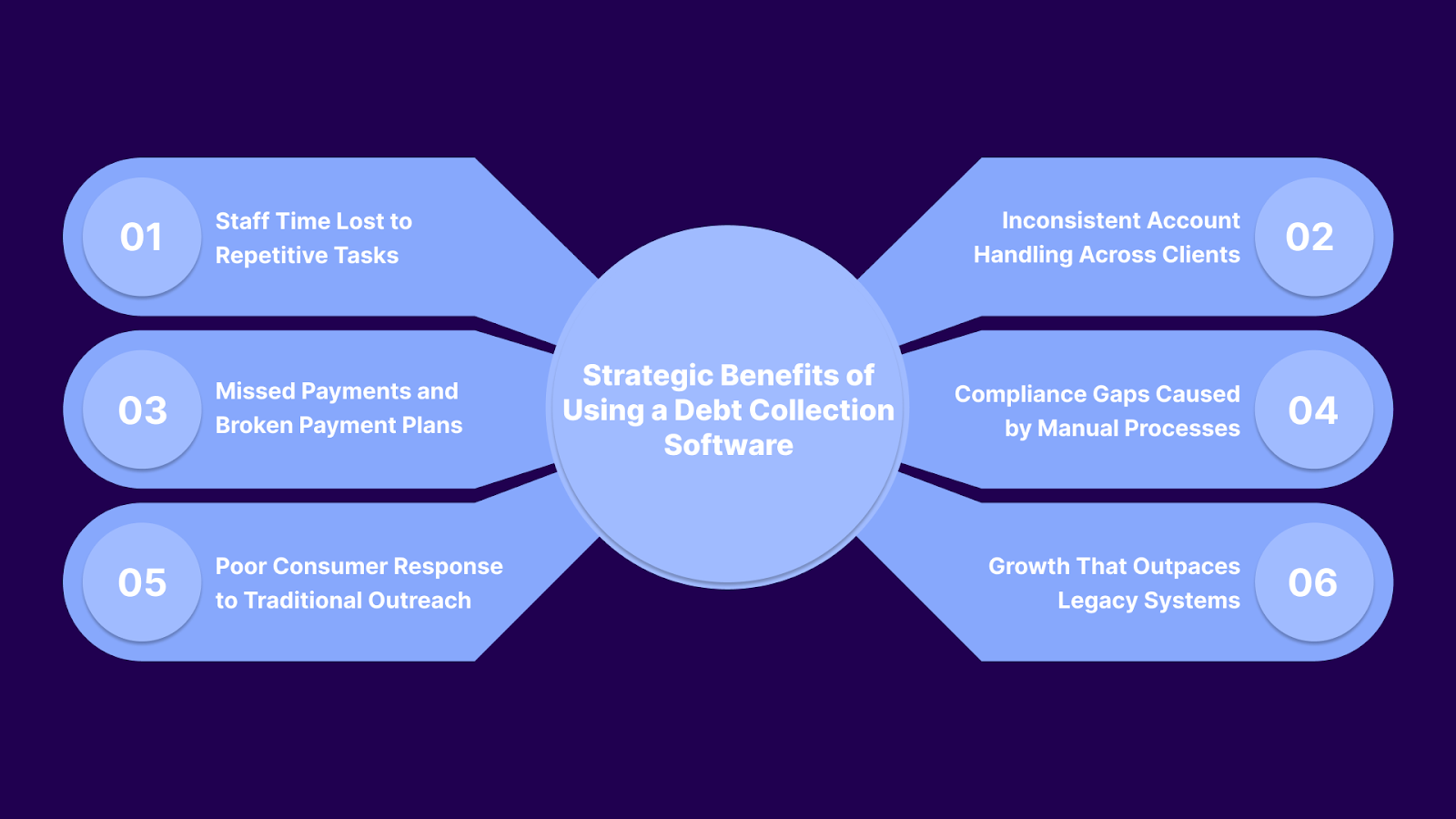
Strategic Benefits of Using a Debt Collection Software
Debt collection software gives mid-size agencies and creditors a single system to manage accounts, payments, communications, and compliance.
It solves the operational breakdowns that appear when volumes increase, but processes and staffing do not scale at the same pace.
This is how a debt collection software can help mid-size operations:
Staff Time Lost to Repetitive Tasks: Automates payment reminders, settlement tracking, and follow-ups that otherwise consume hours of agent time per account.
Inconsistent Account Handling Across Clients: Enforces standardized workflows so every account follows the same rules, regardless of portfolio size or creditor requirements.
Missed Payments and Broken Payment Plans: Reduces manual monitoring by automatically managing schedules, reminders, and failed payments.
Compliance Gaps Caused by Manual Processes: Replaces ad hoc notes and spreadsheets with logged activity, controlled permissions, and auditable records.
Poor Consumer Response to Traditional Outreach: Improves engagement by offering digital self-service and multiple payment options, rather than relying solely on calls.
Growth That Outpaces Legacy Systems: Supports higher volumes and additional clients without needing a full platform replacement or custom workarounds.
The next section reviews the top debt collection recovery platforms, highlighting which solutions are built to address these exact challenges.
14 Powerful Debt Collection Platforms for Mid-Sized Companies in 2026
To create this list, we evaluated platforms based on scalability for mid-size portfolios, compliance features, automation depth, consumer experience, integration flexibility, and real-world performance.
Quick comparison table of recovery platforms for mid-sized companies:
#
Platform
Consumer Self-Service
Compliance Focus
Ease of Use
Scales for Mid-Size Firms
1
Tratta
✓
✓
✓
✓
2
Collect! by Comtech Systems
◐
✓
◐
✓
3
Latitude by Genesys
✗
✓
◐
✓
4
Debtrak
✓
✓
◐
◐
5
Nortridge Software
✗
✓
✗
✓
6
Kolleno
✓
◐
✓
✓
7
Credgenics
✓
✓
◐
✓
8
LeadSquared Collections CRM
✗
◐
✓
◐
9
Beyond ARM
✗
✓
◐
✓
10
Quantrax
✓
✓
✗
◐
11
DAKCS Software Systems
✓
✓
✗
◐
12
CollectMax by JST
✗
✓
◐
✓
13
InterProse
✓
✓
◐
✓
14
C&R Software (Debt Manager)
✗
✓
✗
✓
Legend:
✓ = Strong native capability ◐ = Available, but limited or role-dependent ✗ = Not a core focus
To see how Tratta’s approach compares specifically with other payment orchestration partners, check out a detailed comparison of Tratta vs. PayRazr.
Each platform here helps mid-sized collection agencies, debt buyers, and creditors tackle different challenges. These are explained in detail below:
1. Tratta
Trattais a secure, compliance-focused debt collection and recovery platform designed to help agencies, law firms, and creditors manage receivables with automation, digital self-service, and real-time analytics. It brings together customizable workflows and deep reporting to support growth without enterprise complexity.
Features:
Consumer Self-Service Payment Portal A fully-branded, secure portal where consumers can view balances, validate identities, and make full payments, partial payments, payment plans, or settlement offers, significantly reducing inbound support and abandoned payments.
Multilingual Payment IVR Interactive voice response systems offer payment options in multiple languages, meeting diverse consumer needs and boosting accessibility without burdening agents.
Omnichannel Communications Easily reach consumers via SMS, email, voice, and portal links, maintaining continuity of message and increasing contact likelihood across preferred channels.
Campaigns Smart segmentation, automated trigger-based scheduling, and cohort-specific settlement offers allow campaigns to run with minimal manual oversight and maximal recovery impact.
Reporting and Analytics Real-time dashboards and drag-and-drop reporting offer deep visibility into portfolio performance, campaign success, payment trends, and operational bottlenecks — enabling smarter decisions.
Customization and Flexibility Configurable workflows, branding, consumer notifications, and admin controls let mid-size teams tailor operations without code changes.
Integrations Open REST APIs, file transfer support, and webhook options ensure Tratta connects easily with CRMs, accounting systems, and payment partners, preserving your existing tech investments.
Security and Compliance Built-in controls such as role-based access, encrypted data flows, PCI DSS- and SOC-certified handling, and automated audit logs help reduce compliance risk and strengthen data security.
Payments and Merchant Services Embedded payment options, including ACH, card, and future alternative methods, are integrated directly into outreach and self-service flows, improving conversion rates and accelerating cash flow.
For a detailed breakdown of how Tratta’s payment handling compares to other processors, see ourTratta vs. PaymentVisioncomparison.
Pros:
Strong built-in compliance controls
Excellent consumer self-service experience
Automates payments, plans, and campaigns
Clear, real-time reporting
Flexible integrations
Cons:
Setup requires planning
Learning curve for new teams
Advanced integrations need support
Trattais built for agencies that sit between spreadsheets and enterprise systems and feel the strain first. It standardizes recovery, compliance, and payments without locking teams into rigid workflows. That balance makes growth predictable instead of painful.Schedule a free demo today.
2. Collect! by Comtech Systems
Collect! by Comtech Systems is a flexible, scalable debt collection and recovery platform that automates workflows from initial contact through final payment for agencies, creditors, and debt buyers. Both cloud and on-premise deployments are available, and customizations persist as businesses grow through larger editions.
Key Features:
Configurable Collection Workflows: Actions, priorities, and queues can be adjusted to meet the needs of different clients, portfolios, and compliance requirements.
Automated Account Queues and Batch Processing: Batch actions allow agencies to efficiently apply updates, communications, or status changes across large account volumes.
Payment and Payment Plan Management: Supports one-time payments, recurring plans, and settlements. The system tracks schedules, missed payments, and balances automatically to reduce manual follow-ups.
Compliance and Credit Bureau Reporting Tools: Built-in support for compliant account handling and credit bureau reporting. Activity logs and standardized processes help agencies maintain audit readiness.
Client and Consumer Portals: Clients can view performance and account data without manual reporting. Consumer-facing tools support interaction and transparency without constant agent involvement.
Pros:
Highly flexible workflows and customization options support varied agency processes.
Strong automation and batch processing reduce manual work across accounts.
Cloud and on-premise deployment choices fit different IT strategies.
Cons:
Set up and deep customization can require significant time and expertise.
Reporting and complex query building may feel challenging initially.
Pricing scales withthe number of accounts and users, which may affect mid-size budgets.
Collect! is a mature platform built for agencies that need control and configurability. It excels when workflows are complex and volumes are growing. Teams should plan for setup time. The payoff is long-term operational stability.
3. Latitude by Genesys
Latitudeis a comprehensive debt collection and recovery management platform that helps agencies, creditors, and debt buyers manage delinquent accounts from early stages through charge-off and debt sale. Its unified interface gives agents a complete view of each account with workflows, analytics, and data tools.
Key Features:
End-to-End Collections Management: Tracks and manages accounts through the full lifecycle from early delinquency to recovery and charge-off.
Agency Interface Manager (AIM): Automates the outsourcing of accounts to third-party agencies with bi-directional data updates and performance comparisons.
Workflow Automation Engine: Drag-and-drop automation lets users deploy business logic and account strategies without coding.
Configurable Work Queues and Dashboards: Custom queues and real-time dashboards help teams focus on priority accounts and track operational KPIs.
Custom Desktop for Agents: A browser-based workspace that consolidates account data, notes, and tasks to reduce context switching.
Pros:
Supports the full collections lifecycle with strong automation.
AIM simplifies third-party outsourcing and performance tracking.
Configurable dashboards help teams stay focused on key metrics.
Cons:
A complex configuration may require dedicated implementation resources.
More suitable for mid-to-larger operations than very small agencies.
Not as focused on consumer self-service as newer digital-native platforms.
Latitude is ideal for agencies and creditors handling full collections lifecycles. Its automation, outsourcing management, and analytics make it a strong choice for teams with varied account strategies. Setup requires planning, but the payoff is deeper operational control and visibility.
4. Debtrak
Debtrakis a collections and delinquency management platform built primarily for financial services lenders. It is designed to manage borrower communication, repayment tracking, and delinquency progression across loan portfolios rather than agency-driven collections.
Key Features:
Automated Delinquency Notifications: Debtrak automatically sends borrower notifications as accounts move into delinquency. Messages are triggered by predefined rules, reducing the need for manual follow-ups.
Centralized Account Tracking: All borrower data, balances, and delinquency statuses are managed in a single system. This helps lending teams maintain consistency across large loan portfolios.
Payment Follow-Up Workflows: Missed or partial payments trigger structured follow-up actions. This ensures accounts do not stall due to oversight or delayed responses.
Rules-Based Escalation Logic: The platform adjusts actions as delinquency ages. Accounts escalate automatically based on risk, balance, or lender-defined thresholds.
Portfolio Performance Reporting: Reporting focuses on delinquency trends, recovery rates, and aging buckets. This helps lenders evaluate portfolio health rather than individual collector performance.
Pros:
Strong fit for lending institutions
Reduces manual borrower follow-ups
Clear visibility into delinquency stages
Cons:
Limited flexibility for agency-style collections
Fewer consumer self-service capabilities
Customization depth varies by deployment
Debtrak is best suited for lenders managing delinquent loans at scale. It prioritizes structure and automation. It is less focused on agency workflows or consumer self-service experiences.
Agencies that rely on coordinated SMS, email, and portal communication to drive responses may need platforms built around a communications strategy. SeeTratta vs. Concepts2Codecomparison for perspective.
5. Nortridge Software
Nortridgeis a loan servicing and collections platform built for organizations managing complex repayment structures. It combines servicing, collections, and compliance into a single system used across the loan lifecycle.
Key Features:
End-to-End Loan and Debt Servicing: Nortridge manages accounts from origination through payoff or collections. This makes it suitable for lenders handling long-term or multi-stage repayment scenarios.
Workflow Automation: The platform automates task routing and account actions based on defined servicing rules. This reduces manual intervention while maintaining consistency.
Payment Plan Management: Users can create structured repayment plans and monitor adherence over time. Missed payments are tracked automatically for timely intervention.
Compliance and Audit Controls: Activity logs and standardized workflows support regulatory requirements. This is critical for lenders operating in highly regulated environments.
Operational and Financial Reporting: Reporting provides visibility into servicing efficiency, repayment performance, and delinquency outcomes. Data can be used for internal audits and portfolio reviews.
Pros:
Handles complex loan portfolios well
Strong compliance and servicing depth
Flexible workflows for regulated environments
Cons:
Interface feels dated to some users
Setup and configuration take time
Heavier than needed for simple collections
Nortridge excels where loan servicing and collections intersect. It offers depth and control. Teams should expect a heavier system with longer setup cycles.
Kollenois an accounts receivable automation platform with limited collections functionality. It is designed primarily for finance teams managing overdue invoices rather than third-party debt recovery.
Key Features:
Automated Invoice Follow-Ups: Kolleno sends payment reminders based on invoice status and aging. This reduces the need for manual email or phone follow-ups by finance teams.
Centralized AR Dashboard: The dashboard provides visibility into overdue invoices and customer payment behavior. Finance teams can prioritize outreach based on risk and aging.
Payment Tracking and Reconciliation: Payments are automatically matched to invoices. This reduces reconciliation errors and improves cash application accuracy.
Cash Flow Forecasting: The platform uses AR data to project expected incoming payments. This supports financial planning rather than recovery optimization.
Accounting and ERP Integrations: Kolleno integrates with accounting systems to sync invoice and payment data. This keeps finance records consistent across tools.
Pros:
Strong fit for internal finance teams
Improves visibility into overdue invoices
Reduces manual AR follow-ups
Cons:
Not built for agency collections
Limited compliance tooling for regulated debt recovery
Lacks advanced settlement and recovery workflows
7. Credgenics
Credgenicsis a SaaS-based debt collection and resolution platform that helps banks, non-bank financial companies (NBFCs), fintechs, and collection agencies automate recovery across all delinquency buckets. It supports digital-first outreach, portfolio segmentation, and end-to-end collections workflows, from early outreach to legal escalation.
Key Features:
End-to-End Collections Lifecycle: Manages accounts across all stages of delinquency, including pre-due, regular collection, and legal recovery. This gives teams a unified workflow from early outreach to escalated cases.
Digital Outreach and Self-Service Options: Supports automated email, SMS, and portal-based communications that improve debtor engagement without manual intervention. These tools help boost right-party contact and payment conversions.
Portfolio Segmentation and Prioritization: Segments accounts by risk, age, and strategy so teams can prioritize high-impact actions. This enhances resource allocation and recovery efficiency across large portfolios.
Predictive Analytics and Decisioning: Uses data trends to suggest optimal recovery strategies and next actions. Analytics help teams refine campaigns and allocate agents where they are most effective.
Compliance and Audit Trails: Tracks activity logs, communication history, and account status changes to support regulatory compliance. Built-in audit tools help agencies meet evolving rules without external workarounds.
Pros
End-to-end recovery covers early to late stages
Strong automation of communications and workflows
Data-driven segmentation improves prioritization
Cons
More complex than basic tools for simple follow-ups
Digital-first model may require adjustment for phone-centric teams
Implementation and onboarding take careful planning
8. LeadSquared Collections CRM
LeadSquared Collections CRM is a debt recovery platform that blends CRM capabilities with collections workflows. It helps mid-size agencies and creditors manage borrower segmentation, outbound outreach, and agent productivity with automation and visibility tailored to complex recovery cases.
Key Features
Borrower Segmentation and Strategy: Lets teams categorize borrowers by risk, debt age, repayment history, and other factors so outreach can be targeted and effective rather than one-size-fits-all.
Automated Communication Flows: Sends reminders, alerts, and actions across email, SMS, and call channels based on borrower behavior and account stage, reducing manual work for agents.
Call Center & Field Operations Support: Includes intelligent call distribution and mobile-friendly tools for field agents, helping teams coordinate in-office and in-the-field recovery activities.
Fraud & Legal Tracking: Offers alerts and tracking for potential fraud and legal actions, giving agencies structured visibility into risk events.
Performance Monitoring & Dashboards: Provides insights into agent productivity, case progress, and recovery pipelines, helping supervisors make data-driven decisions.
Pros
Strong segmentation and communication automation
Useful for blended field and office workflows
Performance insights help teams track productivity
Cons
Not as collections-centric as platforms built solely for recovery
Some features overlap with broader CRM functions
Advanced configurations may require implementation support
9. Beyond ARM
Beyond ARMis a cloud-based (and on-premise) debt collection platform designed for agencies of various sizes, including mid-sized operations. It helps teams streamline workflows, manage accounts, and keep track of collector activity while supporting core recovery tasks.
Key Features:
Collector Activity Management: Centralizes notes, actions, and contact history for each debtor. This makes workflows more consistent across teams.
Automated Notices and Follow-Ups: Sends scheduled letters, reminders, and notices to debtors. It reduces manual communication work.
Payment Plan and Settlement Tracking: Supports structured payment plans and settlement negotiations. This helps agencies capture partial recoveries efficiently.
Portfolio Dashboards: Provides visibility into outstanding accounts, aging, and recovery outcomes. Dashboards help supervisors track performance.
Deploy Anywhere: Offers cloud and on-premise deployment options. This can suit different IT and security requirements.
Pros:
Works well for mid-sized agencies
Supports core recovery and payment plan management
Flexible deployment choices
Cons:
Interface is not as modern as some SaaS platforms
Reporting depth may vary by plan
Consumer self-service features are limited
10. Quantrax
Quantraxis a debt collection platform designed for agencies that rely heavily on outbound calling and performance analytics. It combines traditional collections workflows with dialing technology and compliance-focused controls.
Key Features:
Predictive Dialer Integration: Built-in dialing tools help agents maximize talk time and contact rates. Campaigns can be tuned based on call outcomes and agent availability.
Collector Performance Analytics: Provides detailed insight into call activity, recovery rates, and agent productivity. Data is geared toward optimizing collector efficiency.
Compliance and Audit Controls: Supports call recording, activity logging, and standardized account handling to meet regulatory and client requirements.
Pros:
Strong dialing and call analytics
Clear visibility into collector performance
Compliance support for regulated environments
Cons:
Heavily phone-centric approach
Limited consumer self-service capabilities
Interface feels dated compared to modern platforms
11. DAKCS Software Systems
DAKCS provides a debt collection platform used by agencies, healthcare providers, and financial institutions. It focuses on structured workflows, account tracking, and regulatory compliance.
Key Features:
Agency and Healthcare Collections Support: Designed to handle consumer, medical, and financial accounts. Workflows reflect regulated recovery environments.
Account and Case Management: Centralizes balances, notes, and actions in a single system. This supports consistent handling across large portfolios.
Automated Letters and Notices: Generates compliant letters and statements based on account rules. Reduces manual document handling.
Pros:
Strong compliance orientation
Suitable for healthcare and financial collections
Structured and reliable workflows
Cons:
Less flexible for custom recovery strategies
Limited consumer-facing digital tools
Interface can feel dated
12. CollectMax by JST
CollectMaxis a debt collection platform designed for mid-sized financial organizations and agencies. It emphasizes automated correspondence, payment handling, and operational control.
Key Features:
Automated Letters and Notices: Generates and sends standardized collection letters in accordance with account rules. Helps maintain consistency and compliance.
Payment Processing and Tracking: Supports payments and tracks balances across accounts. Reduces manual reconciliation work.
Account Workflow Management: Manages account movement through defined recovery stages. Workflows are structured and predictable.
Pros:
Good fit for mid-sized operations
Strong automation for letters and payments
Emphasis on compliance and consistency
Cons:
Limited flexibility for advanced strategies
Minimal consumer self-service features
Less modern UI compared to newer platforms
13. InterProse
InterProseis a debt recovery platform centered on portfolio management, analytics, and automation. It is designed for agencies and creditors that want tighter control over account strategies and performance across large portfolios.
Key Features:
Portfolio-Centric Account Management: Organizes accounts by portfolio, strategy, and performance tier. This helps teams apply different recovery approaches based on risk and value.
Recovery Workflow Automation: Automates account movement, task assignment, and follow-ups based on predefined rules. This reduces manual intervention as volumes increase.
Advanced Analytics and Reporting: Provides insight into recovery rates, aging, and portfolio effectiveness. Analytics are geared toward strategy optimization rather than agent activity alone.
Pros:
Strong portfolio-level visibility
Useful analytics for strategy refinement
Automation supports scalable recovery
Cons:
Less emphasis on consumer-facing digital experiences
Requires analytical maturity to fully benefit
The interface is more functional than modern
14. C&R Software
C&R Software offers Debt Manager, a debt collection and recovery platform used in regulated environments and by agencies handling complex workflows. It helps teams automate actions, build decision logic, and apply structured recovery strategies across large portfolios, with a long industry track record.
Key Features:
Configurable Collection Logic: Allows agencies to set recovery rules and next-best actions without coding. This helps automate decisions based on balance, aging, or risk profile.
Agent Productivity Tools: Provides work queues, task prioritization, and collector dashboards. These features help teams focus on high-impact accounts.
Compliance and Audit Controls: Tracks actions and logs activity for audit readiness. This reduces risk in regulated environments.
Pros:
Strong, structured recovery logic
Mature compliance and audit support
Deep reporting for performance insights
Cons:
Setup and configuration need planning
The interface is more functional than modern
Less emphasis on consumer self-service
For a side-by-side look at how Tratta’s payment and self-service experience differ from other payment platforms, check out ourTratta vs. HealPaycomparison.
Conclusion
Mid-size collection firms should prioritize platforms built specifically for regulated recovery, with automation that reduces manual work, compliance embedded into workflows, and the flexibility to scale without disruptive system changes. The right choice supports growth, consistency, and client confidence rather than adding operational friction.
Trattastands out by addressing the exact pressure points mid-size agencies face as they grow. It is trusted by organizations such as MS Fuel Card (Shell), InDebted, and FMA Alliance because it combines compliance-first design, strong consumer self-service, and automation that actually replaces manual effort.
Instead of forcing agencies to choose between flexibility and control, Tratta delivers both in a platform built for modern recovery.Speak to our team today for software that reduces risk while improving recovery outcomes.
Frequently Asked Questions
1. When should a collection firm upgrade its recovery platform?
Most firms reach the tipping point when account volumes increase, but recovery rates flatten. Manual processes, inconsistent handling, and reporting gaps usually signal it is time to upgrade.
2. Can one debt recovery platform support multiple clients with different rules?
Yes, but only platforms built for agencies can do this well. Look for systems that allow client-level workflows, reporting, and compliance rules without custom development.
3. How does automation actually impact recovery performance?
Automation reduces missed follow-ups, broken payment plans, and stalled accounts. It also frees collectors to focus on higher-value interactions rather than repetitive tasks.
4. What is the best debt collection software?
The best software helps you automate engagement, payments, compliance, and reporting in one workflow. It should reduce agent workload while improving recovery consistency across growing delinquent portfolios.
5. How long does it take to see results after implementing automation?
Most agencies notice improvements within the first few months. Engagement rates increase quickly, while payment consistency and recovery timelines improve as automated workflows begin guiding delinquent accounts toward resolution.
Note: This information is not legal advice. Tratta recommends that you consult with your legal counsel to make sure that you comply with applicable laws in connection with your collection and outreach activities.
Sign up for our monthly newsletter
Debt collection insights that keep you compliant and competitive.
Thank you! Your submission has been received!
Oops! Something went wrong while submitting the form.