Recoveries may look strong on paper, but if payments arrive late or inconsistently, your cash position tells a different story. Research shows that 82% of small businesses that fail do so because cash flow breaks down.
At the same time, the global market for cash flow optimization solutions is projected to reach about $15.80 billion by 2033, growing steadily from 2025. That signals a clear shift toward tighter control over cash.
For collection agencies, the gap between recoveries and realized cash is where problems start. This article breaks down cash flow optimization strategies, forecasting, and tools to help you build predictable inflows.
Cash flow optimization in collection agencies is not just about increasing recoveries. It is about ensuring those recoveries convert into cash quickly, consistently, and predictably. Because revenue is realized only when payments are completed, agencies must actively manage how cash moves through the collection lifecycle.
Here is how cash flow moves through a typical collection process:
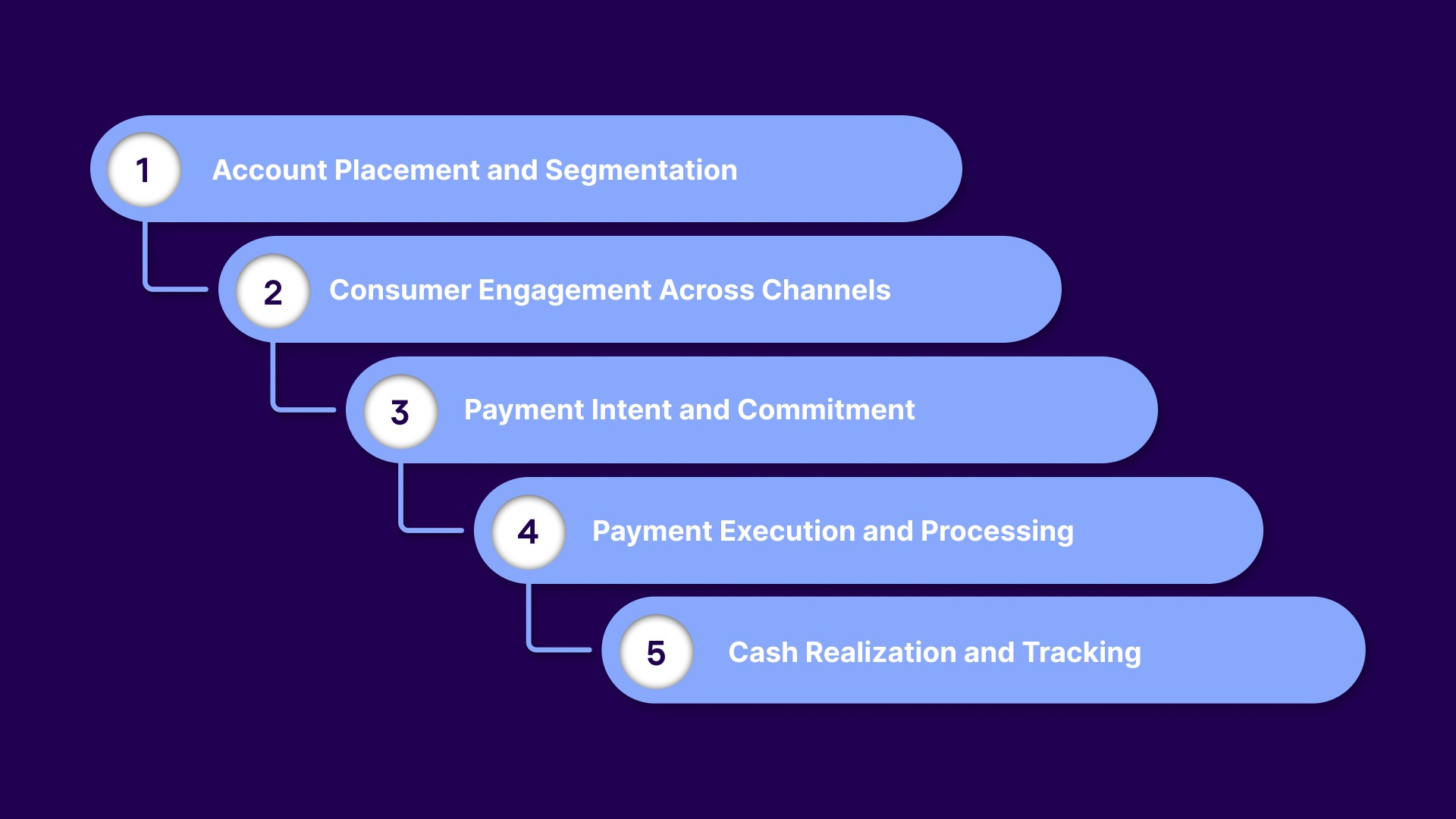
In practice, however, outcomes vary based on how effectively each stage is executed. In the next section, we break down the operational factors that influence how efficiently cash is generated and realized.
Suggested Read: Key Performance Indicators for Debt Collection Metrics
Execution quality across the collection lifecycle determines whether recoveries translate into timely, reliable cash inflows. At scale, even minor inefficiencies compound into delayed realization, increased variance, and reduced liquidity control.
Here are the operational drivers that materially influence cash flow outcomes:
The latency between account placement and initial outreach directly impacts recovery velocity. Shorter TTFA increases early-stage conversions and compresses the overall cash cycle.
The effectiveness of channel sequencing and mix (SMS, email, voice, digital) determines response density. Misaligned channel strategies reduce contact rates and delay payment initiation.
A critical drop-off point exists between consumer intent (promise-to-pay) and actual payment completion. Friction in payment pathways or delayed follow-through reduces realized cash despite apparent engagement.
Static or manually driven workflows introduce delays between actions. The absence of event-based triggers results in missed conversion windows and inconsistent execution across accounts.
Cash flow efficiency depends on how accurately accounts are prioritized based on risk, balance, and likelihood of recovery. Weak segmentation leads to suboptimal allocation of effort and slower inflows.
Regulatory constraints shape outreach timing, frequency, and messaging. Without embedded compliance logic, agencies face interruptions, rework, or exposure that can disrupt collection continuity.
As account volume increases, system and process limitations can create bottlenecks. Reduced throughput slows account progression and extends time to cash realization.
Addressing these drivers requires systems that can standardize actions, reduce latency, and maintain consistency at scale.
Tratta enables trigger-based workflows, omnichannel engagement, and a frictionless self-service payment experience. With built-in compliance controls and real-time visibility, it reduces execution delays and improves conversion efficiency. Schedule a free demo today.
Cash flow in collection agencies is made up of multiple inflows and outflows that move at different speeds and impact liquidity in different ways. Understanding these categories helps you identify where delays occur and where optimization efforts should be focused.
Table showing different types of cash flow:
Each of these cash flow types behaves differently, which is why managing them requires more than a one-size-fits-all approach. Agencies need to monitor how each category contributes to overall liquidity and predictability.
This can be done by:
The real impact comes from actively improving how they are analyzed and optimized. In the next section, we break down the strategies that help collection agencies analyze performance and optimize cash flow outcomes.
Suggested Read: Average Collection Period Calculator
Improving cash flow requires more than tracking outcomes. It depends on how effectively agencies analyze performance across the collection lifecycle and act on those insights in real time.
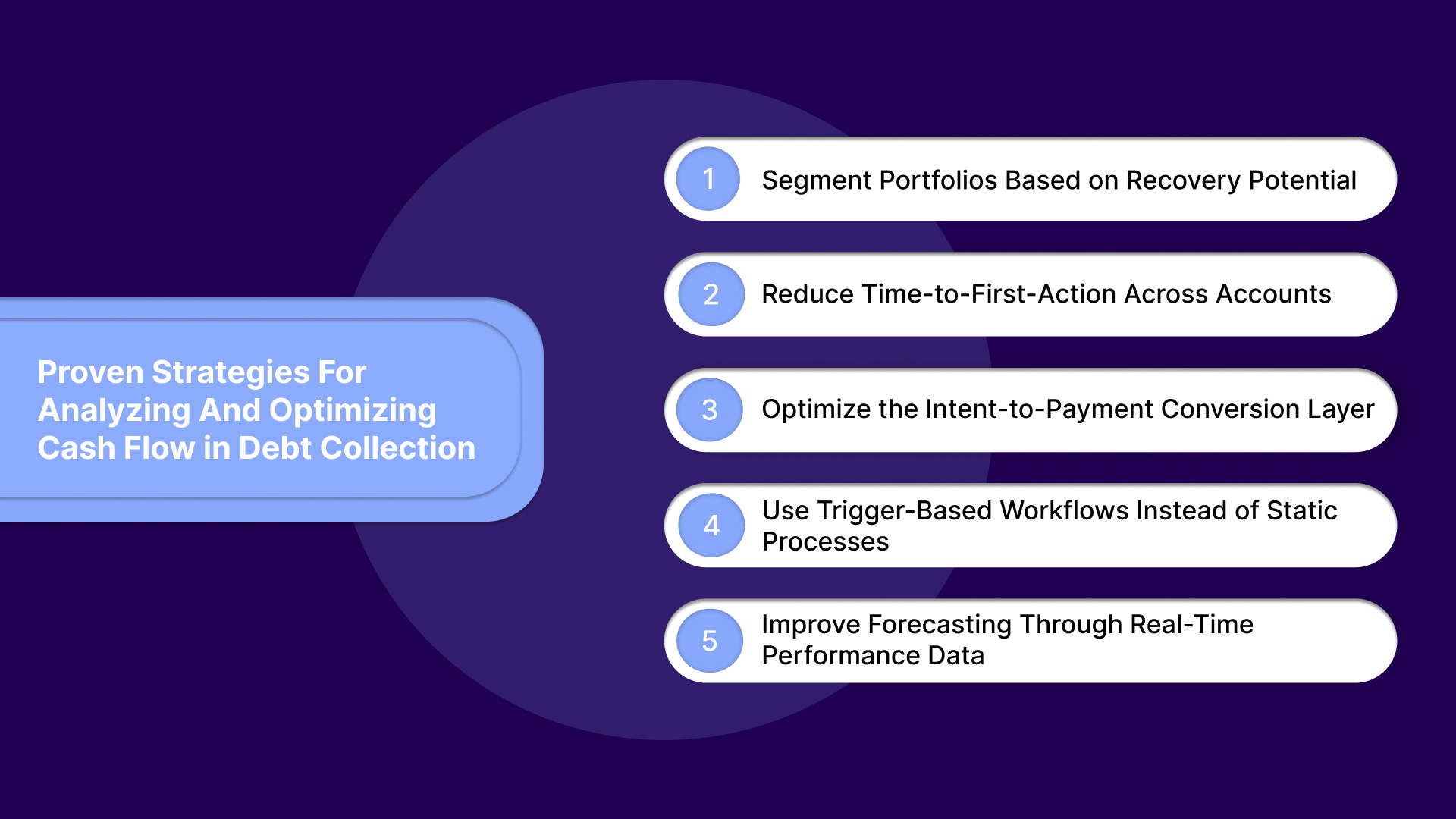
The following strategies focus on identifying inefficiencies, reducing delays, and improving the consistency of cash inflows.
Not all accounts contribute equally to cash flow. Segmenting portfolios by balance, behavior, and likelihood of recovery helps prioritize effort where it drives the fastest and most reliable cash realization.
Focus on:
Delays in initiating engagement extend the recovery cycle and slow down inflows. Compressing the time between account placement and first action improves early-stage conversions.
Focus on:
A significant portion of cash flow is lost between consumer intent and completed payment. Improving this transition increases realized cash without increasing outreach volume.
Focus on:
Static workflows create gaps between actions, reducing consistency and speed. Trigger-based systems ensure that every account progresses based on real-time events and behaviors.
Focus on:
Accurate forecasting depends on visibility into how accounts are performing in real time. Better data allows agencies to predict inflows more reliably and adjust operations accordingly.
Focus on:
Tratta centralizes analytics, automation, and payments in one system. It enables real-time decisioning, trigger-based workflows, and seamless payment execution, helping agencies drive more predictable cash flow outcomes. Contact us to learn more.
Cash flow optimization and forecasting are tightly linked. You cannot improve what you cannot predict, and you cannot predict accurately without understanding how cash actually moves through your operations.
For collection agencies, forecasting is not merely a financial exercise. It is a direct reflection of how well your recovery process converts activity into real cash.
Here are the steps to improve cash flow forecast accuracy in collection operations:
Start by analyzing past performance across portfolios, including recovery timelines, payment behaviors, and conversion trends. This establishes a realistic foundation for forecasting expected inflows. Without historical context, projections tend to be either overly optimistic or disconnected from actual outcomes.
Different account types behave differently, and aggregating them into a single forecast reduces accuracy. Segment forecasts based on balance size, account age, consumer behavior, and recovery likelihood. This allows for more precise projections and better alignment with actual inflow patterns.
Most actionable forecasts are built on near-term visibility, typically within 7 to 30 days. Monitoring short-term trends helps identify shifts in payment behavior and adjust expectations quickly. This reduces variance between projected and realized cash.
Regularly compare forecasted inflows with actual collections to identify gaps and inconsistencies. Understanding where and why deviations occur improves future accuracy. Over time, this creates a feedback loop that strengthens forecasting reliability.
Static forecasts become outdated quickly in dynamic collection environments. Integrating real-time data allows agencies to adjust projections based on current engagement, payment activity, and account progression. This improves responsiveness and decision-making.
Forecast accuracy depends on how consistently processes are executed. If workflows are inconsistent or delayed, projections will not hold. Aligning forecasting models with actual operational behavior ensures more reliable outcomes.
Improving forecasting accuracy strengthens your ability to plan, allocate resources, and maintain liquidity. But the real value of cash flow optimization becomes clearer when you look at the tangible outcomes it delivers. This is explained in the next section.
Suggested Read: Understanding Average Days Delinquent (ADD) and How to Measure
When cash flow is optimized, collection agencies move from reactive operations to controlled, predictable performance. This shift directly impacts financial stability, operational efficiency, and long-term scalability.
The key benefits include:
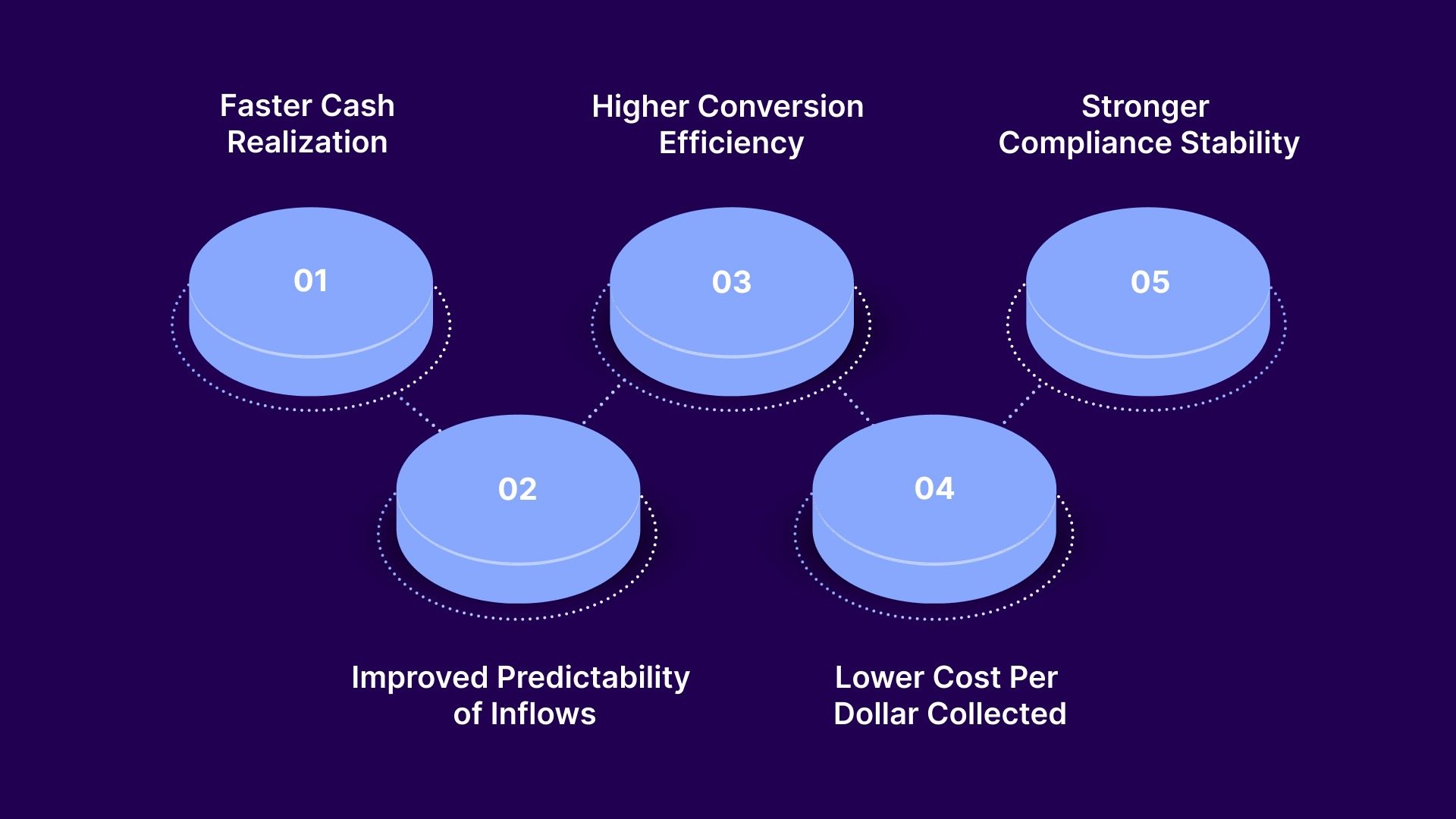
These benefits are achievable only when execution is consistent and scalable. Without the right systems in place, manual processes introduce delays, variability, and hidden inefficiencies.
The impact is not always visible immediately, but over time it distorts data, delays decisions, and reduces control over how cash actually moves through the business. As volumes grow, these inefficiencies become harder to contain.
The missed opportunities include:
These gaps highlight a broader limitation of manual cash flow management. Without the right technology, agencies cannot fully control or optimize how cash flows through their operations.
When cash flow is not actively optimized and supported by the right technology, control over how money moves quickly starts to erode. Recoveries may appear strong, but delays, inconsistencies, and fragmented execution create gaps between expected and realized cash.
Tratta strengthens cash flow control by bringing data, execution, and payment activity into a single system of record. It enables agencies to monitor account progression in real time, refine strategies based on live performance, and maintain consistency across high-volume operations.
See how Tratta can improve your cash flow performance. Request a demo to explore its features in action.
Optimize cash flow by reducing time-to-payment, improving conversion from intent to payment, using automation, enabling self-service payments, and aligning forecasting with real-time recovery data across portfolios.
Agencies should track time-to-first-payment, promise-to-pay conversion rates, recovery velocity, payment completion rates, and variance between forecasted and actual inflows to maintain control over cash flow.
Forecasting helps agencies anticipate short-term inflows based on recovery trends and account behavior. This improves planning, reduces surprises, and allows teams to adjust strategies to maintain consistent cash flow.
Unpredictable cash flow often results from delayed outreach, inconsistent workflows, poor segmentation, and gaps between payment intent and completion. These issues create variability between expected recoveries and actual cash inflows.
Payment plans spread inflows over time, improving consistency but delaying full recovery. Their effectiveness depends on completion rates, follow-up consistency, and how well agencies track and manage active arrangements.