
Accounts receivable teams often struggle with slow follow-ups, limited visibility into account status, and processes that rely too heavily on manual effort. As volumes increase, even small execution gaps compound into delayed payments, aging balances, and unpredictable cash flow. In many organizations, the issue is not a lack of effort but a lack of system-driven consistency.
This challenge is reflected in industry research. Research shows that organizations that automate more than half of their accounts receivable workflows achieve a 32% reduction in Days Sales Outstanding. These businesses collected payments nearly 19 days faster than teams relying primarily on manual processes.
In this article, we break down the core accounts receivable automation best practices that help teams improve execution, accelerate payment cycles, and reduce avoidable delays at scale.
In brief:
Accounts receivable automation refers to the use of software and system-driven workflows to manage billing, communications, payments, and account updates.
Instead of relying on spreadsheets, manual reminders, and disconnected tools, automation standardizes how AR tasks are executed across the entire account lifecycle. The goal is not to remove oversight, but to ensure consistency, speed, and visibility at scale.
When applied correctly, accounts receivable automation improves performance across all accounts, including those already showing signs of delinquency.
For delinquent or at-risk accounts, automation helps by:
To achieve these results consistently, automation must be supported by the right system capabilities. The next section outlines the core components.
A single feature does not define an effective accounts receivable automation framework. It is built on interconnected components that standardize execution, improve visibility, and reduce manual effort across the AR lifecycle.
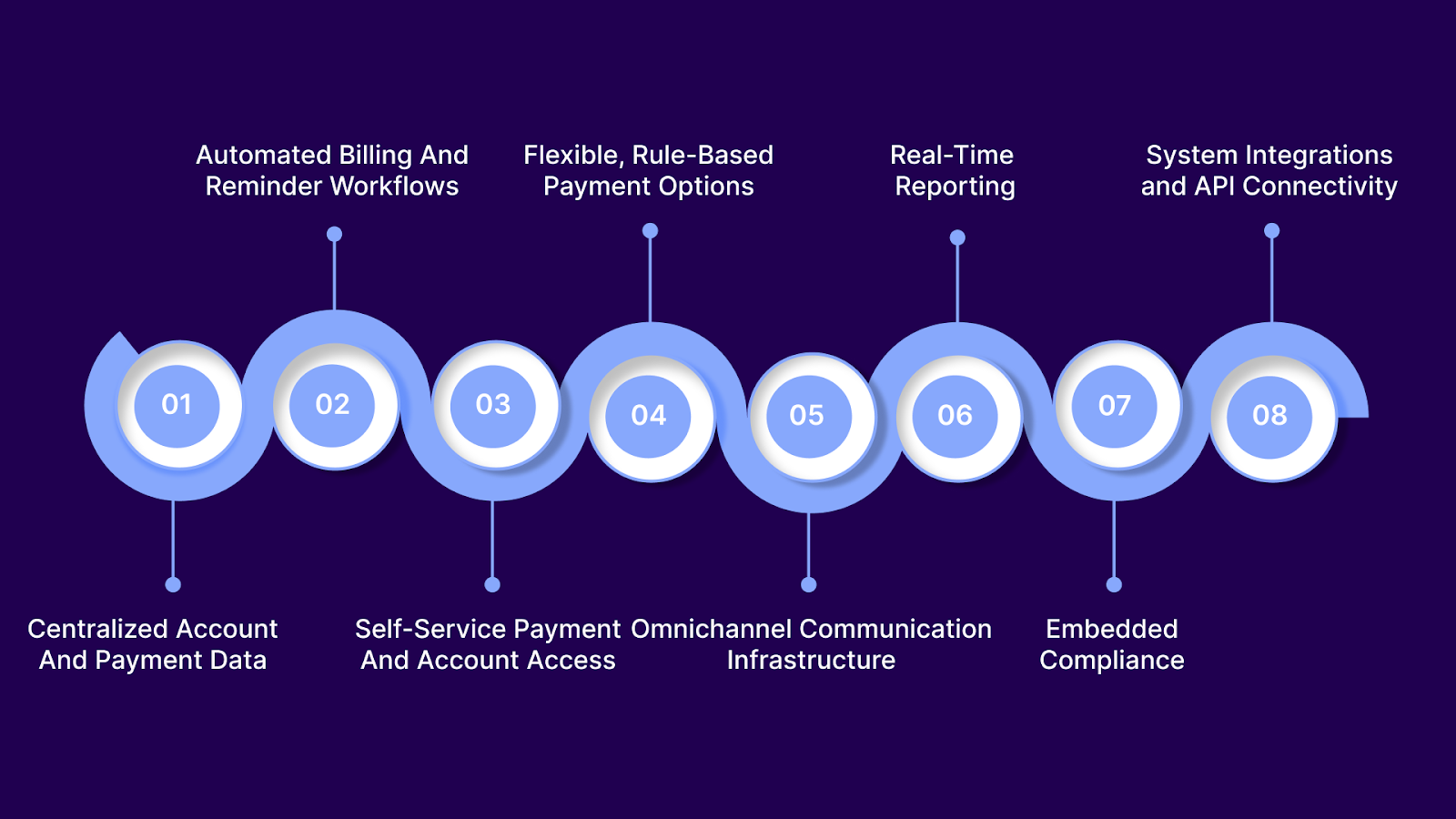
Key components include:
Tratta brings these elements together into a single system by combining payments, communication workflows, self-service access, reporting, and compliance controls. This centralized approach allows AR teams to execute consistently without stitching together multiple tools or workflows.
Suggested Read: Accounts Receivable Dashboard: Examples And Benefits
Implementing accounts receivable automation is most effective when it follows a structured, execution-focused approach. The steps below outline a practical path for moving from manual AR workflows to system-driven execution.
Key steps include:
1. Map Existing AR Workflows
Document how invoices are issued, reminders are sent, payments are processed, and exceptions are handled today. This step exposes where delays, handoffs, and manual dependencies create inefficiencies or inconsistency.
2. Identify High-Friction And High-Impact Areas
Prioritize workflows that consume the most time or cause the most delays, such as follow-ups on unpaid invoices, payment posting, or plan management. These areas deliver the fastest automation gains.
3. Define Automation Rules and Guardrails
Establish clear criteria for timing, frequency, and eligibility for reminders, payment plans, and settlements so automation operates predictably and within policy limits.
4. Centralize Account and Activity Data
Move balances, payment history, communication logs, and account status into a single system to ensure automation is driven by accurate, real-time information.
5. Enable Self-Service Payment And Account Access
Introduce customer-facing portals that allow balance review, payments, and plan management without agent involvement, reducing delays and inbound workload.
6. Integrate With Core Financial Systems
Connect AR automation with ERP, CRM, and downstream collections systems to maintain data continuity and avoid duplicate work or reconciliation issues.
7. Pilot Automation With Defined Segments
Start automation with a specific account group or workflow to validate rules, messaging, and outcomes before expanding system-wide.
8. Monitor Performance And Refine Continuously
Use real-time reporting to evaluate resolution speed, payment behavior, and workload shifts, then adjust automation logic to improve results.
These steps help organizations move from fragmented AR execution to consistent, system-driven workflows. The following section outlines best practices for optimizing performance once automation is in place.
Suggested Read: Accounts Receivable Management: Tips and Process Guide
The most effective AR teams use automation to prevent delinquency early and accelerate recovery of past-due balances. The practices below focus on execution discipline, payer responsiveness, and recovery efficiency.
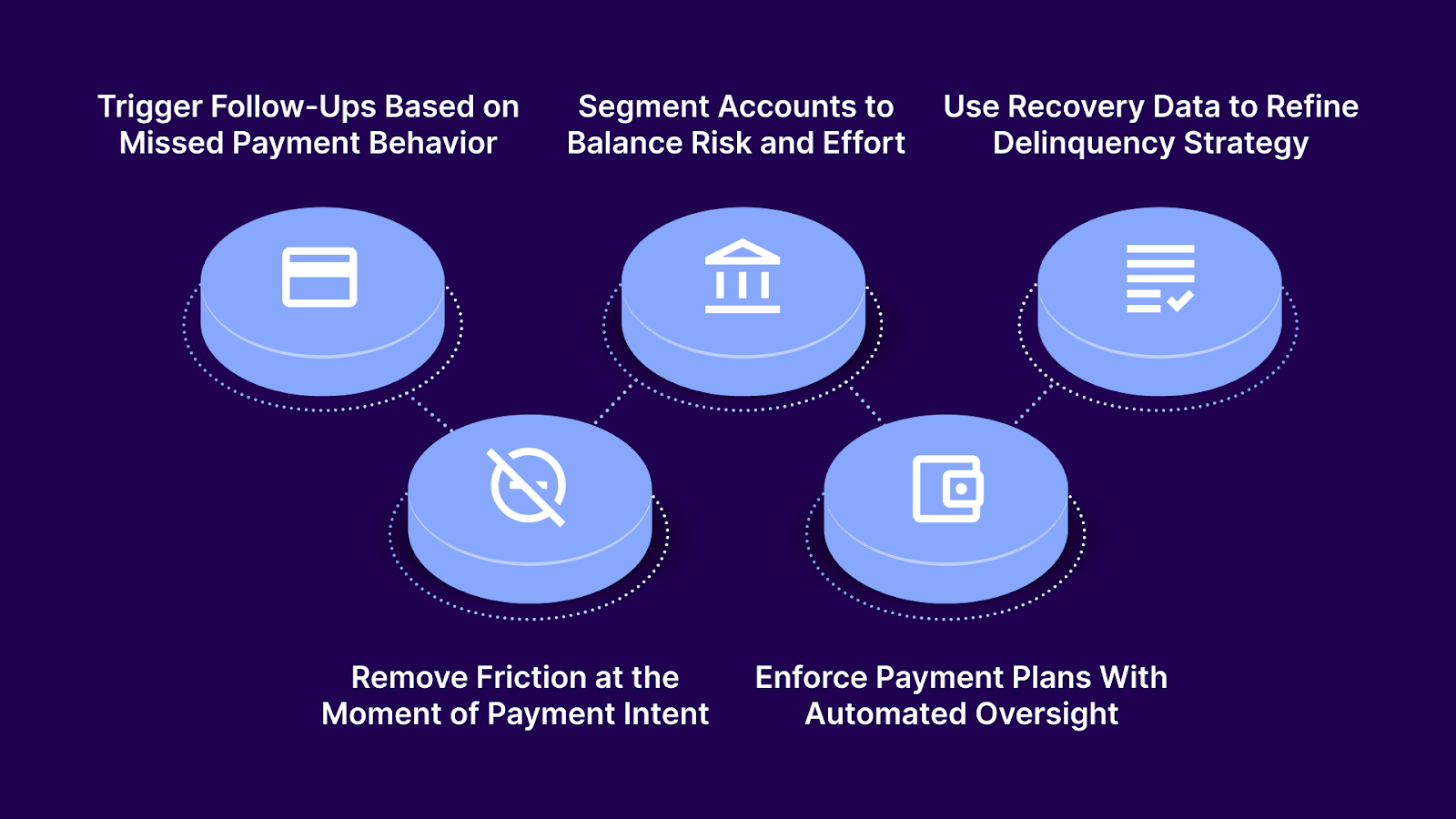
Delinquency worsens when follow-ups rely on fixed aging buckets instead of real payment signals. Recovery improves when actions are triggered immediately by missed, partial, or failed payments. Automation ensures there is no gap between payment failure and response.
This practice is about reacting to payment behavior in real time:
Delinquent accounts often fail to resolve due to unnecessary steps at checkout. Recovery performance improves when payment options are clear, fast, and immediately accessible from reminders. Automation should shorten the distance between intent and completion.
This practice focuses on simplifying payment execution:
Not all delinquent accounts require the same recovery approach. Segmentation allows teams to apply pressure selectively while preserving efficiency. Automation makes this differentiation consistent and scalable.
This practice focuses on prioritizing recovery effort:
Payment plans fail when missed installments go unnoticed. Recovery improves when plans are actively monitored and enforced without delay. Automation prevents silent plan breakdowns.
This practice focuses on protecting plan integrity:
Delinquency control improves when teams measure what actually drives resolution. Automation provides visibility into where recovery stalls and why. Continuous refinement prevents repeat failures.
This practice focuses on performance-based adjustment:
Tratta supports this execution by combining payment access, behavioral triggers, segmentation, and real-time reporting into a single system. AR teams can run follow-ups, payment plans, segmentation, and reporting through a coordinated workflow, rather than managing each function separately. Schedule a free demo.
Many organizations automate too quickly, in the wrong places, or without sufficient operational clarity. These mistakes can weaken recovery performance, increase compliance risk, and create new inefficiencies rather than eliminate existing ones.
Table showing AR automation mistakes and their fixes:
Even when companies avoid these mistakes, performance can stall if automation is not actively governed. Strong AR automation requires ongoing oversight and discipline to remain effective.
To prevent automation from drifting off course, organizations should focus on the following execution principles:
The next section explains how AR automation bridges operational gaps in debt recovery workflows.
Suggested Read: Solving Common Accounts Receivable Challenges and Problems
Accounts receivable automation does not stop once an account becomes past due. When designed correctly, AR automation creates continuity between early-stage receivables management and formal debt recovery, ensuring accounts do not move into disconnected or reactive workflows.
This continuity allows recovery efforts to begin with better data, clearer context, and system-driven consistency. These are a few ways AR automation supports recovery workflows:
This connection between receivables automation and recovery execution is best illustrated through real-world examples. The following section demonstrates how AR automation with Tratta delivers measurable recovery outcomes when applied at scale.
Suggested Read: Top 10 Accounts Receivable Automation Software Solutions
Tratta is a centralized platform designed to support debt recovery without sacrificing operational control, compliance, or customer trust. It extends automation, self-service access, and reporting into later stages of the account lifecycle.
The impact of this approach is best understood through real-world implementations. The following case studies show how different organizations use Tratta to improve recovery performance while protecting cash flow and reputation.
Multi Service Fuel Card switched from a manual collections process to Tratta’s automated system and saw card payments double within seven months.
The company recovered over $650,000 in previously uncollected payments by providing customers with a self-service portal and embedded payment options, while reducing manual effort. The shift improved customer convenience and optimized daily reporting and reconciliation.
Stenger & Stenger implemented Tratta to give debtors modern, web-based options to resolve balances without direct staff involvement. The firm reported significantly higher engagement and smoother resolution experiences thanks to self-service payment portals and automated email campaigns with one-click links.
Staff now leverage the system daily across IT, collections, finance, and operations, enabling the firm to scale recovery activity with fewer manual touchpoints.
FMA Alliance faced 5X growth in transaction volume and regulatory demands that its legacy systems could not meet. After adopting Tratta, the agency maintained a 99.99% customer satisfaction score and supported high-volume recovery operations without system failures.
Tratta also helped significantly reduce the number of calls required to recover debt by using automated outreach and reporting. Detailed analytics enabled the team to refine strategies based on payer behavior.
These examples show how debt recovery performs better when it is treated as a continuation of accounts receivable execution, not a disconnected process. Tratta helps AR automation move beyond efficiency gains and become a strategic advantage in recovery operations.
Automation introduces discipline into billing, communication, payments, and recovery. It allows teams to protect cash flow, improve predictability, and maintain control as volumes grow. When AR processes rely on manual execution and disconnected systems, delays, inconsistencies, and preventable delinquency are inevitable.
Tratta enables this discipline by extending automation from early-stage receivables into debt recovery. It brings self-service payments, behavior-driven workflows, segmentation, reporting, and compliance controls together within one platform. This allows organizations to recover balances efficiently while maintaining customer trust and operational oversight.
See how automation can reduce manual effort, improve recovery outcomes, and strengthen compliance across your operation. Speak with our team today.
Implementation timelines vary based on data complexity and integrations, but most AR automation platforms can be deployed in weeks, not months, especially when workflows and rules are clearly defined upfront.
Yes. Effective AR automation platforms integrate with existing ERP, CRM, and accounting systems via APIs, enabling organizations to automate processes without replacing their core financial infrastructure.
AR automation reduces manual workload for routine tasks, but it does not eliminate the need for staff. It allows teams to focus on exceptions, complex cases, and higher-value recovery activities.
Automation improves customer experience by providing consistent communication, clear payment options, and self-service access. This reduces confusion, delays, and unnecessary back-and-forth while maintaining transparency and control.
Yes. When designed correctly, AR automation strengthens compliance by enforcing disclosures, tracking consent, maintaining audit trails, and standardizing communication timing across all accounts and stages.