Debt recovery teams often struggle to turn raw performance data into timely insight, slowing actions and limiting productivity on high-priority accounts. Research has shown that real-time dashboards significantly enhance operational efficiency and enable proactive decision-making across industries.
It aggregates and visualizes key performance indicators instantly rather than relying on static reports or spreadsheets. Automated dashboards for collectors replace delayed reporting with live visibility, helping teams prioritize effectively, respond faster to changes, and drive stronger debt recovery outcomes.
In this guide, we explore seven ways dashboards can help debt teams stay ahead of trends, prioritize the right accounts, and drive stronger recovery outcomes.
Quick look:
Automated dashboards are real-time reporting interfaces that pull live data from collection workflows and present it in a single, continuously updated view. Unlike static reports or spreadsheets, they surface performance signals as activity happens, allowing collectors and managers to respond immediately rather than after the fact.
When evaluating automated dashboards, debt collectors should look for features that support daily execution. These are
In the next section, we look at the different ways an automated dashboard can help you increase debt recovery.
Suggested Read: Accounts Receivable Dashboard: Examples And Benefits
Automated dashboards increase debt recovery by turning collection activity into immediate, actionable insight. Instead of reacting to delayed reports, collectors and managers can adjust priorities, workflows, and outreach in real time, directly improving conversion and follow-through.
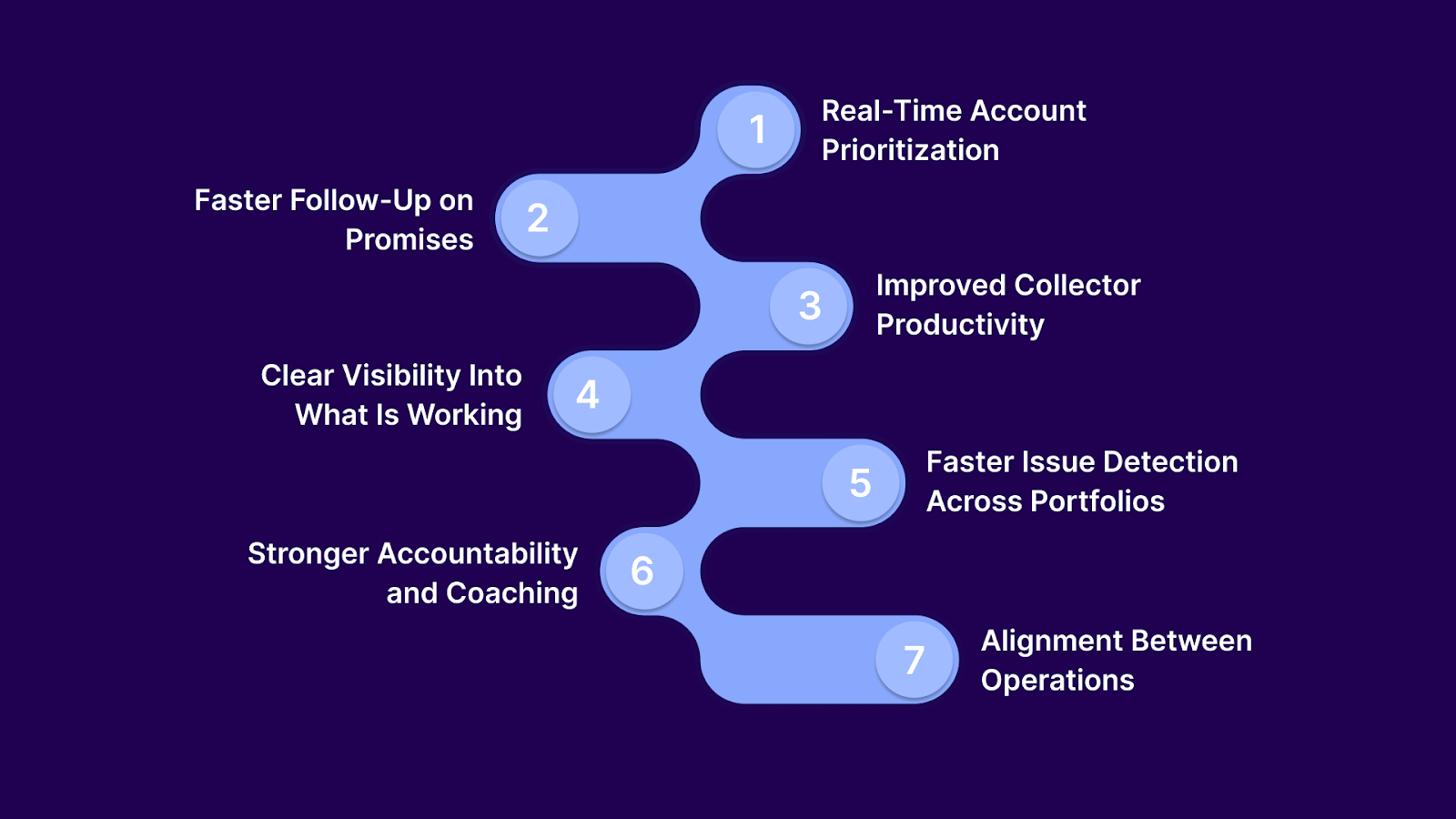
These are seven ways you can improve your collections with automated dashboards:
Automated dashboards continuously update account status based on payments, promises, and engagement. This ensures collectors focus on accounts with the highest recovery potential at any given moment. Time and effort are no longer wasted on stale or low-impact work.
This improves recovery by:
Dashboards track promises to pay and scheduled payments in real time. Missed or upcoming commitments are immediately visible. This prevents a silent drop-off after agreement.
This improves recovery by:
Automated dashboards remove the need for manual tracking and reporting. Collectors spend less time managing data and more time engaging accounts. Productivity gains come from focus, not speed alone.
This improves recovery by:
Dashboards show which strategies, channels, and approaches drive results. Performance trends are visible without waiting for end-of-week reports. Teams can adjust tactics before losses compound.
This improves recovery by:
Automated dashboards surface anomalies such as sudden drops in payments or stalled settlements. Managers can identify workflow breakdowns before they affect large volumes. Problems are addressed at the system level, not account-by-account.
This improves recovery by:
Dashboards provide transparent performance data for collectors and teams. Coaching becomes targeted and objective rather than anecdotal. Accountability improves without micromanagement.
This improves recovery by:
Automated dashboards create a shared view of performance across roles. Collectors, supervisors, and leadership operate from the same data. Decisions align more closely with on-the-ground reality.
This improves recovery by:
Tratta embeds automated dashboards directly into collection workflows rather than treating them as standalone reports. Its reporting and analytics dashboards reflect live payment activity, settlement progress, and engagement across the platform.
Automated dashboards work by continuously pulling live data from collection workflows and presenting it in a structured, real-time view.
Instead of requiring collectors or managers to compile reports, the system updates automatically as payments, promises, settlements, and interactions occur.
It works through the following core mechanics:
Because dashboards operate continuously in the background, teams no longer need to interpret incomplete data or rely on assumptions. The next section explores signs that a collection team has outgrown spreadsheets.
Suggested Read: Debt Recovery Case Management Software for Smarter Workflows
Spreadsheets can support small teams and low volumes, but they become a liability as portfolios grow and workflows become more complex. When reporting and tracking require constant manual updates, visibility lags behind execution, and recovery performance suffers.
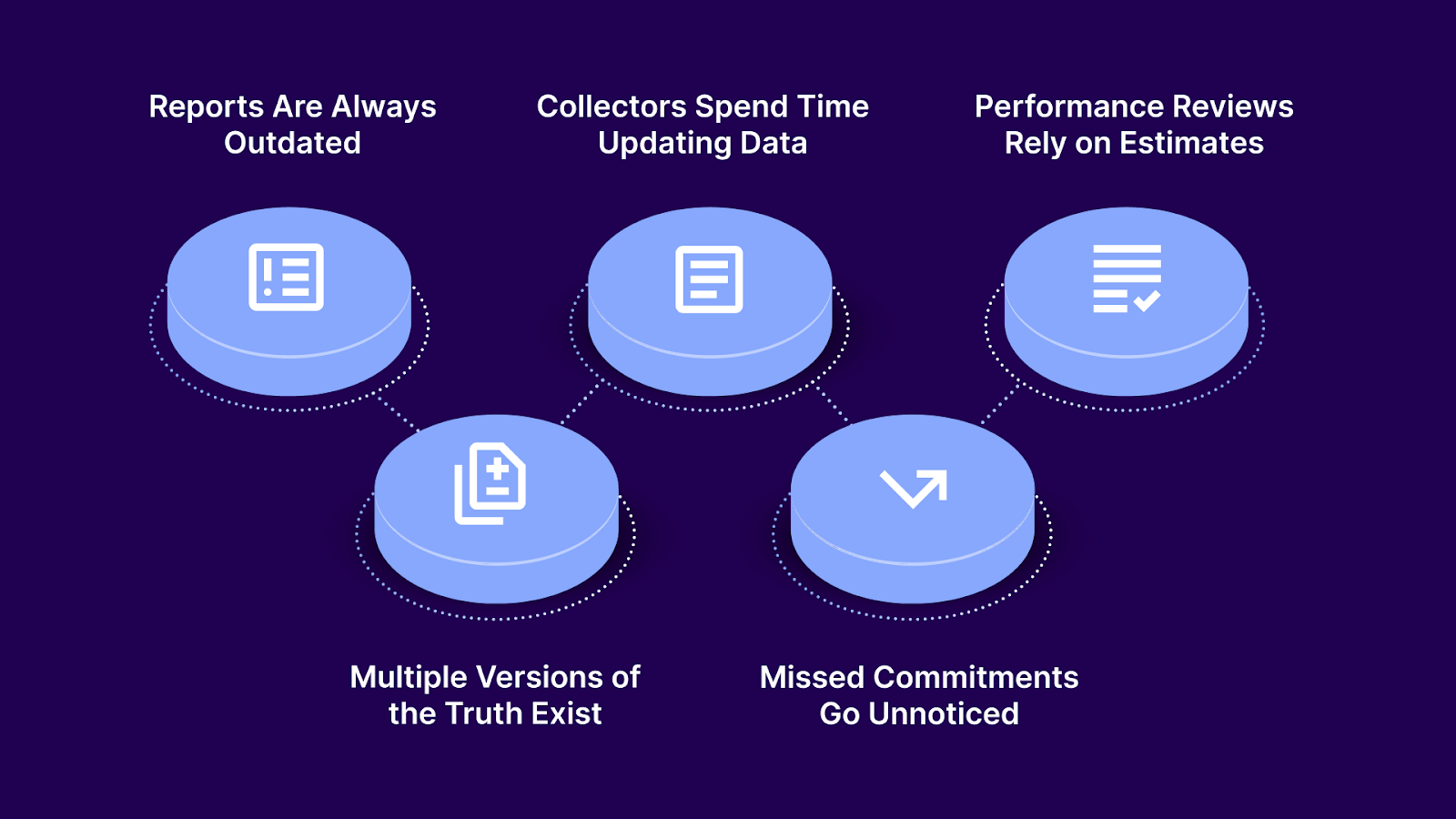
Common signs include:
When these issues become routine, the problem is no longer the spreadsheet itself but the limits of manual reporting. The following section looks at the key metrics automated dashboards can track.
Suggested Read: Essential Debt Collection Software Features Your System Needs
Automated dashboards are only effective when they surface metrics that reflect recovery outcomes, not just activity volume. The goal is to give collectors and managers a clear, shared view of what is converting, what is stalling, and where intervention is needed.
Table showing the KPIs your automated dashboards can track:
Tracking these metrics together helps agencies move from reporting to control. When dashboards connect settlement activity, payments, and follow-through in one place, teams can prioritize effectively and correct issues before losses compound.
To make this actionable, agencies should also focus on:
Tratta surfaces these metrics through automated dashboards that reflect live settlement and payment activity. Because data is generated directly from execution workflows, reporting remains accurate without manual reconciliation. Schedule a free demo today.
Automated dashboards are most valuable when used as early-warning systems rather than as retrospective reports.
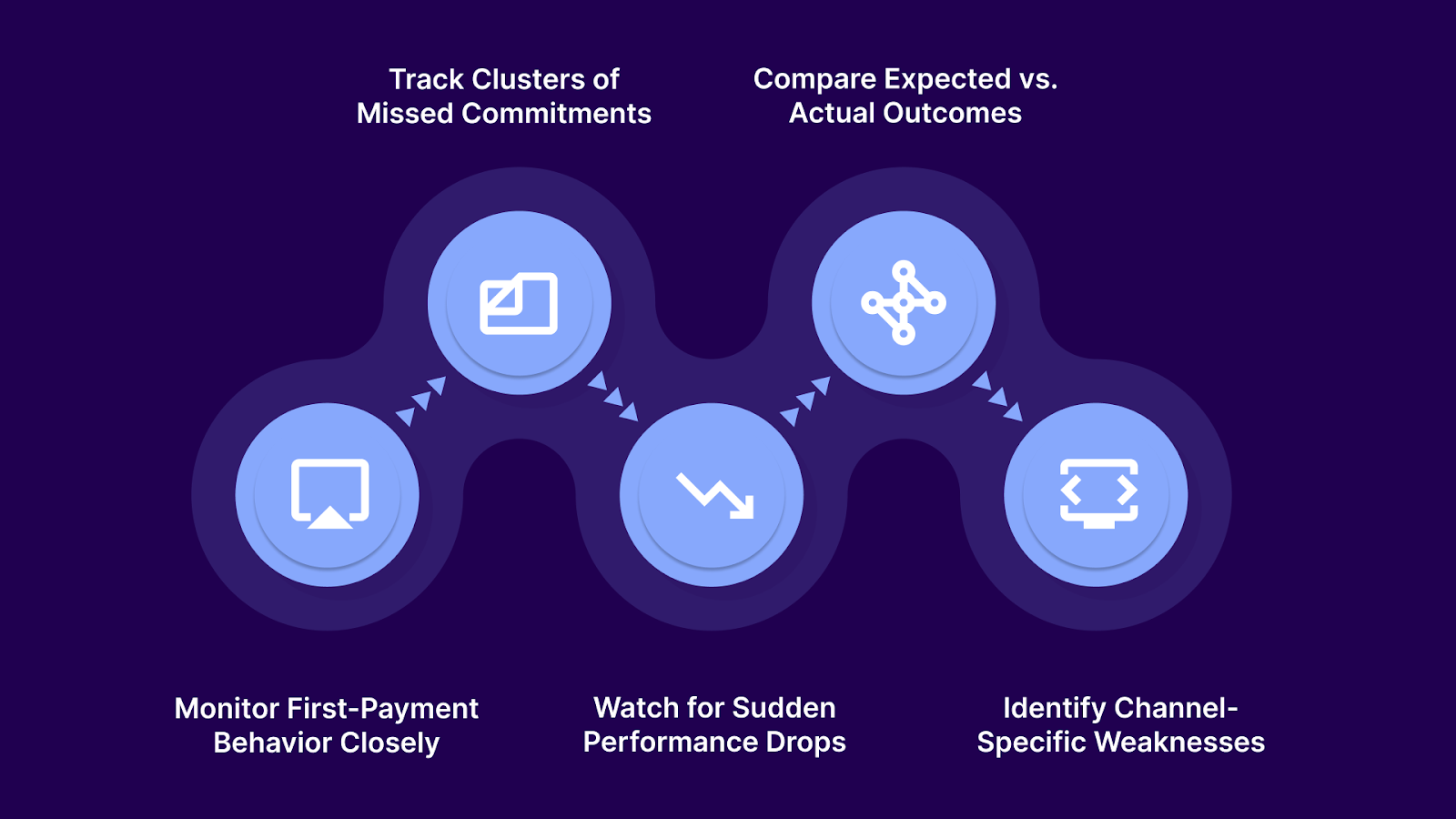
Dashboards help surface early risk when they are used to:
When dashboards are embedded directly into collection workflows, risk detection becomes continuous rather than reactive. This is where platforms built to connect live data with execution allow agencies to respond quickly and prevent small issues from scaling into portfolio-wide problems.
Suggested Read: How Automated Patient Debt Collections Boost Revenue Cycle
Tratta is a debt collection platform designed to help agencies manage growing delinquency volumes without increasing operational complexity. It brings consumer engagement, settlement execution, payments, analytics, and compliance into a single system so recovery workflows remain connected.
These features allow agencies to scale collections with control, consistency, and visibility:
The portal gives consumers a secure digital space to view balances, evaluate options, and take action. It reduces friction by allowing resolution without agent intervention. Agencies benefit from higher engagement and lower inbound workload.
Tratta provides automated dashboards that reflect live payment and settlement activity. Performance data updates continuously without manual reporting. This gives teams accurate visibility into what is working across portfolios.
The IVR enables consumers to make payments by phone in multiple languages. Payment activity is recorded instantly within the system. This expands access while reducing agent dependency.
Tratta supports automated outreach across digital channels to deliver consistent messaging. Consumers can engage through their preferred touchpoints. Agencies increase reach without increasing outbound effort.
Campaigns allow agencies to segment accounts and trigger targeted actions at scale. Scheduling and logic are system-driven rather than manual. This improves throughput while maintaining consistency.
Payments are processed directly within the platform using embedded infrastructure. Posting and reconciliation occur automatically. Agencies gain faster cash flow and fewer errors.
Administrators can configure branding, workflows, and payment options to align with agency policies. The platform adapts to operational needs rather than forcing rigid processes. This supports adoption across teams and clients.
Tratta connects with existing systems through APIs and data pipelines. Account, payment, and status data remain synchronized. Agencies avoid fragmented workflows and duplicate data entry.
Compliance controls and disclosures are enforced at the system level. Every consumer action is automatically logged and retained. This reduces regulatory risk while simplifying audits.
These features make Tratta a scalable collections platform rather than a point solution. They help agencies turn delinquency volume into predictable recovery outcomes without operational drag.
Automated dashboards replace reactive decision-making with continuous awareness. It allows collection agents and managers to respond to missed payments, shifting priorities, and emerging risks as they happen.
Tratta brings this visibility directly into the flow of collections work. Its automated dashboards reflect live settlement, payment, and engagement activity, giving agencies the clarity needed to act with precision at scale. By connecting insight to execution, Tratta helps teams move from monitoring performance to actively shaping recovery outcomes.
If recovery decisions still depend on delayed reports, performance will remain reactive. Speak with our team to learn how Tratta helps agencies turn live data into consistent recovery results.
Yes. Advanced dashboards allow agencies to tailor views, thresholds, and KPIs by client, portfolio, or account type, ensuring reporting aligns with contractual and operational expectations.
Not necessarily. Many agencies use automated dashboards for day-to-day operational control while retaining BI tools for deeper analysis or executive reporting.
Adoption is typically fast because dashboards pull from existing workflows. Collectors continue working as usual while visibility improves immediately through automated reporting.
Yes. When dashboards are fed by system-generated activity, they provide defensible records of actions, timing, and outcomes that support audits and regulatory reviews.
Tratta’s dashboards are driven by live settlement, payment, and engagement data generated within the platform, reducing reliance on manual inputs and ensuring consistent, real-time visibility across portfolios.