12 Best Debt Management Platforms for Agencies and Creditors in 2026
Debt Collection & Recovery Software
12 Best Debt Management Platforms for Agencies and Creditors in 2026
Published on:
February 3, 2026
Debt management today is no longer about volume alone. It is about control, defensibility, and consistency at scale. Agencies and creditors must prove consent, track every payment action, and ensure each consumer interaction aligns with regulatory expectations.
Many organizations still rely on legacy systems, disconnected payment tools, and manual workarounds. That is where disputes, chargebacks, and compliance exposure tend to surface.
Purpose-built platforms are replacing fragmented workflows. The global debt collection and debt management software market is projected to reach $11.30 billion by 2034, reflecting growing demand for automation, traceability, and compliance-first design.
Selecting the right platform is a strategic decision. This guide examines the 12 best debt management platforms for compliant, digital collections in 2026, focusing on real operational capability rather than surface-level features.
Brief look:
Platforms vary by use case. The list covers debt management systems like Tratta, Katabat, Flexys, and Latitude by Genesys.
Execution beats features. The right system keeps payments, compliance, and reporting aligned without manual coordination.
Self-service reduces strain. Shifting routine payments and plans away from agents improves throughput as volume grows.
Integration is non-negotiable. Systems must stay synchronized with existing records to avoid posting errors and disputes.
Technology enables scale. Well-designed platforms allow collections operations to grow without increasing operational risk or headcount.
Why Do Collection Agencies Need Debt Management Software?
Collections break down when execution is inconsistent. Payments, plans, communications, and account data must stay aligned across systems and channels.
When they do not, agencies spend time fixing errors instead of collecting. Debt management software exists to centralize these functions and remove manual coordination from the process.
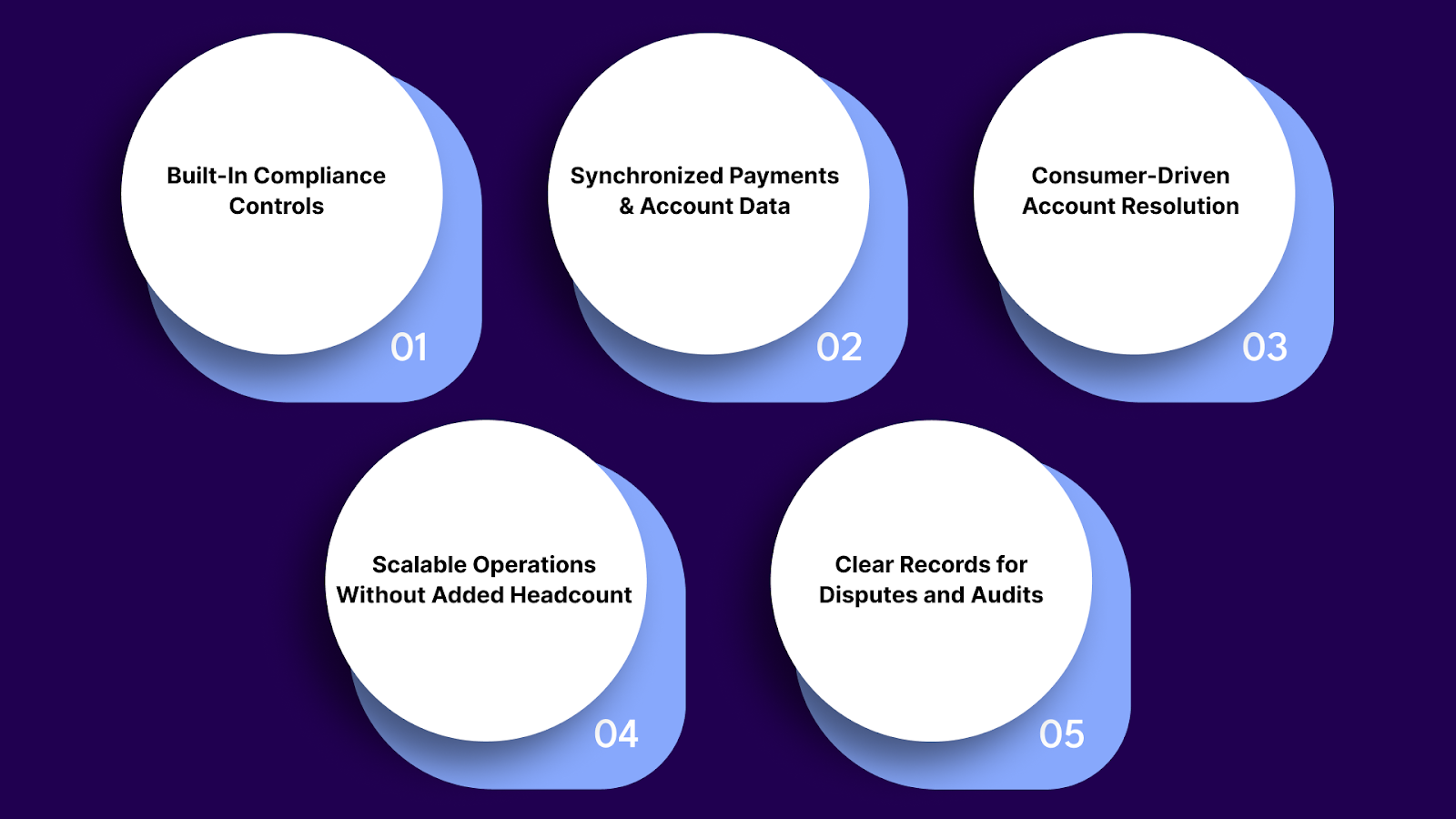
Key reasons agencies use debt management software:
Built-In Compliance Controls: Authorization, consent, and required disclosures are captured automatically during payment and communication flows.
Synchronized Payments and Account Data: Balances, settlements, and payment activity are updated in real time across systems. This prevents delays in posting, reconciliation issues, and consumer disputes caused by outdated information.
Consumer-Driven Account Resolution: Self-service tools allow consumers to review balances, choose payment options, and complete transactions without agent involvement.
Scalable Operations Without Added Headcount: Automation handles recurring tasks such as payment scheduling and follow-ups. You can manage higher volumes without increasing staffing proportionally.
Clear Records for Disputes and Audits: Every action is time-stamped and stored in a single system. Investigations take less time because payment history, consent, and communication records are readily retrievable.
In the next section, we examine the best debt management platforms for compliant, digital collections in 2026.
This list focuses on platforms built for real-world collections, not surface-level features. Selection was based on functional depth, payment handling, scalability, integrations, and compliance support.
Each platform below is evaluated on how well it performs under operational and regulatory pressure.
1.Tratta
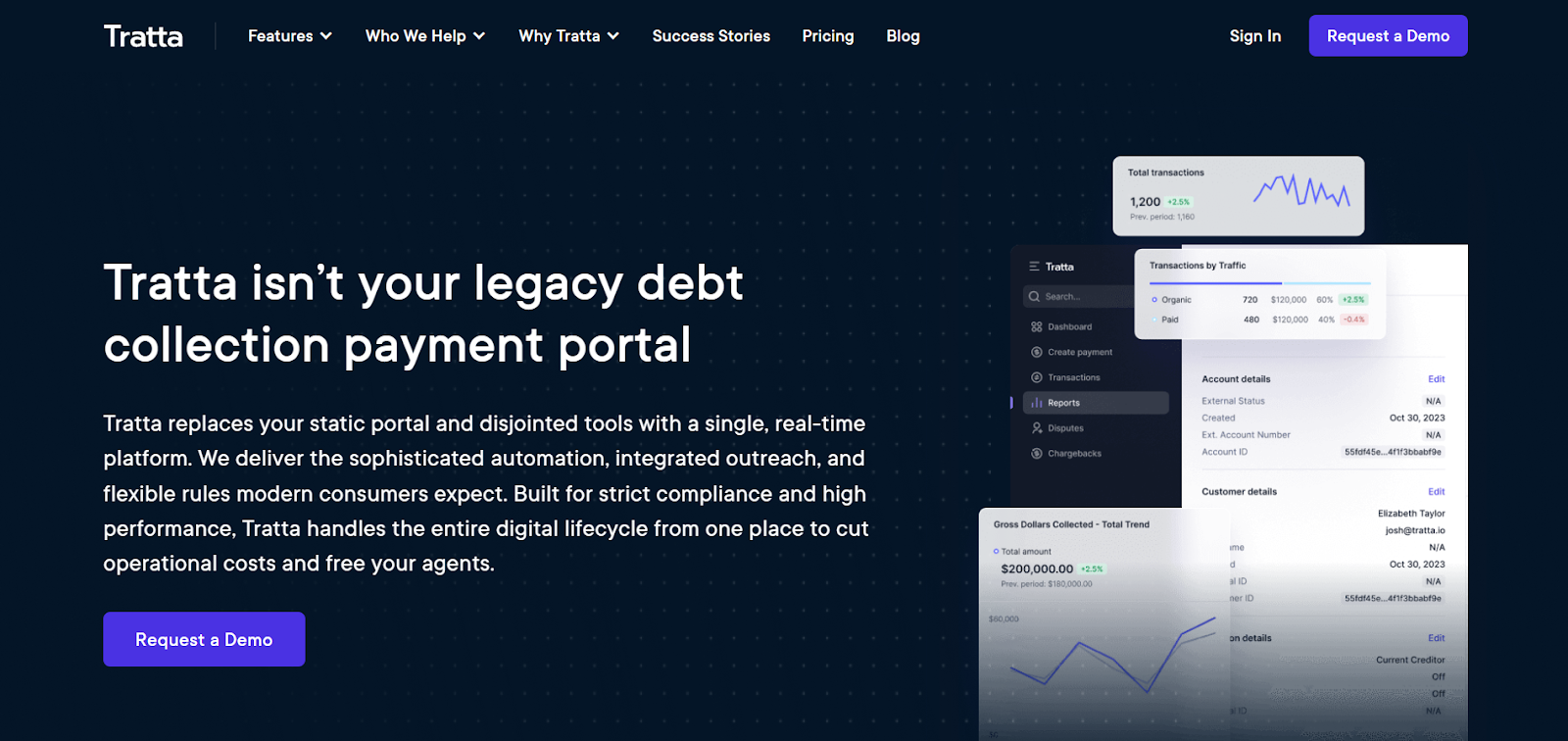
Tratta is a debt management and collections platform designed to handle high volumes without adding manual overhead. It combines consumer self-service, multi-channel outreach, real-time reporting, and compliance controls in a single workflow.
It is a strong option for agencies and creditors focused on payment capture and operational efficiency.
A branded, mobile-optimized portal where consumers can securely view balances, choose payment options, set up plans, and complete settlements without agent intervention. The portal includes identity verification layers, guest pay options, and a document center for uploading and downloading documents.
Payments flow directly through the platform for full, partial, split, and settlement amounts with real-time balance validation. Overpayment protection and flexible method support (such as ACH and card) reduce reconciliation errors and refunds.
A payment-enabled phone IVR that allows consumers to interact in multiple languages and make payments or request SMS portal links. It updates account status in real time and tracks consumer interactions for accurate reporting.
Coordinated messaging across email, SMS, phone, and portal notifications tied to account activity and campaign logic. Messages are trackable and contribute to performance analytics and audit trails.
Automated campaign workflows that segment accounts based on rules such as age, balance, or behavior. Campaigns include smart scheduling, event triggers, and follow-up actions to move accounts through recovery stages.
Real-time dashboards, funnel tracking, and exportable reports provide visibility into contact rates, payments, and campaign performance. Detailed drill-downs help identify trends and operational bottlenecks.
Branding and portal configurations can be adjusted to match client identities and legal requirements. Notices, templates, and workflow rules can be tailored to business logic and regulatory context.
Support for REST APIs and batch data sync keeps account balances, payment history, and statuses up to date between Tratta and back-office systems. Two-way integration helps eliminate manual updates and posting errors.
Built-in controls include SOC 2 Type II and PCI DSS Level 1 compliance, as well as encryption and tokenization to protect sensitive data. Dynamic compliance logic ensures required disclosures and consent capture are part of payment and communication flows.
Pros:
Comprehensive self-service and payment automation reduce agent workload.
Real-time reporting and analytics improve visibility and decision-making.
Built-in compliance and security controls support defensible operations.
Cons:
The feature set may be broader than needed for very small teams.
Some advanced reporting options may require configuration.
User interface updates may vary slightly by role and permission.
Good For:
Tratta is your ideal debt management platform if you struggle with disconnected payments, compliance gaps, or manual workarounds. It is built for collection agencies, law firms, debt buyers, and credit issuers managing complex portfolios. You benefit most if you need self-service payments, audit-ready records, and consistent execution across every channel.
2. Kolleno
Kolleno is an AI-powered accounts receivable and collections platform that centralizes receivables, payments, reconciliation, and dispute tracking in a single system. It automates follow-ups, prioritizes overdue accounts based on risk, and reduces manual effort with advanced cash application tools.
Its interface and workflow automation are designed to improve cash flow visibility and accelerate payment collections.
Top Features:
AI-Driven Collections Workflows: Uses machine learning to identify priority accounts, automate follow-ups, and suggest optimal payment timing.
Centralized Payments and Reconciliation: Automatically matches incoming payments to invoices, reducing manual reconciliation work.
Cash Flow Forecasting: Predicts future cash positions using customer behavior and payment trends.
Self-Service Customer Portal: Enables customers to view invoices and make payments online without manual outreach.
Real-Time Analytics and Reporting: Dashboards and insights help teams monitor collection performance and adjust strategies.
Pros:
Strong AI automation cuts manual workload.
Centralized payment matching improves accuracy.
Real-time insights support better decision-making.
Cons:
Designed mainly for finance teams rather than traditional agency collections.
Some advanced capabilities may be more than smaller teams need.
Pricing details typically require consultation.
Good For:
Kolleno is your ideal platform if you manage receivables across multiple customers and need better visibility into cash flow. It works well for finance teams and credit controllers focused on AR automation and forecasting. It is less suited for agencies that need debt-collection-specific compliance controls and consumer self-service at scale.
3. Katabat
Katabat by Finvi is a digital debt collection platform built to manage the full lifecycle of delinquent and charged-off accounts. It focuses on orchestrating communications, payments, and account actions across channels at scale.
The platform is commonly used by large agencies and creditors with complex compliance requirements.
Top Features:
Digital Collections Orchestration: Manages outreach and payment activity across multiple channels. Supports consistent execution across large portfolios.
Configurable Workflows: Allow teams to define rules based on account type, balance, or delinquency stage. Reduces manual intervention.
Payment and Plan Management: Supports one-time payments and structured payment plans. Keeps account status updated across workflows.
Compliance Controls: Embeds policy rules and audit logging into daily operations. Helps reduce exposure during reviews.
Analytics and Performance Tracking: Provides insight into recovery rates and channel effectiveness. Supports portfolio-level optimization.
Pros:
Built for enterprise-scale collections
Strong workflow and rules engine
Supports complex compliance environments
Cons:
Heavier implementation effort
Less focused on consumer-facing UX
May exceed the needs of smaller teams
Good For
Katabat fits organizations managing high-volume, regulated portfolios with layered workflows. It works best when operational control and compliance consistency matter more than rapid self-service deployment.
4. Invoiced
Invoiced is an accounts receivable and billing platform focused on automating invoicing, payments, and collections. It centralizes billing, customer communication, and cash application into a single system.
The platform is designed for finance teams managing recurring invoices and high transaction volumes.
Top Features:
Automated Invoicing and Billing: Generates and delivers invoices automatically based on schedules or usage. Reduces manual invoice creation and sending.
Online Payments and Customer Portal: Let's customers view invoices and pay through a self-service portal. Supports multiple payment methods to improve payment speed.
Collections Automation: Sends automated reminders and follow-ups based on invoice status. Helps standardize outreach without manual tracking.
Cash Application and Reconciliation: Matches payments to open invoices with minimal intervention. Improves accuracy and reduces reconciliation time.
Reporting and AR Insights: Provides visibility into aging, overdue balances, and payment trends. Helps finance teams monitor cash flow performance.
Pros:
Strong billing and invoicing automation.
Clean customer payment experience.
Useful visibility into AR performance.
Cons:
Primarily invoice-centric in design.
Limited debt collection–specific workflows.
Less emphasis on regulatory compliance controls.
Good For:
Invoiced is best suited to organizations where billing and invoice follow-up are the primary drivers of late payments. It fits finance teams that want to streamline invoicing, reminders, and reconciliation, while collections that involve regulatory oversight or post-charge-off recovery typically require a different class of platform.
5. Collect! by Comtech Systems
Collect! is a long-established debt collection platform used by agencies with mature, highly customized workflows. It provides deep control over account management, payment handling, and compliance processes.
The system prioritizes configurability and functional coverage over modern interface design.
Top Features:
Account and Case Management: Tracks balances, statuses, account hierarchies, and historical activity in detail. Supports complex portfolio structures and long account lifecycles.
Payment Processing and Posting Logic: Manages payments across multiple accounts with configurable posting rules. Emphasizes accuracy and auditability over speed.
Highly Configurable Workflows: Allows extensive customization of rules, triggers, and actions. Supports agency-specific strategies without forcing standardized flows.
Compliance Recordkeeping: Maintains detailed logs of account actions and user activity. Supports audits and regulatory reviews with historical traceability.
Reporting and Data Access: Offers a wide range of standard and custom reports. Supports internal oversight and client reporting requirements.
Pros:
Extremely flexible configuration options
Proven reliability across long-term deployments
Broad coverage of core collection functions
Cons:
Interface reflects legacy design choices
Requires experienced administrators to manage configurations
Slower to adapt to digital-first consumer expectations
Good For:
Collect! makes sense if your collection processes are heavily customized and deeply embedded in your operations. It works best when you need fine-grained control over rules and workflows and are comfortable trading modern UX for long-term stability. It is less suitable if you want fast deployment, consumer self-service, and digital payments driving resolution.
6. Tesorio
Tesorio is a cash flow and collections platform that helps finance teams predict, manage, and accelerate incoming payments. It combines collections workflows with forecasting and analytics to give visibility into expected cash inflows.
The platform is designed around proactive outreach and data-driven prioritization rather than traditional recovery models.
Top Features:
Cash Flow Forecasting: Uses historical payment behavior and open receivables to project expected cash inflows. Helps finance teams plan liquidity with greater confidence.
Collections Workflow Automation: Automates reminders and follow-ups based on invoice status and customer behavior. Reduces reliance on manual tracking and ad hoc outreach.
Customer Payment Portal: Allows customers to view outstanding invoices and make payments online. Improves payment speed by removing friction from the process.
Account Prioritization Logic: Surfaces which accounts need attention based on risk and timing. Helps teams focus effort where it has the greatest impact on cash flow.
Analytics and Performance Reporting: Provides insight into overdue trends, collector activity, and payment outcomes. Supports continuous refinement of collections strategy.
Pros:
Strong visibility into future cash flow
Useful prioritization for finance-led collections
Reduces manual follow-up effort
Cons:
Designed primarily for AR, not debt recovery
Limited support for regulated collection workflows
Less emphasis on multi-channel consumer self-service
Good For:
Tesorio fits organizations where the main challenge is forecasting and stabilizing cash flow from open receivables. It works well for finance teams managing B2B payments. Post-delinquency or compliance-driven collections typically require more specialized platforms.
7. Cogent Collections
Cogent Collections is an enterprise-grade platform built for large-scale, regulated collections environments. It is designed to support complex portfolios, layered workflows, and strict governance requirements.
The platform is typically deployed where operational consistency and risk management are critical.
Top Features:
Enterprise-Scale Collections Engine: Supports high account volumes and transaction throughput. Designed for stability and performance under sustained load.
Advanced Workflow and Rules Framework: Enables granular control across delinquency stages, account types, and client rules. Reduces reliance on manual intervention.
Payment Management and Validation: Handles payments with strict posting controls and validation logic. Helps prevent errors in high-volume environments.
Compliance and Governance Controls: Embeds policy enforcement, permissions, and audit logging into daily operations. Supports regulated portfolios and internal oversight.
Operational and Executive Reporting: Provides detailed performance reporting across teams and portfolios. Supports management-level visibility and decision-making.
Less focus on consumer-facing self-service experiences.
Good For:
Cogent Collections is a fit if you manage large, regulated portfolios where governance and consistency matter more than speed. It suits organizations that can support enterprise-level configuration and oversight. It is not ideal when agility, self-service payments, and rapid iteration are priorities.
8. Debtmaster
Debtmaster is a collections management platform used by agencies that rely on structured, rules-based workflows. It focuses on account tracking, collector activity, and compliance recordkeeping across post-delinquency accounts.
The system is designed for operational control rather than consumer-facing digital resolution.
Top Features:
Account and Case Management: Centralizes debtor records, balances, and activity history. Supports detailed tracking across the collection lifecycle.
Collector Workflow Controls: Uses rule-based task assignment and action sequencing. Helps standardize how accounts are worked across teams.
Payment Posting and Tracking: Records payments and updates account status accurately. Emphasizes internal control over flexible payment experiences.
Compliance and Audit Logs: Maintains logs of actions, communications, and user activity. Supports audits and regulatory reviews.
Operational Reporting: Provides reports on collector productivity and account outcomes. Designed for internal performance monitoring.
Pros:
Strong internal workflow control
Clear audit and activity tracking
Familiar structure for traditional agencies
Cons:
Limited consumer self-service capabilities
Less focus on digital payment flexibility
Interface prioritizes function over experience
Good For
Debtmaster is a good fit if your primary challenge is managing collector activity and enforcing internal processes. It is less aligned if you want consumers to resolve accounts digitally through self-service payments and plans.
9. Latitude by Genesys
Latitude is a comprehensive debt collection and recovery platform built to manage delinquent accounts from early stages through charge-off and debt sale. It provides a unified desktop for collectors, automated workflows, and portfolio-level visibility for decision makers.
The platform is designed for large creditors, agencies, and debt buyers that require systematic controls and data integration across systems.
Top Features:
Workflow Automation and Case Routing: Accounts move automatically through tasks and actions based on defined rules and policies.
Omnichannel Engagement: Supports coordinated activity across email, SMS, IVR, and live agent interactions. Teams can monitor performance and refine outreach across channels.
Pre-Built Integrations: Connects with payment processors, letter vendors, data enrichment sources, and skip tracing tools. This helps augment internal data and streamline workflows.
Unified Collector Desktop: Provides all relevant account information in one browser-based interface. Collectors do not need to switch between multiple applications to work on accounts.
Compliance and Governance Controls: Enforces business rules, permissions, and audit logging to support regulatory oversight. This helps maintain consistent treatment and defensible execution.
Pros:
Strong workflow automation and rule enforcement
Useful for large portfolios with complex oversight needs
Integrates with external systems and vendors
Cons:
Implementation and training can take time
Less focus on consumer-driven self-service options
More operational overhead than lightweight tools
Good For
Latitude by Genesys works well if you manage large, regulated portfolios that demand systematic controls and unified execution across channels. It may be less appropriate when your priority is quick self-service payments and rapid deployment.
10. FICO Debt Manager
FICO Debt Manager is a decision-centric collections platform focused on segmentation, prioritization, and strategy optimization. It is typically used as a layer that determines how accounts are handled, rather than where payments are processed. The platform is strongest in analytics-driven strategy rather than execution.
Top Features:
Decision and Segmentation Engine: Uses data models to segment accounts by risk, behavior, and likelihood to pay. Helps determine optimal treatment paths.
Strategy and Policy Management: Allows teams to define and test collection strategies at scale. Supports rule-based and model-driven decisions.
Integration With Core Systems: Feeds decisions into downstream collection or servicing platforms. Rarely functions as a standalone system.
Advanced Analytics and Modeling: Provides insight into strategy performance and outcomes. Designed for continuous optimization.
Compliance-Aware Decisioning: Applies policy constraints within strategy logic. Helps ensure decisions align with regulatory requirements.
Pros:
Strong analytics and decisioning depth
Suitable for complex portfolios
Trusted in regulated environments
Cons:
Not an execution or payment platform
Requires integration with other systems
Heavier setup and modeling effort
Good For:
FICO Debt Manager fits if your challenge is deciding which accounts to work on, when, and how. It is less effective when you need a unified platform for payments, self-service, and end-to-end collection execution.
11. Quantrax TCS
Quantrax TCS is a case and practice management system widely used by collection law firms. It supports legal workflows, document handling, and court-related processes alongside collections activity. The platform is built around litigation and compliance rather than digital payment resolution.
Top Features:
Legal Case Management: Manages lawsuits, filings, deadlines, and case documents. Designed to support high-volume legal workflows.
Collections Workflow Support: Tracks account status and collection activity alongside legal actions. Keeps financial and legal processes connected.
Document and Notice Management: Handles the generation, storage, and tracking of legal documents. Supports audit and court requirements.
Compliance and Audit Controls: Maintains detailed logs for actions and case events. Supports regulated legal environments.
Reporting and Case Analytics: Provides visibility into case progress and outcomes. Supports firm-level oversight.
Pros:
Strong fit for legal collections
Deep case and document management
Compliance-focused design
Cons:
Not payment-centric
Limited consumer self-service
Less suited for non-legal agencies
Good For:
Quantrax TCS is appropriate if collections are closely tied to litigation and legal workflows. It is less aligned when the goal is to drive faster resolution through digital payments and consumer self-service.
12. Flexys
Flexys is a digital-first debt management and collections platform built on a cloud-native architecture for real-time, end-to-end operations.
It helps lenders and large creditors manage the full debt lifecycle with workflow automation, configurable rules, and customer engagement tools. The platform also supports digital self-service, multi-channel communications, and compliance reporting at scale.
Top Features:
End-to-End Debt Collections: Manages accounts and workflows from early arrears through recoveries with a single unified platform, reducing manual handoffs.
Digital Self-Service Portal: Gives customers 24/7 access to review balances, make payments, and manage arrangements online.
Workflow Automation and Strategy: Uses configurable rules and segmentation to guide account progression and collector actions.
Omnichannel Engagement Tools: Coordinates communications across email, SMS, phone, and portal touchpoints for a consistent experience.
Real-Time Analytics and Reporting: Provides insight into operational performance and effectiveness while helping support regulatory reporting.
Pros:
Full cloud-native platform with real-time visibility
Flexible workflows tailored to portfolio strategies
Enterprise-focused solutions can require longer implementation
Learning curve for configuring advanced strategies
The interface and feature set may feel complex to small teams
Good For:
Flexys is a strong fit if you manage complex portfolios and need a single system for both automated workflows and digital engagement. It works well where compliance and scalable operations are priorities, though smaller teams may find simpler consumer-centric tools more immediately accessible.
Before comparing features line by line, it helps to step back and assess your own operation. The next section outlines clear signs that indicate when your current setup is no longer sufficient.
Many collection operations reach a point where incremental fixes stop working. Adding another payment tool or manual check only increases complexity.
The signs below indicate when your current setup is actively limiting recovery, efficiency, or compliance.
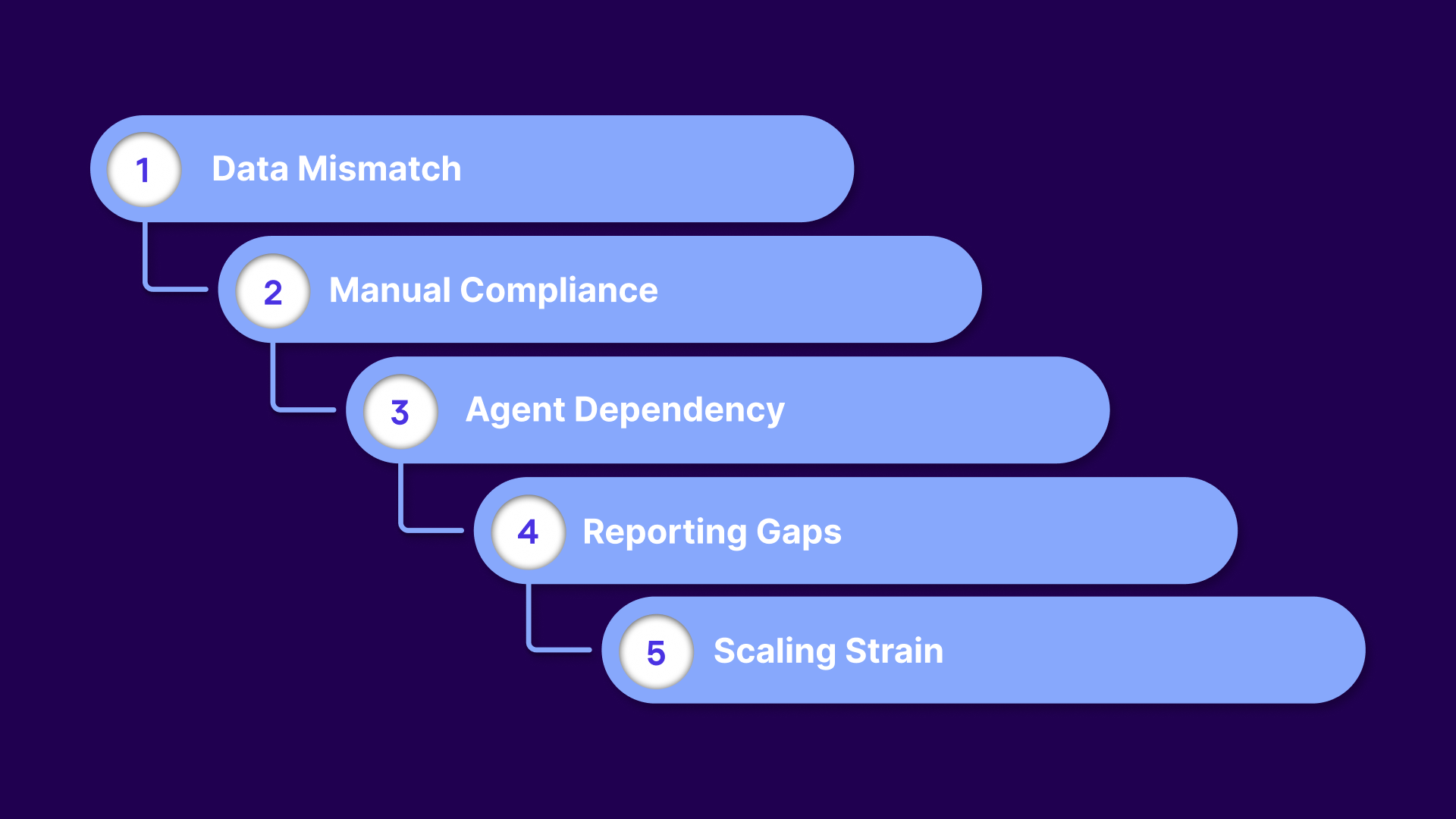
Data Mismatch: You see balances, payments, or account statuses differ across systems, forcing manual fixes and follow-ups.
Manual Compliance: You rely on agents to capture consent and disclosures correctly, rather than having the system enforce them.
Agent Dependency: Your agents handle routine payments and plan setups that consumers could complete on their own.
Reporting Gaps: You have to reconcile data from multiple tools to understand performance or recovery trends.
Scaling Strain: You need to add staff whenever volume increases, because workflows do not scale automatically.
If you think you need a debt collection platform, choose one based on how well it controls execution, not how many features it lists.
Look for systems that keep payments, compliance, and reporting aligned without manual intervention. The right platform should scale your operation without increasing risk or operational overhead.
Staying competitive depends on how well you adopt the right technology. As volumes grow and oversight tightens, debt management software is no longer optional infrastructure. The platforms that succeed are the ones that reduce manual work, enforce consistency, and keep payments, compliance, and reporting aligned as operations scale.
Trattastands out because it is built around execution, not just features. It integrates cleanly with existing systems, supports quick deployment, and brings payments, self-service, compliance, and reporting into a single workflow.
If you are evaluating debt management platforms, focus on how quickly you can operationalize them. Choose a system that integrates easily and reduces work from day one. Schedule a free demo today.
Frequently Asked Questions
1. What is a debt management platform used for in collections?
A debt management platform centralizes payments, payment plans, communications, compliance controls, and reporting. It replaces fragmented tools and manual workflows with a single system that enforces consistency across every account and interaction.
2. How is debt management software different from AR or invoicing tools?
AR tools focus on invoicing and early payment follow-ups. Debt management software is built for post-delinquency workflows, regulated communications, consent capture, audit trails, and consumer self-service resolution at scale.
3. Can debt management platforms integrate with existing systems?
Yes. Most modern platforms integrate with core systems through APIs or batch data sync. This allows balances, payments, and account statuses to stay aligned without replacing existing systems of record.
4. Does debt management software reduce agent workload?
Yes. By shifting routine payments, plans, and account updates to self-service channels, agents spend less time on manual processing. This allows teams to manage higher volumes without increasing headcount.
5. What should you prioritize when choosing a debt management platform?
You should prioritize execution over feature count. Look for platforms that enforce compliance by design, support flexible payments, integrate easily, and reduce manual coordination across operations.
Note: This information is not legal advice. Tratta recommends that you consult with your legal counsel to make sure that you comply with applicable laws in connection with your collection and outreach activities.
Sign up for our monthly newsletter
Debt collection insights that keep you compliant and competitive.
Thank you! Your submission has been received!
Oops! Something went wrong while submitting the form.